
A stone ruin, a legend about swans, and a dispute over dates that no one has settled.
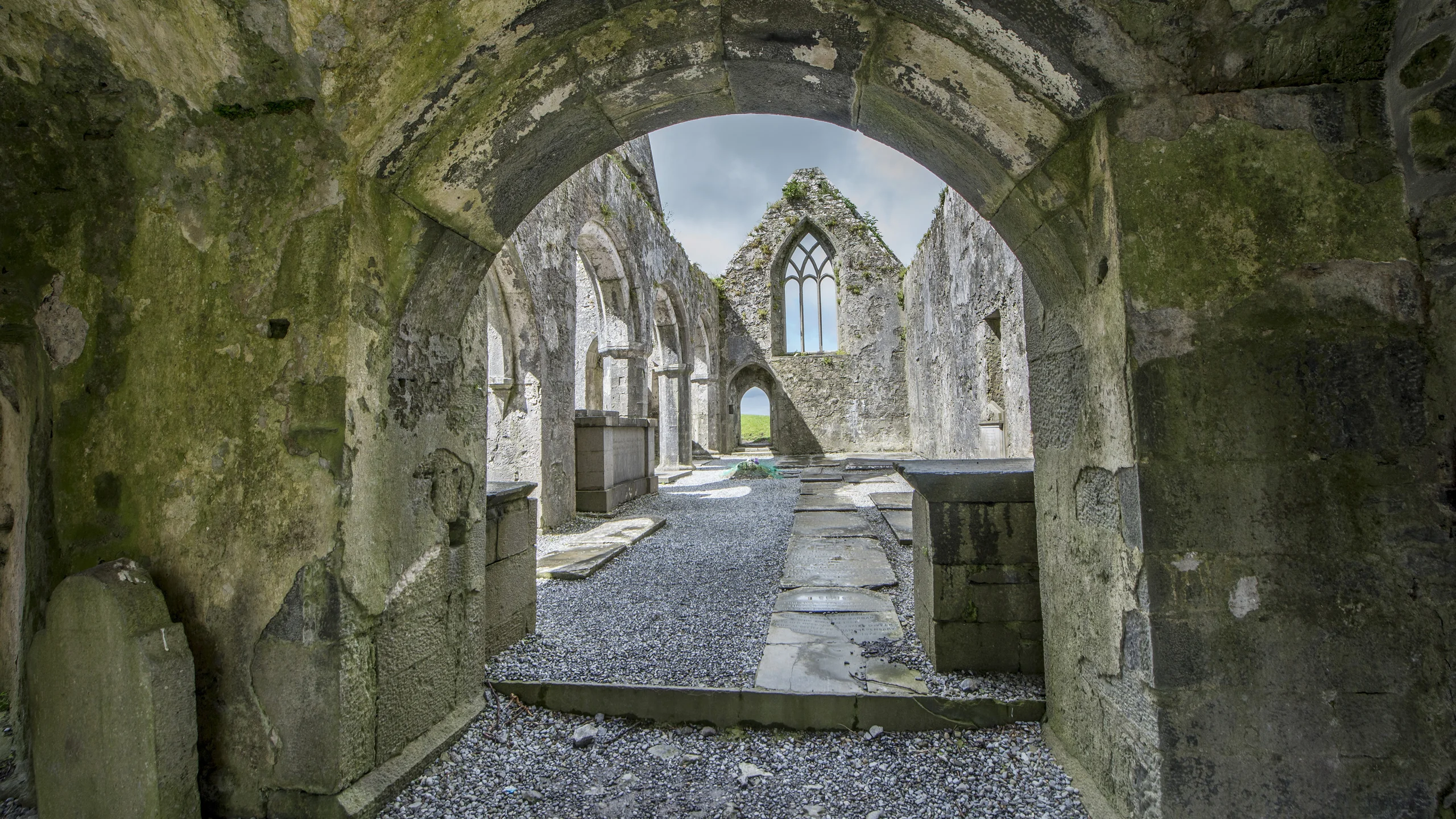
Image: Bing Daily Wallpaper · Ross Errilly Franciscan Friary, County Galway, Connacht, Ireland (© Maria Janus/Shutterstock)
Open Bing today and a gray stone building stands in the middle of a wet green meadow. It has no roof. Its windows are empty, and a square tower rises from the center like a stamp pressed into the grass.
This is Ross Errilly Friary in County Galway, Ireland. Bing gives the image an odd title: "Where Swans Launched a Legend." There are stones, grass and ruins. Where are the swans?
Three Swans and Flax Blooming in February
The swans appear at the very beginning of the story.
According to a local legend recorded by the Galway County Heritage Office, it begins with the Black Death. In the mid-14th century, plague swept Ireland. Malachy MacHugh, archbishop of Tuam, exhausted himself caring for the sick and fell asleep while praying in church. An angel came to him in a dream and said the plague would end if he built a friary for poor friars.
The archbishop set out west with three friars. At a place called Kildara, three swans rose from the sedges, each carrying a flaxseed in its beak. They circled the men three times, then flew toward the Black River.
The friars followed. Where the swans landed, they found three clumps of flax in bloom.
It was February.
Nothing flowers in an Irish field in February. The legend says this was the sign the angel had promised. The archbishop chose the site on the spot, and work began.
The story does not end happily for him. Archbishop MacHugh died of the plague in 1349 and never saw the building completed.
But the Stones Disagree
The legend gives precise dates: construction began in 1349 and was completed in 1351. Bing's English copy accepts the same account, saying the friary was "founded around 1351."
The problem is that modern scholars largely reject the date.
Ireland's Monastic Ireland research project and the prevailing historical assessment place the construction of Ross Errilly much later, around 1460. The evidence follows two paths. One is the stone itself: the building style, window forms and arches do not look like work from the mid-14th century. The other is documentary. The earliest surviving written reference to the friary is the 1469 will of a merchant named John Blake, who left it 40 pence.
The difference is more than a century. It can be read as a victory for scholarship, but it is also an open lesson in how the past becomes known: legends preserve meaning; stones preserve time. The two do not always agree.
The date 1349 was not chosen at random. The Black Death really did reach Ireland around then. The local legend attaches a later building to a genuine and genuinely terrifying episode of history, as people often give important things an older and more tragic beginning.

Locals commonly call the site Ross Abbey, but strictly speaking the name is wrong. An abbey is a monastery governed by an abbot. Ross Errilly was a Franciscan friary, belonging to a mendicant order, and never had an abbot.
The Kitchen's Spring-Fed Stone Tank
Ross Errilly is considered one of the best-preserved medieval friary ruins in Ireland. Its most revealing features are precisely the least sacred ones.
Take the kitchen. A deep, round stone tank there is supplied with running water. It was a fish tank. The friars kept freshly caught fish alive in it until mealtime.
That tank says more than it first appears to. Catholic fasting rules prohibited meat on several days each week, making fish the alternative. In a world without ice, the only way to keep a fish fresh was to keep it alive. So a small hydraulic system became part of a friary kitchen. A rule of faith ended as an engineering problem.
The friary also has something rare in Ireland: a second cloister. One central courtyard would normally suffice. Ross Errilly added another for a practical reason - too many people, not enough room.
Expelled Seven Times, Seven Times They Returned
The building's real story is one of being emptied and filled again and again.
The English Reformation reached it in 1538. In the 1580s, it was confiscated and then restored to the friars by the Earl of Clanricarde; seized again in 1584 and returned again in 1586. An archbishop ordered the friars expelled and the altars demolished in 1612. They were back by 1626. By the early 17th century, the expulsions already numbered seven.
On August 10, 1656, Cromwellian troops sacked the friary, and 140 friars fled. They returned in 1664 to repair it. More departures and returns followed until the site was finally abandoned around 1753. The friars then built huts of wood and stone on an island one mile downstream in the Black River. For another 36 years, they returned every Sunday to say Mass in the collapsing building.
There is a smaller story, too. Before one retreat, the friars are said to have removed the tower bell and sunk it in the Black River. According to legend, it remains there.
After the friary was abandoned, the site became a burial ground and remained one into the 20th century. Some of the paving stones underfoot are gravestones. Bing's copy finds an apt phrase for this: history leaves footprints, sometimes literally.
The Swans Are Real
Return now to the swans.
The swans in the legend are miraculous. Ireland's swans are real, and their arrival repeats every autumn.
The white swans crossing these meadows are likely whooper swans. They do not breed in Ireland. They breed in Iceland and, beginning each October, fly family by family across the North Atlantic to winter in Ireland, returning in March or April. Northern Ireland's species profile describes the journey in a single word: non-stop. Between the two shores lies open ocean with nowhere to land.
These are not a few stray birds. During the eighth international swan census in January 2020, nearly 300 volunteers joined staff from BirdWatch Ireland and the National Parks and Wildlife Service to count 19,111 whooper swans across the island: 14,467 in the Republic of Ireland and 4,644 in Northern Ireland. That was 27% more than in 2015.
The legend therefore contains an ordinary, careful observation. In Ireland, flocks of white birds really do descend onto wetlands and grassland in autumn and disappear again in spring. To someone in the 14th century, that was already enough to look like a sign.
How to Tell the Swans Apart
Whooper swans are winter visitors in China as well. The Rongcheng Whooper Swan National Nature Reserve in Shandong comprises three lagoons - Yuehu, Chaoyanghu and Yangyu Lake - and covers 10,500 hectares. It received national status in 2007. In recent years it has held more than 10,000 wintering swans, with peaks above 20,000, roughly one-third of China's wintering whooper swans. The wintering season runs from October through April. At Sanmenxia Swan Lake National Urban Wetland Park in Henan, the winter population has risen from a few hundred little more than a decade ago to more than 16,000. They arrive from Mongolia and Siberia beginning in mid-to-late October.
The birds can be distinguished by their bills and posture. According to an identification guide from the Miyun District government in Beijing, a whooper swan has a black bill tip, while the yellow patch at its base extends forward beneath the nostril. The yellow occupies a large area and reaches far along the bill. A mute swan looks entirely different: its bill is orange-red, with a black knob on the forehead, and it holds its neck in an S while swimming; the whooper keeps its neck straight. A tundra swan is conspicuously smaller and has much less yellow on its bill.
All three species may mingle on China's winter lakes. Their bills still reveal which is which.
It is August, and the swans have not yet reached those lakes. In mid-to-late October they will set out, traveling on the same seasonal schedule as the three swans that carried flaxseed across the Black River in the legend, 1,600 kilometers away.
Sources: Bing Daily Wallpaper's official copy; Wikipedia's Ross Errilly Friary entry; Monastic Ireland; Galway County Heritage Office; Northern Ireland Priority Species profiles from Habitas; BirdGuides reporting on the eighth international swan census; Dazhong News reporting on the Rongcheng Whooper Swan National Nature Reserve; Xinhua reporting on wintering whooper swans at Sanmenxia; and the Miyun District People's Government of Beijing's illustrated bird-identification guide.