
Today's NASA Astronomy Picture of the Day shows an elephant's trunk winding through a nebula for twenty light-years. It is really a shadow.
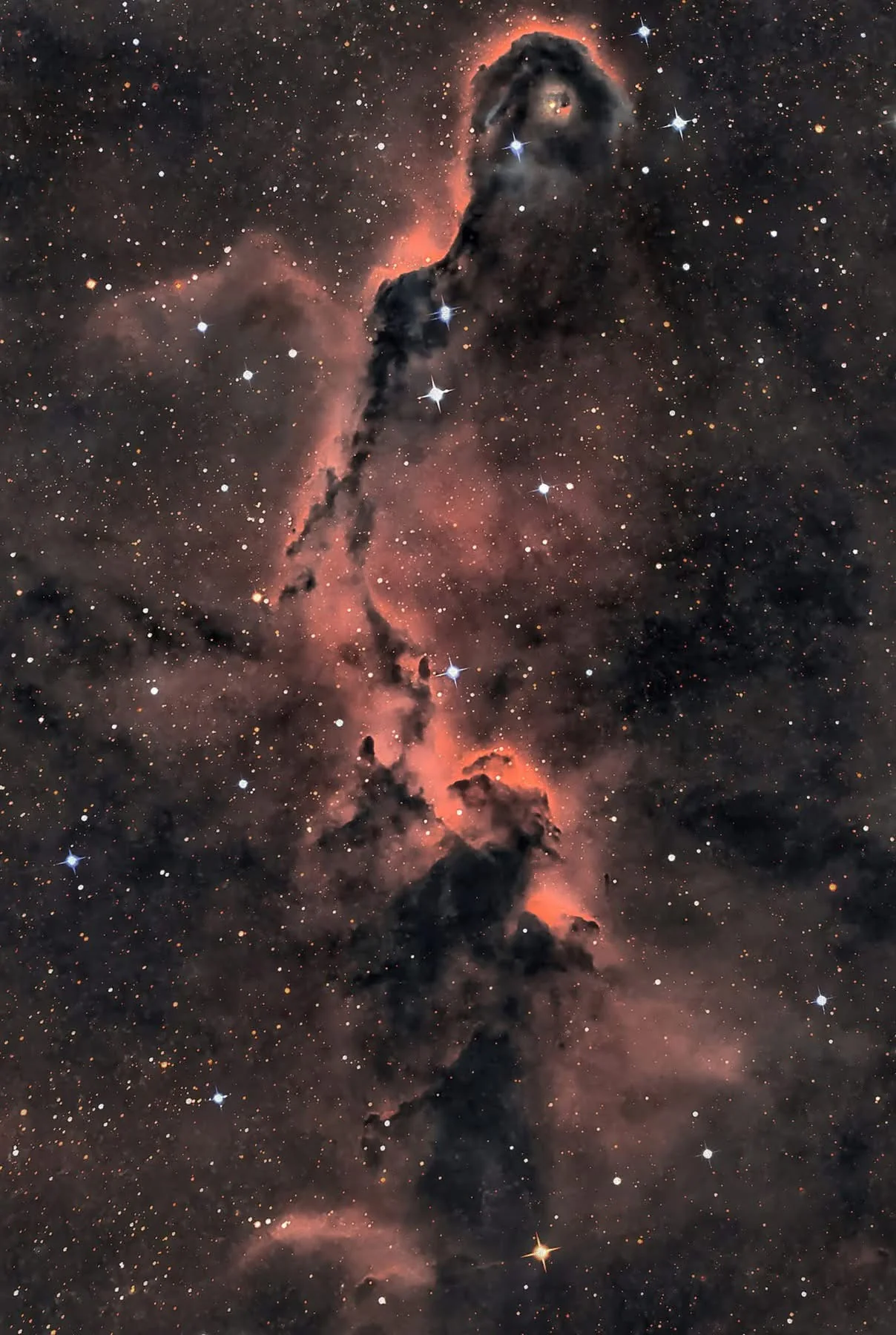
Image: NASA Astronomy Picture of the Day (APOD) | Image Credit & Copyright: Eddie Sgarbossa | Today's page
The first sentence of APOD's official description is a joke: the scene resembles an illustration from Rudyard Kipling's Just So Stories, which includes a tale about an elephant whose originally short nose was pulled into its present shape by a crocodile.
The joke is surprisingly apt. This nebula's "trunk" was pulled out too.
But not by a crocodile. By light.
What Is in the Picture
The subject is a dark column of gas reaching in from one side of the frame. Its head is blunt and rimmed with light; its body narrows behind it before dissolving into the background. Vast fields of deep-red glowing gas surround it, threaded with cooler dust combed into alignment from the same direction.
Its formal name is the Elephant's Trunk Nebula, also cataloged as vdB 142. It is part of the larger emission-nebula and young-cluster complex IC 1396 in Cepheus. According to APOD, the "trunk" is more than twenty light-years long, and the nebula complex is nearly 3,000 light-years away.
One numerical detail deserves a moment. APOD says the image spans "nearly 1 degree, about the angular size of two Full Moons" from top to bottom. Why nearly rather than exactly? Because the full Moon is not precisely half a degree wide. As its distance changes along its orbit, its angular diameter ranges from about 29 to 34 arcminutes, averaging about 31. Two full Moons average 62 arcminutes; one degree is 60. Sixty really is just shy of 62. A casual phrase turns out to have been calculated.
How a Trunk Takes Shape
Now to the real subject of this story.
At the center of IC 1396 sits an object called HD 206267. It is not one star but a multiple system containing at least four massive stars, with an overall spectral type around O6.5 and about 170,000 times the Sun's luminosity. Stars like these emit vast numbers of extreme-ultraviolet photons, energetic enough to split nearby hydrogen atoms into protons and electrons.
Ionized gas heats to about 10,000 kelvins. Hot gas does not sit still: it streams away from the cloud's surface at roughly ten kilometers per second. The process is called photoevaporation. Bit by bit, the nebula is being blown away.
But the cloud is not uniform.
Some clumps began denser and tougher than others. They block ultraviolet light like rocks resisting waves on a beach. The water levels the sand around them while leaving a ridge behind each rock.
That ridge is the elephant's trunk.
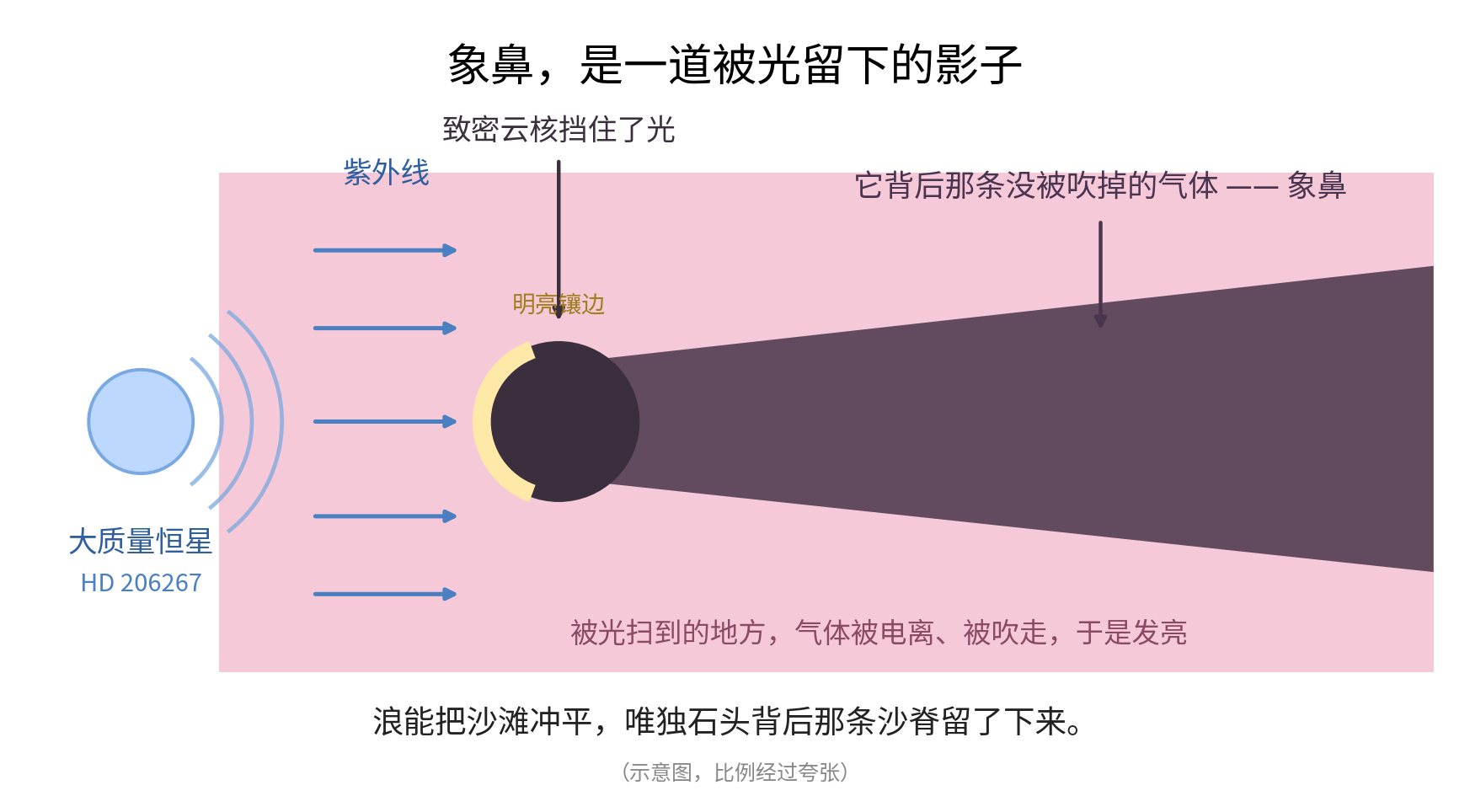
That is why the trunk has a rounded head: it is the side facing the light and being planed away, and its bright rim is the surface now being ionized. Its tail always points away from the light, into the material that has not yet been eroded. Astronomers call objects with this form cometary globules. Their geometry really does resemble a comet: a head toward the light source and a tail pointing away.
A few terms often get blurred together, though they describe different things:
- Photoevaporation is the physical process: the surface is ionized and blown away.
- A bright-rimmed cloud is the observable form: the side facing a massive star has a luminous border.
- A cometary globule is the resulting shape: a rounded head and a long tail.
- Radiation-driven implosion is a causal hypothesis. It proposes that the back-pressure from the evaporative flow drives a shock inward, compressing the cloud core beyond a critical density and igniting new stars.
The first three are descriptions. The fourth is a claim. That distinction soon matters.
What Is Hidden Inside the Trunk
Start with what is not disputed: this trunk really is forming stars.
In 2004, infrared observations from the Spitzer Space Telescope opened up this optically black globule. At infrared wavelengths it glows, revealing a previously unknown population of protostars: eight sources in the earliest Class 0/I stages, plus roughly a dozen slightly older ones. In 2014, the Herschel Space Observatory found an even younger Class 0 source inside it, located directly behind the bright ionization front.
The timeline fits too. The central Trumpler 37 cluster is about four million years old, while the young objects inside the globule are only one to two million years old. In other words, they were born after the massive star switched on.
A 2012 Chandra X-ray Observatory study identified more than 250 young stars in the region, doubling the known population. Researchers also found an age gradient running from within the cloud toward the massive star: stars closer to the light source are older. That is just what the radiation-driven implosion hypothesis predicts.
The case seems solved: a massive star blows on a cloud, the cloud is compressed, and new stars are born. A perfectly logical story.
And that is precisely where caution is needed.
A Story That Fits Too Neatly
In 2024, researchers used the [C II] spectral line to study the dynamics of these bright-rimmed clouds in IC 1396. They found no clear signal of a photoevaporative flow; the measured velocity structure was far more complicated than the models.
Another study found that the overall velocity difference between Trumpler 37 and the globule is only eight kilometers per second, too little to show that recoil from an evaporative flow had significantly pushed the cloud. Yet that push is part of the standard picture.
A more fundamental challenge came from a bluntly titled 2015 paper, The Dangers of Being Trigger-Happy. Its simulations showed that stars formed through "triggering" and stars formed spontaneously become completely mixed in position and cannot be separated. Stellar feedback does not simply make stars; it can also move stars that would have formed anyway into the same region of position and velocity space. The authors tested the usual criterion, treating stars near an ionization front as triggered, and found it less than twice as accurate as guessing at random.
They also noted that "triggering" has at least three inequivalent meanings in the literature: did it raise the star-formation rate, the star-formation efficiency, or the final number of stars? Observational papers often fail to say which one they mean.
The honest position today is this:
The evidence chain is strong: a population of extremely young objects unquestionably exists inside the trunk. The causal chain is weak: whether the massive star actually squeezed them into existence remains a compelling but unsettled hypothesis.
The Elephant's Trunk Nebula is one of the sky's most repeatedly tested candidate cases. Its uncertainty is exactly why it is worth examining. When a story seems too obvious, astronomers ask the question again.
A Candle Being Burned Away
The trunk holds another counterintuitive fact.
The dark regions in the photograph are thick; the bright regions are thin.
The globule's darkest, most substantial-looking areas contain about 100,000 particles per cubic centimeter. That sounds like a lot, but CERN says the vacuum in the Large Hadron Collider's beam pipe is "as empty as interstellar space." That is modest praise. The pipe contains roughly a few hundred thousand molecules per cubic centimeter, about as dense as the darkest, thickest gas inside the Elephant's Trunk.
What about the surrounding pink gas, which looks as though it contains something? A typical ionized-hydrogen region holds only about 100 particles per cubic centimeter, a thousand to ten thousand times emptier than the best vacuum humans spent decades and billions of euros creating.
The material that glows is not the material present in the greatest quantity. It is the material heated most fiercely.
And how long is twenty light-years? Light needs twenty years to cross the trunk. Voyager 1, traveling at seventeen kilometers per second, would need about 350,000 years. The trunk is roughly five times the distance from the Sun to Proxima Centauri. Yet it spans only about 23 arcminutes in the sky, less than four-fifths of a full Moon.
The trunk cannot last. It is evaporating, a little thinner each year. Astronomers cannot give it a precise countdown, but its mass of more than 200 Suns and its current rate of mass loss suggest a remaining lifetime on the order of one to ten million years: an instant to a star, an eternity to us.
All the while, gas inside it continues gathering into new stars.
It is a candle being burned away, while the flame shapes its melted wax into new flames.
The Constellation Cepheus
Pull the view back now to the region of sky containing the trunk. It hides a beautiful coincidence in Chinese astronomy.
Cepheus contains a star called δ Cephei. On October 19, 1784, a Tuesday, the twenty-year-old British astronomer John Goodricke discovered that its brightness varied regularly. Goodricke was deaf. Working with Edward Pigott, he made some of the era's most meticulous variable-star observations with his eyes and a notebook. He died two years later at twenty-one, reportedly after catching cold while observing this star.
The star's period is 5.366 days, and its brightness varies between magnitudes 3.48 and 4.37, a change visible to the naked eye.
More than 120 years later, at Harvard College Observatory, Henrietta Swan Leavitt was measuring variable stars in the Small Magellanic Cloud. In a 1908 paper she noticed something: the brighter variables had longer periods. In 1912, Harvard College Observatory Circular No. 173 published the period-luminosity relation she had established using 25 stars in the Small Magellanic Cloud. The circular carried director Edward Pickering's name, while its text stated that Leavitt had done the work.
Why did the stars have to be in the Small Magellanic Cloud? This is the hinge of the story.
All the stars in the Small Magellanic Cloud are at nearly the same distance from us. That makes "which looks brighter" equivalent to "which truly is brighter," removing the troublesome variable of distance. Leavitt could therefore see the relation cleanly: longer-period stars are intrinsically more luminous.
Once any one such variable had an absolute distance, every star of the same kind became a standard candle. Count its period to learn its luminosity; compare that luminosity with how faint it appears to find its distance.
This is the first rung of the cosmic distance ladder. In Western languages, these stars are called Cepheids, literally the class from Cepheus, because their prototype lies in that constellation.
Chinese took another route.
A Charioteer and a Ruler for the Universe
In the traditional Chinese system of asterisms, δ Cephei has its own name: Zaofu 1.
It belongs to the Rooftop mansion in the northern Black Tortoise, not, as is often claimed, to the Purple Forbidden Enclosure. A group of asterisms in this part of the Rooftop mansion share a theme: Chariot and Coach House, Zaofu the charioteer, and Celestial Hook, all imagery from a horse-drawn royal procession.
Who was Zaofu? He was King Mu of Zhou's charioteer, renowned for his driving. The Records of the Grand Historian, in "The Hereditary House of Zhao," says King Mu had Zaofu drive him west to meet the Queen Mother of the West and lingered there in delight. When King Yan of Xu rebelled, Zaofu drove the king's swift horses a thousand li in a day to return and put down the revolt. King Mu then granted Zaofu the city of Zhao. The Zhao lineage of the later state of Zhao traced itself to him.
The greatest charioteer under heaven became the ancestor of a feudal state.
Because the prototype star happened to be called Zaofu 1, an entire class of variables used to measure the universe took Zaofu's name in Chinese: Zaofu bianxing, or Zaofu variables.
It is a coincidence, but a lovely one: the name of a charioteer became the name of humanity's first ruler for cosmic distances.
(Two widespread errors are worth correcting. Zaofu 3 is λ Cephei, not β Cephei; the Chinese star name for β Cephei is Shangwei Added Star 1. Cepheus also contains the prototype of another class of variables, the β Cephei stars. The mechanism behind Cepheid variables was largely understood in the 1910s, but the cause of β Cephei variability was not solved until the 1980s: astronomers had severely underestimated the opacity of iron at temperatures from 100,000 to 200,000 kelvins. They were once called "variables without a cause.")
The Red Giant
One more star must be mentioned because it is so famous: μ Cephei, known in Chinese as Zaofu 4. William Herschel named it the Garnet Star in 1783 after describing its "very fine deep garnet colour."
It is a red supergiant whose apparent magnitude varies semiregularly from 3.4 to 5.1. It is visible to the naked eye and unmistakably red, easy to pick out through binoculars. Its initial mass was about fifteen to twenty Suns; its core is now burning helium, and its certain end is a Type II core-collapse supernova.
But there are two traps.
First, it may not belong to IC 1396. A 2026 study puts it at about 421 parsecs and explicitly calls its membership in the association "questionable." IC 1396 lies at about 925 parsecs. If the new distance holds, μ Cephei is simply a foreground star projected near the nebula. It is a useful reminder that proximity in a photograph is not proximity in space.
Second, it probably is not in today's photograph. μ Cephei is about 1.6 degrees from the Elephant's Trunk, while this frame is only about one degree across. The star often appears in wider, two-to-four-degree portraits of IC 1396, its most famous group photographs, but not in this close-up of the trunk.
How These Photographs Are Made
An emission nebula does not produce a continuous spectrum. Its light is concentrated in specific emission lines. Astrophotographers therefore use narrowband filters that pass only those lines, blocking moonlight, streetlights, and airglow. Amateur filters commonly span 6 nanometers; high-end versions reach 3 nanometers. An ordinary broadband RGB filter, by comparison, is about 100 nanometers wide.
The three main lines are Hα at 656.3 nanometers, a deep red produced when ionized hydrogen recombines and the main source of the trunk's bright rim; O III at 500.7 nanometers, blue-green light from doubly ionized oxygen, usually found closer to higher-energy ionizing sources; and S II at 671.6 nanometers, an even deeper red from singly ionized sulfur that often traces cooler, denser regions.
Then comes the SHO Hubble palette: S II is mapped to the red channel, Hα to green, and O III to blue. This mapping produces the gold-and-cyan colors of the Pillars of Creation and most images of this kind.
It is important to say that the three lines are deep red, deep red, and blue-green in their actual colors. If your eyes truly could see the nebula, it would look red.
But the SHO palette is not deceptive editing. It encodes physical information in color: gold regions are rich in sulfur, while cyan regions contain highly ionized oxygen. Color is a data dimension here, not makeup. Nor can one say, conversely, that this is what the nebula really looks like. Both qualifications matter.
As for today's photographer, Eddie Sgarbossa, the only public record readily available is an AstroBin gallery. That is normal in contemporary astrophotography: many of the finest deep-sky images come from amateurs without titles or affiliations, whose names survive only as gallery accounts.
Sources: NASA Astronomy Picture of the Day (APOD, 2026 August 20); Okada et al. 2012 and 2024, A&A; Reach et al. 2004, ApJS, and 2009, ApJ; Getman et al. 2012, MNRAS; Sicilia-Aguilar et al. 2014 and 2019, A&A; Bisbas et al. 2011, ApJ; Dale, Haworth, and Bressert 2015, MNRAS; Pelayo-Baldárrago et al. 2023, A&A; Wiesemeyer et al. 2026, A&A; Harvard Plate Stacks; AAVSO; US Naval Observatory lunar phase data; Records of the Grand Historian, "The Hereditary House of Zhao"; the Hong Kong Space Museum's English-Chinese Glossary of Chinese Star Regions, Asterisms and Star Names; Ian Ridpath, Star Tales; CERN; and the National Astronomical Data Center.