
A spaceflight photograph with no rocket, and one caption sentence that many readers missed
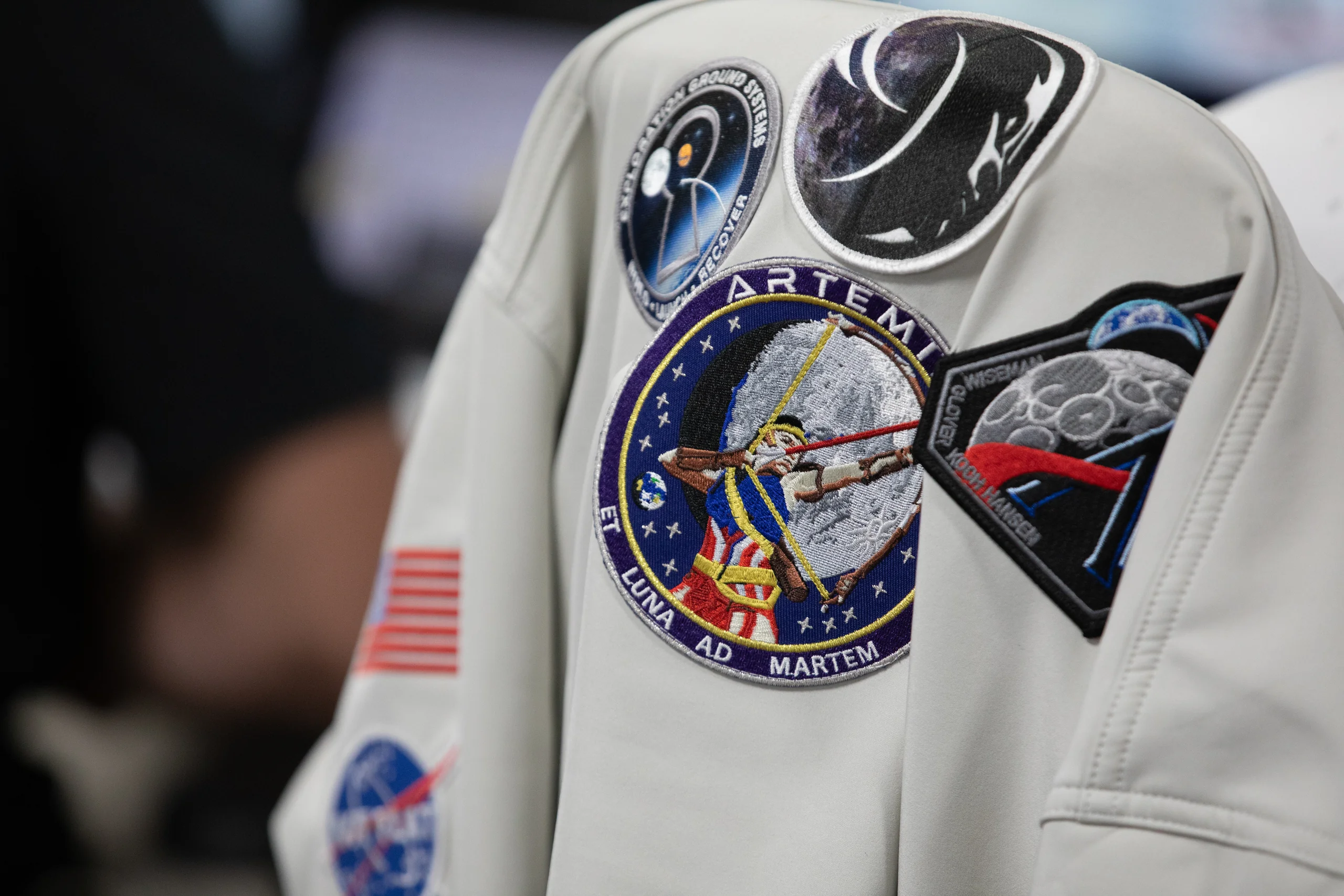
Image: NASA Image of the Day · Image credit: NASA/Clayton Rougelot · Image page
Every day, NASA selects one picture from its enormous archive for the homepage. The choice is often a nebula, a rocket plume or the curve of Earth. This time the subject is a jacket. It rests over the back of a chair, its chest and sleeves covered with round and pentagonal cloth patches.
The photograph was taken on Thursday, August 6, 2026, in the Rocco A. Petrone Launch Control Center at Kennedy Space Center in Florida. An Artemis III terminal countdown simulation was under way. In other words, the picture contains no rocket, astronaut or Moon, only a coat its owner took off for a while. NASA chose it anyway.
One timing detail: NASA Image of the Day updates on weekdays. This photograph reached the homepage on Thursday, August 20, often one calendar day behind readers in Beijing, and the shutter had clicked two weeks earlier. The date of a photograph and the date on which you encounter it are often different things.
What Is on the Jacket?
According to NASA's caption, the jacket bears Artemis I and Artemis II mission patches along with several other NASA emblems.
The status of those two patches deserves a pause: both represent missions already completed. Artemis I was an uncrewed lunar flyby test in November 2022. Artemis II was a crewed lunar flyby in April 2026. Four astronauts, Reid Wiseman, Victor Glover, Christina Koch and Canadian Space Agency astronaut Jeremy Hansen, lifted off from Pad 39B on the evening of April 1. They named their spacecraft Integrity and splashed down off San Diego ten days later. The flight carried humans to a record distance of 252,756 miles, about 407,000 kilometers, surpassing the mark set by Apollo 13 in 1970.
The jacket's owner, then, wore badges from two completed missions while rehearsing the third, which had yet to fly.
The Tradition Began With a Covered Wagon Drawn on Cloth
Mission patches look like souvenirs, but they mark a meaningful turn in spaceflight history. Its anniversary falls the day after this picture appeared on NASA's homepage, separated by sixty-one years.
Gemini V launched on Saturday, August 21, 1965, exactly sixty-one years ago. NASA's histories identify astronauts Gordon Cooper and Pete Conrad as the first crew to design an emblem for their own flight. Before that, a mission was a number, not an image.
They drew a covered wagon, the Conestoga wagon of the American western frontier, to suggest that Gemini was opening a road forward. Along its side ran the words "8 Days or Bust."
Those words caused the problem. NASA Administrator James Webb approved the patch but was deeply uneasy about the slogan. In an August 14, 1965 memorandum, he wrote, "I wish it could be omitted." His concern was concrete: if the mission failed to last eight days, someone would inevitably use the boast against NASA.
The patches had already been made and could not be redesigned. The crew chose a simple solution: they sewed a strip of cloth over the words. Cooper and Conrad flew with a patched patch.
They did complete eight days and returned on August 29. The cloth covering the slogan became one of the most candid revision marks in spaceflight history. It records not a failure, but caution about what would happen if failure came.
Patches became a tradition and the one part of a mission over which a crew had complete control. Apollo 11's shows an American eagle about to land on the Moon, carrying an olive branch in its talons. NASA's official explanation is direct: the branch means the crew came "in peace for all mankind," while the pure black background represents the vast unknown of space. Apollo 13 took another path. Three horses pull the chariot of the Sun god Apollo across the lunar surface, above the Latin phrase Ex Luna, Scientia: "From the Moon, knowledge."
The Artemis generation carries its own ideas. Artemis I had no crew, so teams at several NASA centers designed its emblem together. The overall triangle represents the three pillars supporting deep-space exploration: the Orion spacecraft, the Space Launch System rocket and Exploration Ground Systems. The three lightning towers are the real towers at Pad 39B. For Artemis II, tradition returned design authority to the four-person crew. They embedded the mission name as the letters AII, meaning both "two" and for all and by all. Their four surnames appear at lower left. The view of Earth and Moon pays tribute to Apollo 8's famous Earthrise photograph.
What Were They Rehearsing That Afternoon?
Return to the chair on August 6.
Its owner was taking part in a terminal countdown simulation organized by NASA's Exploration Ground Systems team. The exercise covered the final five hours of launch countdown, including the "terminal count," the last ten minutes.

The relation between those numbers is revealing: ten minutes is 3.3% of five hours, yet almost all the costly effort of a simulation goes into that 3.3%. During the preceding hours, a suspicious sensor reading leaves time to call someone, consult a manual or hold a brief meeting. In the final ten minutes, the rocket is executing its own sequence. The team has only two choices: let it proceed or stop it.
The simulation is not merely a walk-through. Kennedy Space Center's account of Artemis II training says that the simulation team inserts malfunctions, under one strict rule: every scenario must be based on something a real component could physically do. Nothing may be invented out of thin air. The launch director does not know which problems will appear. Some can be diagnosed without stopping the count; others require an immediate postponement.
Simulation supervisor John Apfelbaum has called a cutoff in the final seconds of countdown "one of the most critical situations" a launch team faces. That is why the interval is rehearsed repeatedly.
The logic is simple. People make mistakes under pressure, so let them make those mistakes first when they are cheap. A real launch window may last only minutes. One indecisive pause can consume it.
The building matters too. The Launch Control Center has four firing rooms. Artemis uses Firing Room 1, formally the Young-Crippen Firing Room. The entire building was named the Rocco A. Petrone Launch Control Center on February 22, 2022. Petrone deserves remembering. In 1960, while still an active-duty Army lieutenant colonel, he was assigned to Kennedy as Saturn project officer. He left the military in 1966 to become director of launch operations. He directed the first five crewed Apollo launches through Apollo 11, then became Apollo program director in 1969. At the naming ceremony, Kennedy director Janet Petro called him the most influential architect of the Apollo-Saturn program in the 1960s. Petrone died in 2006 at age 80.
A jacket draped over a chair was draped inside that building.
One "It Is Said" About Countdown
Since countdown has come up, one widely repeated piece of common knowledge needs qualification.
The familiar story says that counting backward to zero for ignition was invented by film. Fritz Lang's 1929 silent movie Frau im Mond used a countdown to build suspense, and real rocket engineers later borrowed the device.
No source for that claim appears in NASA's official material. Smithsonian magazine's air and space section found an earlier example: an English-language science-fiction story from 1897 already counted down from "ten seconds" to the final word NOW. The usual account is therefore best introduced with "it is said." It may be true, but it is not verified fact. That distinction matters more than the anecdote.
The Easiest Sentence in the Caption to Miss
The final sentence of NASA's caption says that Artemis III will accomplish a series of objectives in low Earth orbit to validate critical systems needed for future lunar landings, beginning with Artemis IV.
If you know the Artemis program, that should cause a pause. For years, the widely circulated plan was for Artemis III to make the first crewed lunar landing since Apollo, placing two astronauts near the Moon's south pole.
The caption is not mistaken. It reflects a real, official change.
On February 27, 2026, NASA issued news release RELEASE 26-022 announcing a revised Artemis architecture. A crewed demonstration in low Earth orbit would come before the landing and take the designation Artemis III, targeted for 2027. The first crewed lunar landing moved to Artemis IV, targeted for 2028. Artemis V was also scheduled for 2028, followed by an ambition to conduct one lunar-surface mission every year.
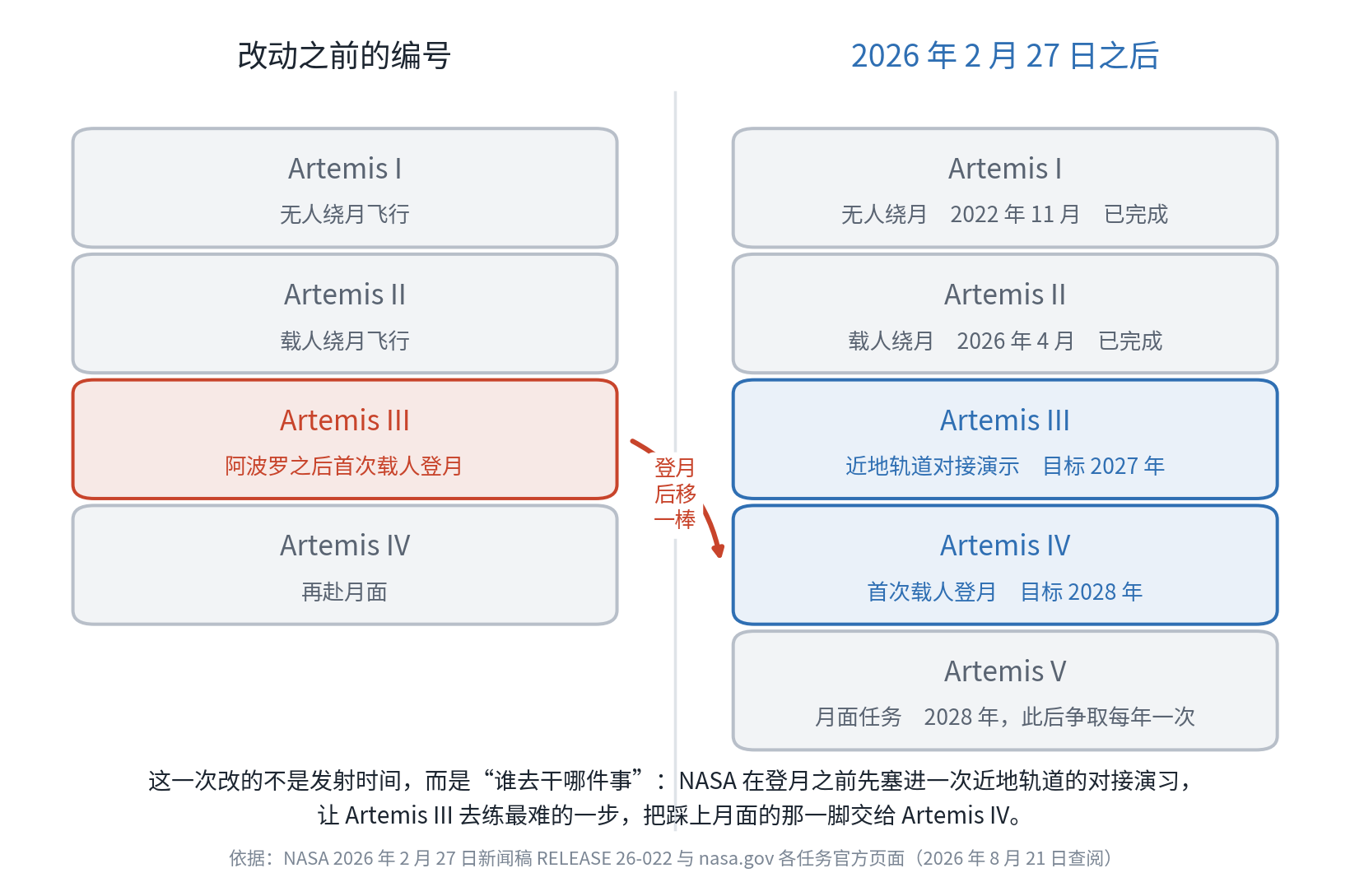
NASA gave two layers of reasoning. The engineering reason is to rehearse the hardest maneuver close to home. Artemis III will have Orion rendezvous and dock in low Earth orbit with commercial crewed landers. Landers from both Blue Origin and SpaceX may participate, and the crew may enter at least one of them. The mission will also test the spacecraft's life-support system over an extended period and validate its upgraded heat shield during return. These are among the most failure-prone links in the landing chain. If the rehearsal goes wrong in low Earth orbit, the crew can be home within hours.
The second reason was more direct. NASA Administrator Jared Isaacman said in the release, "we need to move faster, eliminate delays, and achieve our objectives." His stated premise was that pressure from competitors was increasing every day. Associate Administrator Amit Kshatriya said NASA was returning to the wisdom of the Apollo generation: do not change the rocket configuration for every flight; consistency creates reliability. The new architecture also made a less conspicuous but firm decision to abandon the planned Exploration Upper Stage and not build a second mobile launcher. The first missions will all use the same configuration.
Several points require precision. These years are official targets, not fixed launch dates. NASA's Artemis site says it "continues targeting 2028" for the first landing and notes that the date has not changed since mid-2025. Its Artemis III page gives only 2027, with no more specific date. Future events can be described no more firmly than that.
NASA announced the four Artemis III crew members on June 9, 2026: commander Randy Bresnik, European Space Agency pilot Luca Parmitano, and mission specialists Andre Douglas and Frank Rubio, with Bob Hines as backup. Hardware was advancing too. NASA reported on August 5 that Orion's crew and service modules had been joined on July 30 in Kennedy's Neil Armstrong Operations and Checkout Building. Four RS-25 engines arrived from Stennis on July 21, and stacking of the solid rocket booster segments in the Vehicle Assembly Building began in early July.
The jacket on the chair on August 6 therefore appeared at a very specific moment: the previous mission had returned just over four months earlier, hardware for the next was being assembled, and the purpose of that next mission had changed only months before.
In China: Names, and an Emblem Chosen by Public Vote
China's timetable and method differ.
When the China Manned Space Agency announced its 2026 mission plan on February 27, it said the program was "aiming to achieve the first Chinese crewed lunar landing before 2030." The same document summarized progress: the Long March 10 launch vehicle, Mengzhou crewed spacecraft and Lanyue lunar lander had completed major tests including Mengzhou's zero-altitude escape, Lanyue's landing and ascent, and a tethered firing of Long March 10. One major priority for 2026 was full-speed construction of supporting facilities for lunar missions at the Wenchang Space Launch Site, along with ground support for tracking, communications and landing operations.
The most eventful day was February 11, 2026. At 11:00 Beijing time, a newly built pad at Wenchang ignited for a test that combined two objectives: a low-altitude demonstration and validation flight of the Long March 10 system, and a maximum-dynamic-pressure abort test of the Mengzhou crewed spacecraft. The official notice listed four firsts: Long March 10's first powered flight in its prototype state; China's first maximum-dynamic-pressure spacecraft escape test; China's first ocean splashdowns of both a crew-return capsule and a rocket first-stage body; and the new Wenchang pad's first powered flight test. The rocket stage and return capsule both made controlled landings in their designated sea areas. Officials described the day as an important milestone in development of the crewed lunar-exploration program.
Then there are the names. On February 27, 2024, China's new crewed lunar vehicles received official names. The spacecraft became Mengzhou, or "Dream Vessel," carrying the Chinese dream of spaceflight while continuing the family of names established by Shenzhou and Tianzhou. The lunar lander became Lanyue, or "Embrace the Moon," from the phrase "to ascend the nine heavens and embrace the Moon." The next-generation crewed launch vehicle had already been named Long March 10.
The United States puts meaning into crew-designed patches. China puts meaning into names, but it has its own emblem tradition, built on a very different model.
Each year the China Manned Space Agency invites the public to submit emblems for the following year's missions. The call is open to any individual, legal person or organization interested in China's crewed space program. In other words, anyone can enter. The 2026 call opened on October 28, 2025, seeking designs for Tianzhou 10, Shenzhou 23, Shenzhou 24 and Mengzhou 1. When voting began on January 30, 2026, officials reported more than 500 submissions from across society. Ten designs for each mission advanced to a seven-day online vote, open from 9:30 a.m. on January 30 to 9:30 a.m. on February 6. Expert review and the public vote together selected one for each mission.
The rewards are specific. Every shortlisted designer receives a commemorative certificate. The creator of each winning emblem is invited to the launch site to watch a crewed launch in person.
What did the result look like? The Shenzhou 23 mission emblem, released on May 11, 2026, uses a circular composition depicting the spacecraft docking with the space station. Three five-pointed stars represent the three astronauts. At left, a Long March 2F rocket launches beside golden auspicious-cloud and ruyi motifs; at right appears a celestial feitian figure with flowing ribbons. Technological blue is the main color, accented with Chinese red.
The two approaches make an interesting pair. American patches are drawn by crews for themselves, a tradition beginning with the covered wagon in 1965: what the people going into space want to say. Chinese mission emblems come from open submissions and public voting: what people on the ground want the mission to look like. The same piece of cloth, with two different kinds of ownership.
Sources: NASA Image of the Day, "Artemis Mission Patches"; NASA news release "NASA Adds Mission to Artemis Lunar Program, Updates Architecture" (RELEASE 26-022, February 27, 2026); NASA's Artemis III, Artemis IV and Moon to Mars pages; NASA news release "NASA Marches Toward Artemis III Mission in 2027, Names Crew Members"; NASA releases "Liftoff! NASA Launches Astronauts on Historic Artemis Moon Mission" and "NASA Welcomes Record-Setting Artemis II Moonfarers Back to Earth"; Kennedy Space Center articles "NASA Completes First Launch Simulation for Artemis II Moon Mission" and "Artemis I Simulations Ramp Up for the Countdown"; NASA Exploration Ground Systems material on the Rocco A. Petrone Launch Control Center and its naming; NASA History's "Gemini V: Paving the Way for Long Duration Spaceflight"; NASA Science's "Apollo Mission Patches"; NASA's "Artemis I Identifier" and "Artemis II Insignia Honors All"; the NASA education activity "Design a Mission Patch" (NP-2020-066-GRC); nasa.gov/live; the China Manned Space Agency website, including the 2026 mission plan, Long March 10 and Mengzhou flight-test notice, calls and voting notices for mission emblems, and releases of the Shenzhou 23 and Tianzhou 10 emblems; the China National Space Administration website; and Smithsonian magazine's air and space account of the origins of countdowns.