
A thirteen-year-old photograph, a store that no longer exists, and the process by which a plum has its water taken away.
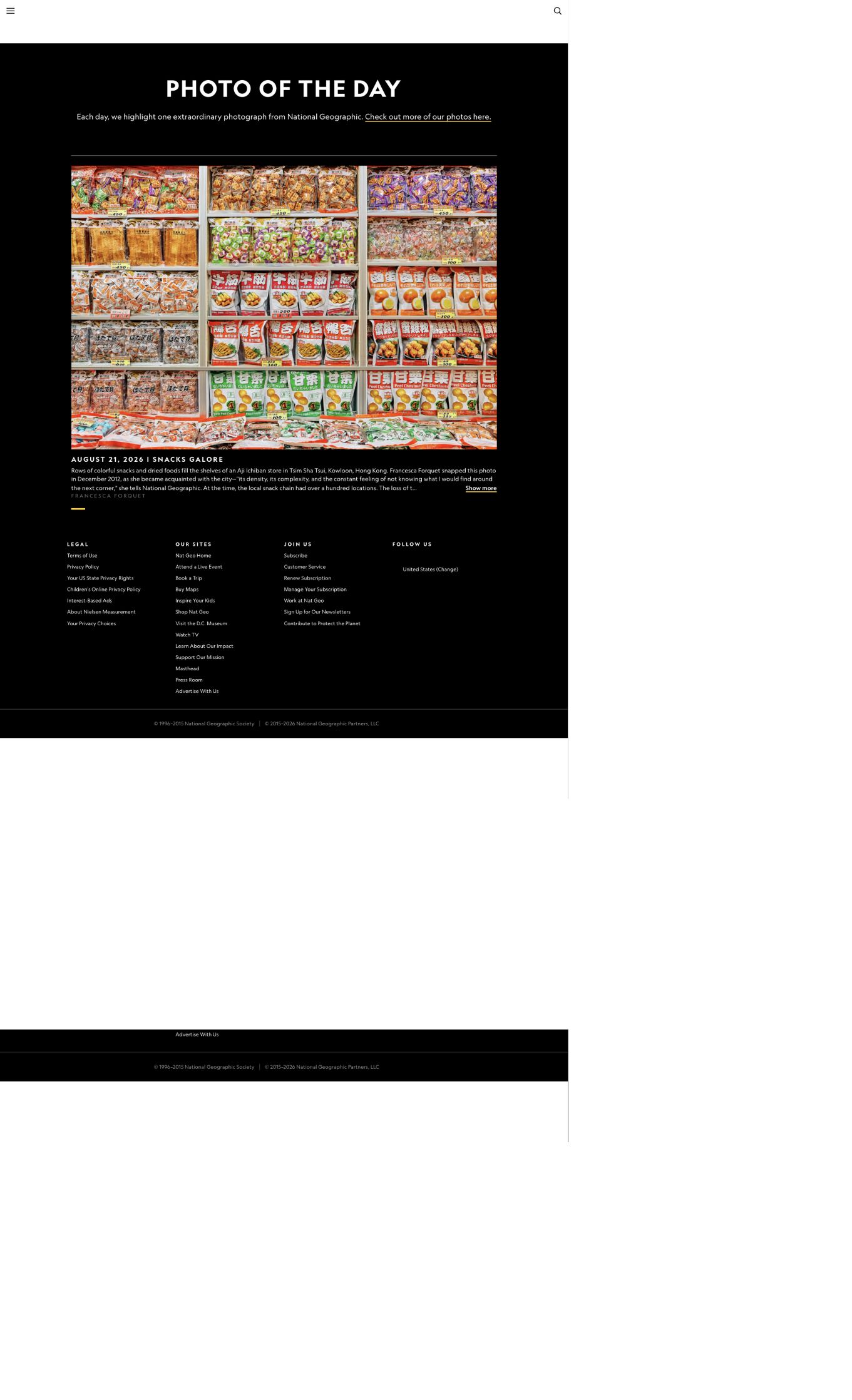
Screenshot: National Geographic Photo of the Day · Original page
National Geographic's photograph today is not a snow mountain, a lion or an aurora. It is an entire wall of snacks.
Rows of brightly colored preserves, dried fruit and other dry goods fill the shelves from top to bottom. The place is an Aji Ichiban store in Tsim Sha Tsui, Kowloon, Hong Kong. The original title, "Snacks Galore," says exactly what the wall offers. Today that wall exists only in the photograph; National Geographic's original image page is linked at the end.
In the Year of the Photograph, the Chain Still Had About a Hundred Stores
According to photographer Francesca Forquet's account to National Geographic, she pressed the shutter in December 2012. She was just beginning to know the city and was drawn to the feeling that she never knew what might wait around the next corner. A densely packed wall of snacks was that thought made tangible.
Thirteen years and eight months have passed since that day.
National Geographic adds a sharper detail in its caption: when the photograph was made, the local snack chain had more than a hundred Hong Kong stores. About a decade later, it closed every one of them.
The photograph is a time capsule. Everything in it remains arranged on the shelves, but the shelving, the store and the narrow aisle that shoppers once squeezed through are gone.
That Japanese Character Did Not Come from Japan
First, a widespread impression needs correcting.
Aji Ichiban's Chinese sign contained the Japanese hiragana character no, and its English name came from the Japanese aji ichiban, meaning "taste number one." It looked like a Japanese brand. It was not. According to the company's own account, it was founded in Hong Kong in 1993 by Lai Chan Yuk-hing and Lai Hin-tai. Reports in Hong Kong and mainland Chinese media often note that Lai Hin-tai came from a family in the traditional preserved-fruit trade. The English Wikipedia entry also makes a point of saying that, despite the character on the sign, this was not a Japanese chain.
It was a Hong Kong company with a Japanese-sounding name, selling preserved fruit and dry goods that people in southern China had eaten for centuries. That was not unusual in 1990s Hong Kong, when local retailers were especially adept at repackaging traditional goods.
The business grew very large. Market data cited by Hong Kong and mainland Chinese media put its share of Hong Kong's local snack retail market above 60 percent around 1999. By January 2007, it had more than 700 employees and roughly 150 stores when franchises outside Hong Kong were included. Accounts of its peak differ: National Geographic says it had more than a hundred Hong Kong stores in 2012, while the Japanese-language Hong Kong Economic Journal says it had "nearly a hundred" in Hong Kong at its height. One says more than a hundred, another nearly a hundred. Both indicate the same order of magnitude, but there is no single official figure, so both are reported here.
The later contraction had already begun to show. From 2011, the company retreated from mainland China. Hong Kong media cited franchisees who stopped paying fees and imitation brands that crowded the market. But the decisive blow came from another direction: the chain had become increasingly dependent on tourists.
June 6, 2022
The last Hong Kong stores closed on June 6, 2022. In the Hong Kong Commercial Daily, a company spokesperson put the reason plainly: Hong Kong had remained closed to cross-border travel after the pandemic, and without visitors the business could not continue. The company would compensate the dozen or so affected employees under labor law and did not rule out reopening if normal travel resumed. A report by Yicai added that seventeen franchise stores remained in mainland China, most near airports, but the company was no longer accepting new franchisees.
The chain lasted 29 years, from 1993 to 2022. From Forquet's photograph to the final day of business was nine years and six months. National Geographic rounds that to "a decade later"; the actual interval was six months short. Another four years and two months have passed since the closure.
This should not be romanticized. A snack chain's closure first meant that more than a dozen people lost their jobs and a group of preserved-fruit suppliers lost orders. Nor was the company simply wronged by history. Hong Kong media and readers have offered a pointed criticism: in its later years, the chain replaced loose preserved snacks that local people ate every day with higher-priced gift boxes designed for tourists. It lost local customers first, and when the tourists disappeared it had no second leg to stand on. That is a retrospective explanation from media and readers, not the company's account, and it is presented here as one interpretation rather than a settled conclusion.
But the things on those shelves have histories much longer than the store's.
The Real Question: Why Do These Foods Not Spoil?
Look again at the shelves.
Most of the preserved plums, candied fruit, dried fruit and other dry goods were kept at room temperature. There was no refrigerator and no vacuum packaging. Some sat in open bulk bins, sold with tongs and paper bags. Why could they last for months or even longer?
You might think the answer is sterilization. It is not.
The answer is: take away the water.
Microbes need water they can use. The last two words matter. Water in food is not an open pool available to anything that wants a drink. Some of it is held tightly by molecules such as sugar, salt, proteins and polysaccharides, beyond the reach of microbes. Food science measures this with water activity, written as aw. The US Food and Drug Administration defines it as the vapor pressure of the food divided by the vapor pressure of pure water under the same conditions. Pure water is 1.00. The drier, saltier or sweeter the food, the lower the number.
The FDA says most foods have an aw above 0.95, enough for bacteria, yeasts and molds to grow freely. Each class of microbe has a limit below which it cannot continue. Most spoilage bacteria need about 0.90 or higher. Clostridium botulinum needs about 0.93, and as high as 0.96 under some product conditions. Staphylococcus aureus can go as low as 0.86 in the presence of oxygen, but needs 0.91 without it. Most yeasts require more than 0.88. Molds are the hardiest and can reach roughly 0.65. The Codex Alimentarius Commission's 2015 Code of Hygienic Practice for Low-Moisture Foods, CXC 75-2015, draws a general line: food at an aw of 0.85 or below is low-moisture food. That 0.85 is not a convenient round number. The FDA's seafood hazards guide explains that it comes from the lowest water activity at which S. aureus can grow and produce toxin.
Set the foods on the shelves against that scale and the answer becomes clear. A Kansas State University Extension publication gives the following ranges: dried and candied fruit and honey are around 0.60 to 0.65; jam is 0.75 to 0.80; fresh fruit and fresh meat are above 0.95. A preserved plum sits precisely in the range where almost no microbe can remain active.
Sugar and Salt Are Doing the Same Job
How do sugar and salt lower aw? Two things happen at once.
First, they hold water. Sugar molecules and salt ions attract water molecules and gather them close. That water remains present, but it cannot move freely, evaporate or serve as a solvent for microbes. University of California food-preservation materials call sugar and salt humectants: their talent is binding water.
Second, they pull water out of living cells. This is osmotic pressure. Outside a bacterial cell, sugar or salt is concentrated and usable water is scarce; inside, the concentration is lower and water more abundant. Water moves spontaneously from the wetter side toward the drier one. The bacterial cell loses water, shrivels and stops metabolizing. It can neither divide nor spoil the fruit.
Three old kitchen techniques that appear entirely different - sun-drying, salting and candying - therefore reach the same destination. Sunlight removes water outright. Salt and sugar hold water in place so that it cannot do useful work, while also drawing water out of microbes. All three push aw below the line.
One figure explains why preserved plums are both salty and sweet. According to the same University of California material, a brine containing 13 percent salt by weight has an aw of about 0.91. To reach the same 0.91 with sugar requires a concentration of 55 percent. By weight, salt is roughly four times as efficient as sugar at reducing water activity. In traditional preserved-fruit making, large amounts of salt first force the water out of green plums to make a salted plum base. Excess salt is then removed, and the fruit is repeatedly soaked with sugar and licorice and dried. Salt does the hard work; sugar makes the result pleasant to eat. Both lower the same number.
There is another fact that few people know. Life's tolerance for dryness has a physical lower boundary, and it lies close to these shelf-stable snacks. A 2015 study in The ISME Journal measured growth in halophilic archaea at an aw as low as 0.635, while the most xerophilic fungi could still germinate between 0.755 and 0.605. The authors proposed a common water-activity floor of about 0.61 for the bacterial, archaeal and eukaryotic domains. That is not a biological preference but a wall imposed by physical chemistry. The preserved plum in your hand sits against it.
One limit must be stated clearly: low moisture does not mean sterile. The Codex code is explicit. Pathogens such as Salmonella cannot multiply in low-moisture food, but their cells can survive for a long time. Taking away water stops them; it does not make them disappear. When dried fruit or nuts cause a food-safety problem, contamination introduced during processing may simply have remained quiet inside. "Very dry" is never a substitute for "clean."
Every Preserved Plum Was Once a Plum Blossom
Now restore each item on the shelf to the tree it came from.
The raw material for a preserved plum is a green, unripe fruit of Prunus mume, a member of the rose family. According to Kew's Plants of the World Online, it flowers in central and southern China from January through March, while the branches are still bare. A crown of white or pink flowers on leafless wood makes it one of the most recognizable trees at winter's end. Fruit from the same blossoms matures for harvest in May and June, or as late as July and August in northern China.
The mouth-puckering plum you eat was therefore a flower in cold wind four or five months earlier. The distance between them is exactly one winter and the beginning of summer.
The bin of aged citrus peel is more exacting. Genuine Xinhui chenpi is made from the peel of the Xinhui mandarin, Citrus reticulata 'Chachi.' This is not merely a local boast. In 2006, China's former General Administration of Quality Supervision, Inspection and Quarantine recognized Xinhui mandarins and Xinhui chenpi as protected geographical-indication products in announcements 157 and 159. The protected area was defined as Huicheng Subdistrict and the ten towns of Daze, Siqian, Luokeng, Shuangshui, Yamen, Shadui, Gujing, Sanjiang, Muzhou and Da'ao in Xinhui District, Jiangmen.
Harvest is graded by the traditional solar calendar. According to the official product description from the Guangdong Intellectual Property Protection Center, fruit picked between the Beginning of Autumn and Frost's Descent produces qingpi: thin, hard peel with a pungent and bitter taste. Fruit picked between Frost's Descent and Light Snow produces slightly red peel. Fruit picked after Light Snow produces fully red peel, thicker and softer, pungent but with a faint sweet fragrance. On the Gregorian calendar, harvest runs roughly from early August through December. Once removed, the peel must age locally in Xinhui for at least three years before it qualifies as Xinhui chenpi. Those three years are not a poetic honorific; they are a threshold written into the standard.
Is there a testable chemical basis for the saying that chenpi improves with age? There is some, and it is more specific than one might expect. A 2025 study in Foods compared Xinhui chenpi aged for one, three, five and seven years. As age increased, concentrations of 4-vinylguaiacol, vanillin and guaiacol rose while ferulic acid declined. The researchers isolated three microorganisms from the samples and demonstrated in vitro that they could convert ferulic acid into 4-vinylguaiacol and then into vanillin and guaiacol.
Vanillin is the molecule associated with vanilla's aroma. In other words, part of the elusive sweet undertone in old chenpi is produced over years by invisible organisms, molecule by molecule, from chemical precursors in the citrus peel. At least some of the three-year threshold reflects the time these reactions require.
The published research is not yet comprehensive. We still have only partial answers about differences among places of origin and storage conditions, and about which chemical changes actually correspond to human taste. It is fair to say there are chemical clues behind "the older, the better." It is not fair to say the whole account has been settled.
Sources
National Geographic's "Snacks Galore" caption, August 21, 2026; US Food and Drug Administration, Water Activity (aw) in Foods technical guidance; US FDA, Fish and Fishery Products Hazards and Controls Guidance, Chapter 13; Codex Alimentarius Commission, Code of Hygienic Practice for Low-Moisture Foods, CXC 75-2015; Kansas State University Extension publication MF3674, Water Activity of Foods; University of California Agriculture and Natural Resources food-preservation materials; Stevenson et al., "Is There a Common Water-Activity Limit for the Three Domains of Life?" (The ISME Journal, 2015); Gan et al. on aroma compounds in aging Xinhui chenpi (Foods, 2025); Kew's Plants of the World Online entry for Prunus mume; the Guangdong Intellectual Property Protection Center's geographical-indication description for Xinhui chenpi; the Xinhui District People's Government's rules on the use and protection of the Xinhui chenpi geographical-indication mark; Aji Ichiban's official company history; and reports from the Hong Kong Commercial Daily, Hong Kong Economic Journal and Yicai on the chain's closure.