
Everyone tells the story above the shoreline. Today we tell the half below it.
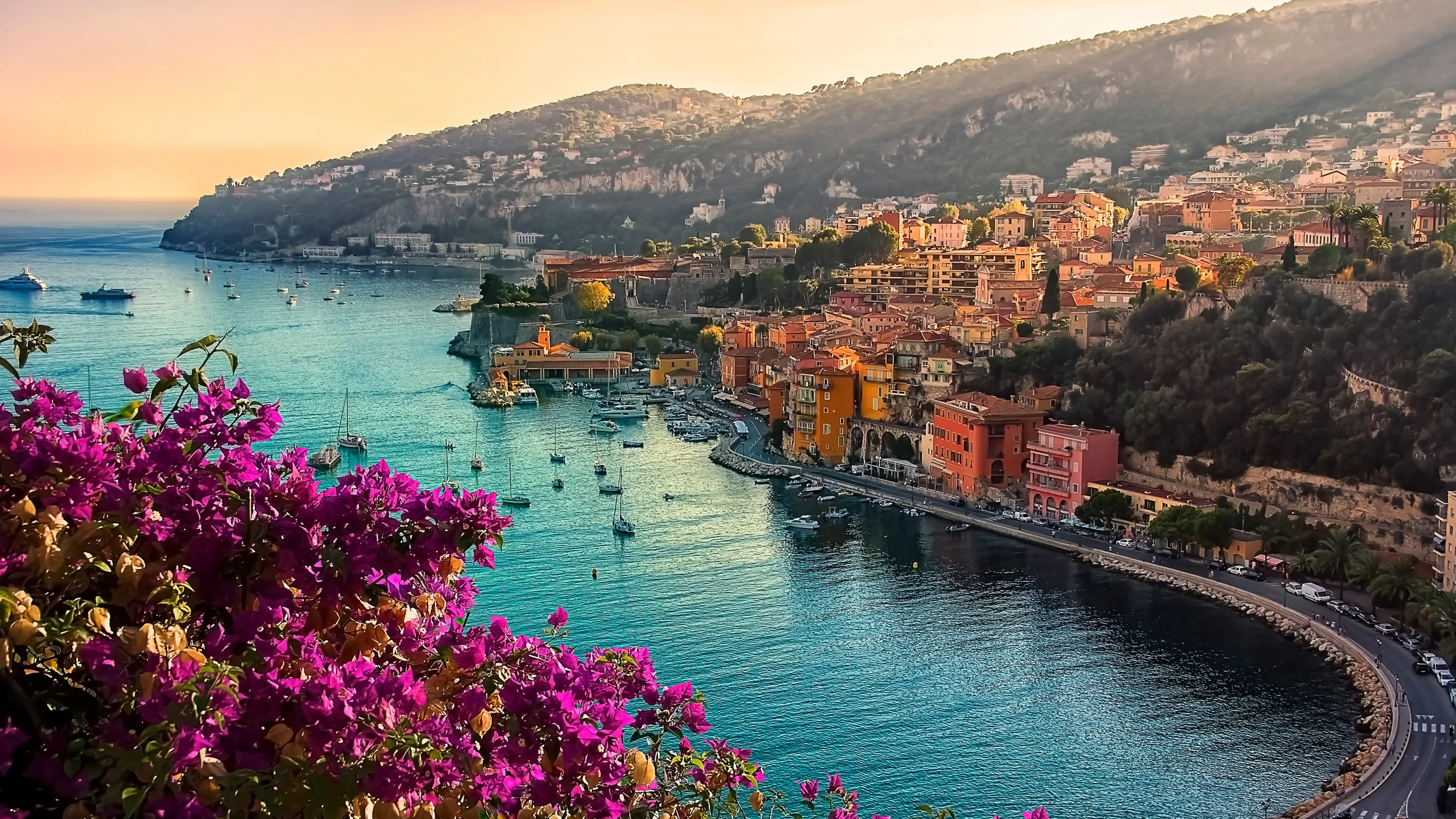
Image: Bing Daily Wallpaper | Villefranche-sur-Mer, French Riviera, France (© StockByM/Getty Images) | Bing homepage
Open Bing in China today and the Mediterranean fills the screen. Orange roofs descend in layers to the water, whose blue seems available only on the Côte d'Azur. Bing calls the image "Mediterranean Charm" and supplies a single line of location: Villefranche-sur-Mer, French Riviera, France.
We have seen many photographs like this: a Mediterranean town, warm-colored walls, a quiet bay. You look, feel a little better and move on.
But this bay is different. What makes it different cannot be seen in the photograph because it lies underwater.
One Official Sentence Is Worth Every Adjective
First, something I nearly got wrong.
The most common Chinese-language claim about this town calls it "the deepest natural harbor in the Mediterranean." I checked and could not verify it. Neither France's Ministry of Culture nor its marine research organizations make the claim. The municipal website offers only an unnumbered promotional phrase, calling it "one of the deepest and most beautiful bays in Europe." Other sources give depths ranging from tens of meters to a thousand, contradicting one another.
So that claim does not appear here.
But a formal record from France's national marine observation network, SOMLIT, contains a plainer and much firmer sentence. It says the bay's entrance is more than 300 meters deep and, crucially, notes the absence of a continental shelf.
The marine institute beside the bay says the same thing in French and states the consequence:
The absence of a continental shelf in Villefranche Bay, combined with the particular coastal currents, makes it a convergence zone exceptionally rich in plankton.
What does "no continental shelf" mean?
Imagine most coastlines with a long, shallow platform extending out from shore, like the shallow end of a swimming pool where you can walk a long way before the water reaches your waist. That platform is the continental shelf. Life from the open ocean must cross this entire shallow stretch to approach land, and for many organisms that live only in deep water, the shallows are a wall they cannot pass.
Villefranche Bay has no such platform. The seafloor drops away from the shore.
The open ocean is not far away. It presses directly against your feet. Organisms that would ordinarily remain tens of kilometers offshore and hundreds of meters down can be carried straight to the town's shoreline by currents. SOMLIT's record puts it plainly: oceanic organisms, including various kinds of gelatinous plankton, reach the coast with offshore water masses.
That is why a resort town of only a few thousand people holds a world-class marine research institute.
144 Years, and One Point Sampled for 69
The institute has changed its name six times. The names alone could make a novel.
In 1882, two Frenchmen, Jules Barrois and Hermann Fol, opened a laboratory in the town's former arsenal. In 1884, with the support of Russian zoologist Alexis Korotneff, it moved into a building locals called the Russian House. In 1888, it formally became the Russian Zoological Laboratory: a Russian laboratory on a French bay, directed by Korotneff until his death in 1915. Only in 1931 did it come under the French Ministry of National Education.
Later names included the Villefranche Marine Station and the Oceanological Observatory. Since 2019, it has been the Institut de la Mer de Villefranche, or IMEV, part of Sorbonne University and the French National Centre for Scientific Research, with two laboratories under it. Its official account describes what those 144 years have been for:
IMEV continues this tradition of plankton research, using the latest methods from microscopy and quantitative imaging to genomics.
One hundred and forty-four years, one subject.
The most moving detail in that history is a coordinate.
Inside this bay, only 3.2 kilometers long and 1.3 kilometers wide, is a site called Point B: 43°41′ north, 7°19′ east, in water 80 meters deep. Every week since 1957, someone has gone to this point and collected water.
What do they measure? Temperature, salinity, nutrients, pH, isotopes, suspended particles, organic carbon, organic nitrogen and chlorophyll-a biomass. Flow cytometry was added in 2009. Nearby are the deeper Point B+ at 150 meters and Point C at 300 meters.
Sixty-nine years. Once a week. The same point.
There is nothing romantic about it. It may even seem stubbornly dull. Yet almost every conclusion about how the ocean is changing ultimately rests on this kind of stubborn work. To say something has changed, someone first has to record honestly what it used to be. Without those 69 years, every conclusion about this stretch of sea would be only an impression.
Earth's Largest Migration Happens Twice a Day Beneath Your Feet
The bay's plankton also demonstrate motion on another scale.
Plankton, organisms so small they are nearly invisible and can only drift with the water, perform something every day on a scale that seems impossible.
By day, they remain 200 to 1,000 meters below the surface, in the ocean's "twilight zone," where the light is so faint it is nearly dark.
After sunset, they begin to swim upward, rising hundreds of meters toward the surface to feed on still smaller phytoplankton.
Before sunrise, the entire procession sinks back into the darkness.
Two trips every day, across the world's oceans at once.
NASA calls it "the largest migration of animals on Earth in terms of total number." Notice the qualification: largest by number, not by distance. Arctic terns fly tens of thousands of kilometers in a year. By population, no migration compares with the creatures rising from the twilight zone each night.
Why expend so much effort?
The tradeoff is direct: food lies at the surface, but daylight leaves them exposed; the depths have less food but also fewer predators able to see them.
Their compromise is to work in darkness and hide in the light. Every day they pay the cost of traveling hundreds of meters up and down simply to avoid being seen. NASA says the behavior evolved "primarily as a means to avoid visual predators during the day."
A migration spanning the planet, all because it is safer not to be visible.
A Familiar Claim Needs Calibrating
Since we are discussing plankton, one widespread claim deserves correction because it is half right and half wrong.
The claim is: "Every second breath you take comes from the ocean."
The U.S. National Oceanic and Atmospheric Administration says scientists estimate that roughly half of Earth's oxygen production comes from the ocean, while acknowledging that the exact share is difficult to calculate because it changes constantly. At that level, the popular line has the right order of magnitude.
But NOAA immediately adds a sentence that almost no one repeats:
Although the ocean produces at least 50% of the oxygen on Earth, roughly the same amount is consumed by marine life.
The ocean is an enormous oxygen factory, but it is also an equally hungry mouth. It produces a great deal and consumes a great deal, leaving relatively little net gain. The oxygen you breathe today comes mainly from the atmospheric stock accumulated over billions of years, not from the ocean's daily production supplied in real time.
The distinction matters. Whether a number describes gross production or the net remainder can reverse the meaning of the same sentence. Many spectacular-sounding science claims do not use the wrong number; they leave out the second half.
They Photographed Plankton, Then Laid the Images Out for Everyone
The team beside this bay also improved how plankton are observed.
Traditionally, there was only one method: drag a net through the water, haul up the catch and count it under a microscope. The problem is that many organisms are already destroyed by the time they come aboard. Gelatinous creatures, softer than water and as fragile as jelly, disintegrate in the net.
The Villefranche team developed an instrument called the Underwater Vision Profiler, or UVP. Instead of collecting organisms, it descends through the water and photographs them as it goes. "Haul it up" became "take its picture."
Then came a second and even more elegant step. Someone still had to identify the photographs, and examining them one by one was an astronomical workload. The team built EcoTaxa, a platform that brings plankton images from around the world together for people and machines to classify jointly.
The platform now holds more than 700 million images from about 900 institutions and 4,500 users.
EcoTaxa sits on the observatory's own domain, ecotaxa.obs-vlfr.fr, and its homepage says visitors can browse identified images for free without registering. The team also made a film project called Plankton Chronicles, produced by Christian Sardet, a research director at the French National Centre for Scientific Research in Villefranche. Its French, English and Spanish website lists all 12 series publicly. One is titled Plankton of the Côte d'Azur. It was filmed in the water shown in today's photograph.
China's Camera Is in Fujian
China is also photographing plankton, for a particularly practical reason.
Each spring, "blue tears" appear off the coast of Pingtan, Fujian: disturbed seawater glows an eerie blue. The China Meteorological Administration explains that China's coastal blue tears are usually produced by bioluminescent Noctiluca, a single-celled marine dinoflagellate whose luciferin reacts with oxygen outside the cell to emit blue light.
The Pingtan Meteorological Bureau began developing a model in 2017 to forecast the weather conditions for blue tears. According to Xinhua, in May 2023 it used an "underwater plankton imager" for the first time, taking direct pictures of the glowing single-celled organisms.
At one end is a Sorbonne laboratory with 144 years of history; at the other, a county-level meteorological bureau in Fujian. They use the same class of camera for the same reason: stop guessing what is in the water and take a look.
Farther down, China has another way to "take a look." An announcement on the Ministry of Science and Technology website records that the Fendouzhe crewed submersible reached 10,909 meters in the Mariana Trench on November 10, 2020, setting a Chinese record for crewed deep-sea diving. During sea trials it made 12 dives, seven beyond 10,000 meters, and more than 96.5% of its core components were domestically produced.
At Villefranche, descend 300 meters and an ocean's worth of organisms comes to meet you. In China, people must descend 10,000 meters to see what lives there. The action is the same: go down, see clearly and record it.
Two Public Dates in September
September 11 has no observance directly connected with the ocean, France or Villefranche-sur-Mer. Bing's search terms contain only the place name. Two public events are approaching this season:
- Eight days from now, Saturday, September 19, is International Coastal Cleanup Day. It is observed on the third Saturday of September, which falls on that date in 2026. The organizer's website does not publish the date verbatim; this date is calculated from the rule.
- France's Fête de la science runs from October 2 to 12. The Villefranche institute holds an "Ocean Science Village" during the festival each year, including sessions for schools.
Sources: the IMEV marine institute's website and history; the Point B dataset description from the French marine data center SEANOE/SOMLIT; NASA's release "NASA-French Space Laser Measures Massive Migration of Ocean Animals"; Behrenfeld et al., Nature (2019); the U.S. National Oceanic and Atmospheric Administration at oceanservice.noaa.gov; the EcoTaxa platform; the Plankton Chronicles website; the China Meteorological Administration; Xinhua; the website of the Ministry of Science and Technology of the People's Republic of China; the French Ministry of Culture's POP/Mérimée heritage database; the Nice Côte d'Azur Convention and Visitors Bureau; the French Ministry of Higher Education and Research; and Ocean Conservancy.