
A shell grows only at the rim of its opening, making it a diary that can never be revised.
Screenshot: National Geographic Photo of the Day | Original page
Begin with the composition, because it determines the rest of the story.
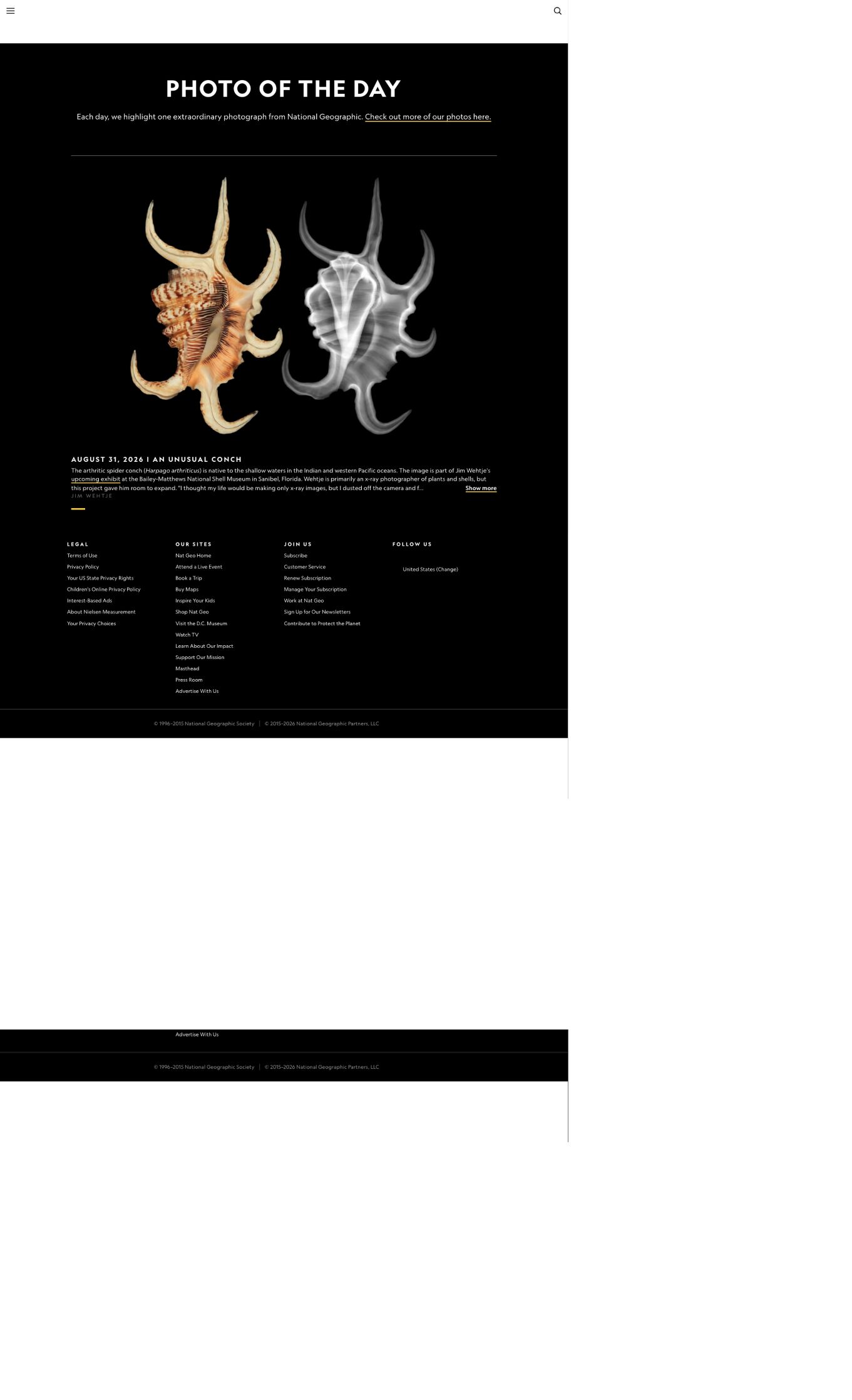
National Geographic's own image description says that a spotted conch with fingers pointing in different directions sits beside an X-ray of the same snail.
Two images, one snail. This is not simply a photograph made by an X-ray artist. It pins two ways of seeing beside each other: exterior and interior. The work is titled "An Unusual Conch."
Who Is This Snail?
Its scientific name is Harpago arthriticus (Röding, 1798), and the World Register of Marine Species recognizes it as an accepted species. It belongs to Strombidae, the large conch family that also includes the queen conch. Its shell is about 11 to 19 centimeters long.
National Geographic's caption says it inhabits shallow water in the Indian and western Pacific oceans. That statement deserves a small question mark.
Of 363 georeferenced records for the species in the Global Biodiversity Information Facility, about 74 percent cluster in the western Indian Ocean, in the Seychelles, Tanzania, Kenya, Mozambique, Mauritius, Réunion and Madagascar. The Pacific side contains only scattered records: 12 from the Philippines, four from French Polynesia, two from Indonesia and mostly single-digit totals elsewhere. The dataset even includes several impossible locations in Argentina, Namibia, Senegal and Guinea, all on the Atlantic side.
This is not an attempt to catch National Geographic in a mistake. It illustrates something worth knowing: scientific databases, too, contain drawers whose labels were copied incorrectly over centuries. A museum record marked "Argentina" may preserve one nineteenth-century collector's error, recopied for a hundred years. The next time a source says a species is "distributed across" some ocean, it is reasonable to ask who counted.
No evidence was found for the species in the Red Sea or in Chinese waters. The China connection in this article therefore comes not from this species, but from a relative and a Chinese character.
An Eighteenth-Century Doctor Saw a Gouty Hand; Chinese Eyes Saw a Character
The genus name Harpago is Latin for grappling hook.
The type species in the genus is Linnaeus's 1758 chiragra. The word combines the ancient Greek cheir, meaning hand, with agra, meaning a seizure or attack: gout of the hand. Its exact counterpart is podagra, gout of the foot. Arthriticus means arthritic, or relating to diseased joints.
These are doctors' names. Linnaeus was a practicing physician, while Röding was a naturalist compiling a catalog for a private collection. To anatomically trained eyes, the shells' thick, swollen, jointed projections resembled fingers enlarged by gout. The English shell trade still calls Harpago chiragra the "gouty spider conch."
In Chinese, however, Harpago chiragra is called the shui zi luo, the "water-character conch."
Its six extended fingers resemble the handwritten Chinese character for water.
The same six fingers look like a diseased hand to one culture and a written character to another. It is one of the most delightful facts in this story, and it costs nothing: two civilizations, two pairs of eyes, one shell.
No established Chinese common name was found for Harpago arthriticus itself. The name water-character conch is well established for its relative, but no new name is invented here for this species.
The Mechanism: A Shell Grows Only at Its Opening
This is the heart of the story, and one sentence explains it.
A 2014 study of snail-shell form described a shell as, in essence, "a calcified history of the aperture, that is, the mantle edge."
The mechanical description in the same paper is equally direct: the mantle extends slightly beyond the current opening and adds a small increment of new shell at the edge.
Think carefully about what that means.
A shell is not a house. It is the fossil left by that rim of living tissue.
A snail builds in only one place throughout its life: around the edge of the opening. The mantle reaches out, adds a little at the outermost rim, then a little more. Everything behind the aperture is the past. The animal can never return to revise any part of it.
The mantle edge usually has three folds, and sometimes as many as five. Shell-making begins not with mineral but with an organic periostracum, formed in a groove between the outer and middle folds. This skin seals a tiny space where crystals can grow. How large is the chamber where mineralization actually occurs? One study gives a thickness of about 100 nanometers.
The workshop in which this animal makes its entire shell is one ten-thousandth of a millimeter high.
The Spiral Is Not a Design but an Unavoidable Result
What happens when an animal adds material only at the opening and adds it in the same proportions every time?
Its shape cannot change. It can only get larger.
In geometry, only one curve can enlarge while retaining the same shape: the logarithmic spiral, also called the equiangular spiral. It is self-similar. Enlarge it and the new curve differs from the original only by a rotation.
The seventeenth-century mathematician Jacob Bernoulli was captivated by this curve. He called it spira mirabilis, the marvelous spiral, and asked for it to be carved on his tombstone.
Among biologists, D'Arcy Thompson said it best in On Growth and Form in 1917:
"We can conceive of no simpler law in the growth of a shell than this, that it shall widen and lengthen in the same unchanging proportions. And this simplest law is what nature tends to follow. The shell, like the creature within it, increases in size but does not change in shape."
The beautiful spiral was not designed. It is the only possible outcome of a construction method that adds material at the edge in constant proportions. Build a house that way and you, too, could produce only this form.
In 1966, paleontologist David Raup took the next step. His model could generate a shell's geometry from just four parameters:
W: how much the aperture expands with each revolution.
D: how far the aperture sits from the central axis, determining whether the shell has an open center.
T: how far each revolution advances along the axis, determining whether the shell forms a flat disc or a tall spire.
S: the shape of the aperture itself, expressed as the ratio of its long and short axes.
His famous cube used only three of them, which is why popular accounts often say that three numbers can make every shell. There are actually four.
More important than the count of parameters was Raup's real question. When he placed all known shells within this parameter space, he found vast empty regions.
Were the shells in those blank regions physically impossible, he asked, or had evolution simply never made them?
That question is a hundred times more interesting than "three numbers make every shell." The possibility space of shells is a continent, and life has built only a few cities on it.
What Are the Six Fingers For? Honestly, No One Really Knows
The most obvious explanation for the shell's fingerlike projections is defense from predators. Yet Savazzi's classic 1991 study of form in Strombidae, published in Lethaia, did not interpret the spines as armor. It proposed several other functions.
First, avoid overturning. A broad wing or a ring of long spines around the opening increases the shell's contact area and reduces the chance that it will tip over.
Second, recover more easily after overturning. Knobs on the back make an overturned shell lean to one side, reducing the rotation needed to right itself from 180 degrees to 100 to 140 degrees. That is a remarkably specific piece of geometry.
Third, and most unexpectedly, facilitate mating. In the related spider conch Lambis lambis, these spines are sexually dimorphic. In the much larger female, the spines nearest the stromboid notch curve upward. The male's are shorter and point backward. The paper concluded that this difference lets the two shells approach more closely during mating.
Some of the fingers form a kind of latch.
As for predators, Savazzi wrote that conchs facing shell-crushing crabs and fish typically retreat inside and rely on the shell's passive mechanical protection. The whole thick shell does the work, not the spines.
One more caveat is essential, and it may be the best science lesson here. A popular review states bluntly that no one has tested these spiny shells in field studies or laboratory simulations, so the proposed functions remain untested hypotheses.
An expensive, conspicuous structure has lain in shallow seas for millions of years. People have devised five or six explanations for it, yet not one has truly been tested.
Science still contains gaps this visible. That is not bad news. It is an open door for a curious child.
When the Ruler Stops
Strombidae exhibit what biologists call determinate growth.
Once the shell reaches its final size, it stops growing. Just beforehand, its opening changes dramatically: the suture may turn upward, the outer lip spreads and thickens, and spines may form. A shell on the beach with a flared, thick, hard edge came from an adult conch. One with a thin, sharp edge belonged to an animal that died before growing up.
That distinction can be checked on almost any conch shell in ten seconds. It may be the most useful little test in this article.
But it requires a correction. It is tempting to assume that a flared lip means sexual maturity. It does not. Fossil-conch research shows that this family's final shell form and size are reached before sexual maturity. Fisheries research on queen conchs is more specific: gonadal maturity lags well behind the first formation of the shell lip. Researchers found only minimal maturity when the lip reached 9 to 12 millimeters thick; half the population was mature only at 24 to 26 millimeters. They consequently recommended a minimum harvest lip thickness of 15 millimeters.
The actual sequence is this:
The shell stops expanding. The animal keeps living and adds layer after layer to the lip. Only later does it become able to reproduce.
In other words, the diary records only childhood and adolescence. Nothing the adult does is added to the spiral. Adult life is recorded only in the lip's thickness. Fisheries scientists estimate a conch's age by measuring that lip.
The ruler of growth stops before adulthood. The lip keeps recording quietly, no longer moving forward, only growing thicker.
A Snail That Pole-Vaults and Sees Clearly
Conchs do not glide along the seabed like other snails. They leap.
The animal anchors the rear of its foot by driving the tip of its sickle-shaped operculum into the seabed. It then extends the foot forward and lifts and throws the whole shell ahead. A 1922 description used the word "leaping."
Consider the operculum. In other snails it is a door, sealing the opening when the animal withdraws. A conch's operculum is a slightly curved sickle with seven or eight faint serrations along its edge. It is a claw and a pole. The same organ that other snails use as a door lets this one jump.
The most systematic accounts of that leap date from 1922 and 1974. No modern biomechanical study using high-speed photography was found. A famous behavior was last carefully described half a century ago.
The eyes are even more remarkable. A 2022 paper in the Journal of Experimental Biology measured another member of Strombidae. Behavioral tests found a spatial resolution of 1.06 degrees. A prediction made independently from retinal anatomy was 1.04 ± 0.14 degrees, agreement within 2 percent. Its contrast sensitivity reached 0.07, meaning it could detect objects with only slight differences in brightness. All of this fits inside an eyeball only 1.2 millimeters across. Each eye contains 157,000 retinal cells divided among six types, more than had previously been described.
The paper called it the sharpest vision yet described in any nonpredatory gastropod. For comparison, periwinkles resolve 3.6 degrees and slugs 52 degrees.
What does 1.06 degrees look like? It is roughly the width of a little fingernail at arm's length. With two eyes barely more than a millimeter wide, a conch can distinguish that much detail. Researchers believe it allows the animal to detect potential predators early.
There is more: they can regrow their eyes. A 1976 study reported that five to 16 days after an eyestalk was cut, a new eye appeared at the tip of the stump. After roughly 14 more days, it had developed into "a complete but reduced organ." In three or four weeks, a functional eye grew from a wound.
A Photographer and a Museum That Flooded
The artist is Jim Wehtje of Lancaster, Massachusetts. He makes what he calls creative X-ray photography for design, art and science, concentrating on natural subjects such as plants and shells.
National Geographic's caption contains the only direct quotation from him available for this article:
"I thought I would only make X-ray images for the rest of my life, but I dusted off my camera and rediscovered surface and color."
That sentence explains why today's work contains two images. Wehtje did not exchange one medium for another. He placed two ways of seeing side by side.
The caption says the work will appear in an upcoming exhibition at the Bailey-Matthews National Shell Museum. Precision matters here. At publication time, the museum's website had not announced the exhibition's name or dates; its special-exhibitions page listed three different shows. No title or date is invented, and the event remains in the future tense.
The museum itself has a story that fits this article exactly.
It opened to the public on Sanibel Island, Florida, in 1995 and holds nearly 600,000 specimens. In 2020, it added a living aquarium gallery with more than 300 animals representing over 60 marine species.
On September 28, 2022, Category 4 Hurricane Ian made landfall.
Seawater flooded the building to 5.5 feet, or about 1.7 meters. The Sanibel Causeway broke, stranding people on the island for days. About 80 percent of the aquarium animals died, and about 70 percent of the building was structurally damaged.
The shell specimens, meanwhile:
Five hundred thousand of them survived intact.
Set that fact beside this article's central idea. A shell is a record whose writing has ended. The storm killed nearly everything still living, yet could not revise the finished spirals by so much as a fraction. What had already been written proved sturdier than what was still being written.
The museum returned step by step. Its Great Hall of Shells reopened on a limited basis on February 1, 2023, alongside a temporary exhibition called After the Storm: Community Photographs of Hurricane Ian and Its Aftermath. The first stage of the museum reopened on March 1, 2024. The first restored phase of the shell hall arrived in May 2025. In October 2025, reconstruction after the hurricane was complete.
Three years.
What an X-Ray Can and Cannot See
An X-ray and a photograph are fundamentally different. A photograph records light reflected from a surface. An X-ray records the accumulated density through the entire object.
On a shell, an X-ray reveals what a photograph cannot: the columella, the central pillar around which the whorls turn; the coiling axis; variations in shell-wall thickness; the early whorls hidden inside; and any internal damage and repair.
One common error must be stopped here. Gastropods do not have air chambers. A nautilus has partitions that divide its shell into chambers. A conch contains one continuous spiral tube and a columella. The nautilus's anatomy does not belong inside a sea snail.
This is more than art. X-rays and their modern descendant, micro-CT, are serious tools in mollusk taxonomy. Scanning an entire shell into a three-dimensional model allows Raup's four parameters and the internal structures needed for identification to be measured without cutting the specimen open. The European Journal of Taxonomy has even published a handbook of best practices for micro-CT imaging of natural-history specimens.
The lineage of the craft begins with the first plant X-rays, published in 1913 and 1914, soon after Röntgen's 1895 discovery. Hazel Engelbrecht and physician Dain Tasker worked in the 1930s; Albert G. Richards followed in the 1960s and 1970s; Steven Meyers, Albert Koetsier and Judith McMillan were among those working from the 1980s onward.
Richards has the best story. A professor emeritus at the University of Michigan with a background in chemical engineering and physics, he entered its dental school in 1940. He became a world authority on dental radiology, held six patents, published more than a hundred papers and invented a recessed cone for dental X-ray machines. In retirement he began X-raying flowers and published The Secret Garden, a book of one hundred floral X-rays.
National Geographic once described him this way:
"He taught teeth, but he thought flowers."
Decades ago, the magazine wrote about a dentist who X-rayed flowers. Today it publishes an X-ray of a conch. The same medium, the same impulse.
A Chinese Character and Lacquerware That Cannot Be Made With Conch Shell
This species does not occur in Chinese waters, but shell has a deeper place in Chinese culture than it does almost anywhere else.
Begin with a tomb. An article from the Chinese Academy of Social Sciences about the tomb of Fu Hao at Yinxu says the burial goods included more than 6,000 money cowries.
About 3,200 years ago, a female ruler and military commander of the Shang dynasty was buried with more than 6,000 marine shells. They were her treasure.
Why were cowries money? The Eastern Han scholar Xu Shen explained it in the second-century dictionary Shuowen Jiezi: cowries are marine shell animals; in ancient times people used them as currency and treasured turtle shell; the Zhou used bronze coins, and the Qin abolished cowrie money in favor of coinage.
The trace of that history remains in the language. Chinese characters associated with money or value commonly carry the cowrie radical: expensive, poor, worthy, wealth, tribute, devalue, sell, purchase, string, goods and account. The modern word baobei, meaning treasure or darling, literally invokes a precious shell.
There is another pleasing link. Five cowries commonly formed one string, and two strings made one peng. The earliest form of the character peng, now used in the word for friend, depicts two strings of shells hanging from cords. Friendship and material wealth share the same etymological ancestor: strung cowries.
A correction belongs here. These shells are often said to have come from the South China Sea. Their origin is disputed in modern research. The money cowrie occurs throughout the Indo-Pacific, while the Maldives are thought to have been a principal source of cowrie currency in Asia and East Africa. "Distant southern seas" is safer than "the South China Sea."
Now connect that history to the mechanism described earlier. The Chinese symbol for value is a picture of a marine shell because a beautiful shell was something inland people could not manufacture. It could not be rushed. Only a mollusk's mantle could make one, adding one narrow rim at a time.
Then there is lacquerware. Luodian, the art of inlaying lacquerware with pieces of shell, appears twice on China's national list of intangible cultural heritage. Yangzhou lacquer decoration, project VIII-52 in the first group recognized in 2006, lists dotted shell first among nine contemporary techniques and includes both polished and soft mother-of-pearl inlay. Jishan mother-of-pearl lacquer decoration, project VIII-127 in the fourth group recognized in 2014, combines natural lacquer, soft and hard shell, gold, silver, wood and paper in more than ten stages.
The name contains an irony. Luodian literally contains the word for conch, but its finest material comes from abalone and pearl oysters, not conchs.
The reason is that mother-of-pearl requires nacre, layers of aragonite platelets arranged like bricks in a wall. Their thickness is on the scale of visible-light wavelengths, producing iridescence. Today's conch has no nacreous layer. Strombid shells use a crossed-lamellar structure.
That crossed-lamellar structure has its own gift. A classic 2000 paper in Nature tested queen conch shell. It is about 99 percent ordinary aragonite and less than 1 percent organic material, yet its fracture toughness exceeds that of a pure mineral crystal by two to three orders of magnitude, or one hundred to one thousand times. At low loads, abundant microcracks in the outer layer disperse energy. At high loads, crack bridging in the middle layer holds the fracture back.
The same brittle mineral becomes a thousand times tougher when arranged differently. Architecture outperforms material.
So abalone shell is more beautiful, while conch shell is tougher. Lacquerware chooses the first because it wants light. The animal chooses the second because it wants to live.
One final correction concerns protected species. On China's 2021 List of National Key Protected Wild Animals, only two mollusks receive Class I protection: the giant clam Tridacna gigas and the chambered nautilus. The horned helmet Cassis cornuta, triton shells, the great green turban and the tiger cowrie are Class II. Many online sources incorrectly call the horned helmet Class I.
No member of Strombidae appears on that list. The water-character conch has no national-level protection in China. Internationally, the only strombids listed under CITES Appendix II are queen conchs, added in November 1992; the United States listed the species as threatened under the Endangered Species Act in 2024. No listing for the genus Harpago was found. Read that last statement as an absence of evidence, not confirmation that no listing exists.
Sources
National Geographic Photo of the Day, August 31, 2026; World Register of Marine Species, AphiaID 738385; Global Biodiversity Information Facility distribution records; Liew, Clements and Schilthuizen, PeerJ 2:e383, 2014; Checa, Frontiers in Marine Science 5:353, 2018; Kamat, Su, Ballarini and Heuer, Nature 405:1036, 2000; Raup, Journal of Paleontology 40(5), 1966; D'Arcy Thompson, On Growth and Form, 1942 edition, chapter 11; Savazzi, Lethaia 24(3):311, 1991; Halder and Paira, 2019; Stoner et al., Fisheries Research, 2012; Irwin, Williams, Speiser and Roberts, Journal of Experimental Biology 225:jeb243927, 2022; Hughes, Cell and Tissue Research 171(2):259, 1976; Parker, 1922, via a secondary source; Deep Sea News, "Malacology Monthly: Spines and How to Use Them"; Bailey-Matthews National Shell Museum; Visit Florida release, March 28, 2024; Sanibel and Captiva Islands Chamber of Commerce announcement; flowerxrays.com, Albert G. Richards biography; xraypics.wordpress.com history of X-ray art; European Journal of Taxonomy handbook on micro-CT best practices; NOAA Fisheries queen conch management materials; China's 2021 List of National Key Protected Wild Animals; People's Daily app; Chinese Academy of Social Sciences, "Meeting the Many-Sided Fu Hao Through Archaeological Objects," April 20, 2023; Guangming Daily, April 8, 2016, "The Bei in Baobei"; Xu Shen, Shuowen Jiezi; China Intangible Cultural Heritage Network, projects VIII-52 and VIII-127; iNaturalist; and LensCulture's profile of Jim Wehtje.