
A dirty snowball perhaps one or two kilometers wide shed part of its crust and, 150 million kilometers away, made a green cloud 300,000 kilometers across.
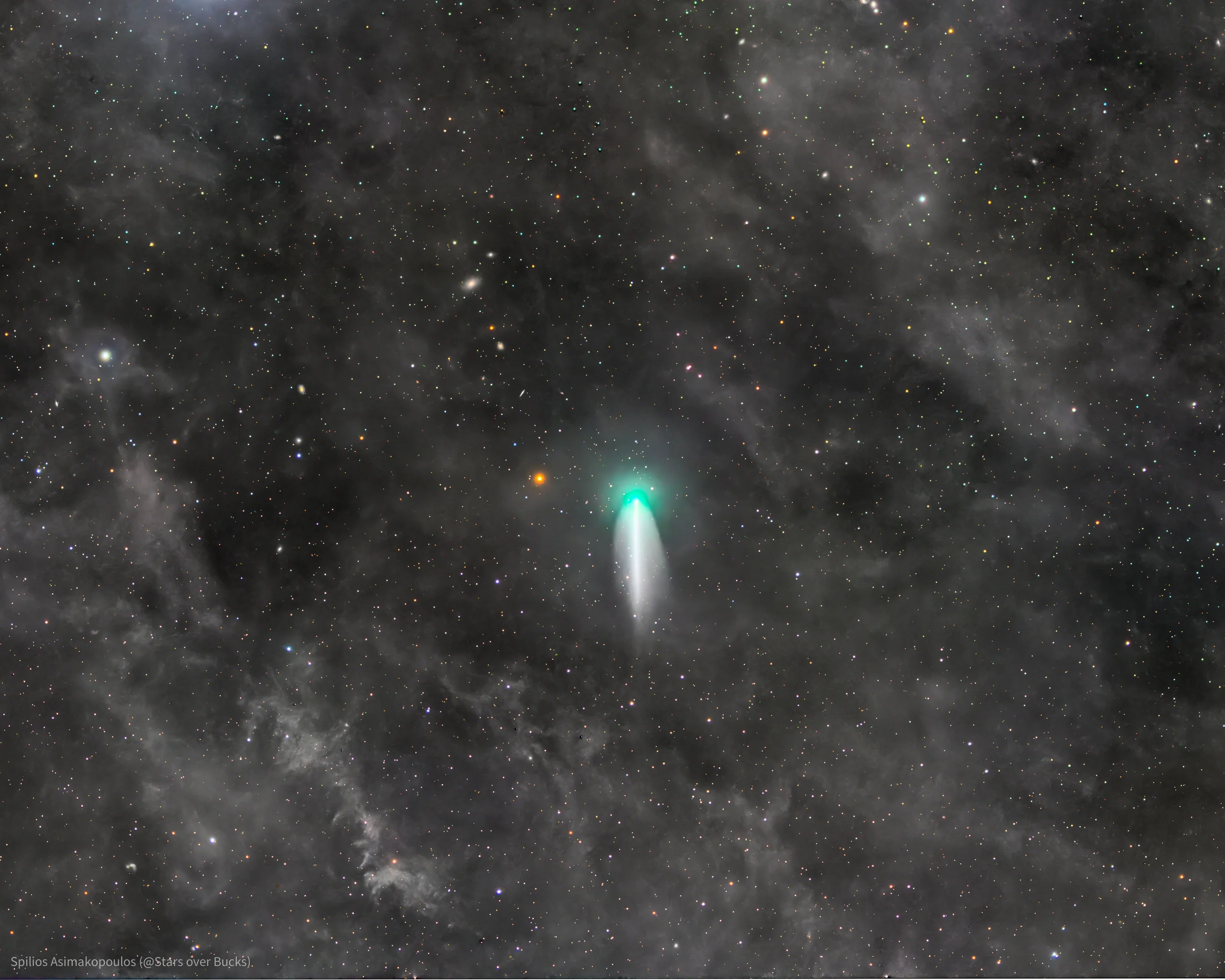
Image: NASA Astronomy Picture of the Day (APOD) | Image Credit & Copyright: Spilios Asimakopoulos | Today's page
Today's NASA Astronomy Picture of the Day, dated August 24 in the United States, is a long-exposure photograph of Comet 220P/McNaught. APOD offers only two lines about what it shows: a bright green coma and a short dust tail. The photograph was taken in South Africa about ten days ago, around August 14.
This comet is normally so faint that it takes a telescope to see.
This year, on two separate occasions, it suddenly became about 20,000 times brighter.
Now an ordinary pair of binoculars can find it.
There are two questions to answer. First, why did it brighten? We do not really know. Second, why is it green? That we understand remarkably well, down to the lifetime of a single molecule.
First, Meet the Comet
On May 20, 2004, R. H. McNaught found a faint point of magnitude 17.7 on a photographic plate made with the 0.5-meter Uppsala Southern Schmidt Telescope at Siding Spring Observatory in Australia.
How faint is magnitude 17.7? The limit of human vision under a perfectly dark sky is about magnitude 6. A difference of five magnitudes is a factor of 100 in brightness. Magnitude 17.7 is roughly 15,000 times fainter than the naked-eye limit.
The comet later received the permanent designation 220P. I transcribed its orbital elements from JPL's Small-Body Database on August 24, 2026: solution 69, based on 1,528 observations spanning 8,128 days.
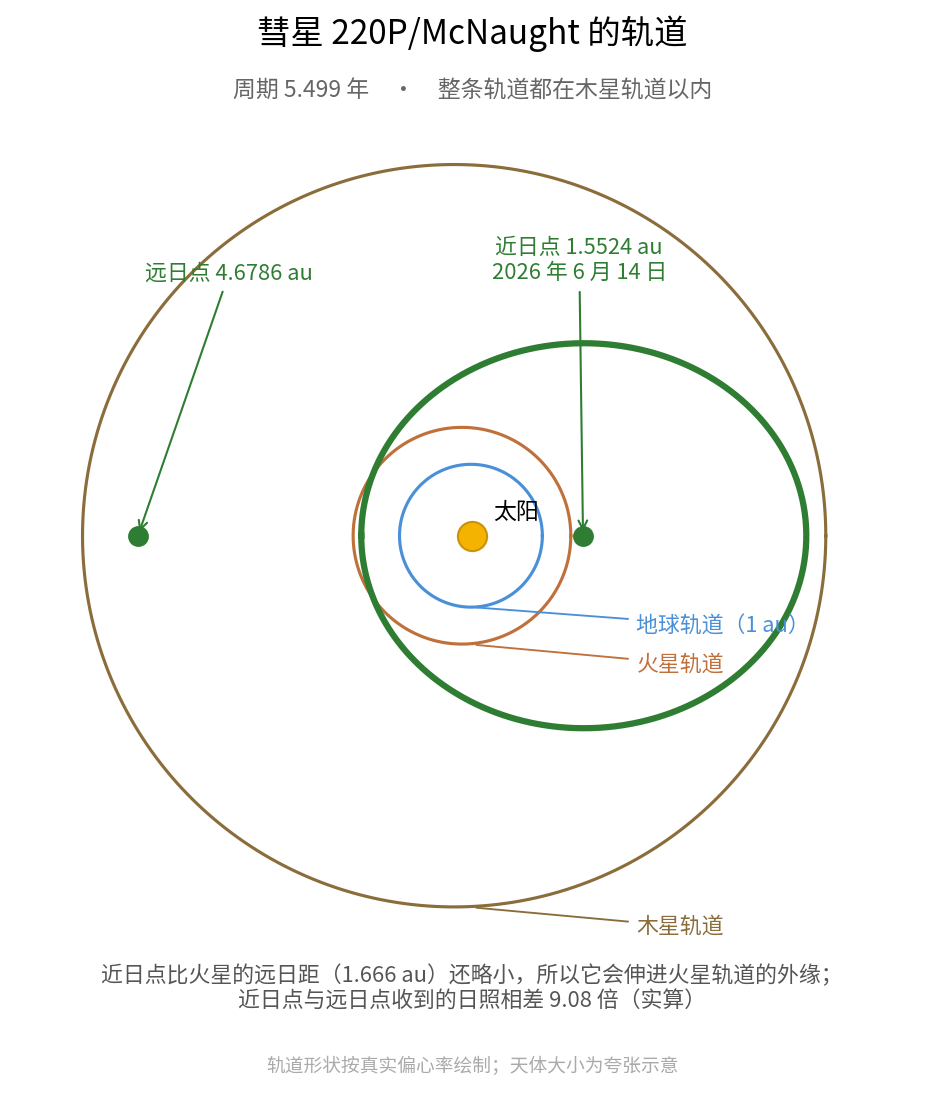
Its perihelion distance is 1.5524 astronomical units, its aphelion distance 4.6786 AU, its eccentricity 0.5017, its orbital inclination 8.13 degrees, and its period 2,008.59 days, or 5.499 years.
APOD says it orbits "between Mars and Jupiter." More precisely, its aphelion is indeed inside Jupiter's orbit, but its perihelion of 1.5524 AU is slightly smaller than Mars's aphelion distance of 1.666 AU. In other words, its orbit reaches just inside the outer edge of Mars's. Its Tisserand parameter is 2.995, between 2 and 3, making it a standard Jupiter-family comet.
One number conveys the force of its seasons: it receives 9.08 times as much sunlight at perihelion as at aphelion, from (4.6786/1.5524)^2. Its "summer" is nine times more intense than its "winter."
As for the size of its nucleus, no one has measured it directly. It can only be inferred from the database's nuclear absolute magnitude, M2 = 17.9. With a typical comet-nucleus albedo of 0.04, the diameter works out to roughly 1.4 to 2.5 kilometers. Even that is more like an upper limit, because photometry can hardly exclude all contamination from the coma. Calling it "on the order of one or two kilometers" is honest. Calling it "1.75 kilometers" is not.
Two Outbursts and Three Correct Numbers
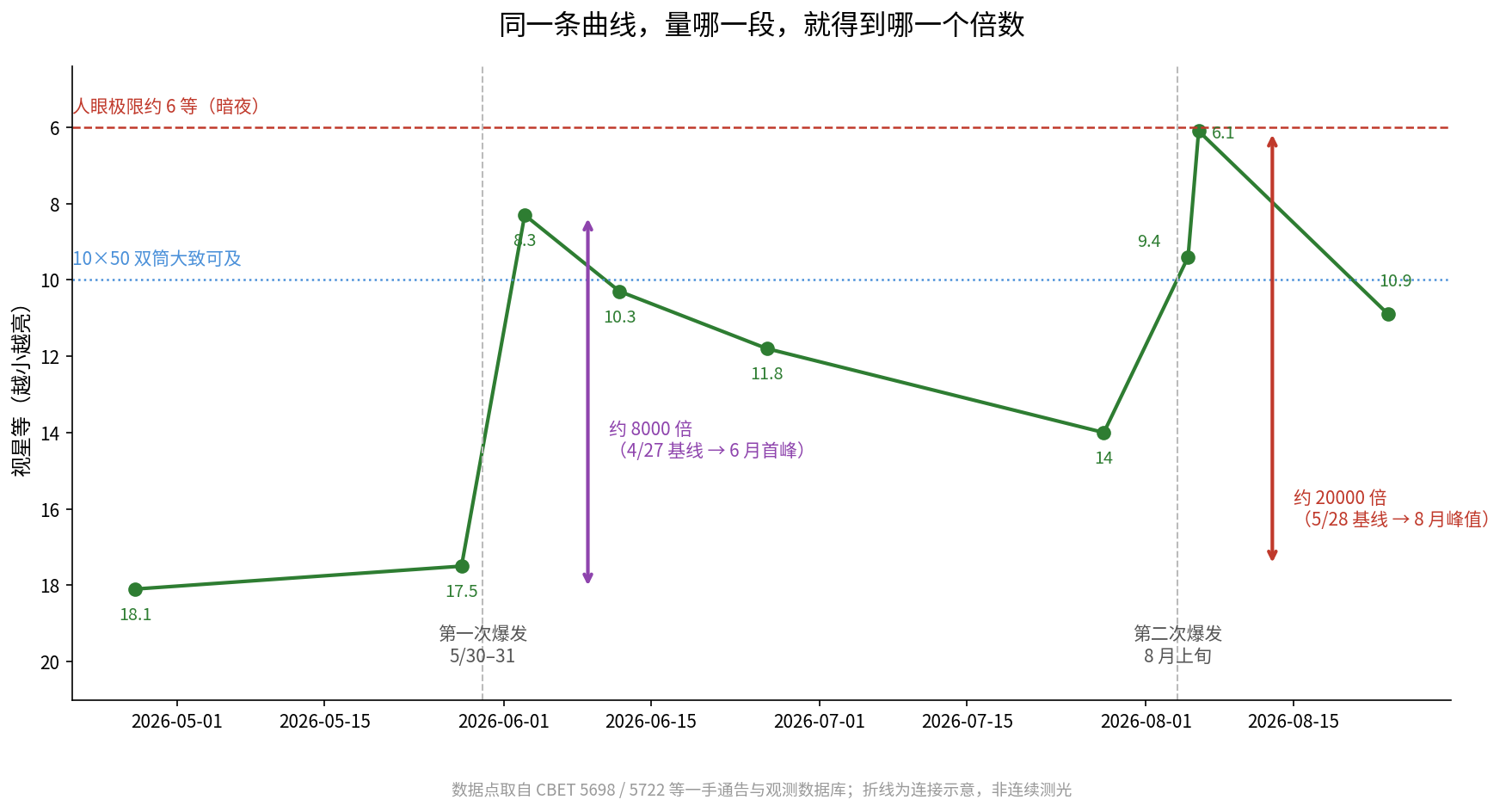
The first outburst occurred between May 30 and 31, 2026.
The ATLAS survey brackets it between May 30.59 and 31.15 UT, a window of about 13.4 hours. Before the outburst, ZTF measured r = 17.39 on May 26; the total magnitude was about 18.1 on April 27 and still about 17.5 through May 28.
Then, on June 3, K. Yoshimoto in Japan reported a total magnitude of 8.3 and a coma 6.5 arcminutes wide using a 0.11-meter remote astrograph. That same day, two observers in Brazil measured magnitudes 8.5 and 8.3 with a 0.27-meter telescope and 20x100 binoculars, respectively.
The second came in early August.
Primary notices can bracket it only between July 28.74 and August 5.12 UT, using magnitude 14.0 on July 28 as the baseline. Observer reports point to August 4 or 5.
On August 5.78, Yoshimoto visually estimated magnitude 6.8 with 8x42 binoculars, with a 7-arcminute coma. On August 6.04, J. J. Gonzalez in Spain estimated magnitude 6.1 with 10x50 binoculars, with a 9-arcminute coma.
An ordinary pair of binoculars had picked up a sixth-magnitude comet.
So where does APOD's figure of "20,000 times" come from?
The conversion from a brightness ratio to magnitudes is Δm = 2.5 x log10(ratio):
Δm = 2.5 x log10(20000) = 10.75 magnitudes
Check it in reverse: magnitude 17.5 in quiescence to the August peak of 6.8 gives Δm = 10.70, or 19,055 times brighter. That is almost exactly 20,000.
Another figure widely repeated in the media is 8,000 times. It is correct too. That compares the April 27 baseline of magnitude 18.1 with the June peak of 8.3: Δm = 9.80, or 8,318 times.
There is a third number in the ZTF telegram: a change of -6.3 magnitudes, or 344 times. That is also correct. It describes the immediate jump in a single band over five days; the ejected dust continued expanding for several more days before reaching its visual peak.
All three numbers are right. They simply use different baselines and peaks. Whenever something is said to have brightened by a factor of N, the first question should be: from what to what?
For a larger comparison, 17P/Holmes in 2007 remains the ceiling for this kind of event. Around October 23, 2007, it surged from magnitude 16.5 to 2.5, a rise of 14 magnitudes, or roughly 400,000 times. It gained those 14 magnitudes within the first 42 hours. Its tenuous dust coma eventually expanded beyond 1.4 million kilometers, larger than the Sun's diameter of about 1.392 million kilometers.
The latest 220P event spanned 10.75 magnitudes. The Holmes outburst produced about 20 times as much flux.
The precise claim, then, is this: 220P is the closest thing to Holmes in nearly two decades, but it remains more than an order of magnitude smaller.
Why Did It Brighten? No One Knows, and That Is Not Rhetoric
APOD offers two possibilities: a release of accumulated subsurface gas, or "comet quakes."
The latter needs qualification. "Comet quake" is APOD's popular term, not an academic one. Searches of peer-reviewed literature for cometquake, comet quakes, and cometary seismicity return no results.
Yet there is a genuine scientific counterpart to the idea, backed by unusually direct evidence because a spacecraft was there to watch it.
A 2016 paper in MNRAS cataloged 34 high-energy transient events photographed by Rosetta during roughly three months around Comet 67P's August 2015 perihelion. They occurred on average once every 2.4 rotations, or about every 1.27 days, and each lasted less than five minutes. Nearly all the source regions were on steep slopes and cliffs in the southern hemisphere. The authors proposed several triggers: rapid morning temperature changes causing thermal-stress fractures, afternoon heat waves reaching shallow buried volatiles, and, in some cases, the outright collapse of a cliff.
One collapse was documented from beginning to end. In September 2014, Rosetta found a crack 70 meters long and one meter wide along the edge of the Aswan cliff on 67P. On July 10, 2015, its navigation camera recorded a large dust plume traced back to that region. By July 15, the cliff had collapsed, exposing fresh ice with an albedo greater than 0.4: pristine interior material that had never seen sunlight.
The resulting Nature Astronomy paper explicitly presented this as a new way to create a dust plume, without necessarily requiring a pressurized crustal rupture or supervolatiles.
In other words, a landslide alone can create an outburst visible from Earth.
Several other explanations remain on the table, and they do not agree with one another.
Subsurface gas release. A 2016 Icarus paper proposed a mechanism called exsolution, in which gas dissolved in a quasi-liquid phase at low temperature suddenly escapes. The physics is much like opening a bottle of soda.
Amorphous water ice becoming crystalline. This is the best-known explanation. Crystallization occurs within a narrow temperature range around 140 K and releases roughly 90 to 118 kJ/kg of latent heat. But an authoritative 2022 review noted a counterintuitive fact: that heat is only about one twenty-fifth of the latent heat of sublimation. Crystallization alone is therefore not enough to drive extensive sublimation. Its effect is indirect, heating nearby material and releasing volatile gases trapped in water ice.
Even for 17P/Holmes, this explanation is disputed. The title of a 2010 Icarus paper states its conclusion: crystallization was "probably not" the cause of the 2007 outburst. Another 2010 paper in MNRAS compared four mechanisms and favored stress from carbon-monoxide inclusions. Yet the 2022 review cited above says that the 17P outburst has been successfully modeled through crystallization.
This is a real and unresolved disagreement in the literature. There is no basis for settling it here.
That makes the most honest sentence in this APOD story something like this:
We can calculate the hour and minute of its closest approach to Earth on October 12 to eight significant figures, yet cannot say why it brightened.
Geometry is what humanity does best. Physics is what humanity does least well.
One more point needs to be explicit. Some have asked whether the comet broke apart. One telegram says only that the tail morphology may indicate fragmentation; another measured only the size of dust grains. No primary source has reported fragments separating from 220P. It should not be described as having split.
The Head Is Green. The Tail Never Is
This is the line worth keeping.
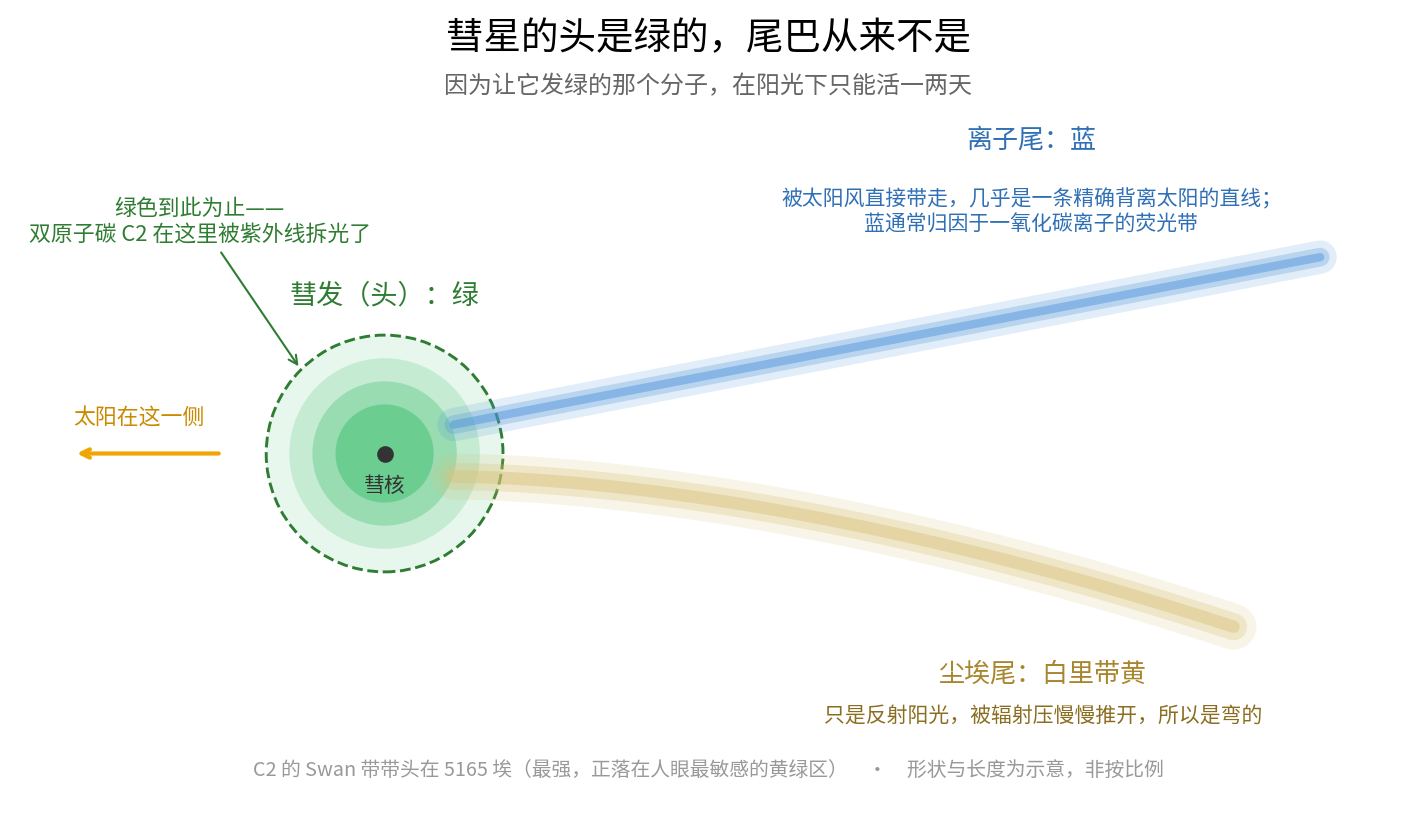
The green glow of the coma comes mainly from diatomic carbon, C₂, two carbon atoms joined in a molecule that can scarcely remain stable on Earth. It emits three principal bands. An official European Southern Observatory caption gives their band-head wavelengths as 5,165, 5,635, and 6,192 angstroms. The strongest, at 5,165 angstroms or 516.5 nanometers, falls right in the yellow-green region where human vision is most sensitive. The bands are named for the 19th-century spectroscopist William Swan.
Now comes the crucial step.
Sunlight breaks organic material from the comet nucleus into C₂. Then the same solar ultraviolet light breaks the C₂ apart. The process is called photodissociation.
How long does C₂ survive at Earth's distance from the Sun?
About one to two days.
A comet's tail forms only after radiation pressure and the solar wind have carried material hundreds of thousands or even millions of kilometers outward. At a typical outflow velocity, that takes several days.
Before C₂ can be swept into the tail, ultraviolet light has already destroyed it.
Therefore:
A comet's head is green, but its tail never is. The edge of that green glow is drawn by the lifetime of a molecule.
The hypothesis was proposed in the 1930s by Gerhard Herzberg, who later won the 1971 Nobel Prize in Chemistry. It was experimentally confirmed only 90 years later. The 2021 study in PNAS used a vacuum chamber about two meters long and three ultraviolet lasers. Researchers first stripped chlorine atoms from perchloroethylene to create C₂, then measured how fast the carbon atoms flew apart after the molecule broke. They determined the bond strength to a precision of about one part in 20,000.
The specific figure of "about two days" appears only in popular coverage of that paper, not in the paper itself, which was unavailable for this article. Independent estimates from the photodissociation rate at 1 AU and the scale lengths in standard coma models nevertheless both land a little above one day. One to two days is therefore the defensible range.
The three colors of a comet divide their work cleanly:
The coma, or head, is green. C₂ fluoresces in the Swan bands, survives no more than a day or two, and cannot travel far.
The dust tail is white with a yellow tint. It simply reflects sunlight. Radiation pressure pushes it outward gradually, so it curves and trails the comet's path.
The ion tail is blue. Ultraviolet light ionizes the gas, and the solar wind, moving at more than 400 kilometers per second, carries it directly away. The result is an almost perfectly straight line pointing away from the Sun. Its blue color is usually attributed to fluorescence bands from carbon monoxide ions, CO⁺.
Two mistakes are easy to make here. The blue of the ion tail is fluorescent emission, not scattering. And the most abundant ion is actually H₂O⁺, but it emits toward the red end of the spectrum. The most abundant ion is not necessarily the ion that determines the color.
For 220P, the green is measured, not inferred. Three independent astronomical telegrams detected it. A Palomar Observatory spectrograph recorded prominent visible C₂ emission. Narrowband measurements from TRAPPIST-North in Morocco found a C₂ production rate of 5.50x10²⁵ molecules per second on June 5 and showed that the comet was C₂-rich relative to CN. From August 12 to 15, covering the date of APOD's August 14 image, a German researcher used a polarimetric camera to see a "greenish-blue outer coma" and attributed it to C₂ emission.
October: The Geometry Is Certain, the Brightness Is Not
The comet will make its closest approach to Earth around October 12, 2026.
I searched the JPL ephemeris in six-hour steps from October 10 through 16. The geocentric distance reaches its minimum at about 18:00 UT on October 12, or about 02:00 Beijing time on October 13, at 1.01698 AU, or 152.14 million kilometers. One-way light time is 8.46 minutes. The distance rate changes sign between 12:00 and 18:00 UT on October 12, independently confirming the minimum. A separate Central Bureau ephemeris gives 1.019 AU on October 17, in full agreement.
APOD's "about one Earth-Sun distance" is literally correct.
One trap should be avoided: the minimum possible distance between this comet's orbit and Earth's orbit is 0.54 AU, but that is not its distance on this pass. The actual figure is 1.017 AU.
Where will it be? I retrieved the right ascension and declination from the ephemeris line by line and compared them with constellation boundaries.
In September it lies near the boundary between Cetus and Taurus. Throughout October it remains in a low-declination, sparsely starred region in southwestern Taurus, at roughly 3h22m to 3h33m right ascension and +3 to +6 degrees declination. Around October 21, it crosses into Cetus.
The easiest landmarks are the Pleiades and the V-shaped Hyades with Aldebaran. The comet lies roughly 12 to 15 degrees down and southwest from Aldebaran, in a dark area without bright stars.
Its solar elongation rises from 134 to 154 degrees during October and reaches a maximum of about 165 degrees on November 10, close to opposition. In practical terms, the second half of the night is best in October, while by early November it is visible for nearly the entire night.
I calculated conditions for three Chinese cities by converting the ephemeris right ascension and declination to horizontal coordinates and defining astronomical darkness as a solar altitude below -18 degrees. The culmination-altitude identity provided an independent check, agreeing to within 0.1 degree for all five dates and all three cities. Atmospheric refraction was not included and can change positions near the horizon by 0.5 degree.
On October 11, the comet is above the horizon during astronomical darkness at these Beijing times:
- Beijing: 20:10 to 04:51 the next day; culmination at 02:24, altitude 54.8 degrees
- Shanghai: 19:54 to 04:34 the next day; culmination at 02:04, altitude 63.5 degrees
- Guangzhou: 20:30 to 05:07 the next day; culmination at 02:36, altitude 71.6 degrees
On November 10, close to opposition, it remains above the horizon for the entire astronomical night in all three cities. It culminates at 00:01 and an altitude of 52.0 degrees in Beijing, and at 00:13 and 68.8 degrees in Guangzhou.
Lower latitudes have the advantage: the comet climbs 17 degrees higher in Guangzhou than in Beijing.
Then comes a striking coincidence.
New moon falls on October 10. Closest approach comes on October 12 to 13. At midnight on October 12, the Moon is only about 4.4% illuminated.
Closest approach almost exactly coincides with a moonless night.
The second window is just as favorable: new moon comes on November 9, and the comet nears opposition on November 10, when the Moon is about 2.0% illuminated at midnight.
The best windows are therefore October 8 to 16 and November 6 to 14, 2026. For comparison, the Moon is already about 71% illuminated on October 1.
How bright will the comet be? No one knows, and that is not modesty.
I ran three public brightness models. First, I reproduced the Central Bureau's own printed ephemeris from its stated parameters, matching every row to within +/-0.03 magnitude and confirming the implementation. For mid-October, the Central Bureau parameters give magnitude 8.4, JPL's long-term fit gives 16.7, and another fit to the previous 30 days gives 3.3.
The brightest and faintest estimates differ by a factor of 13,000.
The reason is straightforward: every model is forcing a power law onto the decay curve of an active outburst. When the Central Bureau announced the June outburst, it explicitly warned that an event near perihelion should be expected to fade rapidly over weeks or months. Then the comet erupted again in August.
Only measurements are reliable. The visual peak on August 5 and 6 was magnitude 6.1 to 7.0. On August 7, an observer using an entry-level smart telescope measured 7.2. By around August 24, an observation database put it near magnitude 10.9. It faded by about four magnitudes in two and a half weeks.
This article therefore offers no brightness forecast. The geometry is certain; the brightness is not.
What the Observations Say About Equipment
The first-hand observations from August provide a more useful guide than advertising. 8x42 binoculars detected it at magnitude 6.8. 10x50 binoculars found it at magnitude 6.1 with a 9-arcminute coma. A 7.6-centimeter refractor measured magnitude 9.1. A roughly 50-millimeter smart telescope not only measured 7.2 but photographed a tail 21 arcminutes long.
Could it be seen with the naked eye? The physics says that would be difficult. Spread magnitude 6.1 over a circular coma 9 arcminutes wide and the mean surface brightness is about 19.5 magnitudes per square arcsecond, against a natural dark-sky background of roughly 21.6 to 22.0. Even at its peak, then, it was only about two magnitudes brighter than the pristine night-sky background, and it was a diffuse patch nine arcminutes wide. An experienced observer under exceptionally dark skies might just detect it, but every visual estimate in the magnitude 6 to 7 range that August was made through binoculars. There was no naked-eye record.
The evidence supports binoculars rather than unaided vision. Three techniques matter more than a larger aperture: at least 20 minutes of dark adaptation without looking at a phone screen; slowly sweeping the field indicated by a star chart, because a diffuse patch is easier to notice in motion than under a fixed stare; and steady support, such as a vehicle roof or door frame, because hand shake in 10x50 binoculars can erase a faint blur.
The identification cue is simple: the comet is not a point but a small patch of haze without a sharp edge. A crisp point is a star.
From 613 BCE to 2016 HO3
China has the longest-running record of comet observations on Earth.
For the 14th year of Duke Wen of Lu, 613 BCE, the Spring and Autumn Annals records: "In the seventh month of autumn, a broom star entered the Big Dipper." These nine Chinese characters are often called the world's earliest record of Halley's Comet.
A 1986 paper in Earth, Moon, and Planets was more cautious. The account lacks specific information about position, brightness, and motion. The accurate claim is therefore that it is a comet record whose date is consistent with a return of Halley, not a record whose text alone proves that identification.
The same paper says that the first Chinese record securely identifiable as Halley is the return of 240 BCE recorded in the Records of the Grand Historian. From then through 1910, Chinese sources recorded 29 consecutive returns, a continuity found in no other civilization.
There is an even more vivid survival. The silk manuscript known as the Divination by Astrological and Meteorological Phenomena, excavated from Mawangdui Tomb 3 in Changsha and buried before 168 BCE, contains nearly 30 drawings of comets. The usual count is 29, though some sources say 31, and the primary literature needed to settle the difference was unavailable. The complete silk sheet contains about 250 drawings, each with a name and divinatory text.
Every source agrees on one detail: most of those drawings correctly show comet tails pointing away from the Sun.
More than 2,100 years ago, someone was watching, and watching accurately.
In the present day, the Near-Earth Object Telescope at the Xuyi station of the Chinese Academy of Sciences' Purple Mountain Observatory, a 105/120-centimeter Schmidt telescope, first detected Comet C/2023 A3 on January 9, 2023. The Minor Planet Center confirmed it in a circular on March 1, 2023. It later acquired a name familiar across China: Comet Tsuchinshan-ATLAS. This was the comet that led many people to search the sky for the first time in autumn 2024.
The August polarimetry telegram cited earlier happens to compare the dust grains in 220P directly with those in C/2023 A3, finding larger grains in 220P's tail. Two comets were measured side by side in a single professional notice.
Another strand of this story is unfolding now. This article began with our uncertainty about why comets suddenly erupt. The most direct way to answer that question is to station a spacecraft beside a small body and watch it for an extended period. That is how Rosetta caught a cliff collapse.
At this moment, China's Tianwen-2 is stationed beside asteroid 2016 HO3. According to information released by the China National Space Administration on July 6, 2026, the spacecraft launched from Xichang on May 29, 2025, first acquired the target in an image on June 6, 2026, and reached a point 20 kilometers from the asteroid on July 2. It has entered the scientific-observation phase and will gradually conduct more detailed studies in preparation for later sampling operations.
To be clear, neither sampling nor return has yet occurred. The official July statement said only that the spacecraft had just begun close-range scientific exploration.
Measuring magnitudes from afar and inspecting a cliff face at close range are two different kinds of knowledge.
Sources: NASA Astronomy Picture of the Day for August 24, 2026; JPL Small-Body Database and Horizons ephemeris system; IAU Circular 8348; MPEC 2004-M19; CBET 5698 and 5722; The Astronomer's Telegram #17829, #17838, #17956, and #17984; Vincent et al., "Summer fireworks on comet 67P" (MNRAS, 2016); Pajola et al., "The pristine interior of comet 67P revealed by the combined Aswan outburst and cliff collapse" (Nature Astronomy, 2017); Miles, "Heat of solution..." (Icarus, 2016); Gronkowski and Sacharczuk (MNRAS, 2010); Kossacki and Szutowicz (Icarus, 2010); Prialnik and Jewitt, "Amorphous ice in comets" (Comets III, 2024); Gritsevich et al., "Long-term outburst activity of comet 17P/Holmes" (MNRAS, 2026); Borsovszky et al. (PNAS, 2021) and the University of New South Wales press release; European Southern Observatory caption eso9515a; Wang and Gong, "The Historical Records of Halley's Comet in China" (Earth, Moon, and Planets, 1986); Purple Mountain Observatory, Chinese Academy of Sciences; China National Space Administration; COBS Comet Observation Database; British Astronomical Association Comet Section; and Zooniverse.