
A 143-year-old bridge, a lie still buried inside it, and a principle you can test with one drinking glass.
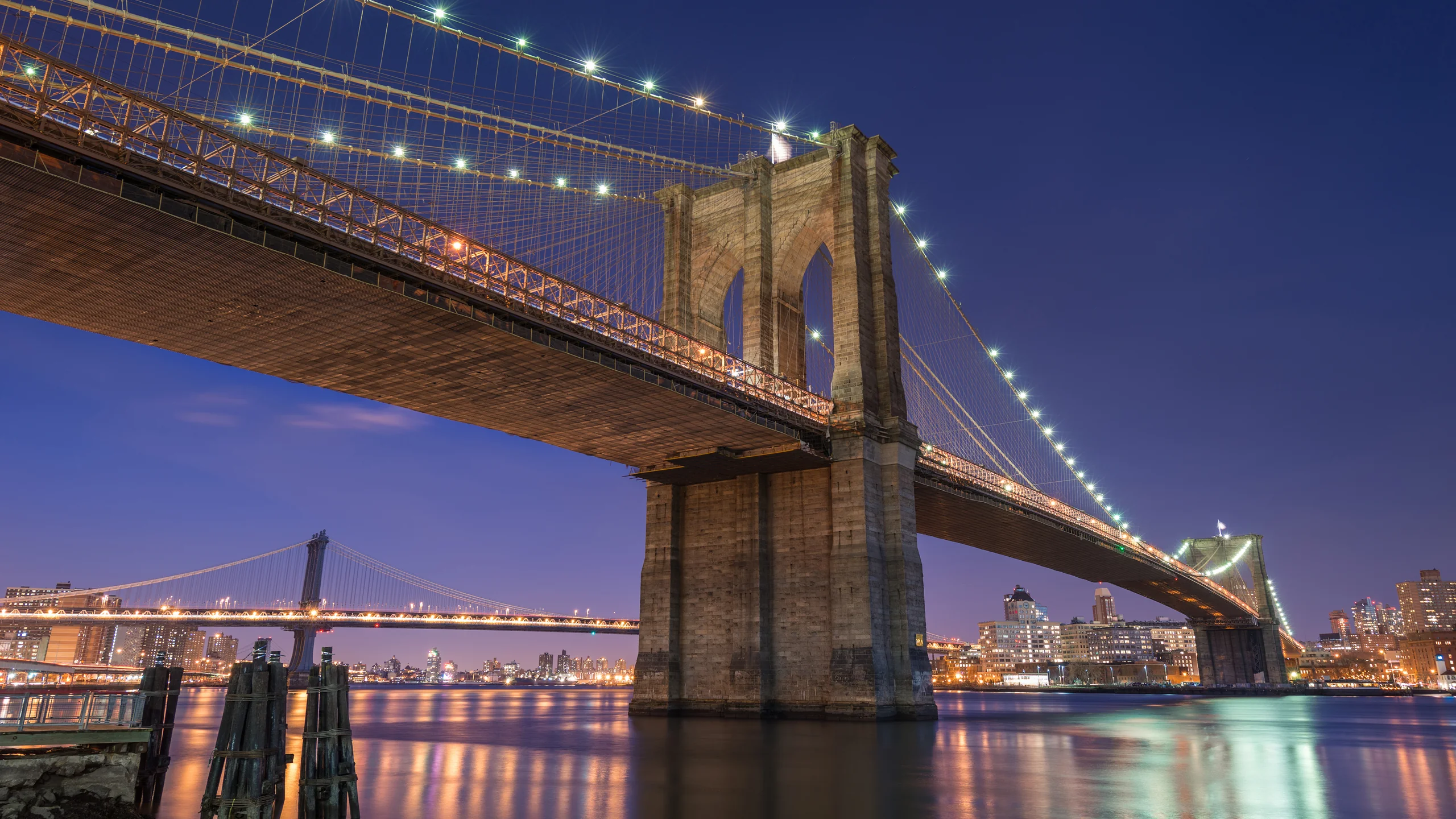
Image: Bing Daily Wallpaper · Brooklyn Bridge, New York City, United States (© shayes17/Getty Images) · View on the Bing homepage
Open Bing today and the homepage shows a bridge. Two granite towers rise from the water, each pierced by a pair of pointed arches. Thousands of steel wires fall vertically and sweep diagonally from their summits, weaving a net in the air. Bing titled the photograph Spanning History.
This is the Brooklyn Bridge. It opened on Thursday, May 24, 1883, and remained the longest-span suspension bridge on the planet for exactly twenty years.
But this story is not about its length. It is about a simpler problem: to stand those two towers on the bottom of a river, people first had to descend to the riverbed. And the riverbed was underwater.
An Upside-Down Cup
Begin with something you can do now.
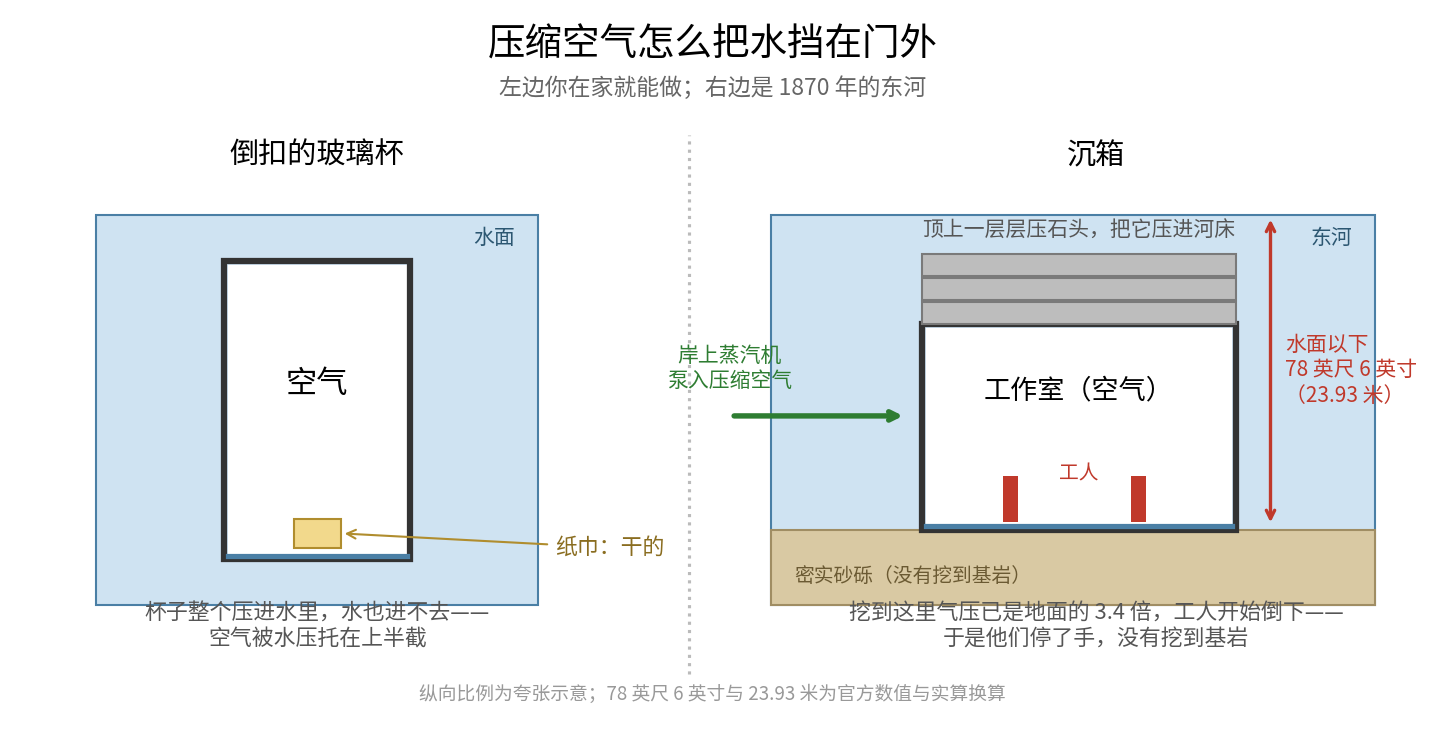
Find a clear drinking glass and a basin of water. Crumple a small piece of tissue, wedge it into the bottom of the glass, and make sure it is dry. Turn the glass mouth down and slowly press it straight into the water until the whole glass is submerged.
Look from the side. Water does not fill the glass. A clearly visible pocket of air remains in its upper half, held in place against the water. Lift out the glass and touch the tissue. It is dry.
In 1870, they enlarged that glass twenty thousand times.
The box on the Brooklyn side measured 168 by 102 feet, about 51 by 31 meters; the one on the Manhattan side was larger still. Built of timber sheathed in iron, it had a sealed roof and a completely open bottom, like an enormous tray turned upside down. Workers sank it into the East River, then laid masonry course by course on top, using the weight to drive it into the riverbed.
This structure was a caisson. Steam engines on shore continually pumped compressed air inside. The air forced water out through the open bottom, creating a dry room the workers called the "working chamber." They entered through an airlock in the roof: a small room with two doors. The outer door closed, the chamber was pressurized to match the caisson, and only then did the inner door open. Excavated mud and gravel rose through a vertical shaft filled with water; the water column's own weight sealed in the air.
For every foot excavated below, another course of stone above pushed the caisson down one foot.
Return to the glass and try a second step: push it deeper.
You will see the water rise inside. Greater water pressure outside compresses the trapped air into a smaller volume.
That is the origin of the Brooklyn Bridge's critical figure. On the Brooklyn side, workers found a sufficiently solid bearing layer 44 feet 6 inches below high water, or 13.56 meters. Air pressure in the caisson was about 21 psi gauge. The riverbed on the Manhattan side was softer. Even at 78 feet 6 inches, or 23.93 meters, they had not reached bedrock, and pressure inside had climbed to 35 psi gauge, equivalent to 3.4 atmospheres at the surface.
Then they stopped.
They stopped on dense sand and gravel without reaching bedrock and sealed the bottom with concrete on July 12, 1872. Washington Roebling, the engineer directing construction, judged that the layer could carry the load without further settlement.
With one engineering judgment, he discarded the doctrine that every foundation had to rest on rock.
The tower has stood on that gravel for 143 years.
Why They Had to Stop
Because workers were collapsing.
Compressed air kept out the water, but not the pressure. The explanation begins with a law learned in secondary school but rarely used to explain anything tangible: Henry's law. The amount of a gas dissolved in a liquid is proportional to its partial pressure above that liquid.
The consequences unfold in three steps.
First, a person descends into a caisson at 3.4 atmospheres. The partial pressure of nitrogen in the air is 3.4 times its value at the surface, so roughly 3.4 times as much nitrogen dissolves in the person's blood and tissues. While the person remains in the caisson, nothing is wrong. The nitrogen stays dissolved.
Second, the person ascends. As the pressure falls, the excess nitrogen must come out.
Third, if the ascent is too fast, the nitrogen has no time to leave gradually through the lungs. It forms bubbles directly in blood and tissue.
You have watched the same process. Twist open a bottle of soda, hear the hiss, and bubbles emerge from the liquid. That is not an analogy. It is the same process, except it happens in joints, muscles and the spinal cord.
The pain bends a person's body, which is why decompression sickness became known as the bends. The site's decompression rate was 5 to 6 psi per minute, astonishingly fast by modern standards.
A review published in Undersea and Hyperbaric Medicine counted the bridge's cases: 110 cases of caisson disease and 3 deaths, concentrated between January 25 and May 31, 1872, the months when excavation on the Manhattan side reached its greatest depth and pressure. About 2,500 people worked on the project in all. Other sources report 5 deaths; this article uses the peer-reviewed figure.
The contemporary comparison was worse. Caissons for Eads Bridge in St. Louis went down 127 feet at about 55 psi, producing 119 severe cases and 14 deaths.
One reason the toll at the Brooklyn Bridge was "only" this high is that Roebling stopped at 78 feet.
The physician who recorded those 110 cases was Andrew Smith, and he coined the name "caisson disease." This was a small but firm starting point in the history of occupational medicine: the first engineering project to employ a dedicated physician, to keep systematic records, and to name an entirely new industrial disease.
As for Roebling himself, the official biography from the American Society of Civil Engineers is restrained. In 1872, he was carried unconscious from the caisson, and "it took great effort to save his life." He became too weak for long conversations with his assistants, suffered damaged vision and lived with chronic pain for the rest of his life, directing work from the window of his sickroom. His instructions reached the workers through his wife, Emily Warren Roebling, who consequently became the project's practical technical center for roughly a decade.
A widely repeated detail says that he supervised the work through a telescope from his bedroom. The ASCE biography says only that he watched from his sickroom window; it does not mention a telescope. We will follow the official account.
Why the Cable Is Not Shaped Like a Chain
The second experiment you can perform at home is simpler still.
Fasten the ends of a fine necklace or bicycle chain to a wall about 40 centimeters apart and let it hang freely. Take a photograph.
That curve is a catenary.
Now draw vertical lines on a sheet of paper at equal horizontal intervals, one every 5 centimeters. At every point where the chain crosses a line, hang an identical small weight: a string of paper clips or a nut will do. Each must weigh the same, and their combined weight must be much greater than the chain's own.
Take another photograph and overlay the two.
The middle has flattened a little and the ends have grown steeper. The curve has changed from a catenary into a parabola.
The distinction takes one sentence:
When weight is distributed evenly along the chain's own length, the curve is a catenary. When weight is distributed evenly in the horizontal direction, it is a parabola.
A chain hanging alone carries its own weight, distributed evenly along its length, so it forms a catenary. A suspension bridge's main cable carries a horizontal road. Closely spaced suspenders attach the deck's weight at equal horizontal intervals. That makes a parabola.
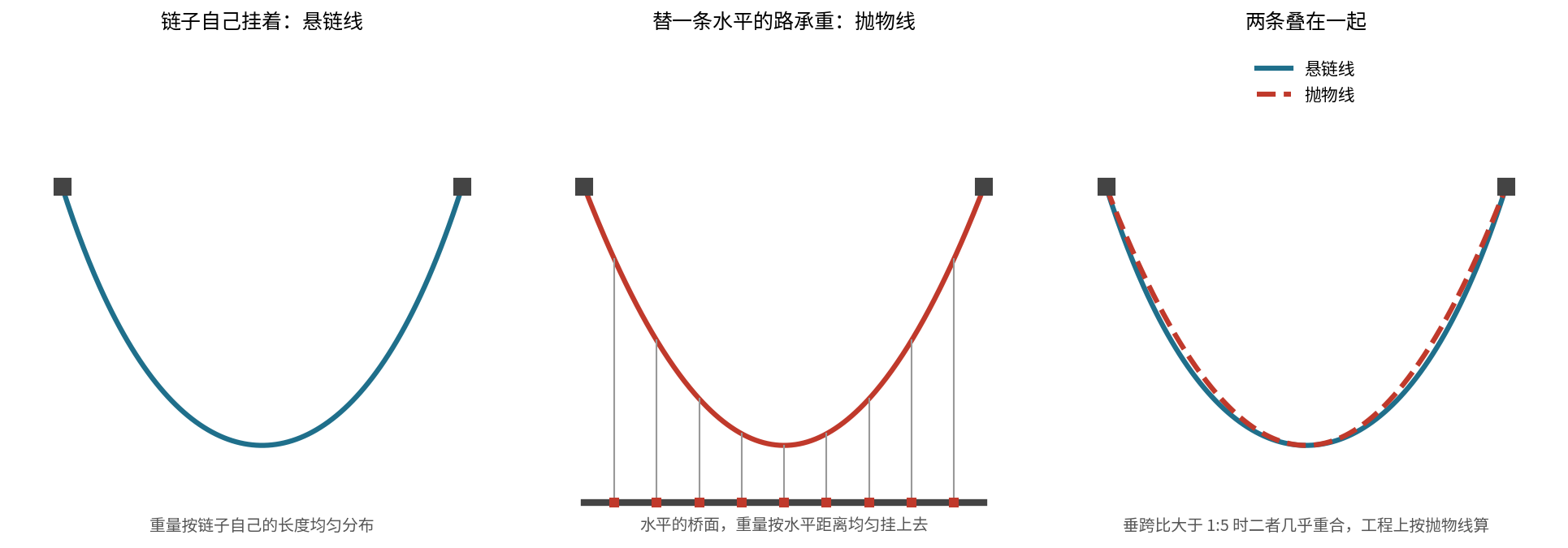
The interesting part comes next. The two curves look almost identical. Engineering textbooks state that when the sag-to-span ratio exceeds 1:5, the curves are "almost exactly the same" and can be treated as parabolas in practice.
If you overlay the photographs and think, "I cannot see a difference," that is the correct result. Engineers cannot see it either.
What matters is the information contained in the shape: the load distribution determines the curve completely. Hang all the weights in the middle and the chain becomes a V; place them only near the ends and the center flattens. That is the intuition worth remembering: you do not choose the curve first. You choose where to put the weight, and the curve appears by itself.
The bridge's flow of force can be summed up in one sentence:
The main cables are in tension, the towers are in compression, and the road you walk on carries almost nothing by itself. It simply hangs, strand by strand, from more than twenty thousand fine steel wires.
The deck is not supported from below; it is suspended from above. Its weight first travels upward into the main cables, then along them to the tower tops and vertically down into the ground. The rest continues through the cables to anchorages weighing 60,000 tons on each bank, which hold them fast.
The 400 Diagonal Cables
Besides the vertical suspenders, the photograph shows cables fanning diagonally from the tower tops to the deck. Many people assume they are decorative.
They are diagonal stays, 400 across the bridge: 25 on each side of each main cable at each tower.
John A. Roebling, Washington's father, designed the bridge before dying in a construction accident in 1869. The stays were the feature he insisted on throughout his career. In an 1849 report on his Niagara bridge, he listed four elements: weight, longitudinal beams, trusses and diagonal stays. Together, he wrote, they could make a bridge as stiff as necessary against trains and storms.
Why was he so concerned about wind?
Because on Wednesday, May 17, 1854, the Wheeling Suspension Bridge, with a main span of 1,010 feet, collapsed in high winds. The next day's Wheeling Intelligencer described it as swaying "like a ship in a storm," twisting and rolling until it lay "like a giant prostrate across the Ohio River." One crucial observation records a torsional wave running through the entire span, followed by one main cable being thrown from its roller at the tower top.
The bridge lacked an adequate system of diagonal stays and stiffening.
When John Roebling submitted his design for the East River bridge in 1867, the wreck of Wheeling was in his mind. He designed this bridge with an earlier failure in view.
The stays do something simple. The system of main cables and suspenders is flexible vertically. Stays run directly from the tower tops to points along the deck, creating a second path for forces with a completely different geometry and tying vertical and twisting movement back to the towers. Together with the stiffening trusses, they make the Brooklyn Bridge's deck heavy, deep and porous, allowing wind to pass through the truss openings.
Eighty-six years later, at 11:02 a.m. on November 7, 1940, the center span of the Tacoma Narrows Bridge fell into the water. The Washington State Department of Transportation describes "extreme twisting waves" in the deck amplified by the aerodynamic effects of the wind. One very common error deserves correction: this was not resonance. The modern conclusion is torsional flutter, a self-excited oscillation coupling airflow and structural movement. WSDOT's official wording does not use the word "resonance" either.
That bridge used extremely thin, closed solid-web steel girders. Chosen to save money and improve appearance, they had very little torsional stiffness, and wind could only pass around them.
The engineering profession looked back and discovered that Roebling's 1849 list - weight, longitudinal beams, trusses and diagonal stays - was nearly an anti-wind checklist written ninety years early.
Do not overstate it. Roebling understood that wind could lift a flexible deck; he did not understand the aerodynamic theory of flutter. We can say only that each of his four measures happened to increase torsional stiffness or damping.
A Lie Still Inside the Bridge
The steel wire for the main cables was supplied under contract by J. Lloyd Haigh.
He did the following: wire that inspectors had rejected and returned was mixed back into acceptable lots and delivered to the site again. The same material was tested, rejected, then resubmitted.
By the time the fraud was discovered, Roebling estimated that about 221 tons of rejected wire had already been spun into the main cables. It could not be removed.
It remains inside the bridge today.
The remedy was to add 150 extra wires to each main cable, at the contractor's expense.
The numbers make a fine piece of detective work. A professional account gives the original design as 19 strands of 278 wires per main cable. The arithmetic is 19 x 278 = 5,282. Yet the National Park Service's National Historic Landmark nomination and ASCE's magazine both say that each main cable contains 5,434 wires.
5,282 + 150 = 5,432.
The two figures do not contradict each other. They describe the cable before and after the fraud. There are still 2 wires I cannot explain, perhaps because of a counting convention. That uncertainty should be stated.
What happened to the safety factor? John Roebling designed for a strength six times the required load. How much remained afterward? Two primary official documents give different answers. ASCE's landmark page says it became fourfold rather than sixfold; the NPS nomination says the safety margin was five.
That disagreement is itself worth understanding. Even official documents differ because a safety factor of this kind is an estimate, not a mark on a ruler. Whether four or five, it remained far above the necessary strength. The bridge was safe enough that a main cable adulterated by fraud has stood for more than 140 years without failing.
22,000 Kilometers of Steel Wire
The wire in each main cable has a combined length of 3,515 miles. With four main cables:
3,515 x 4 = 14,060 miles = 22,627 kilometers
22,627 / 40,075 (Earth's equatorial circumference) = 0.565
Laid end to end, the wires would circle more than half of Earth's equator. For a more vivid comparison in China, the Beijing-Shanghai high-speed railway is about 1,318 kilometers long. The wire would cover 17 one-way lengths of that route with room to spare.
Each individual wire is only as thick as pencil lead, about 3.2 millimeters in diameter. There are more than twenty-one thousand of them.
One honest note: the widely repeated total of "14,357 miles" has no primary source I could find and cannot be derived from 3,515 miles per cable, so this article uses 3,515 x 4.
Six Days After Opening, 12 People Died on the Stairs
It was Wednesday, May 30, 1883, Memorial Day and the sixth day after the bridge opened.
Holiday crowds jammed a staircase where the walkway narrowed to only 15 feet. Someone fell. Then someone shouted that the bridge was collapsing. The crowd behind pushed forward.
Seven women, four men and one boy died; at least 35 people were injured. The New York Times described the narrow staircase packed with people, one on top of another.
The structure of the bridge had never been in danger.
Those 12 people were killed not by steel wire or a main cable, but by one rumor and a 15-foot staircase. The engineering had a safety margin of four to six. The crowd's safety margin was zero.
On Saturday, May 17, 1884, circus owner P. T. Barnum led 21 elephants and 17 camels across the bridge. The next day's New York Times said it looked as though Noah's Ark were emptying itself onto Long Island.
The episode is often told as though Barnum used elephants to prove the bridge safe. More precisely, he secured brilliant free advertising for his circus, and the public took the opportunity to relax. The combined weight of 21 elephants was negligible beside the bridge's design load. This was not an engineering load test.
There is another coincidence, amusing but not meaningful. The elephants crossed on May 17, 1884, exactly thirty calendar years after the Wheeling Bridge was destroyed by wind on May 17, 1854. It is only a coincidence.
Why August 24?
Bing does not say. The copyrightlink search phrase contains only the words "Brooklyn Bridge," with no suggestion of a holiday or anniversary.
I looked anyway, through the births and deaths of the three Roeblings, the start and completion of construction, legislation, accidents and landmark designations at every level. There is only one real connection between this date and the bridge.
On Thursday, August 24, 1967, the New York City Landmarks Preservation Commission formally designated the Brooklyn Bridge a New York City landmark. The document is LP-0098; public hearings took place on October 19 and November 17, 1965. That five-page typewritten report is still available for download from the New York City government website.
On August 24, 2026, the designation is 59 years old.
It is not a round-number anniversary, and there is no evidence that Bing selected the bridge for this reason. All that can responsibly be said is that August 24 happens to be a real date in the bridge's own record.
The discipline of searching, finding something and refusing to call it a cause is itself worth recording.
The Bridge Today, and Bridges in China
The bridge is still at work. New York City Department of Transportation figures for 2024 give daily averages of 103,051 motor vehicles, 28,845 pedestrians and 5,504 cyclists. It carries five lanes, and trucks are prohibited.
On September 14, 2021, New York converted one traffic lane into a protected two-way bicycle lane, leaving the original promenade for pedestrians only. The effect was immediate: average daily cycling in October 2021 rose 88% from the same month in 2020. By 2025, daily ridership had more than doubled, from 2,652 in 2021 to 5,625.
Between 2019 and 2023, the bridge underwent the most comprehensive rehabilitation in its 151-year history, costing $300 million. Crews strengthened the masonry towers, repaired arch blocks and foundations, replaced brick infill walls with concrete shear walls, and repointed the granite. The promenade remained open throughout construction.
In March 2026, New York added a dedicated bicycle connector on Centre Street on the Manhattan side, fully separating pedestrians and cyclists for the first time in the bridge's history.
What about China?
First, fix the Brooklyn Bridge's main span at 486.31 meters, or 1,595 feet 6 inches, which I converted independently.
The current world record among bridges open to traffic is not in China. Turkey's 1915 Canakkale Bridge has a 2,023-meter main span and opened on March 18, 2022. Guinness World Records recognizes it officially. Its span is 4.16 times that of the Brooklyn Bridge.
China's longest-span suspension bridge open to traffic is Wuhan's Yangsigang Yangtze River Bridge, with a 1,700-meter main span. It opened on October 8, 2019, carries twelve lanes on two levels and is the world's longest-span double-deck suspension bridge. Its span is 3.50 times Brooklyn's. Close behind is the Shenzhong Bridge in the Shenzhen-Zhongshan Link, with a 1,666-meter main span. It opened on June 30, 2024. China's Ministry of Transport calls it "the world's largest-span fully offshore steel-box-girder suspension bridge." Its span is 3.43 times Brooklyn's.
Two still larger bridges remain under construction. The south channel bridge of the Zhangjinggao Yangtze River Bridge has a 2,300-meter main span, 4.73 times Brooklyn's, and towers 350 meters high. Its main saddles were installed in April 2026 as work moved to the superstructure. The Shiziyang Bridge has a 2,180-meter main span, 4.48 times Brooklyn's; its eastern and western main towers topped out in March 2026.
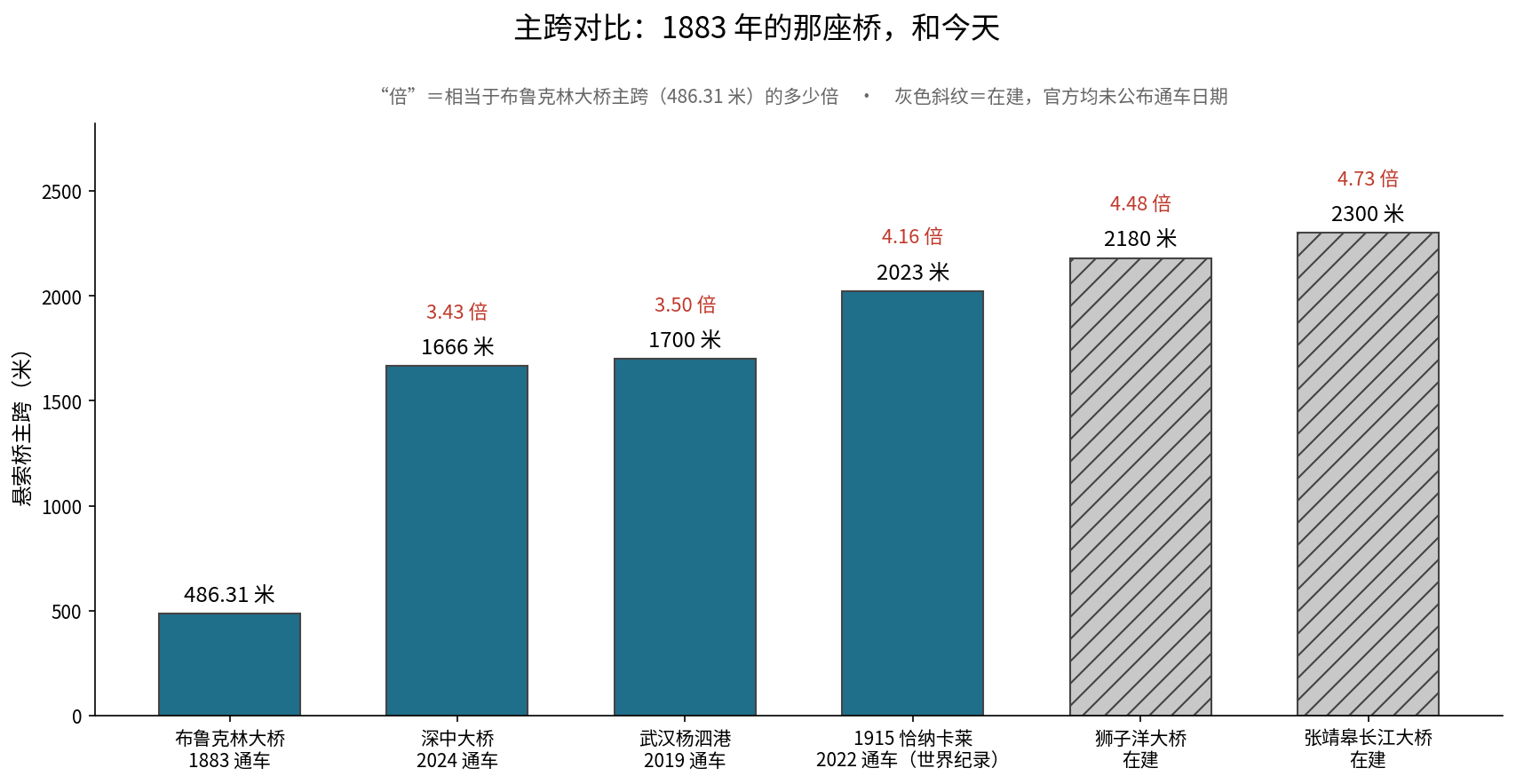
Two boundaries must be explicit. Neither Zhangjinggao nor Shiziyang is open to traffic. The official releases themselves use future-tense language, and none of the three government or ministry reports gives a planned opening date. It is therefore wrong to say that China has already completed the world's longest-span suspension bridge, and wrong to supply a predicted date on their behalf.
The comparison is strong enough without embellishment: the bridge that astonished the world in 1883 has a main span less than one-quarter that of Zhangjinggao today.
The tools have changed. Reinforced concrete, large bored piles and GPS positioning have replaced timber boxes, compressed air and a chief engineer confined to a sickbed.
The parabola has not.
Sources: New York City Landmarks Preservation Commission designation report LP-0098 (1967-08-24); the National Park Service National Historic Landmark nomination (NRHP 66000523); Library of Congress HAER NY-18 and Today in History; the New York City Department of Transportation's Brooklyn Bridge page and 2021 and 2025 releases; the New York City mayor's office release of 2026-03-27; the American Society of Civil Engineers' landmark page and Civil Engineering magazine; Butler WP, "Caisson Disease During the Construction of the Eads and Brooklyn Bridges" (Undersea and Hyperbaric Medicine, 2004); NIH/NCBI StatPearls, "Henry's Law"; Linn-Benton Community College, Basic Concepts of Structural Design; Johns Hopkins University civil engineering course materials on Roebling; the Ohio County Public Library's text of the 1854 Wheeling Intelligencer; the Washington State Department of Transportation's official history of the Tacoma Narrows Bridge; the Smithsonian National Museum of American History's notes on the William Steinway diary; the New-York Historical Society; STRUCTURE magazine; Guinness World Records; the Ministry of Transport of the People's Republic of China; Jiangsu Maritime Safety Administration; and the Guangzhou municipal government portal.