
A dark streak tens of light-years long is drawing itself together into stars.
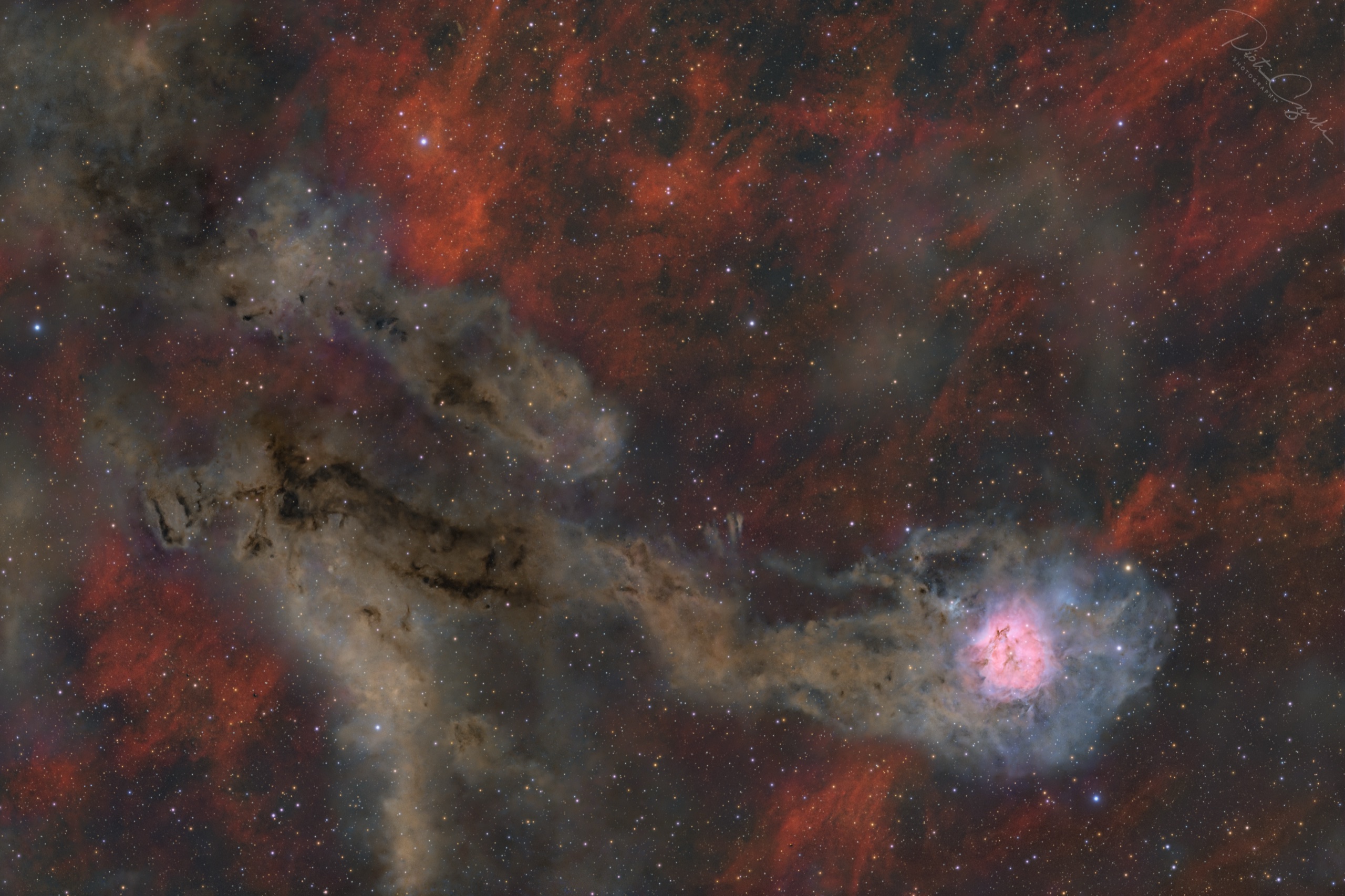
Image: NASA Astronomy Picture of the Day (APOD) | Image credit and copyright: Piotr Czerski | Original page
At first glance, today's NASA Astronomy Picture of the Day looks like a comet.
A bright pink head sits on the right. A long, dark tail stretches left across a crowded star field, spanning more than two degrees of sky, about four full Moons side by side. The silhouette could have come from a textbook diagram.
But this object is roughly 2,500 light-years away, while comets move around within a few astronomical units. It is the Cocoon Nebula, IC 5146, in the constellation Cygnus.
What Is in the Photograph?
The bright head is a star-forming region about 10 light-years across. At its center is a large blue-white star, BD+46 3474. A 2014 study classified it as B0.5 V, with a surface temperature of about 30,100 K, more than five times the Sun's. This single star ionizes the surrounding hydrogen, making it glow pink.
The dark band on the left is Barnard 168, extending nearly 100 light-years. It is no empty patch in the picture. Something is blocking the stars behind it: an immense, cold filament of molecular gas and dust.
The region carries several catalog names: Caldwell 19, Sh 2-125 for the emission nebula, Collinder 470 for the star cluster, and Barnard 168 for the dark cloud. Different catalogs have registered different aspects of the same patch of sky.
A Similar Shape, an Opposite Process
A real comet's tail is blown outward. As the nucleus approaches the Sun, material begins to vaporize. Gas and dust escape, then solar wind and radiation pressure push them away. The tail points away from the Sun even when the comet itself is departing, so it can stream ahead of the nucleus. It is a dispersal unfolding over days to weeks.
Barnard 168 works very differently.
This molecular filament is governed by its own gravity. It is drawing inward. Turbulence and gravity concentrate material toward the filament's axis. Density rises until a threshold is crossed, material collapses and a new star lights up. The timescale is millions of years.
A comet's tail scatters matter. This dark tail gathers it.
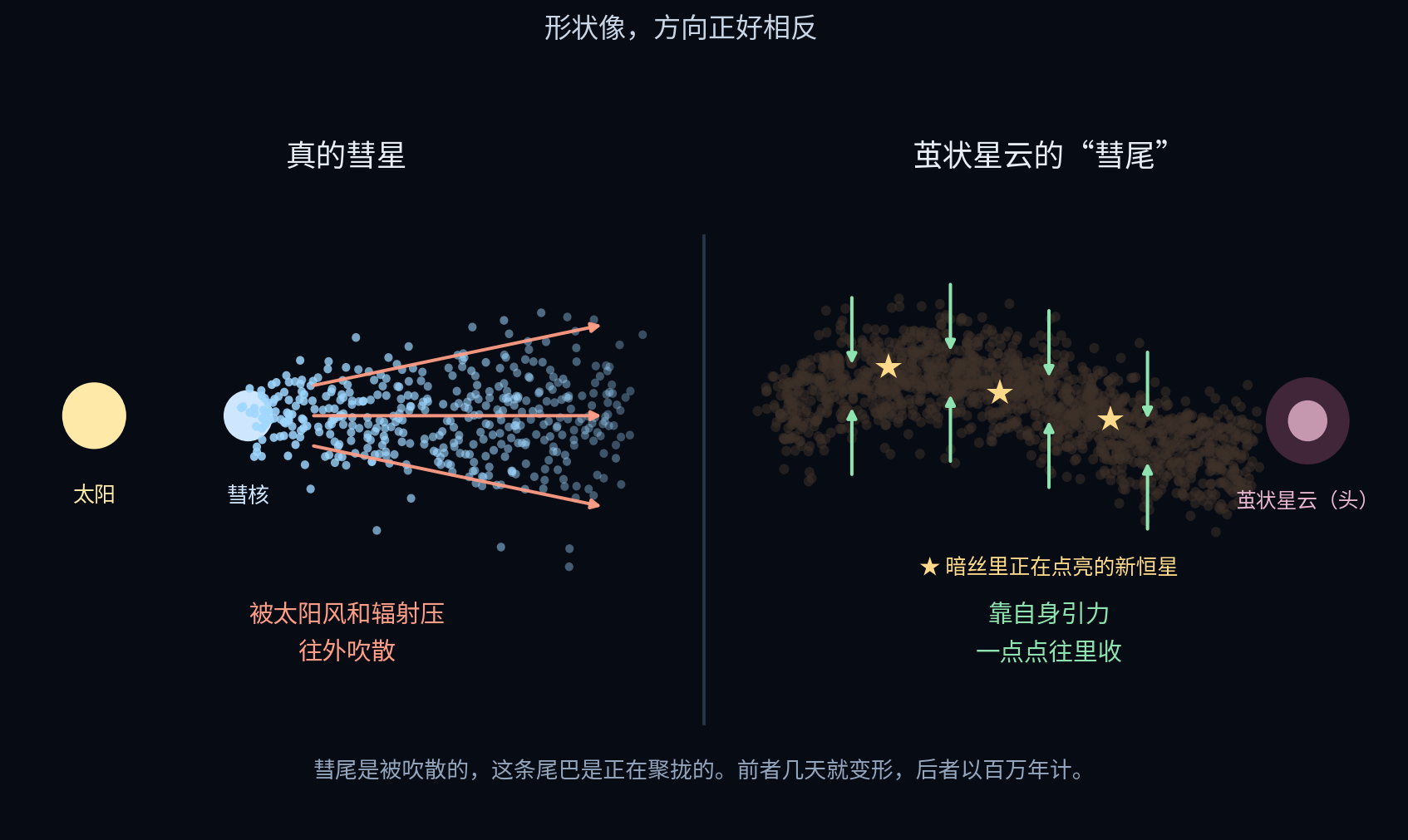
Two things in the universe can look alike while doing exactly the opposite. A resemblance is a starting point for an explanation, rarely the explanation itself.
A Bright Head and a Dark Nursery
Why is the head bright while the tail stays dark?
Saying that stars illuminate the head is correct, but misses the more interesting distinction.
The James Clerk Maxwell Telescope's Gould Belt Survey mapped the region at submillimeter wavelengths and identified 96 dense clumps, ranging from 0.5 to 116 solar masses. The Cocoon's head has converted a higher fraction of its mass into dense clumps and protostars. The tail contains more clumps overall, with most of its known protostars still embedded inside them.
The head is bright because stars have already emerged there, lighting, ionizing and blowing away the surrounding gas. The tail is dark because its stars are still being born, wrapped in their natal material.
The two ends of the cloud show different stages of star formation, a before and an after in the same photograph.
Finer observations have resolved the tail further. Using carbon monoxide isotopes and N₂H⁺ molecules, South Korea's TRAO telescope found that the apparently single dark band comprises 14 intertwined filaments, or 24 when subfilaments are included, containing 22 dense cores. The single rope is actually a bundle.
The Star Has Broken Open the Cocoon
The name "Cocoon" suggests a star enclosed in a sealed shell. The proposed structure is more interesting.
In their 2002 study, Herbig and Dahm described a "blister" model. BD+46 3474 formed near the cloud's surface facing us, rather than at its center. Once it began shining, it blasted a cavity into the surrounding gas. That cavity broke open toward us, and gas and dust are flowing out through a funnel-shaped passage in the Sun's direction.
The pink glow is therefore not the outside of a spherical shell. It is the inner wall of the opening. We happen to be looking straight into the funnel.
The cloud's dimming effect has also been measured. Observations of 38 spectrally classified stars yielded an average visual extinction of about 3.0 magnitudes: starlight passing through the cloud is dimmed by a factor of roughly 16.
A Smoke-Sized Obstacle
What, exactly, is this dust?
Interstellar grains are not much like the dust on a table. They measure 10 to 100 nanometers across, each containing roughly a million to a billion atoms. The analogy in astronomy textbooks is the solid particles in cigarette smoke.
At 10 to 100 nanometers, they are about an order of magnitude smaller than visible light's wavelengths of 400 to 700 nanometers. Shorter wavelengths scatter more readily, stripping out much of the violet, blue and green light while letting more orange and red through. The same dust both dims and reddens the stars behind it.
Some of the darkest places in the universe owe their darkness to particles the size of smoke.
How Far Away Is It?
The distance to IC 5146 is still unsettled.
Published estimates have varied for decades: 1,000 parsecs in 1959, 460 in 1999, 1,200 in 2002 and a Spitzer-based reassessment of 950 in 2008. The highest value was more than twice the lowest. The European Space Agency's Gaia satellite brought substantial progress. A 2018 measurement of 62 young stars using Gaia data gave 813 ± 106 parsecs, or about 2,650 light-years. APOD's figure of 2,500 light-years falls within that range.
A 2020 study raised a more awkward possibility: the head and tail may not even lie together in space. It proposed that the IC 5146 cloud complex contains two separate clouds, with the densest main dark filament at about 600 parsecs and the Cocoon itself at about 800 parsecs, a separation of more than 600 light-years.
If that interpretation holds, the apparent comet is not a single connected structure in three dimensions. Its head and tail merely line up in projection. One caveat remains: whether the study's "main dark filament" corresponds exactly to the Barnard 168 identified by APOD still needs confirmation.
This distance problem reaches into a famous result. A 2011 Herschel Space Observatory study proposed that interstellar filaments have a universal width of about 0.1 parsec, regardless of their overall size. IC 5146 was among its initial samples, and the study adopted a distance of 460 parsecs, later ruled out by Gaia. Physical width is angular width multiplied by distance. Change the distance and the width must change too. A 2024 study remeasuring the same region at 813 parsecs found widths of 0.23 to 0.32 parsec, substantially above 0.1.
The foundations of an elegant rule are still shifting. That is how science develops.
Crossing an Ocean for a Dark Sky
The photographer is Polish astrophotographer Piotr Czerski.
He lives near Krakow under a Bortle 6 sky, bright suburban conditions in which the Milky Way is largely invisible. He began astrophotography only in 2018, with equipment on the scale of a 135-millimeter lens and a small equatorial mount.
This photograph was made in Death Valley, California.
North America's lowest, driest and hottest place also has some of the darkest skies in the United States. On February 20, 2013, the International Dark-Sky Association certified it as an International Dark Sky Park at the highest level, Gold Tier. At 13,848 square kilometers, it was then the world's largest.
The journey gives the photograph another dimension: someone living under light pollution had to cross an ocean to see stars that ought to have been visible outside his own window.
A Dark Sky in China, Too
On November 9, 2025, the Xueshanliang area of Huanglong National Scenic Area in Sichuan received DarkSky International certification, becoming mainland China's first International Dark Sky Park.
Its core dark-sky area lies at 3,900 to 4,000 meters. Zenith sky-brightness readings frequently exceed 21.4 magnitudes per square arcsecond, better than the certification threshold. The announcement from the Aba Tibetan and Qiang Autonomous Prefecture government and DarkSky International's release agree on those details.
A distinction matters here. Ngari and Nagqu in Tibet are often described online in Chinese as China's first internationally certified dark-sky reserves. In 2018, they were included in a world directory of dark-sky places by the International Union for Conservation of Nature's Dark Skies Advisory Group. Directory inclusion and DarkSky International certification belong to separate systems. Both are valuable, but they are different designations.
Mainland China's first DarkSky-certified park is Huanglong, certified in November 2025. It is also an established scenic area, with roads and accommodation that make it accessible to the public.
Sources
NASA Astronomy Picture of the Day, September 21, 2026, "Cocoon Nebula Wide Field"; García-Rojas et al. (2014), A&A 571, A93; Herbig and Dahm (2002), AJ 123, 304; Dzib et al. (2018), ApJ 867, 151; Wang et al. (2020), ApJ 888, 13; Arzoumanian et al. (2011), A&A 529, L6; Zucker et al. (2020), A&A; JCMT Gould Belt Survey, submillimeter observations of IC 5146; TRAO FUNS survey, IC 5146 study; Miller-Jones et al. (2021), Science 371, 1046; OpenStax, Astronomy 2e, chapter on cosmic dust; Astronomy.com observing guide; DarkSky International, Death Valley and Huanglong certification pages; National Park Service, Death Valley dark-sky park announcement; Aba Tibetan and Qiang Autonomous Prefecture government announcement; ZWO photographer interview; Tibet Autonomous Region Department of Culture and Tourism, 2018 report.