
Today's Bing wallpaper looks into a forest on the Northern California coast. Of that forest's only two living relatives on Earth, one is in the Sierra Nevada and the other in Hubei, China.
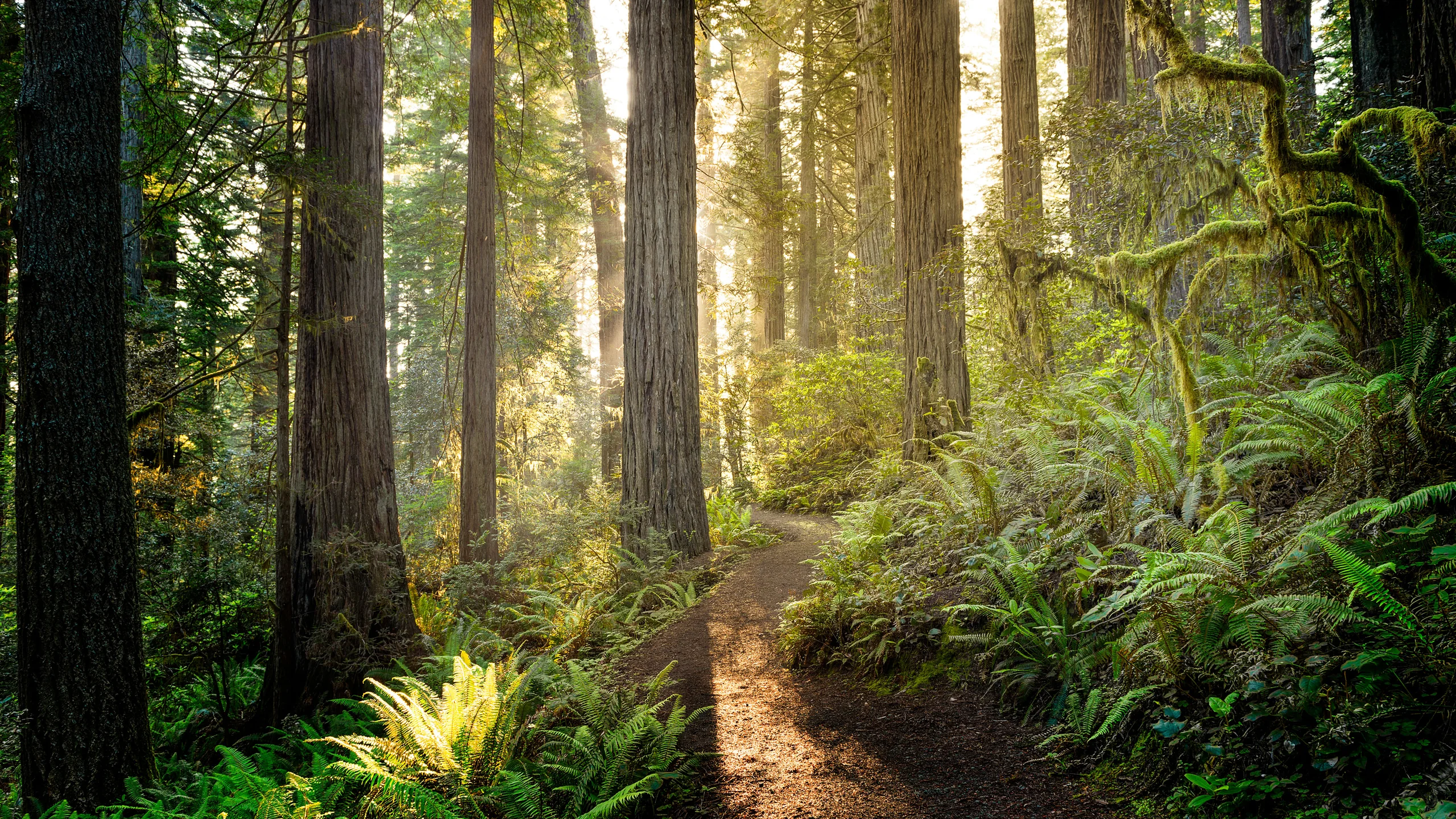
Image: Bing daily wallpaper | Sunrise in Redwood National and State Parks, California, United States (© HadelProductions/Getty Images)
How tall can a tree grow?
This is not a poetic question but a calculable one. Researchers have arrived at an answer: roughly 122 to 130 meters. The tallest living tree is already 116 meters high, leaving less than ten stories between it and the ceiling.
Today's image on the Chinese Bing homepage shows the forest where that tree lives.
First, a Small Problem with the Name
Bing's Chinese copyright line translates the site as "Redwood National and State Parks," while the search term attached to the same image uses a Chinese name that can also mean "Sequoia National Park." One forest, two names.
The species shown here is the coast redwood, Sequoia sempervirens. In Chinese, the word used for "redwood" often means the tropical hardwoods used in fine furniture, such as rosewood, which are something else entirely.
There is an easier confusion to make. What Chinese speakers often call "Redwood National Park" is sometimes Sequoia National Park in the Sierra Nevada, a different park built around a different species. Today's photograph comes from Redwood National and State Parks on the Northern California coast. An entire California separates the two.
The names drift easily. It helps to set them straight before going farther.
What the Picture Shows
Bing's English title is Sunrise in Redwood National and State Parks. The Chinese introduction mentions an understory of ferns and moss.
The protected area joins one national park with three state parks. The National Park Service gives its total area as 131,983 acres, about 534 square kilometers, including 38,982 acres of old-growth forest. It became a World Heritage Site in 1980. UNESCO describes its coast redwoods as the surviving remnant of "a group of trees that has existed for 160 million years."
The metadata does not say exactly where or when the photograph was taken, so there is no basis for guessing.
How Water Climbs 116 Meters
The first intuition to discard is that a tree pumps water upward. A tree has no heart, no muscles, and no component actively doing work to push water.
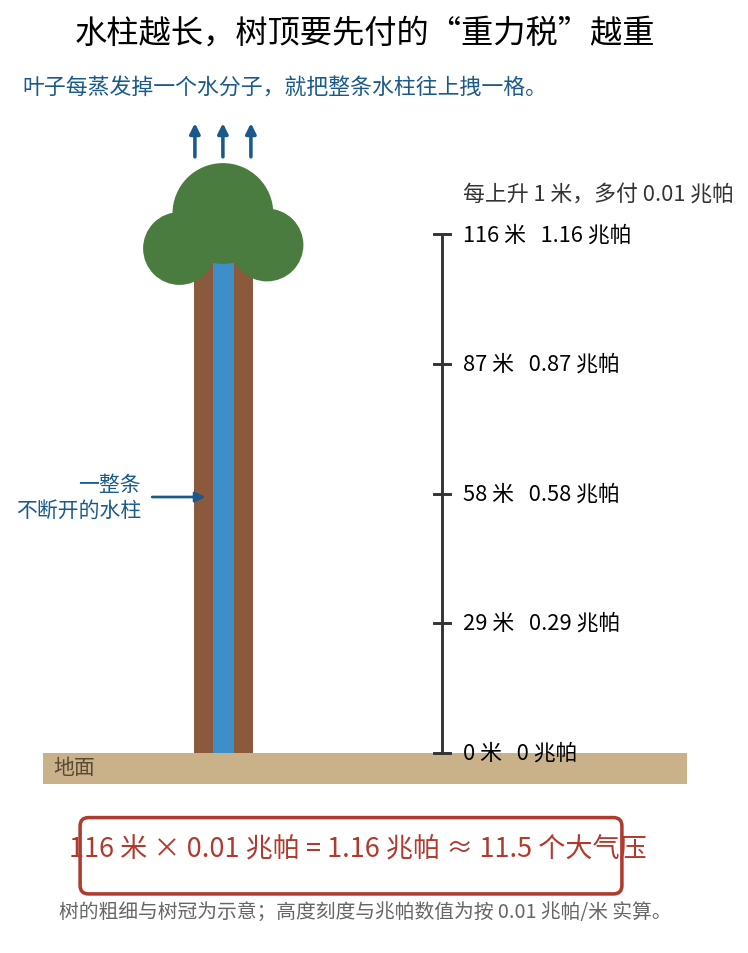
Instead, each leaf at the top has tiny pores through which water molecules evaporate into the air. Water molecules strongly attract one another and hold together. When a molecule escapes from the crown, it tugs upward on the unbroken column of water behind it, stretching all the way from roots to treetop.
This 116-meter "rope of water" is pulled from above, not pushed from below.
How heavy is that rope?
Research from the U.S. Forest Service supplies a useful figure: gravity contributes 0.01 megapascal to water potential for every meter of height. Each meter therefore carries a small additional cost. Multiply 116 meters by 0.01 and the result is 1.16 megapascals, about 11.5 atmospheres.
That is the "gravity tax" a leaf at the crown must pay even when there is no transpiration and the water is motionless. Once transpiration begins in daylight, friction from water moving through narrow conduits adds another cost.
Where the Ceiling Lies
In 2004, Koch, Sillett, and two colleagues published a paper in Nature with an exceptionally plain title: "The limits to tree height." They climbed coast redwoods in Northern California, including the tallest then known at 112.7 meters, and measured how leaf traits changed all the way up.
The abstract's conclusion was that regressions of the height gradients in functional leaf traits produced a maximum tree height of 122 to 130 meters, barring mechanical damage.
More important was the explanation: as a tree grows taller, water stress from gravity and path length eventually constrains leaf expansion and photosynthesis, preventing further growth even when soil moisture is abundant.
It is worth taking that sentence slowly. The water is not scarce. It is right below the tree, but the leaves at the top are spending all their strength holding onto it and have none left to spread open toward the Sun.
Later research completed the picture. On the same redwood, leaves at the crown are small, thick, and held upright close to their branches. Leaves lower in the canopy are broad, flat, and spread horizontally. The upper and lower reaches of one tree grow two differently shaped kinds of leaf. They are two compromises made by the same organism under two water-pressure regimes.
Fog: Rain Made by the Trees Themselves
Summer brings almost no rain to California's north coast. Fog carries the redwoods through the dry season, and one fact about it sounds almost too neat to be true.
In 1998, Dawson published an isotope study of water sources in redwood forests in Oecologia. He found that fog droplets supplied an average of 34% of annual hydrologic input where trees were present, but only 17% where there were no trees.
In other words, the trees collect half the fog water themselves. Redwood needles, bark, and branches comb droplets out of the air and let them fall to the soil below. The trees do not merely happen to stand in a foggy place. They turn fog into rain.
The same study found that fog supplied about 19% of the redwoods' summer water and 66% of the water used by understory plants, while accounting for 13% to 45% of annual redwood transpiration.
An NPS explainer says that fog provides about 40% of redwoods' water uptake. That is the park's public-facing figure and comes without a citation; it is not defined in the same way as the three measurements above.
A 2009 study took the story one step further. Plants in the redwood forest drink not only through their roots but through their leaves. Limm and colleagues studied ten dominant species and found that 80% could absorb water through their foliage. Fog wetting the leaves could raise leaf water content by 2% to 11%.
This closes the loop: the thirstiest leaves are at the top of the tree, and fog arrives precisely there.
But the Fog Is Declining
In 2010, Johnstone and Dawson published a troubling study in PNAS. Using long-term series of maximum inland temperatures to reconstruct fog frequency, they concluded that coastal fog in California had declined by about 33% since the early 20th century.
Their figures were specific: estimated average fog frequency was about 56% from 1901 to 1925, measured frequency averaged 42% from 1951 to 2008, and the record low was 27% in 1997.
The paper's own cautions matter. The pre-1925 values are an index inferred from temperature, not direct fog observations. Observation methods changed several times over the century, from airport observers in the early period to increasing use of automated laser ceilometers in recent years. Missing nighttime data in some periods were interpolated. This is a regional trend, not proof that every redwood receives one-third less water.
But the direction is clear, and every one of these trees depends on fog to sustain a height above 100 meters.
The World in the Canopy
The crown of an old-growth redwood is not simply a pole with a ring of branches. It develops reiterated trunks, thick upright branches growing from the main trunk that each take the form of another tree. One scholarly paper was titled "A redwood tree whose crown may be a forest canopy."
At the junctions of those branches, decades or centuries of fallen leaves, bark fragments, and moss accumulate into real soil. It has its own technical name: arboreal histosol. Ferns, chiefly evergreen leatherleaf ferns, grow in it and form deep mats. Save the Redwoods League says these fern mats can store more than 5,000 gallons of water per acre in midair, nearly 19 metric tons.
Animals live there too.
The wandering salamander, Aneides vagrans, is about ten centimeters long. It lives in fern mats more than 45 meters up in the redwood canopy, and many individuals may never touch the ground in their entire lives.
In 2022, Brown and colleagues published a wind-tunnel study of the species in Current Biology. When it falls, the salamander actively assumes a skydiving posture that reduces its vertical descent speed by about 10%. About half the time, it also undulates its tail and body to glide away from a purely vertical path. It precisely controls pitch, roll, and yaw while keeping its body upright throughout.
Yet it has no wing membrane, no skin flap, and no visible structure for flight.
Researcher Robert Dudley described it this way: "They're totally surfing on air."
Three Genera, One Living Species in Each
The redwood subfamily to which the coast redwood belongs once ranged across the Northern Hemisphere. Today only three genera survive, and, in the National Park Service's words, "each of these genera is represented by a single living species."
They are:
Coast redwood, Sequoia sempervirens: more than 115 meters tall, with a maximum trunk diameter of eight meters; evergreen; confined to the coastal belt of Northern California and extreme southern Oregon.
Giant sequoia, Sequoiadendron giganteum: up to 96 meters tall, with a maximum trunk diameter of nine meters; evergreen; confined to the western slope of the Sierra Nevada.
Dawn redwood, Metasequoia glyptostroboides: up to 43 meters tall, with a maximum trunk diameter of two meters; deciduous. The same NPS comparison table gives its range as "Central China."
That document becomes more specific elsewhere: the dawn redwood's range is "confined to Lichuan County in the Hubei Province of China, a fertile, moist lowland that also is desirable for farming."
The world's tallest tree has a relative in Hubei, and that tree is one of its only two living relatives on Earth.
A Genus Found First as a Fossil, Then as a Living Tree
The dawn redwood has one of the least plausible stories in 20th-century botany.
In 1941, Japanese paleobotanist Shigeru Miki was studying fossils from Pliocene deposits in Japan when he noticed that some specimens long classified as Sequoia had opposite leaves and cones, unlike redwoods. He created a new genus for them, Metasequoia, meaning "like a sequoia."
It was a fossil genus, describing trees believed to have been extinct for millions of years.
At that very time, in a valley in southwestern China, someone was standing beneath a living specimen of the genus.
The year is disputed.
The standard account, repeated by China's National Forestry and Grassland Administration and the People's Daily, says that in 1941 forester Tuo Gan, traveling from Hubei to Sichuan, saw the unusual tree at Modaoqi in Wan County, now Modaoqi Village in Moudao Town, Lichuan, Hubei.
But a 2024 paper in Biodiversity Science, based on unpublished manuscripts by Wang Zhan and Xue Jiru, objected explicitly: "There is currently no evidence, such as a specimen or photograph, that Gan Tuo ever saw the large tree." It argues that the living dawn redwood was discovered in 1943, not in 1941 as some sources state.
National Park Service materials give a third year: 1944.
Three sources, three years. The discrepancy carries its own lesson: a scientific "first" is defined by evidence, not legend. A specimen, photograph, or accession number carries more weight than an account passed from person to person.
Whatever the starting point, the subsequent timeline is clear, and each step has a number attached.
On July 21, 1943, Wang Zhan collected the first dawn redwood specimen, including more than 20 complete stalked cones. Its specimen number is C. Wang 118.
In spring 1944, Wang asked Wu Zhonglun to take a cone-bearing specimen to Zheng Wanjun and ask whether it represented a new species.
After consulting Miki's 1941 paleobotanical paper, Zheng concluded that the specimen belonged to the fossil genus Metasequoia. He sent it to Hu Xiansu.
In 1946, Zheng sent his graduate student Xue Jiru to collect again at the site.
On May 15, 1948, Hu and Zheng formally published the species under the name Metasequoia glyptostroboides.
A genus believed extinct for millions of years had been named from fossils, then found alive in China within seven years.
How Its Seeds Traveled the World
At the end of 1946, specimens reached Harvard University's Arnold Arboretum. Its director, Elmer D. Merrill, allocated money from the arboretum's special Chinese-exploration fund so Zheng could organize seed collection at the type locality, with assistance from Xue.
The seeds were handed over in Nanjing in early December 1947. The first shipment reached Boston on January 5, 1948. Sown early that month, they had germinated by its end.
The arboretum then distributed more than one kilogram of the small, lentil-like seeds to botanical gardens and arboreta around the world. Almost every cultivated dawn redwood today can be traced to that lot.
Merrill wrote in Science that year that it was "an event of extraordinary interest to botanists and paleobotanists," adding that the conifer was apparently "on the verge of extinction" in its native range.
A dispute over credit arose the same year. Paleobotanist Ralph Chaney led an expedition to China, found three dawn redwoods in Modaoqi Village, and located more than 1,000 in nearby parts of Hubei. Although reports mentioned Chinese scientists, American newspapers awarded the title of "discoverer" to Chaney and the reporter traveling with him. Merrill objected forcefully, calling the expedition a "publicity stunt" and arguing that Western scientists should support local researchers instead of claiming their credit. In his view, the era of colonial "botanical piracy" was over.
This August, the Arnold Arboretum installed a plaque beside one of its dawn redwoods honoring Hu Xiansu, who earned a Harvard doctorate in 1925 and became a founder of modern Chinese botany. In a 1946 letter to Merrill, Hu wrote:
"What a marvelous discovery this is! Only three big trees, thirty-four meters high, are still living."
In the same month that Bing put California's redwoods on its homepage, a plaque honoring a Chinese botanist was installed beneath a dawn redwood in Boston.
Tree No. 0001
The oldest tree is still there.
It grows below Qiyue Mountain in Modaoqi Village, Moudao Town, Lichuan, Hubei. The state has registered it as Dawn Redwood Type Specimen Tree No. 0001. According to the National Forestry and Grassland Administration and the People's Daily, it is more than 660 years old, 35 meters tall, and 2.4 meters in diameter at breast height, requiring four or five people to encircle it with their arms. Each year it can produce more than ten kilograms of seeds, roughly half a million of them. Local people originally called it shuimiao.
Lichuan has identified and registered more than 5,600 ancient dawn redwoods, all over 100 years old, in several hundred groves. The management principle is "one number, one card, one file for each tree." Every protection marker carries a QR code; retaining walls and fences surround the groves, and lightning rods have been installed.
The wild population is nevertheless under pressure. The IUCN assesses the dawn redwood as Endangered. A 2002-2003 inventory counted naturally occurring parent trees with trunks at least 20 centimeters in diameter: 5,360 in Lichuan, Hubei; 28 in Shizhu, Chongqing; and five in Longshan, Hunan, about 5,393 trees in total. The assessment identifies the main threat as the near absence of opportunities for natural regeneration because of land-use change driven by population growth.
This is the dawn redwood's deepest contradiction: endangered in the wild, flourishing among people.
Uncounted dawn redwoods line city streets, parks, and riverbanks around the world. It may be one of the most successfully rescued trees on Earth. Yet in the few valleys where it evolved, it can scarcely produce a new generation.
Across the Pacific, coast redwoods face another side of the same problem. Save the Redwoods League estimates that about two million acres of old-growth coast redwood forest existed in California before 1850 and that roughly 5% remains. The NPS says 96% was logged. The two authoritative figures differ by one percentage point, but describe the same loss. Today's redwood parks protect 45% of California's remaining old-growth redwoods. More than half the park is second-growth forest recovering from logging.
The Redwoods Rising program, launched in April 2018, is a three-way partnership working across a 120,000-acre project area to restore more than 70,000 acres of second-growth forest and remove 300 miles of abandoned, deteriorated, impassable logging roads.
California is spending decades returning a logged forest inch by inch. Lichuan is numbering and documenting more than 5,000 old trees one by one. They are two methods of doing the same work.
The Tallest Tree and Its Birthday
The tallest living tree is Hyperion, in the Redwood Creek watershed. Guinness World Records lists its current height as 116.07 meters, measured in 2019.
It was discovered on August 25, 2006.
That is today. Today is also the 110th anniversary of the National Park Service, created when President Woodrow Wilson signed the Organic Act on August 25, 1916. In 2026, National Park Week runs from August 22 to 30 rather than its usual April dates, and today is a fee-free day.
Hyperion itself is inaccessible. Since 2022, the National Park Service has closed the entire area around it.
The official explanation is direct:
"Visitation to Hyperion has caused the degradation of the habitat surrounding the tree. There are no longer any ferns around the base of the tree due to trampling."
"Visitors viewing this tree have trampled and, in some cases, killed the native vegetation surrounding it."
"Hiking in this closure could result in a fine or jail time."
Two further lines are worth considering:
"Hyperion's trunk is not particularly large in comparison to many other old-growth redwood trees, and the tree's height cannot be seen from the ground."
"It is expensive to build and maintain a trail, especially to a tree that may not remain the tallest in the future."
The page ends with this sentence: "Forests grow by the inch and die by the foot."
Sources: National Park Service pages for Redwood National and State Parks and its Three Trees comparison; California State Parks; UNESCO World Heritage Site No. 134; Koch et al. (2004), Nature; Woodruff et al. (2004), U.S. Forest Service; Dawson (1998), Oecologia; Limm et al. (2009), Oecologia; Johnstone and Dawson (2010), PNAS; Brown et al. (2022), Current Biology; Save the Redwoods League; Guinness World Records; China's National Forestry and Grassland Administration, "Dawn Redwoods Flourish Among the Mountains"; People's Daily, December 11, 2023; Qian Hong et al., "The History of the Discovery of Metasequoia glyptostroboides" (Biodiversity Science, 2024); the Arnold Arboretum's Arnoldia and dawn redwood pages; Threatened Conifers of the World, citing the IUCN assessment; Wuhan Municipal Government; and Utah State University Extension.