
Today's Google homepage shows Yellowstone National Park's Lamar Valley. But the part of this park that most changed your life is neither in the picture nor above ground.

Image: Google Doodle, Celebrating National Parks Week: Yellowstone | Official page
In 2020, billions of people lined up for COVID tests. One of the most important enzymes in each test kit came from a bacterium. On September 5, 1966, an undergraduate scraped that bacterium from a mat in the hot water of Mushroom Spring, in Yellowstone National Park's Lower Geyser Basin, and brought it back to the laboratory.
Today's Google homepage depicts that park.
The official description says the artwork honors the long history of Yellowstone, "the oldest national park in the world." It belongs to the National Park Week series and shows a view of Lamar Valley. Today is the National Park Service's 110th birthday and a fee-free day during this year's National Park Week. That is enough about the celebration. The story begins underground.
"The World's Oldest" Depends on What Is Being Counted
Google's official description calls Yellowstone "the oldest national park in the world." The honest version of that statement needs a definition.
President Ulysses S. Grant did establish Yellowstone by signing legislation on March 1, 1872. The law reserved the land "as a public park or pleasuring-ground for the benefit and enjoyment of the people," in the language of the 19th century. The National Park Service calls it the world's first national park.
But under the broader standard of a natural place formally protected by national authority, Mongolia's Bogd Khan Mountain received official protected status in 1778, 94 years before Yellowstone. Religious bans on logging and hunting there may reach back to the 12th or 13th century. UNESCO calls it "one of the world's oldest protected areas": one of them, not the single oldest.
The accurate formulation is therefore this: if a national park means the complete modern institution of national legislation, public ownership, and exclusion of private and privileged claims, Yellowstone was the first. "First" depends on how the thing being counted is defined. That point is worth remembering on its own.
Why Half the World's Geysers Are Here
This is the mechanism that matters most.
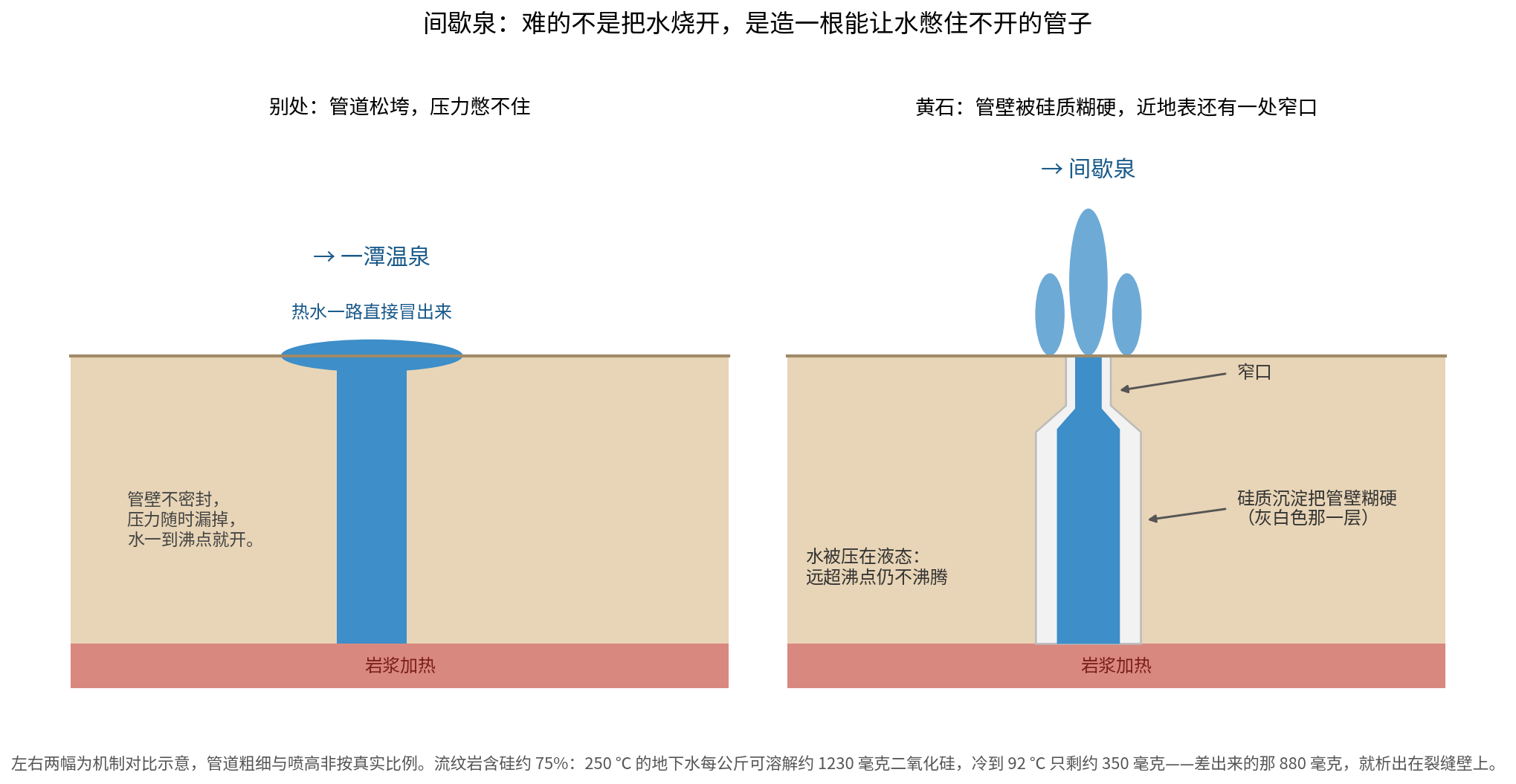
The instinctive answer is that magma underground makes Yellowstone hot. That is only half an answer, and the less important half. Geothermal heat is widespread. Iceland has it, as do Japan, Tibet, and Yunnan. Heat is not scarce. What is scarce is a pipe that can contain the pressure.
Yellowstone has something unusual underground: it has fired its own plumbing hard and sealed it narrow.
Rainwater seeps underground and is heated by Yellowstone's magmatic system. It flows through rhyolite, volcanic rock with an exceptionally high silica content of about 75%. The U.S. Geological Survey gives two numbers that can be subtracted directly. At 250°C, groundwater can dissolve about 1,230 milligrams of silica per kilogram. After cooling to 92°C, it can hold only about 350 milligrams.
Where do the extra 880 milligrams go?
They precipitate onto the walls of the fractures.
The National Park Service states the causal chain clearly: hot water dissolves some of the silica in rhyolite, and "these silicates are deposited on the walls of the plumbing system, strengthening the system to withstand the great pressure needed to produce a geyser."
The result is a natural pipe, built up layer by layer with hard silica, capable of resisting high pressure and narrowed by a constriction near the surface.
Everything else follows. Water deep below is heated far beyond its ordinary boiling point, but tens of meters of water press down from above, keeping it liquid. Pressure accumulates until a little water at the top finally spills from the constriction. The pressure drops, and the entire column of superheated water flashes violently into steam, blasting itself skyward.
Yellowstone's distinction is not an abundance of hot water. It is a pipe hard enough to keep water under pressure. The pipe contains the pressure, and the pressure makes the eruption.
One detail is particularly satisfying: Yellowstone's elevation lowers atmospheric pressure, so water boils at the surface at only 93°C. At Yellowstone, it does not take 100 degrees.
Yellowstone has more than 10,000 hydrothermal features, including more than 500 geysers, about half the world's total. There is an instructive footnote to those counts. One NPS page says "more than 500" geysers, while an older exhibit page says "more than 300," also half the global total. The USGS has explained similar changes in its own field inventories: "The increase in the number of thermal features documented is due to changes in the definition of what constitutes a 'feature,' not because of any geologic change." How a number is produced is itself part of the knowledge.
The Volcano, Without the Myths
Yellowstone does sit above an enormous magmatic system. Its heat comes from a mantle plume rising from the core-mantle boundary. Near Yellowstone, the plume is about 350 kilometers wide, and its top lies roughly 70 kilometers underground.
The North American Plate is moving southwest at about 2.5 centimeters, or one inch, per year. The hotspot is not traveling. The continent is sliding across this fixed flame. The scar across Idaho known as the Snake River Plain records what has passed over it during the past 16 million years.
The USGS figures for the "magma chamber" deserve close attention. The shallow rhyolitic reservoir lies 4 to 14 kilometers underground and is only about 5% to 15% molten. The deeper basaltic reservoir lies 20 to 50 kilometers down, has a volume of 46,000 cubic kilometers, and is only 2% to 5% actually molten.
It is not a vast lake of seething magma. It is a hot sponge that is already 85% to 95% solid, with a small amount of melt occupying its pores. This corrects one of the most widespread myths about Yellowstone.
In April 2025, a new seismic-imaging study in Nature identified a sharply defined roof above a reservoir about 3.8 kilometers beneath the northeastern Yellowstone caldera. Its pores contain roughly equal proportions of supercritical water and rhyolitic melt.
The easiest headline was "magma is shallower than expected, so the danger is greater." The paper said the opposite. The current volume of gas bubbles is below the typical level preceding a rhyolitic eruption. The team inferred that the system is stable because of "efficient upward gas migration through the hydrothermal system." In other words, gas is continually escaping and releasing pressure through more than 10,000 hot springs and vents.
The geysers are the volcano's pressure-release valves.
On the claim that Yellowstone is "overdue," the USGS response is almost merciless:
"Volcanoes do not work in predictable ways and their eruptions do not follow predictable schedules."
"No. First of all, one cannot present recurrence intervals based on only two values. It is statistically meaningless."
The gaps between Yellowstone's three caldera-forming eruptions were 800,000 and 660,000 years. Calculating a cycle from two intervals is invalid statistics. Even if they are forced into an average of 730,000 years, Yellowstone would still be about 90,000 years short of "overdue." The USGS gives an annual probability of one in 730,000.
The agency says the most likely next "eruption" is not a volcanic eruption at all, but a hydrothermal explosion.
The latest real example occurred on the morning of July 23, 2024, at Black Diamond Pool in Biscuit Basin. A column of water and rock shot an estimated 120 to 180 meters into the air and destroyed a nearby boardwalk. No one was injured. The USGS explanation was that "silica precipitation may have clogged pathways in the reservoir, allowing steam to accumulate and pressure to build." It also noted that "monitoring instruments detected no precursor to this event."
The loop is complete: the same process of silica sealing a pipe creates both geysers and the explosion. Seal the pipe just enough and it holds water for a jet. Seal it too completely and trapped pressure blows it apart.
As of early August 2026, the Yellowstone Volcano Observatory alert level was green/normal.
Old Faithful Is Not Very Faithful
Its name is an impression, and impressions need correction by data.
As of January 2025, the median interval between Old Faithful eruptions was 102 minutes, plus or minus ten minutes, while actual intervals ranged from 54 to 118 minutes. Eruptions rise 32 to 55 meters, averaging 40 meters; last 1.5 to 5 minutes; discharge 14 to 32 metric tons of water; and emerge from a vent at 95.6°C.
The rule rangers use to forecast it looks almost too simple:
If the last eruption lasted less than three minutes, the next comes in 68 minutes.
If it lasted more than three minutes, the next comes in 94 minutes.
The logic fits in one sentence. A short eruption leaves more water in the system, so it recharges quickly; a long eruption empties more of the system and takes longer to rebuild pressure. About 90% of forecasts fall within ten minutes on either side under this rule.
Another figure is more revealing. An old park exhibit gives an average interval of 92 minutes, while the current 2025 page gives a median of 102 minutes.
This is not a contradiction. It is time. Old Faithful is slowing down.
At times, the slowdown has jumped. The magnitude 7.3 Hebgen Lake earthquake of 1959 killed 28 people, most in a giant landslide that sent about 38 million cubic meters of earth and rock into a canyon. The next day, at least 289 springs erupted in the Firehole River geyser basins, including 160 with no previous eruption record, and at least 590 springs turned muddy. Before the earthquake, Old Faithful's mean interval that summer was 61.8 minutes. By the end of the year it was 67.4 minutes, and it has continued to increase.
Once, the geyser stopped much more completely.
In 2020, Hurwitz and colleagues reported in Geophysical Research Letters that they had collected 13 pieces of mineralized wood from Old Faithful's geyser mound and divided them into 41 samples for radiocarbon dating. The results showed that lodgepole pines grew on the mound between 1233 and 1362 CE.
There is only one way trees could grow there: Old Faithful did not erupt for more than a century.
The cause was a severe, prolonged drought in the mid-13th century. The beginning of tree growth coincides with the beginning of the drought. Decades of reduced precipitation and groundwater supply stopped the geyser.
The team also looked forward. Climate models predict more severe regional drought by the middle of this century, and geyser eruptions may become less frequent.
A geyser that has erupted for centuries once fell silent for more than a hundred years because rain stopped, long enough for a pine forest to grow over its vent. The record was not kept in a diary but in 13 pieces of wood encased in minerals.
Yellowstone has a more violent example. Steamboat Geyser, the world's tallest active geyser, can send major eruptions more than 90 meters high. In March 2018, after 34 years of intermittent dormancy, it suddenly revived; it erupted 48 times in both 2019 and 2020. A 2021 PNAS paper explained why it rises higher, in terms that fit the pipe physics above: "Steamboat erupts higher because water is stored deeper there, where more energy is available to power the eruption." Greater depth means more pressure and more stored force.
The Colors Are Alive, Except for the Blue in the Middle
Grand Prismatic Spring is Yellowstone's largest hot spring, 60 to 100 meters across and more than 37 meters deep. Its color transition from deep blue at the center to orange-red around the edge has become the park's defining image.
The National Park Service explains it cleanly:
"Colorless and yellow thermophiles grow in the hottest water."
"Orange, brown, and green thermophiles grow in cooler waters."
Thermophiles are microorganisms that thrive at high temperatures. Different species can survive only within their own temperature ranges; slightly hotter or cooler water excludes them. Because the organisms gather in populations of trillions, their colors become visible in broad bands.
The view is not mineral staining but a living thermometer. Each ring of color is a community that can live only at that temperature.
One part is often explained incorrectly: the deep blue center is not made by microbes.
In 2015, researchers from Montana State University and Brandenburg University of Applied Sciences published a quantitative study of Yellowstone hot-pool colors in Applied Optics. They found that microbial mats contribute more color in shallow water, while absorption and scattering by water itself dominate in deeper pools.
The orange, red, yellow, and brown at the edge are alive. The blue in the center comes from pure water absorbing red light, the same reason the ocean is blue.
Now for the Enzyme
This is Yellowstone's greatest effect on daily life, and it has nothing to do with scenery.
In June 1965, Indiana University microbiology professor Thomas Brock first came to Yellowstone for research. The following year, he and undergraduate Hudson Freeze collected microbial-mat samples from Mushroom Spring in the Lower Geyser Basin. The USGS gives the spring's temperature as 71.5°C. Brock later described its source pool as 73°C, "just at the upper temperature for known photosynthetic life."
From a sample collected on September 5, 1966, Freeze and laboratory technician Sally Murphy isolated a bacterial strain labeled YT-1.
Sally Murphy's name is worth retaining. A laboratory technician did the work of isolating the bacterium, and textbooks rarely mention her.
In 1969, Brock and Freeze formally published the new genus and species: Thermus aquaticus. Their paper gave an optimum growth temperature of 70°C, a maximum of 79°C, and a minimum of about 40°C.
Brock also did something that seemed unremarkable at the time. He deposited the strain with the American Type Culture Collection. YT-1 acquired another number, ATCC 25104, and became available to any researcher.
In 1976, Chien, Edgar, and Trela purified a DNA polymerase from the bacterium. The abstract began: "A stable DNA polymerase has been purified from the extreme thermophile Thermus aquaticus, having an optimum temperature of 80°C."
Then nothing happened for seven years. No one knew what use there was for a DNA polymerase that worked best at 80 degrees.
In 1983, chemist Kary Mullis conceived the polymerase chain reaction, or PCR. It works by repeated heating, cooling, and reheating. Heat separates the two DNA strands; cooling lets primers bind; polymerase then copies the DNA. Each cycle doubles the amount.
There was a fatal problem: every heating cycle destroyed the polymerase, so fresh enzyme had to be added each time. The National Park Service says this made the process "extremely slow and expensive."
Then someone remembered that a bacterium in Yellowstone's 70-degree water contained an enzyme that worked hardest at 80 degrees.
PCR changed from an expensive laboratory technique into an automated process a machine could run. In 1989, Science named Taq polymerase the first-ever "Molecule of the Year." In 1993, Kary Mullis received the Nobel Prize in Chemistry for inventing PCR.
A USGS explainer reduces the chain to one sentence:
"Without microorganisms from Yellowstone's hot springs, we could not test for COVID."
Here is the whole sequence:
In 1966, an undergraduate scraped a microbial mat from water at 71.5°C. The bacterium was named in 1969. In 1976, researchers purified from it a DNA polymerase most active at 80°C. In 1983, a chemist conceived PCR. In 1993, the idea won a Nobel Prize. In 2020, the COVID tests taken by billions of people depended on that enzyme.
Brock wrote about the experience in a 1997 article titled "The Value of Basic Research." Its final sentence was:
"Indeed, one never knows where a research project will ultimately lead."
There is a less pleasant but equally important sequel. The NPS itself says:
"Companies that sold Taq enzyme made a profit, but Yellowstone National Park and the American public received no direct benefits."
The people who discovered the bacterium received neither a prize nor a share of the profits. Yellowstone signed its first benefit-sharing agreement with a biotechnology company only in 1998. The National Park Service formally adopted the system in 2010, after completing an environmental impact statement.
Lamar Valley, the Valley in the Doodle
Now return to the picture.
Travelers and media call Lamar Valley "America's Serengeti." It is a nickname, not an official designation. The valley is Yellowstone's best wildlife viewing ground for a simple reason: when the last ice sheet retreated about 13,000 to 14,000 years ago, it carved a broad U-shaped valley and scattered glacial erratics across it. The open terrain and unobstructed view make long distances visible.
One of the narrowest escapes in American conservation history unfolded there.
By the beginning of the 20th century, only about 20 wild bison remained in Yellowstone. Different NPS pages give 25 animals in 1901 and "about two dozen" in 1902. Even the official record cannot produce a single count, which conveys how precarious the population was.
On May 7, 1894, a law specifically protecting Yellowstone's birds and animals was enacted. Congress later appropriated $15,000 to buy 21 bison from private owners, move them to Lamar Valley, and establish the Lamar Buffalo Ranch for intensive husbandry and breeding.
"As the herd grew, ranch-raised bison were released to interbreed with the wild herd and to establish new herds on other public and tribal lands."
The 2025 population estimate was nearly 5,300. More important, Yellowstone's bison are among the few genetically pure herds in North America that have never interbred with domestic cattle. Every bison seen in Lamar Valley today traces back to the roughly two dozen animals that survived in 1902.
The 1894 statute is often shortened to the "Lacey Act," but it is distinct from the better-known Lacey Act of 1900. The same member of Congress sponsored both laws.
The wolves came later. Fourteen gray wolves arrived from Alberta, Canada, in 1995; 17 from British Columbia in 1996; and another ten from northwestern Montana in 1997. Yellowstone reintroduced 41 wolves in all. By December 2024, 108 wolves lived in the park in nine packs.
Did Wolves Really Change the Rivers?
In 2014, a video titled How Wolves Change Rivers reached hundreds of millions of viewers. Its story was simple: wolves returned; elk stopped lingering in river valleys; willows and aspens recovered; beavers returned; channels became narrower and more stable; wolves changed the shape of rivers.
The story was so compelling that it entered textbooks.
In peer-reviewed literature, it has been disputed from 2010 through 2025, with no consensus.
In 2010, Kauffman and colleagues published the first serious landscape-scale test in Ecology. Its title was a question: "Are wolves saving Yellowstone's aspen?" Their answer was no.
In 2022, Brice, Larsen, and MacNulty published "Sampling bias exaggerates a textbook case of a trophic cascade" in Ecology Letters. The methodological problem they identified is almost painfully simple.
Researchers had routinely measured aspen recovery by selecting only the five tallest trees in each stand.
With that biased sampling, 13% to 68% of stands had a median stem height above 200 centimeters. With random sampling, only 1% to 13% did.
The same forest yielded a conclusion four to eight times larger depending on how it was measured.
The point can be stated simply: measure only the tallest trees and the result describes an expectation, not the forest.
The argument continued. In early 2025, a team led by Ripple argued in Global Ecology and Conservation that this was one of the world's strongest trophic cascades. They reported that mean willow crown volume rose by about 1,500% from 2001 to 2020, exceeding 82% of the cases in a global meta-analysis of 114 studies.
Late the same year, the same journal published a point-by-point rebuttal. Its central objection was circular reasoning:
"Because height is used to calculate volume, it appears in both the independent and dependent variables. Thus, this regression does not test an independent relationship between two variables. It simply restates the definition of volume."
The other objections were substantial. Long browsing had already deformed willow crowns, yet the model continued to assume a half-ellipsoid shape, increasingly overestimating later volumes. Only 22 plots were sampled in 2020, and just three had matching 2001 baselines. The photographs were also vulnerable to selection bias: visually dramatic but unrepresentative examples could be generalized too broadly.
A fair account is this:
The wolves returned. Elk numbers declined. Willows and aspens recovered in some places, a point most researchers accept. But the strength and geographic extent of recovery are deeply uncertain. Random sampling finds genuinely taller aspen stands at only a few percent to the low teens, while recovery depends heavily on local hydrology, groundwater level, and the presence of beaver dams, not simply on wolves. The claim that "wolves changed the rivers" has never been scientifically established.
That is the part most worth teaching. A compelling story, repeated in textbooks and watched by hundreds of millions of people, is being dismantled and retested by scientists themselves. The reason is not hostility to wolves. Once a method such as "measure only the five tallest trees" comes to light, the entire conclusion has to be recalculated.
Science is not the act of getting a story right once. It is the continuing work of finding where the story was wrong.
The National Park Service itself is cautious. It says that as predator densities increased, "and together with other factors," elk decreased, bison increased, and Yellowstone entered a new period. Even the agency does not give wolves all the credit.
China Has a Mountain Like This One
Yellowstone's counterpart in China is Changbaishan Tianchi, or Heaven Lake on Changbai Mountain.
The Jilin Earthquake Agency calls it "the best-preserved Cenozoic polygenetic composite volcano in China." About a thousand years ago, it produced a large explosive eruption.
The date was assembled from three independent lines of evidence. A 2017 multi-method study by Oppenheimer and colleagues placed it in late 946 CE using seasonally resolved sulfur deposition in Greenland ice cores, a Japanese chronicle recording ashfall on November 3, 946, and tree rings in wood killed and buried by the eruption, calibrated through the cosmogenic carbon-14 event of 774 CE. The eruption reached VEI 7, and its ash traveled as far as Hokkaido, Japan.
The Jilin Earthquake Agency notes a revealing absence: "No account of the Tianchi volcanic eruption has yet been found in Chinese historical records." Prevailing northwesterly winds carried the ejecta toward Korea, while the area around the volcano was sparsely inhabited.
A VEI 7 eruption took place within China, yet Chinese histories contain not a single word about it. It had to be reconstructed from sulfur in Greenland ice, a Japanese chronicle, and the rings of trees buried by ash.
Yellowstone's three caldera-forming eruptions reached VEI 8, one level above Changbaishan. But the Changbaishan event was among the largest eruptions of the Holocene, and it happened in China.
The volcano now has its own observatory. The Tianchi Volcano Observatory was completed in 1999, and the Changbaishan Volcano Observatory in 2006. Operated by the Jilin Earthquake Agency, it is an integrated station monitoring seismicity, deformation, geoelectricity, and fluids, with 18 sets of digital instruments in service. One of its sites is the Julong Spring fluid-monitoring station.
Chinese scientists are listening to the chemical changes of a hot spring because a hot spring is a volcano breathing. It is the other end of the "efficient upward gas migration through the hydrothermal system" described in the 2025 Nature paper.
Changbaishan has moved. From 2002 to 2005, Tianchi showed a pronounced episode of unrest: accelerated uplift and swelling of the cone, anomalous volcanic-gas indicators, and sharply increased volcanic seismicity. A 2020 study used matched-filter techniques to detect 3,763 clear volcanic earthquakes in records from that interval. The largest, inside the crater, measured ML 3.8.
Then nothing happened.
This is the same lesson as Yellowstone's current green/normal status: monitoring does not predict disaster. It narrows uncertainty enough to live with it.
Beside Tianchi is a group of hot springs with a maximum water temperature of 82.3°C, more than 40 springs above 60 degrees, and over 100 vents. Those counts come from the scenic area's operator rather than a research institution and should be treated only as an indication of scale.
Sources: Google Doodles official page; National Park Service Yellowstone pages and the teacher's guide Predicting Old Faithful; U.S. Geological Survey and Yellowstone Volcano Observatory pages; Duan et al. (2025), Nature; Brock and Freeze (1969), Journal of Bacteriology; Chien et al. (1976), Journal of Bacteriology; Brock (1997), Genetics; Hurwitz et al. (2020), Geophysical Research Letters; the 2021 PNAS study of Steamboat Geyser; Nugent et al. (2015), Applied Optics; Kauffman et al. (2010), Ecology; Brice et al. (2022), Ecology Letters; Ripple et al. (2025) and MacNulty et al. (2025), Global Ecology and Conservation; the Nobel Prize website; UNESCO's Man and the Biosphere Programme; Jilin Earthquake Agency; Volcanoes of China; Oppenheimer et al. (2017), Quaternary Science Reviews; and Liu Dongyang et al. (2020), Earthquake Research in China.