
Guardsman Pass, Utah, 2,962 meters above sea level. That golden hillside is one tree wearing the shape of a forest.
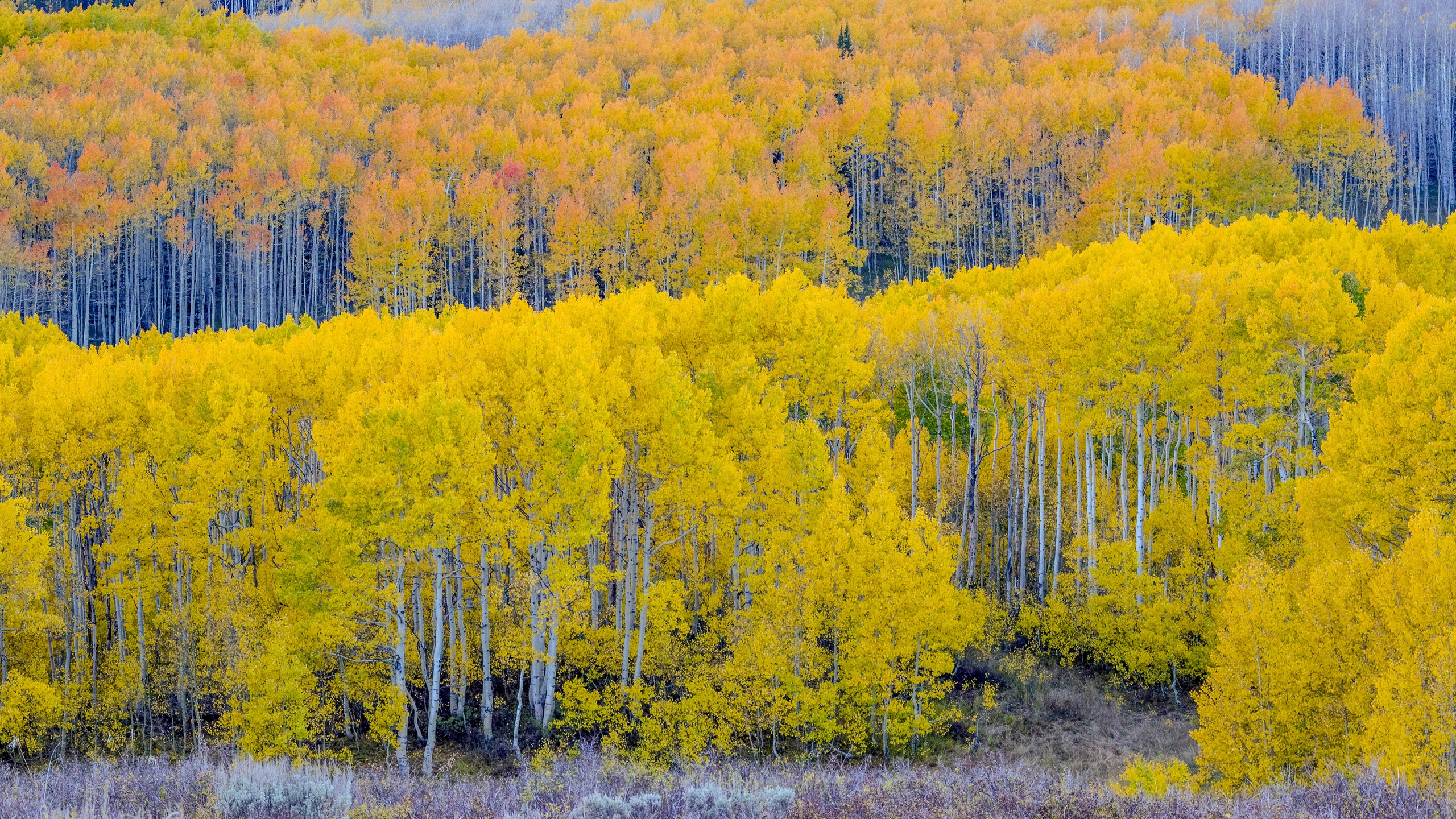
Image: Bing Daily Wallpaper | Autumn aspens near Guardsman Pass, Utah, United States (© Danita Delimont/Shutterstock) | Original page

Bing's homepage today is a hillside ablaze. White trunks stand close together like thousands of pencils pushed into the soil, each topped with the same unbroken gold.
This is Guardsman Pass in Utah's Wasatch Mountains, at 9,717 feet, or 2,962 meters. A paved road climbs through Big Cottonwood Canyon on the Salt Lake City side, crosses the pass and descends toward Park City. Half an hour's drive can take a person from city traffic into these colors.
What makes the photograph remarkable is how perfectly the trees match.
A Forest That May Be One Tree
Those thousands of trunks may belong to a single tree.
They are quaking aspens, Populus tremuloides, North America's most widely distributed tree species, ranging from the northern foothills of Alaska's Brooks Range to the mountains of Mexico. Aspen has an unusual way of multiplying: it relies chiefly on roots, rather than seeds.
The U.S. Forest Service's Fire Effects Information System describes the mechanism. Auxin produced in the stems travels into the roots and suppresses their buds, an effect called apical dominance. When an aboveground stem dies, or a gap opens in the canopy and admits light, that suppression is released. Cytokinins in the roots stimulate growing tissue on lateral roots to send up new shoots.
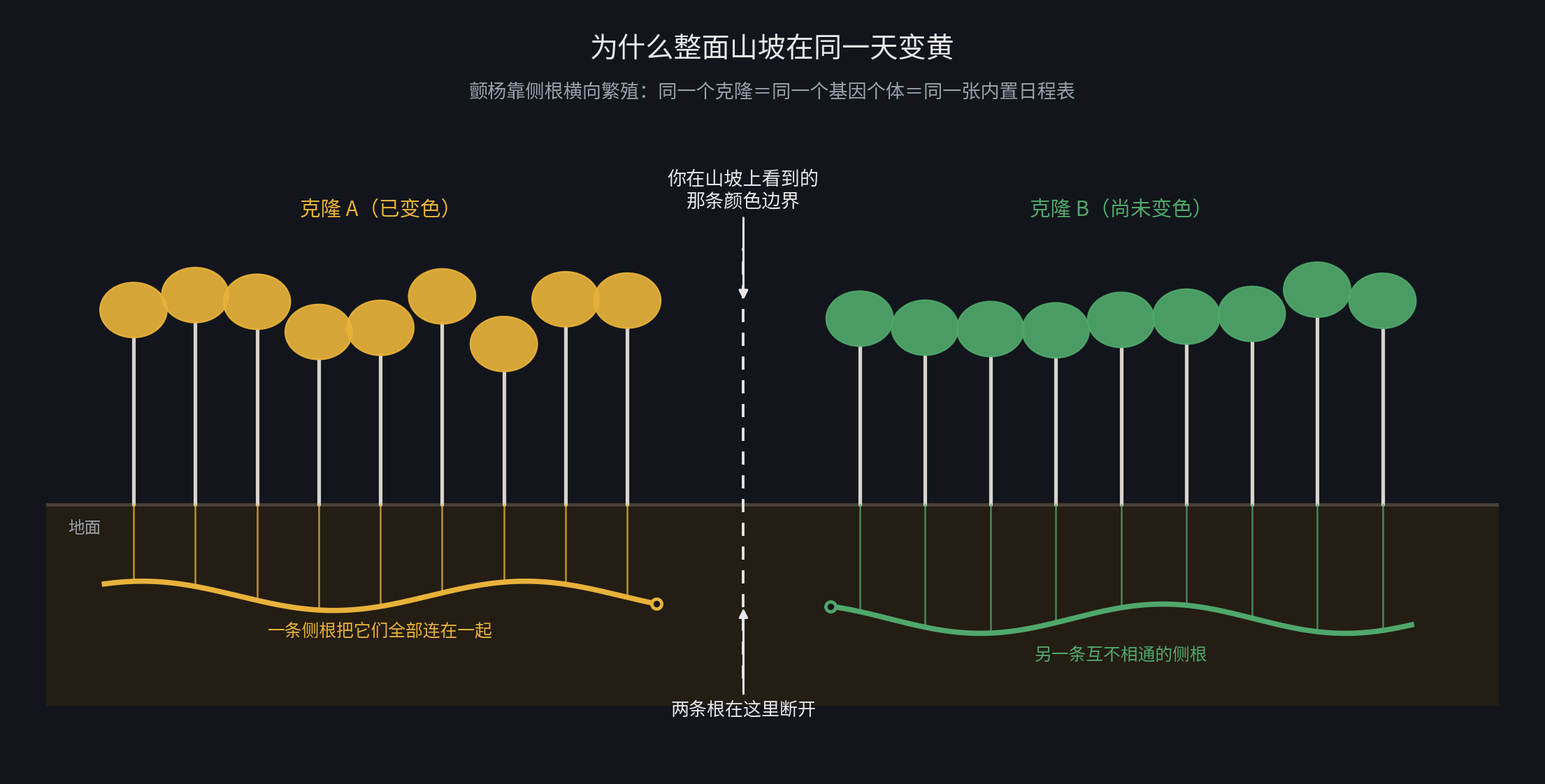
An aspen therefore grows sideways as well as upward. A lateral root can extend tens of meters underground, producing new trunks along the way. The Forest Service says a clone can occupy less than an acre or as much as 100 acres. One hillside may hold a single clone or several crowded together.
How can anyone tell which trunks belong together?
Autumn color is one clue.
The Forest Service's technical report on western aspen ecology and management, RM-GTR-119, identifies two ideal periods for distinguishing clones: leaf-out in late spring, and the days of color change and leaf fall in early autumn. As the report explains, "Many clones that look extremely similar in midsummer contrast sharply during these two periods."
Jeff Mitton, an ecology professor at the University of Colorado Boulder, lists several useful traits: bark color, branch angle, leaf size, black patches on the bark, and when buds open in spring, when leaves change in autumn, and what color they become.
A clone is a single genetic individual. Its trunks share an internal calendar.
What looks almost unnaturally coordinated is therefore entirely natural. The trees turn yellow together because they are parts of the same tree.
What Sets the Calendar?
The onset of autumn color follows a calendar more than a weather report.
Leaves are green because of chlorophyll. During the growing season, chlorophyll is continually produced and broken down. In autumn, production slows, then stops, and the remaining supply is dismantled. As green fades, carotenoids that were present all along become visible. The yellow has been there all summer, hidden beneath the green.
The interesting question is what starts that dismantling.
A Swedish study published in Plant Physiology in 2009 followed the same European aspen for eight years. In seven of those years, the onset of senescence fell within the same four-day window, September 9-12. Its conclusion was that temperature did not determine when senescence began, but did affect how quickly it progressed afterward.
Research from 2018 onward has refined the mechanism. Day length may not trigger senescence directly. Instead, photoperiod may first induce bud formation, after which senescence becomes possible. The details are still being worked out, but the basic division remains: light sets the schedule; temperature influences the pace.
One tree, one set of genes, a calendar almost precise to the day. Thousands of stems belonging to that clone follow it together.
This also challenges the familiar Chinese saying that frost paints the leaves red. University of Illinois Extension calls the idea folklore. The Minnesota Department of Natural Resources makes a more practical distinction: a light frost may help a little, but a hard frost can ruin the entire autumn display. Frost can erase the colors it is credited with painting.
The Orange and Red among the Gold
If a patch of orange or red interrupts the gold, it is likely another clone.
A common explanation says aspens cannot produce anthocyanins and therefore turn only yellow, while maples produce those pigments and turn red. That is too simple.
A 1989 paper in Forest Science analyzed pigments in Colorado quaking aspen leaves. Orange and red leaves contained two anthocyanins: cyanidin-3-glucoside and, probably, cyanidin-3-galactoside. Neither was detected in yellow leaves.
Aspens can produce anthocyanins; most clones simply do not. Whether they do, and how much they produce, is encoded in their genes.
Those orange and red patches are signatures. A shift in color brings an invisible underground boundary to the surface.
About That "80,000 Years Old" Claim
Any account of aspen clones eventually reaches Pando.
This male clone in Utah's Fishlake National Forest covers about 43 hectares, has roughly 47,000 stems and weighs an estimated 6,000 metric tons. A claim repeated widely online in Chinese calls it "80,000 years old, the oldest organism on Earth."
No measurement supports that statement.
The nonprofit that protects Pando traced the figure to a Bryce Canyon National Park webpage from the 1990s. It was never based on an actual measurement of Pando's age. The National Park Service removed it in 2023.
The defensible estimates are more complicated. Charcoal and pollen in nearby lake sediments provide a lower limit of at least 9,000 years. A 2018 study in PLOS ONE placed an upper limit at about 14,000 years, when the land became suitable for aspen after the last glacial period. A genomic study circulating from 2024 used accumulated somatic mutations to infer a range of 12,000 to 37,000 years, but eLife's public review classified its evidence as "incomplete."
The answer remains unknown, but it is not 80,000 years.
The Forest Service's own fire-effects database illustrates another problem. Its page still describes the Utah clone as occupying "17.2 acres (43 hectares)" and being "estimated at 1 million years old."
Both figures are wrong. Forty-three hectares equals 106 acres, not 17.2: the acres and hectares were reversed. A million years exceeds the postglacial habitat limit by nearly two orders of magnitude.
The page dates from 1996, 30 years ago. Official provenance alone does not make a number current or correct.
Even the title "largest organism on Earth" needs qualification. By area, an Armillaria ostoyae fungus in Oregon's Malheur National Forest covers 9.1 square kilometers, with an estimated mass of up to 35,000 metric tons. By the volume of a single trunk, the giant sequoia General Sherman is larger. Pando's most precise distinction is the heaviest known tree.
Why September 22?
Bing chose this photograph for September 22.
The U.S. Naval Observatory places the autumn equinox at 00:05 Universal Time on September 23, or 8:05 a.m. Beijing time on Wednesday, September 23.
That seems a day late. But Utah uses Mountain Daylight Time, six hours behind Universal Time. There, the same instant falls at 6:05 p.m. on September 22.
The photograph and the equinox share a date at the place in the picture. Time zones separate them elsewhere.
After this date, Northern Hemisphere nights begin to outlast the days. The trees' internal calendar has already issued its instructions; the equinox gives that seasonal shift a marker in the sky.
According to the Utah Office of Tourism, peak fall color begins at the highest elevations in mid-September and ends in most places by early October. At 9,717 feet, Guardsman Pass belongs to that highest group. The image falls squarely within that brief seasonal window.
Quaking aspen became Utah's state tree only on May 13, 2014, replacing Colorado blue spruce after more than 70 years. Fourth graders at Monroe Elementary School in Sevier County drove the change, arguing that blue spruce did not represent the whole state. Their proposal went through the full legislative process, from the state Senate to the governor's signature.
A Golden Forest Connected by Roots in China
China has another important member of the same genus: the Euphrates poplar, Populus euphratica, known in Chinese as huyang.
Each October, the poplar forests of Ejin Banner in Inner Mongolia's Alxa League turn a memorable, uniform gold. On September 20 this year, the Ejin Banner meteorological bureau forecast good autumn color around October 2, peak color around October 6, leaf fall beginning around October 16, and the season ending around October 23. Earlier high temperatures had slowed the yellowing, it added, pushing the peak slightly later than usual. Temperature was affecting the pace.
The parallel extends underground. A 2008 study in Acta Ecologica Sinica examined root suckering in the Ejin Oasis and found that population renewal depended almost entirely on vegetative reproduction. The researchers found no seedlings grown from seed in the surveyed area. Only roots within 30 centimeters of the surface produced suckers.
One tree lives on a Utah mountain pass, the other in the Gobi of northwestern China. Both use the same strategy: a network below ground, many stems above it.
Autumn color is a documented way to distinguish quaking aspen clones. The available Chinese literature does not establish that the same method works for Euphrates poplar, so that inference cannot simply be transferred. Nor is the familiar claim that a huyang "lives for a thousand years without dying" a scientific description; it is literary imagery. China Meteorological Administration materials explain that the tree's survival depends heavily on groundwater. It grows well when the water table is no deeper than 4 meters, declines when it falls to 6-9 meters, and struggles to survive below that. Its limiting factor is water.
The history of recording such seasonal dates in China leads to Zhu Kezhen. He and Wan Minwei coauthored Phenology, published by Science Press in 1963, the year the Chinese Phenological Observation Network was established. The network has had two interruptions: 1969-1972, because of social upheaval, and 1997-2002, because of funding shortages. Its observation rules are simple and exacting. First flowering and first leaf-out mean the day one designated individual plant produces its first fully open flower or its first fully expanded leaf.
The same observer, the same tree, year after year.
Sources
U.S. Forest Service, Fire Effects Information System (FEIS), quaking aspen entry; U.S. Forest Service, technical report RM-GTR-119, Aspen: Ecology and Management in the Western United States; U.S. Forest Service, "Science of Fall Colors"; University of Colorado Boulder, Jeff Mitton on identifying clones by autumn color; Chang et al. (1989), Forest Science, anthocyanins in quaking aspen autumn leaves; Fracheboud et al. (2009), Plant Physiology, regulation of autumn senescence in aspen; Lihavainen et al. (2021), Physiologia Plantarum, discussing Michelson et al. (2018); Rogers and McAvoy (2018), PLOS ONE, mule deer effects on Pando's regeneration; Pineau et al., eLife reviewed preprint 110244, somatic mutations in Pando; Friends of Pando, facts and figures questions and answers; U.S. Naval Observatory, 2026 seasons table; Utah Office of Tourism, fall colors page; Utah Legislature, S.B. 41 (2014), and Utah State Library, state tree page; University of Illinois Extension and Minnesota Department of Natural Resources, autumn color explainers; iPlant, quaking aspen and Euphrates poplar entries; Wu Fengping et al. (2008), Acta Ecologica Sinica, root-sucker reproduction in Euphrates poplar; Inner Mongolia News, September 20, 2026 report on the Ejin Banner meteorological bureau's autumn color forecast; China Meteorological Administration, Meteorological Knowledge, Euphrates poplar and climate; Science Press, Phenology catalog entry; Chinese Academy of Sciences, Institute of Geographic Sciences and Natural Resources Research, remembrance of Zhu Kezhen; Advances in Meteorology (2014), history of the Chinese Phenological Observation Network; Chinese Academy of Sciences, South China Botanical Garden, "BioGrid" V2 public beta document.