
A 463-meter cone of rock, a green curtain hanging from the zenith, and a cause-and-effect story that almost everyone tells backward.
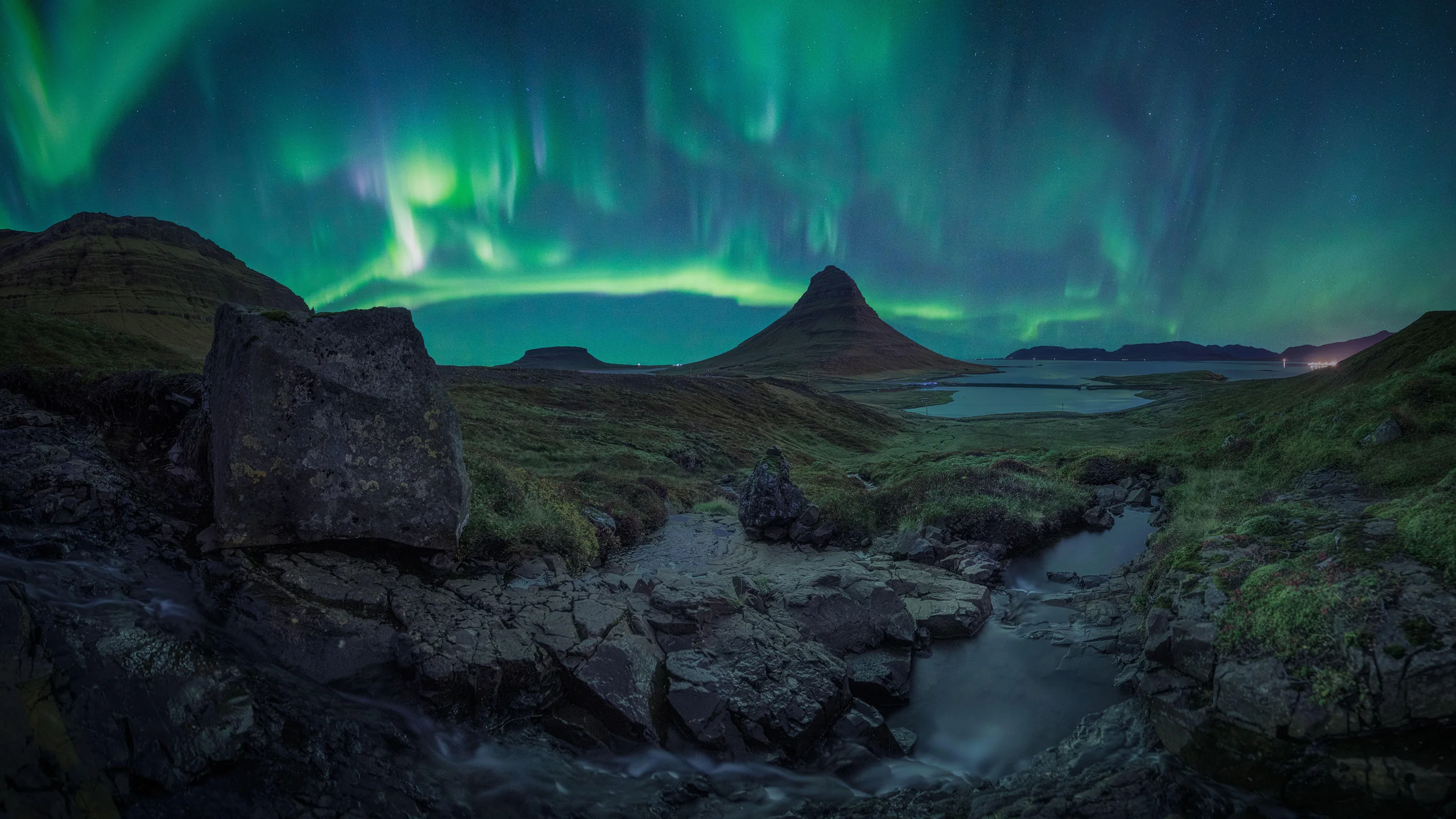
Image: Bing Daily Wallpaper | "Aurora borealis over Kirkjufell, Iceland (Cavan Images/Alamy)" | "Dancing skies" | Bing homepage
Open Bing's Chinese homepage today and the screen shows a sky just after dark. A green light hangs on the left, spreading at the top and narrowing below like a curtain stirred by wind. The sharp cone on the right is Iceland's Kirkjufell.
Its Icelandic name combines kirkja, church, and fell, mountain: Church Mountain. Danish sailors once called it Sugarloaf, while earlier Icelandic sources called it Firðafjall. The 463-meter mountain stands beside the town of Grundarfjörður on the northern coast of the Snæfellsnes Peninsula, facing Breiðafjörður Bay. It has been photographed almost absurdly often. It appeared in seasons six and seven of Game of Thrones, where characters described it as "the mountain shaped like an arrowhead." That was not a formal place-name in the series, just a character's description, later adopted by Iceland's tourism industry.
But the mountain is not today's real subject. The light above it is, along with a causal story nearly everyone remembers in reverse.
Those Electrons Were Not Blown Here by the Sun
The most familiar explanation for an aurora says that the Sun releases charged particles, which strike the atmosphere and make it glow.
The second half is right. The first half is wrong.
The aurora tutorial from the US National Oceanic and Atmospheric Administration's Space Weather Prediction Center says it directly: the electrons that produce auroras come from Earth's own magnetosphere, not directly from the solar wind. The solar wind charges Earth's magnetic field; it does not supply the bullets.
How are those electrons thrown downward? On February 26, 2008, NASA's THEMIS mission lined up five satellites while twenty ground stations across Canada and Alaska observed simultaneously, capturing the full process. On Earth's sunward side, the solar wind compresses magnetic-field lines. On the night side, it stretches them into a long magnetotail. Energy accumulates in the tail until, at some point, the field lines can stretch no farther. They snap apart and reconnect. This is magnetic reconnection, and it occurs at roughly one-third of the Earth-Moon distance, about 130,000 kilometers from Earth.
Project scientist David Sibeck said reconnection releases energy stored in the stretched field lines and flings charged particles back toward Earth's atmosphere. Principal investigator Vassilis Angelopoulos put it more elegantly: they had found what makes the northern lights dance.
The returning electrons are not free to go anywhere. They can travel only along magnetic-field lines, which converge at the poles like the ribs of an umbrella. Their impact zone is therefore not a point but a ring around each magnetic pole: the auroral oval.
Here is the counterintuitive part: the pole itself is usually dark. ESA describes the oval as lying between 65 and 70 degrees north and south latitude and "encircling the polar caps," which means the caps sit inside it. The ring is roughly 10 degrees wide, with its equatorward edge generally between 65 and 75 degrees magnetic latitude. Stranger still, its orientation relative to the Sun remains broadly fixed while Earth rotates beneath it. In the Northern Hemisphere, the ring crosses Scandinavia, Iceland and the southern tip of Greenland.
Iceland turns beneath that ring all year.
The Secret of Color Is Not What Gets Hit, but How Long It Can Wait
Now for color, the point this story most wants to make clear. The answer is unexpectedly simple.
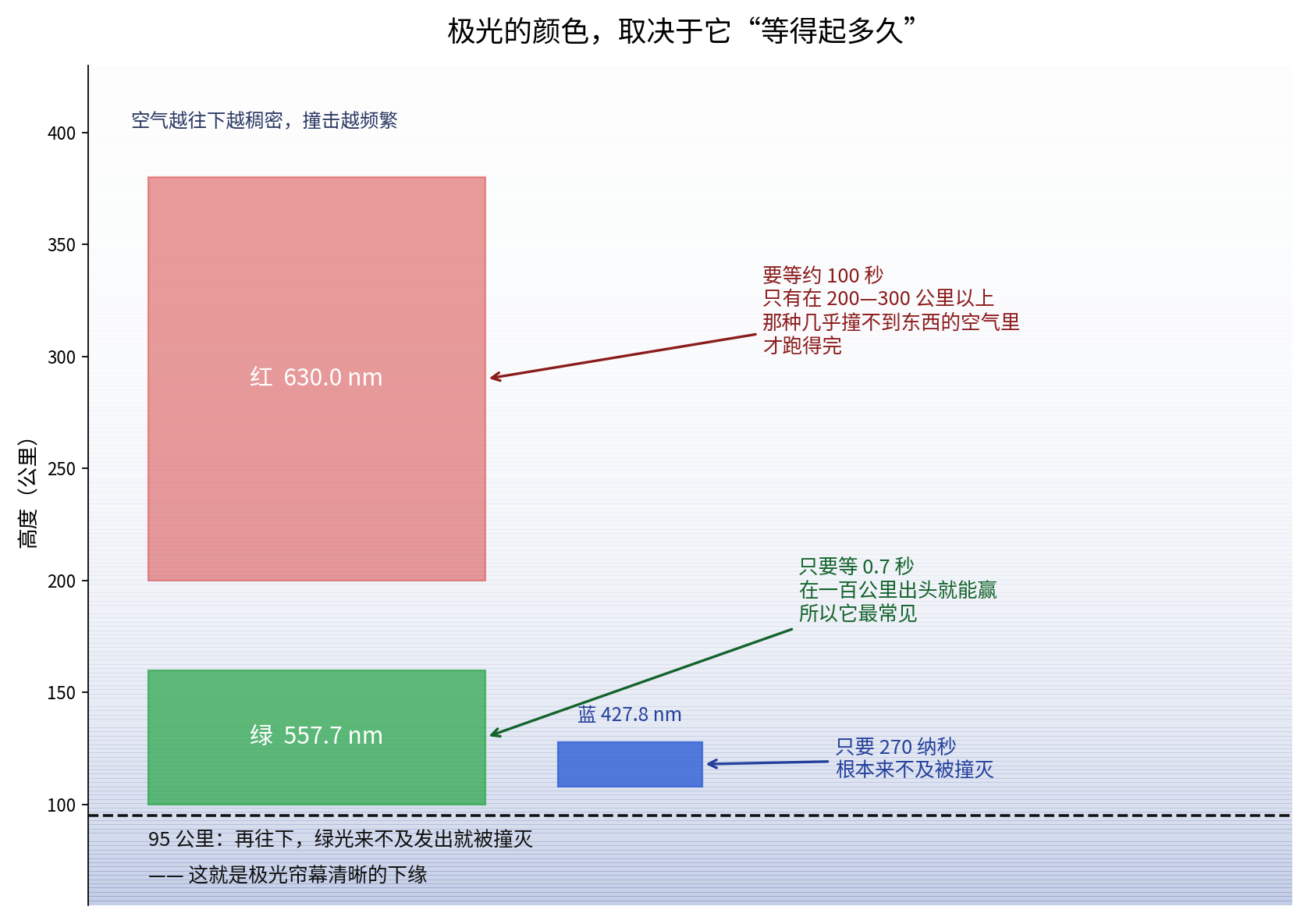
Auroral green comes from atomic oxygen at a wavelength of 557.7 nanometers. Red also comes from atomic oxygen, at 630.0 nanometers. Deep blue comes from ionized molecular nitrogen at 427.8 nanometers. If green and red both come from oxygen, why does the color change?
The crucial term is metastable state.
A high-speed electron strikes an oxygen atom and lifts it into a higher energy state. Quantum-mechanical selection rules prevent it from dropping back immediately; these transitions are called "forbidden lines." The atom has to wait. The green line's state lasts an average of 0.7 seconds, according to aurora scientist Dirk Lummerzheim of the University of Alaska Fairbanks. An independent calculation from transition probabilities gives 0.79 seconds, confirming the scale. The red line waits roughly one hundred seconds. Sources vary: Lummerzheim says about 100 seconds, SWPC says more than 150, and the scientific literature often gives 110. In every case, the scale is one or two minutes.
During that wait, a single collision with another molecule can turn the energy into heat, and the light is never emitted. This is collisional quenching.
The entire question becomes a race: the longer-lived the excited state, the thinner the air must be for it to survive long enough to shine.
Lummerzheim makes the mechanism explicit. Below about 95 kilometers, collisions are so frequent that the green oxygen line "does not get a chance" to be emitted. That is why an auroral curtain has a sharp lower edge. Electrons are present below it, but the air is too dense; green light is quenched before it can appear.
Red waits more than a hundred times as long as green, so it can complete the transition only above 200 to 300 kilometers, where collisions are exceedingly rare.
The blue line is different. This transition in ionized molecular nitrogen is allowed, with a lifetime of only 270 nanoseconds, 2.6 million times shorter than the green line. It has essentially no time to be quenched. Peer-reviewed measurements show that even at 90 kilometers, less than 1 percent of the blue emission is lost to quenching.
(One common mistake is worth correcting. The violet-red lower border of an auroral curtain is a mixture of deep-blue and red nitrogen emission, not "violet light at 427.8 nanometers.")
Auroral color is therefore governed not by what the electron strikes, but by how long the excited state can afford to wait. Green needs only 0.7 seconds and can win just above 100 kilometers. Red needs a hundred seconds and can finish the race only two or three hundred kilometers up.
Why a Phone Sees More Color Than Your Eyes
Nearly everyone who sees an aurora for the first time experiences the same disappointment: photographs glow vivid green, while the naked eye sees a gray-white haze.
The camera is not lying. The limitation belongs to the eye. SWPC explains that human night vision initially perceives bright auroras as pale white; only as the brightness rises do their true colors appear. Digital cameras can often capture fainter auroras and their colors better than the human eye.
The physiology is straightforward. Rod cells work in the dark. They are much more sensitive, but see only black, white and shades of gray. Aurora light is generally too faint for the color-sensitive cone cells.
A phone uses a different strategy: longer exposures, wider apertures, higher sensitivity and multi-frame processing in night mode. Computational-photography researcher Douglas Goodwin offers a useful formulation: in low light, the brain prioritizes motion and shape, and color is what it gives up.
So when someone says the photograph has been manipulated, the better answer is that the photograph is not exaggerating; your eyes deliberately abandon color in the dark.
Why Late August?
The date on which this image reached the homepage is itself informative.
Iceland's aurora season begins in late August, but the switch is controlled not by the Sun but by Earth's axial tilt. The Icelandic Met Office's aurora forecast states plainly that aurora viewing requires "dark and partly clear skies." Alongside its 0-to-9 aurora-activity forecast, it lists sunset, darkness and sunrise times for Reykjavik.
Iceland has no night in summer. Solar-position calculations for Kirkjufell, at 64.92 degrees north and 23.25 degrees west, with Iceland observing no daylight saving time, show that civil twilight first ends on July 28, nautical twilight first ends on August 19, and true astronomical night, with the Sun more than 18 degrees below the horizon, does not return until September 5.
On the night of August 26, sunset at Kirkjufell is at 21:13. The Sun descends only 14.63 degrees below the horizon, leaving just 3.7 hours darker than nautical twilight.
In other words, Icelanders see the aurora again in late August not because the Sun has become more active, but because the night has finally become dark again.
The official description of the Sun's activity requires precision. On October 15, 2024, NASA and NOAA jointly announced that the Sun had entered the solar-maximum period of cycle 25. But NOAA space-weather operations director Elsayed Talaat immediately added that the announcement "does not mean that this is the peak of solar activity we'll see this solar cycle." The exact peak month can be identified only in retrospect, after activity has declined for months or even years.
Another seasonal pattern is often overlooked: geomagnetic activity really is stronger around the equinoxes. The Russell-McPherron effect takes its name from a 1973 paper in the Journal of Geophysical Research. Because of the orientation of Earth's dipole axis around the equinoxes, the transverse component of the interplanetary magnetic field is effectively converted into a southward component, making reconnection with Earth's field easier. The semiannual variation peaks around March 20 and September 22, while the Russell-McPherron effect itself peaks near April 4 and October 7.
(An honest qualification: SWPC's three-day forecast issued at 1230 UTC on August 25 gave a maximum three-hour Kp of only 4.00 for August 25 through 27, below storm level. Geomagnetic conditions this week are actually quiet. This photograph was not taken tonight.)
Why Mohe Misses Auroras That London Sees
This is the part most worth explaining to readers in China.
Mohe Arctic Village lies at 53.48 degrees north. Kirkjufell lies at 64.94 degrees north. Their geographic latitudes differ by only 11.46 degrees. But auroras do not follow Earth's rotational axis. They follow its magnetic axis.
Using the NOAA geomagnetic model's dipole north-pole position, Kirkjufell's geomagnetic latitude is about 69.7 degrees, in the middle of the auroral oval's 65-to-75-degree belt. Mohe's is only about 44.6 degrees. The difference is 25 degrees.
There is independent support for the figure. A paper by Liu Qiang in the 2017 Bulletin of Mineralogy, Petrology and Geochemistry, vol. 36, no. 5, gives Mohe's geomagnetic latitude as 43.88 degrees, consistent with the calculation. It also gives a telling example. During the G4 geomagnetic storm of March 17, 2015, London, at 51.5 degrees geographic north, saw a spectacular aurora, while geographically more northerly Mohe saw nothing, because London's geomagnetic latitude is much higher.
Kirkjufell is only 11 degrees north of Mohe geographically, but 25 degrees north magnetically. That is why Iceland spends the year beneath the auroral oval while Mohe must wait for a major storm.
How major? The only public formulation from an official Chinese forecaster comes from the November 2025 storm. Chen Anqin, chief forecaster at the National Center for Space Weather, said auroras might be visible north of 40 degrees north latitude, with observers at higher elevations around 35 degrees north also able to try. Xinhua reported that the real-time geomagnetic activity index reached its maximum level of 9.
Verified Chinese aurora observations are not numerous, but they are substantial. From the night of November 5 into the early hours of November 6, 2023, red and green auroras appeared over Mohe Arctic Village and Jiagedaqi in the Greater Khingan Range, lasting more than seven hours at Mohe, according to the Heilongjiang provincial government. On May 11, 2024, the National Center for Space Weather issued a red geomagnetic-storm warning for a Kp=9 superstorm; auroras were photographed in Altay and Hami in Xinjiang, as well as Inner Mongolia, Gansu and Heilongjiang. On the night of September 12 into September 13, 2024, the Heilongjiang Department of Culture and Tourism reported that red, green and violet auroras could be seen with the naked eye dancing together above the river at Mohe Arctic Village.
Eight Hundred and Fifty Records, and "Five-Colored Light"
On a longer timescale, China has one of the richest bodies of auroral records on Earth.
In 1995, the Rutherford Appleton Laboratory in Britain published A Catalogue of Auroral Observations from China, Korea and Japan (193 BC-AD 1770), report RAL-TR-95-073. Its three authors were affiliated with the US Jet Propulsion Laboratory, Durham University in Britain and the British research council's Central Laboratory. The abstract called it the first comprehensive catalog of East Asian auroral records published in a European language. It spans 1,963 years and contains nearly 850 independent records.
Nearly eight hundred and fifty. More than a millennium later, entries describing "red vapor" and "white vapor spanning the heavens" have become raw data for modern reconstructions of historical solar activity.
An earlier account may push the oldest candidate aurora back by three centuries. In 2022, Hisashi Hayakawa of Nagoya University and independent scholar Marinus Anthony van der Sluijs published a paper in Advances in Space Research. They argued that the Bamboo Annals account of a "five-colored light" in the northern night sky late in the reign of King Zhao of Zhou is a candidate record of extreme space weather. They located the observation at Haojing and dated it to 977 or 957 BC, depending on the chronology adopted for the Zhou dynasty. The previous oldest candidates were Assyrian cuneiform records dated between 679 and 655 BC.
The authors were explicit about the uncertainty. The original Bamboo Annals was lost, excavated in the third century and lost again during the Song dynasty. A sixteenth-century variant describes the phenomenon as a comet rather than "five-colored light." The record can therefore be only a candidate. (A widely circulated sixteen-character quotation in Chinese could not be verified in any classical-text database or in the paper itself, so it is not reproduced here.)
China has since moved from recording space weather to monitoring it. The National Center for Space Weather is the China Meteorological Administration's second world-class operational center. On November 26, 2021, it joined the International Civil Aviation Organization's global space-weather center service as one of four centers, serving in rotations of roughly two weeks. In March 2025, phase two of the Chinese Meridian Project passed national acceptance. The Chinese Academy of Sciences described it as the world's first comprehensive ground-based space-environment monitoring facility covering every layer of Sun-Earth space. Its mid-latitude high-frequency radar covers an Asian sector more than 4,000 kilometers north to south and more than 10,000 kilometers east to west.
Two observatories are also in space. Xihe, launched on October 14, 2021, made the first space-based spectral imaging observations of the Sun in the H-alpha band. Kuafu-1, launched on October 9, 2022, has the scientific objective known as "one magnetic field, two eruptions": observing the solar magnetic field alongside flares and coronal mass ejections, the Sun's two most violent kinds of eruption.
A thousand years ago, people looked up and wrote down "five-colored light." Today, instruments travel between the Sun and Earth.
Sources: NOAA Space Weather Prediction Center's aurora tutorial and 30-minute forecast; NASA's report on THEMIS observations of magnetic reconnection; ESA's Cluster material on the auroral oval; Dirk Lummerzheim, "The Colors of the Aurora," in the US National Park Service's Alaska Park Science; 2023 measurements of auroral emission heights in Annales Geophysicae; the Icelandic Met Office aurora forecast; West Iceland's official Kirkjufell page; the joint NASA/NOAA 2024 announcement of solar maximum; Russell and McPherron (1973) and Lockwood et al. (2020); Liu Qiang, "Going to Mohe to See the Aurora?" in the 2017 Bulletin of Mineralogy, Petrology and Geochemistry, vol. 36, no. 5; aurora reports from the Heilongjiang provincial government, the Heilongjiang Department of Culture and Tourism and Xinhua in November 2025; Yau, Stephenson and Willis (1995), the East Asian aurora catalog; van der Sluijs and Hayakawa (2022), Advances in Space Research; official pages from the China Meteorological Administration and Chinese Academy of Sciences on the National Center for Space Weather, phase two of the Chinese Meridian Project, Kuafu-1 and Xihe; Gallardo-Lacourt et al. (2018), Geophysical Research Letters; Aurorasaurus; and the Norwegian tourism board's aurora photography guide.