
Today's NASA Astronomy Picture of the Day follows nearly an hour in the life of the northern auroral oval. On the ground, the lights look like curtains. From far above Earth, they form a ring.
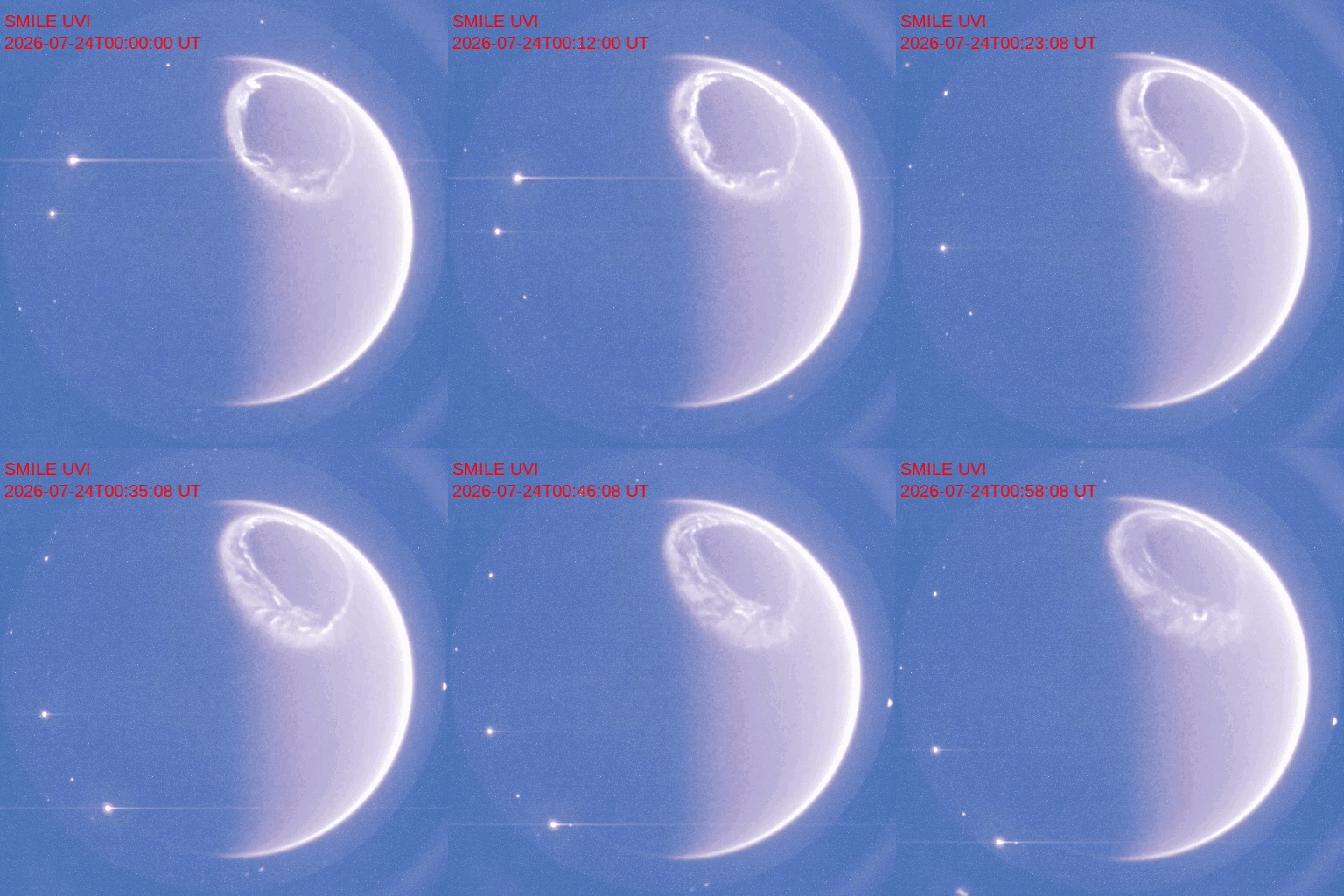
Image: ESA & CAS/Smile/UVI | License: CC BY-SA 3.0 IGO or ESA Standard Licence | Original page | ESA footage and licensing information.
ESA identifies the sequence as 00:00-00:58 Universal Time on July 24, 2026. The white ring ripples while distant ultraviolet stars appear to move as the spacecraft's viewpoint shifts.
This ring is the auroral oval. SMILE is the first spacecraft since 2008 to image the complete northern oval in ultraviolet. Its record-setting capability is to observe continuously for 45 hours. The released hour is a glimpse, rather than the full observing interval.
Why a Ring Lights Up
The solar wind continually meets Earth's magnetic environment. Energy released within that environment can accelerate charged particles along magnetic field lines into the upper atmosphere, where they make gases glow.
Viewed from above, the emissions occupy a band around a magnetic pole. A person on the ground sees only a local part of it. The oval is a changing region, expanding and shifting with geomagnetic activity.
ESA says the rippling in this sequence indicates a substorm, a relatively brief disturbance that can intensify auroras. The length of the clip alone does not identify exactly which stage of that event it contains.
Room for the Whole Oval
SMILE's highly elliptical orbit takes it about 121,000 kilometers above the North Pole at apogee. ESA compares that height with almost a third of the distance to the Moon.
The ultraviolet imager's instrument paper reports a circular field of view of 9.97 degrees. To fit the large auroral oval within that limited angle, the spacecraft needs a distant vantage point.
The orbit also makes prolonged observation possible. A local brightening may disappear quickly; a long global sequence can place that event within the wider activity of the magnetic system.
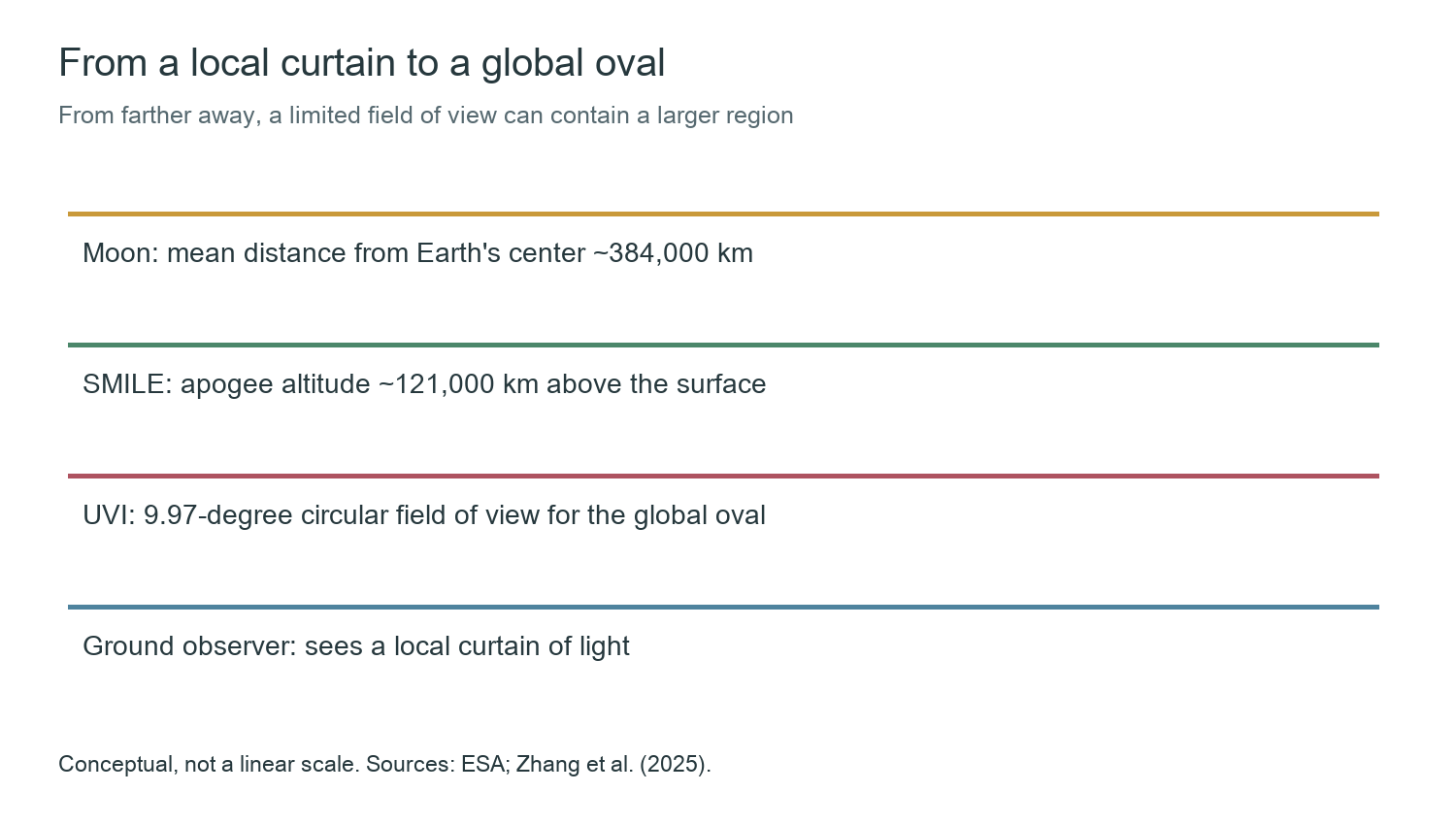
Diagram: The Daily Backstory, based on ESA and Zhang and colleagues' 2025 instrument paper. The distances are labeled with their reference points; this is not a linear scale.
Daylight Does Not Switch the Aurora Off
People normally need dark skies to see auroras because daylight overwhelms their visible glow. The auroras themselves can persist on the daylight side.
UVI observes the 160-180-nanometer ultraviolet band, including molecular nitrogen's Lyman-Birge-Hopfield emissions. Its optical design suppresses unwanted light outside the band and limits contamination from dayglow.
That allows it to study a part of the oval a visible-light camera would struggle to distinguish. The instrument does not darken the Sun. It selects a more useful part of the spectrum.
A Camera Built Across Borders
SMILE is a joint mission of the European Space Agency and the Chinese Academy of Sciences. It launched on May 19, 2026, reached its target science orbit on June 20, and was approved to begin science operations on September 23.
China's National Space Science Center led UVI's development with the Centre Spatial de Liege in Belgium. Contributors include the University of Calgary, ESA and the Chinese Polar Research Institute. A camera looking down at auroras from space also draws on expertise developed beneath them.
Beginning science operations does not mean every instrument has achieved every intended view. ESA reported on September 30 that the soft X-ray imager, SXI, had obtained test images of supernova remnants but still detected too much stray light when pointed toward Earth. Teams were adjusting settings and software, hoping for a good magnetopause or northern polar-cusp image in mid-October. That remains an anticipated result.
Together, SMILE's instruments will investigate connections between the solar wind, the magnetosphere and the auroras. Those connections also matter to satellites, communications and electrical infrastructure on the ground.
Far above Earth, a curtain becomes a changing ring. Distance changes the question: from how bright the sky is here, to how the whole system is responding.
Sources
NASA APOD: A Complete Auroral Oval from SMILE; ESA: Science begins for Smile; ESA: Smile's ultraviolet vision; ESA: mission overview; Zhang et al.: Ultraviolet Imager for the SMILE Mission (2025).