
The encapsulated Roman Space Telescope travels to the hangar at Kennedy Space Center's Launch Complex 39A.
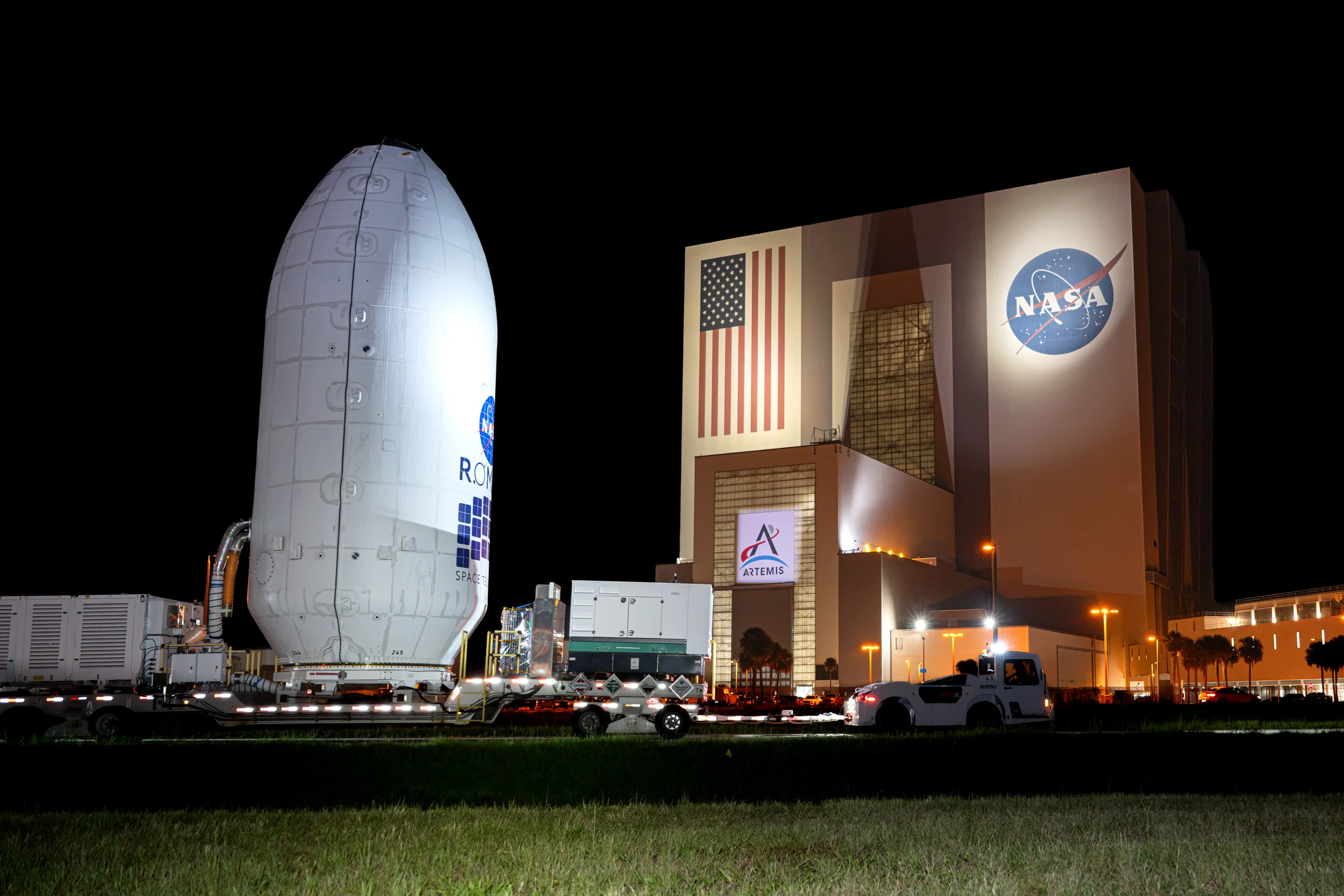
Image: NASA Image of the Day | Image credit: NASA/Sydney Rohde | Image page
The white cylinder in the photograph, which offers no clue about its contents, is on the move.
It is a payload fairing about 13 meters tall. Inside is a telescope, and no one will probably see it again before it leaves Earth. On August 21, the team sealed it inside at Kennedy Space Center's Payload Hazardous Servicing Facility. On Tuesday, August 25, the encapsulated payload traveled to the hangar at Launch Complex 39A. Over the next few days, it will be joined to a Falcon Heavy rocket.
At 7:26 a.m. Eastern time on Sunday, August 30, it will leave.
In Beijing, that is 7:26 p.m. the same day. A Sunday evening launch is one a family can watch together.
Its name is the Nancy Grace Roman Space Telescope.
The Telescope in One Sentence
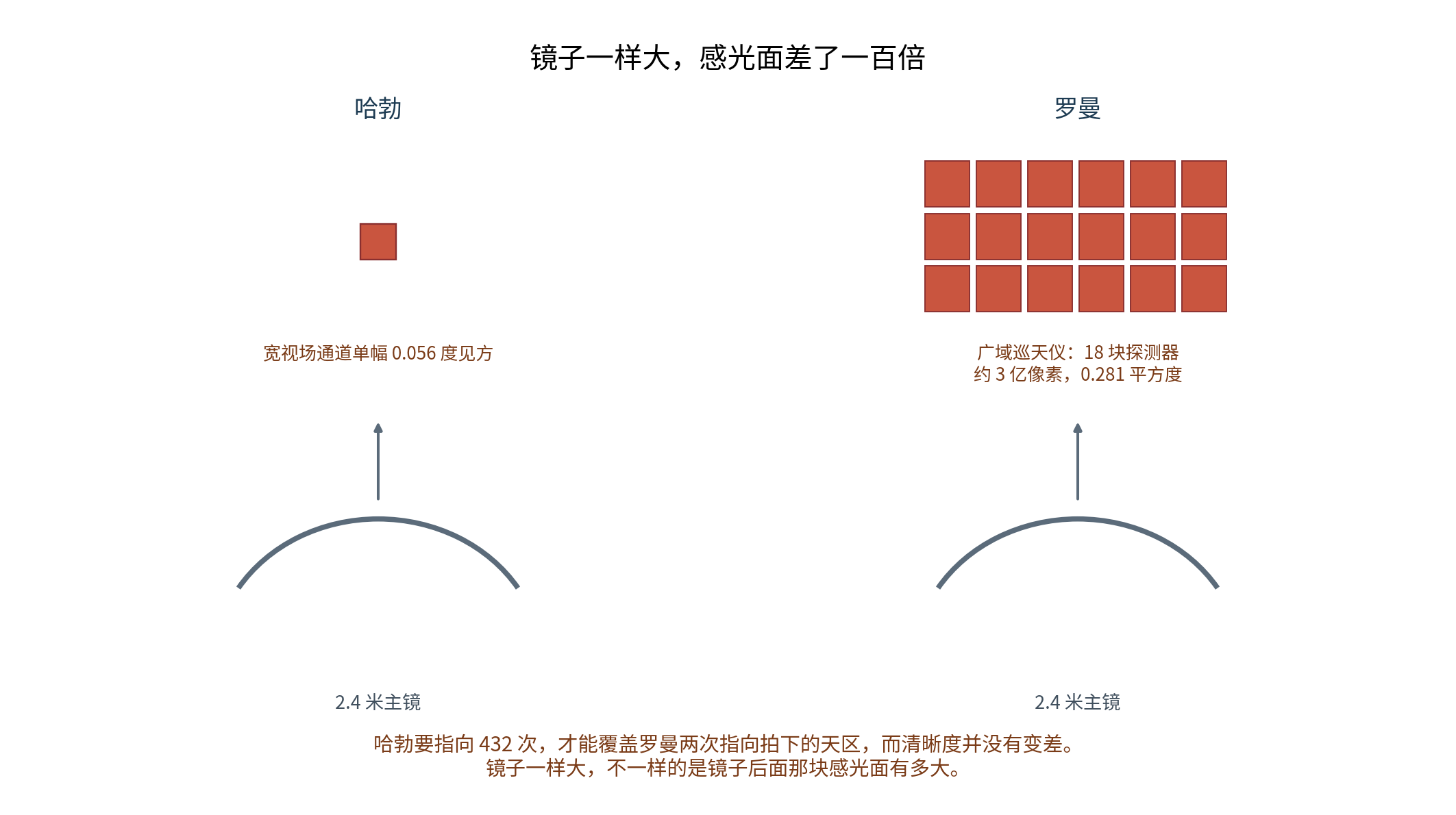
Roman's primary mirror is 2.4 meters across.
Hubble's primary mirror is also 2.4 meters across.
They are identical in size.
Yet Roman can image more than one hundred times as much sky in a single exposure.
That sounds impossible. How can the same-size mirror see a field a hundred times wider?
The answer is that the mirror determines how much light the telescope can collect and how finely it can see; the field of view depends on the area of the light-sensitive surface spread behind the focus.
It is the same eye with a retina a hundred times larger.
Roman's "retina" looks like this. The Wide Field Instrument's focal plane holds 18 detectors side by side. Each has 4096 x 4096 pixels, for a total of about 300 million pixels. NASA's own explainer describes each of the eighteen chips as about the size of a soda cracker. Together they cover 0.281 square degrees of sky. Hubble's wide-field channel covers only 0.056 degrees on a side in a single exposure.
Crucially, the wider view does not sacrifice resolution. Roman's pixel scale is 0.11 arcseconds per pixel, and NASA's technical page describes it as having better sensitivity and comparable spatial resolution to Hubble.
It is not making a larger picture by making it blurrier. It is genuinely making the same sharp picture over a larger area.
NASA's comparisons are direct. Hubble's wide-field camera needs 432 pointings to cover the area Roman captures in two. Roman can make a complete portrait of the Andromeda galaxy nearly 1,500 times faster than Hubble. In the near-infrared, a few months of Roman observations can survey the area Hubble covered in thirty years.
(NASA's own figures are not fully consistent. The mission homepage and renaming announcement say "at least 100 times," while a Goddard Space Flight Center technical page says "about 200 times" because it compares Roman with Hubble's near-infrared WFC3-IR camera. The difference depends on which Hubble camera is used for comparison.)
The mirror itself has a story. NASA's official wording is that the mission "leveraged a primary mirror that was transferred to NASA from the National Reconnaissance Office." The team then modified the mirror's shape and surface and applied a new silver coating less than 400 nanometers thick. Once finished, its average surface variation was only 1.2 nanometers, more than twice as smooth as the mission required. It weighs just 186 kilograms, far less than a conventional mirror of the same size.
A mirror originally built to look down was remade to look up.
Three Jobs for This Eye
First: count galaxies and search for dark energy.
Roman's High-Latitude Wide-Area Survey will cover more than 5,000 square degrees over roughly 17 months. It will use weak gravitational lensing and galaxy clustering, inferring the distribution of invisible matter from the slight distortions in the shapes of distant galaxies, along with baryon acoustic oscillations and redshift-space distortions. NASA says Roman may measure light from one billion galaxies over its lifetime.
Second: find planets through gravitational microlensing. This is the one worth explaining.
NASA's explanation translates directly: light travels in straight lines, but near a massive body such as a star, spacetime is curved, so light follows the curve.
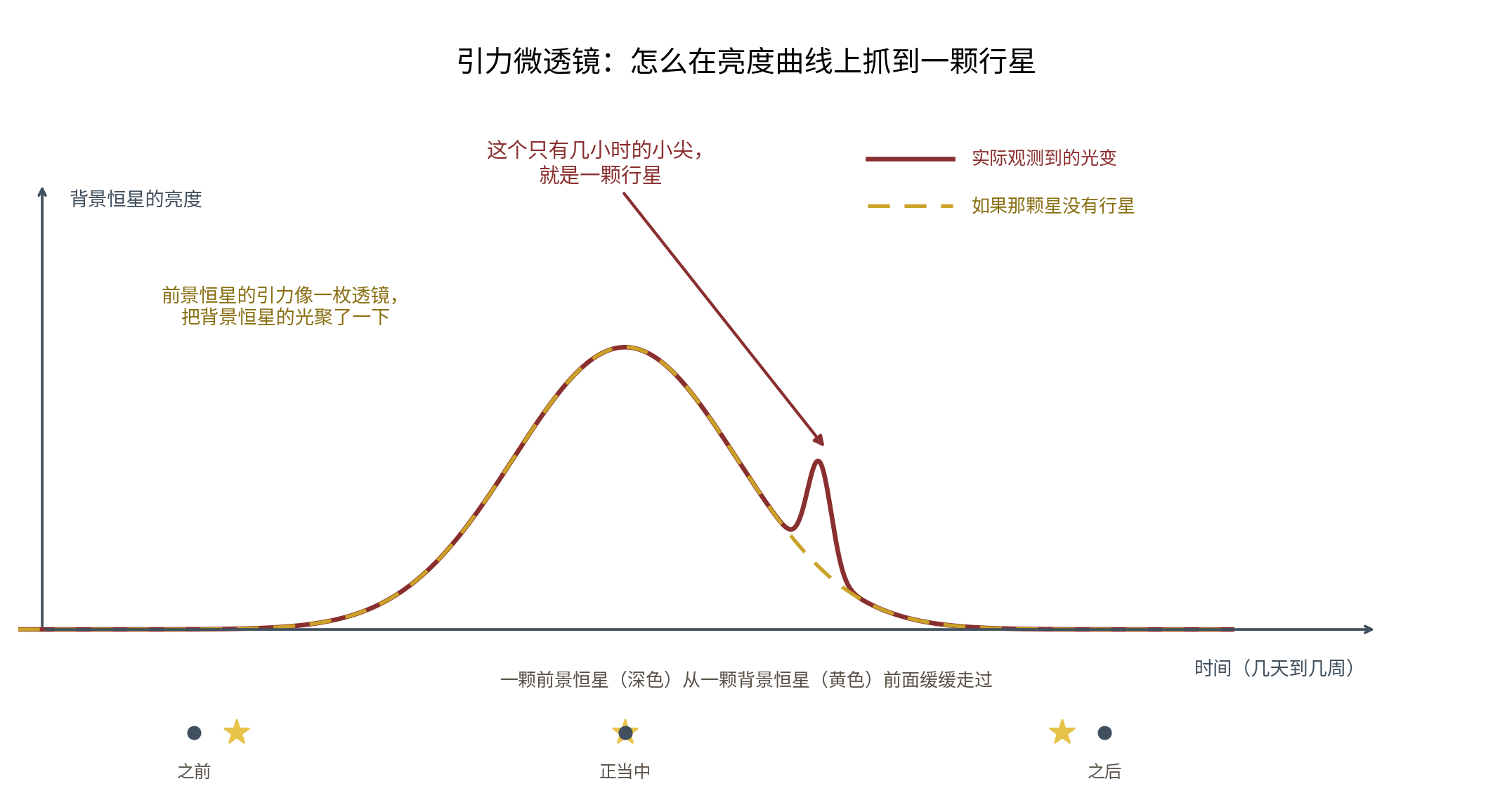
When a foreground star passes almost exactly in front of a background star, its gravity acts as a lens and briefly focuses the background star's light. The distant star quietly brightens for days or weeks and then fades again.
If the foreground star has a planet, the planet's gravity adds a small bump lasting only a few hours to that smooth light curve.
That small bump is a planet.
Microlensing has an advantage that the transit and radial-velocity methods do not: it does not require the planet to emit light, does not require its orbit to line up edge-on from Earth, and does not even require it to have a host star.
The transit method is especially good at finding planets larger than Neptune in orbits closer than Mercury's. NASA is candid: extraterrestrials using the transit method to observe our Solar System might not detect a single planet. Microlensing is best at finding precisely the worlds farther out, from the habitable zone onward: cold, distant planets on wide orbits.
Roman will monitor 200 million stars toward the center of the Milky Way. It is expected to find more than 1,000 planets in and beyond their stars' habitable zones, and may collect as many as 100,000 more through transits. It is particularly suited to rogue planets, worlds ejected from their home systems and left to drift alone in the dark. (A 2023 study predicted that Roman might find 400 Earth-mass rogue planets. That is a research prediction, not an official mission target.)
Third: practice a technique needed for the future. Roman carries a coronagraph designed to block starlight and directly image planets. NASA's benchmark is the ability to image a planet almost a billion times fainter than its host star, an improvement of two to three orders of magnitude over any coronagraph previously flown in space. Adjustments made by its deformable mirror are smaller than the width of a strand of DNA.
The instrument is a technology demonstration. It is scheduled to complete that demonstration in the mission's first 18 months and, if successful, will then become available to the scientific community. It will demonstrate direct imaging of Jupiter-class worlds around Sun-like stars. Its real destination is a future telescope able to photograph Earth-like planets.
The Telescope Bears Her Name, and She Was Told Not to Study Mathematics
Nancy Grace Roman was born in Nashville on May 16, 1925, and died on December 25, 2018, at the age of 93.
At eleven, while living in Reno, Nevada, she organized her classmates into an astronomy club and used a book to learn the constellations. By seventh grade, she had decided to become an astronomer.
Then came the remark.
NASA's biography records that when she chose algebra instead of Latin, a high-school guidance counselor responded dismissively:
"What lady would take mathematics instead of Latin?"
Roman earned her doctorate from the University of Chicago in 1949. She joined NASA in 1959, only six months after the agency was established. In 1960, she became NASA's first chief of astronomy and its first woman executive.
Her life's largest project was Hubble.
Her work was the kind stories often omit: leading scientific and planning committees, bringing scientists and engineers to the same table, briefing government officials, lobbying NASA leaders and establishing a minimum set of technical requirements for the telescope as a negotiating position with Congress. NASA says that securing congressional approval for Hubble was one of the greatest challenges of her career.
One detail is worth remembering. When Senator Proxmire questioned Hubble's cost, Roman calculated that the annual cost to each American would equal the price of one movie ticket, in return for fifteen years of exciting discoveries.
Hubble chief scientist Ed Weiler later called her the "Mother of Hubble," paired with Lyman Spitzer's title as its father.
On May 20, 2020, NASA renamed the telescope, formerly WFIRST, the Nancy Grace Roman Space Telescope. Thomas Zurbuchen, then associate administrator for the Science Mission Directorate, said her name deserved a place in the heavens she studied and opened for so many.
It Is Arriving Early
The telescope's schedule contains a rarity: it is ahead of plan.
NASA's June 3 blog called the August 30 launch date "eight months ahead of schedule, and even earlier than previously targeted." Its August 10 blog said "nine months early." Those figures come from two NASA posts and do not agree, so both are given here.
Space telescopes almost never run early.
The 2026 timeline unfolded this way. Roman arrived at Kennedy Space Center on June 21 and entered a Payload Hazardous Servicing Facility specially upgraded for it. Teams tested the solar arrays, inspected thermal blankets and loaded about 290 gallons of hydrazine. Launch-integration operations began on August 10. The launch rehearsal was completed August 20. Roman passed its flight readiness review on August 21 and was encapsulated in the fairing the same day. On August 25, the journey shown in today's photograph brought it to the hangar at Launch Complex 39A.
Next comes the launch readiness review on Friday, August 28, followed by two press conferences on August 29 and launch on August 30.
NASA explains that the fairing maintains a safe, controlled environment for Roman on the ground and allows the team to transport it out of the facility. During ascent, it protects the instruments from acoustic vibration, aerodynamic pressure and aerodynamic heating. The fairing separates on the way to orbit, and Roman continues toward the Sun-Earth L2 Lagrange point, about 1.5 million kilometers from Earth. SpaceX will recover and reuse the two fairing halves.
China Is Solving the Same Problem
Wide fields and frequent revisits are a shared language in contemporary astronomy, and China is writing its own answer.
The China Space Station Telescope, or CSST and also known as Xuntian, has a 2-meter aperture and five observing instruments, including an exoplanet-imaging coronagraph. It will fly independently in an orbit shared with China's space station, carrying its own fuel. When necessary, it can rendezvous and dock with the station for refueling, repairs and equipment upgrades. Its planned mission life is ten years, with servicing able to extend it. Roman cannot do this. Once it travels to L2, 1.5 million kilometers away, no one can touch it again.
A 2022 Chinese Academy of Sciences article offered a metaphor nearly identical to "the same eye with a larger retina": imagine a flock of sheep on a mountain. Hubble can photograph one sheep; CSST can photograph thousands or tens of thousands at once, with every sheep as clear as the one Hubble sees.
Official figures for the field-of-view comparison vary. A 2023 Xinhua report says about 300 times Hubble's field, while 2022 reports from the Chinese Academy of Sciences and Xinhua say 350 times larger. Galaxy counts likewise appear as both "more than one billion" and "nearly two billion." All are official sources, so both formulations are retained. The survey module is planned to cover 40 percent of the entire sky. In January 2026, the National Astronomical Observatories, Purple Mountain Observatory and Tsinghua University's astronomy department jointly released an end-to-end observation simulation suite for overall performance evaluation and exoplanet-detection preparation.
As for its launch date, no Chinese authority had announced one by publication time. Official articles in 2022 and 2023 said it was expected in 2023, a date that has passed. The China Manned Space Agency's annual mission plan, released February 27, 2026, did not mention the telescope at all. The various years circulating online have no named official source.
For a Chinese wide-field telescope already at work, there is the Mozi Survey Telescope, or WFST, which has been observing for four years.
Developed jointly by the University of Science and Technology of China and the Chinese Academy of Sciences' Purple Mountain Observatory, it is the first large telescope built by a Chinese university. Its primary mirror is 2.5 meters wide, its effective field of view is 6.5 square degrees, roughly thirteen times the Moon's apparent diameter, and its mosaic CCD camera has 765 million pixels. It stands on Saishiteng Mountain at Lenghu in Qinghai, at an elevation of about 4,200 meters.
On September 17, 2023, it formally began survey observations and released its first-light image of the Andromeda galaxy. Its capability is concise: every three nights, it surveys the entire northern sky.
Roman at L2 will scan the Galactic center every 12.1 minutes. Mozi at Lenghu scans the northern sky every three nights. The two telescopes share an idea: gain reach through a wider field and faster revisits, not simply a larger mirror.
Sources: NASA Image of the Day for August 26, 2026; NASA's Roman launch countdown page and launch-coverage release; NASA's June 2026 Roman press kit; NASA Roman mission blog posts from June through August 2026; NASA's Hubble-Roman comparison; Goddard Space Flight Center pages on the Wide Field Instrument and High-Latitude Wide-Area Survey; NASA pages on microlensing and exoplanets; NASA's coronagraph page and CGI technical reference; NASA's report on completion of the primary mirror; NASA, "Who Was Nancy Grace Roman?" and its Roman biography; NASA's telescope-renaming release of May 20, 2020; the IPAC/Caltech report on rogue-planet research; NASA's Exoplanet Watch citizen-science page and Roman Space Observer game; reports from the Chinese Academy of Sciences and Xinhua on the China Space Station Telescope; the official CSST site of the National Astronomical Observatories; the China Manned Space Agency's 2026 mission plan; Chinese Academy of Sciences and Ministry of Science and Technology reports on first light from the Mozi Survey Telescope; and the Mozi Survey Telescope's official website.