
How can a mirror the same size as Hubble's see 100 times more sky at once?
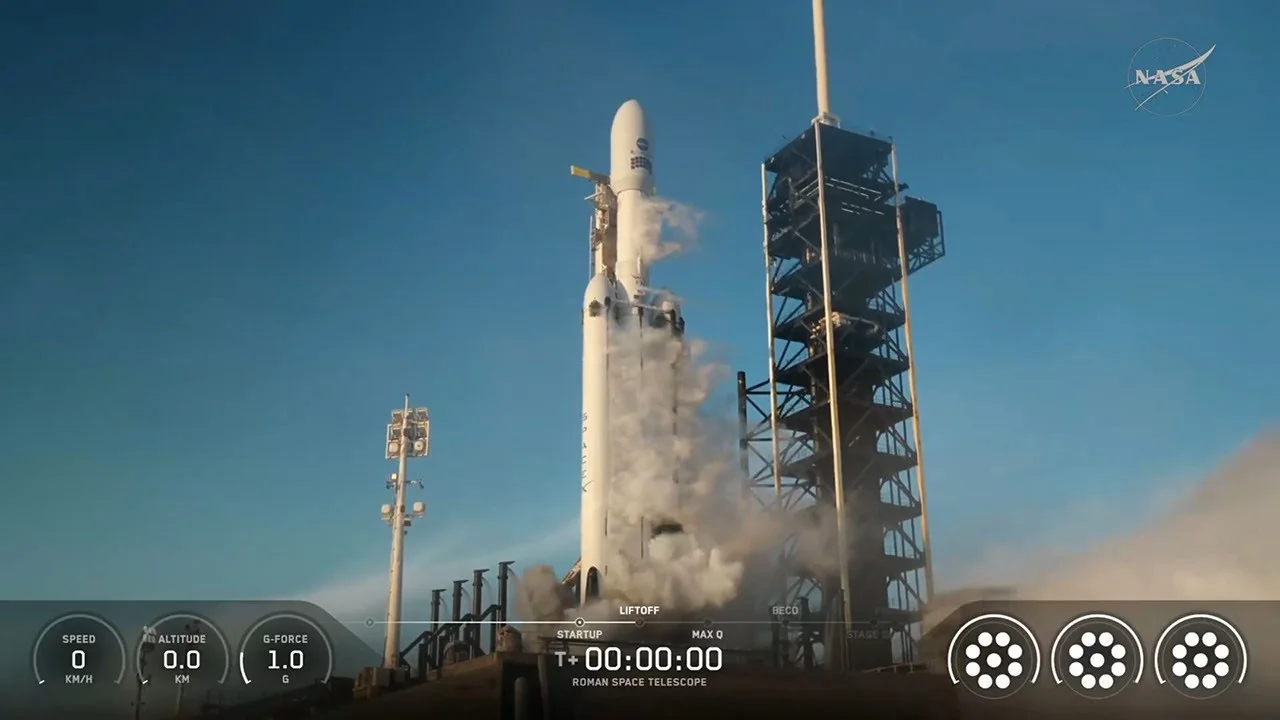
Image: NASA Astronomy Picture of the Day (APOD) | Video credit: NASA | Today's page
Today's NASA Astronomy Picture of the Day is not a picture. It is a video.
That is unusual for a feature that has spent more than two decades selecting one image of the universe each day and pairing it with an astronomer's explanation. Today, a still frame was not enough for what happened yesterday:
A new space telescope launched.
Yesterday at 7:26 A.M.
The launch came at 7:26 a.m. Eastern time on Sunday, August 30, 2026. That was 11:26 UTC and 7:26 p.m. in Beijing.
The site was Launch Complex 39A at Kennedy Space Center in Florida, the pad from which Apollo's Moon rockets once departed. The vehicle was a SpaceX Falcon Heavy, with 27 Merlin engines and, according to NASA's release, "more than five million pounds" of thrust.
NASA confirmed the next steps. The ground received the telescope's signal about seven minutes after liftoff. The spacecraft separated from the rocket at T+31 minutes. Its solar arrays and lower instrument sunshade finished deploying one hour and 23 minutes after launch.
Its name is the Nancy Grace Roman Space Telescope.
The Girl Asked, "Which Lady Would Take Mathematics Instead of Latin?"
Before the telescope comes the name.
Nancy Grace Roman was born in Nashville, Tennessee, on May 16, 1925, and died on December 25, 2018, at 93. She was NASA's first chief astronomer and the first woman to hold an executive position at the agency.
Her mother was the first person to teach her the constellations and took her to see the aurora in Michigan. Her mother was also one of the people who later told her that science was not an appropriate career for a woman. The person who opened the sky for her also tried to close it.
In high school, Roman wanted to replace a fifth year of Latin with a second year of algebra. NASA's oral-history project preserves her memory of the guidance counselor's response:
"Which lady would take mathematics instead of Latin?"
Roman remembered the counselor as seeming "about 10 feet tall" as she looked down at her. Her verdict was that the discouragement "couldn't have been more obvious."
She also said, "I was told from the beginning that women could not be scientists," and, "If I hadn't been stubborn, I would have been discouraged very early in the game."
Roman later became central to turning the Hubble Space Telescope from a proposal into a project funded by Congress. When lobbying lawmakers, she used an argument every science communicator could learn from: for the cost to each American of one movie ticket a year, the country could have 15 years of exciting discoveries.
Her colleague, astronomer Ed Weiler, gave her the nickname "Mother of Hubble." It was a nickname, not a title conferred by NASA. The agency's formal description has always been "NASA's first chief astronomer."
After retiring, Roman taught science to middle-school students in Washington, D.C., and recorded audio textbooks for students with visual impairments.
On May 20, 2020, NASA renamed the telescope, previously called WFIRST, in her honor. On July 28 this year, workers attached a commemorative plaque to it, along with a memory card holding 1,350,144 names submitted by the public.
One million, three hundred fifty thousand, one hundred forty-four names are now traveling 1.5 million kilometers from Earth.
The Mechanism: The Same Mirror, One Hundred Times the Sky
Roman's primary mirror is 2.4 meters in diameter. Hubble's primary mirror is also 2.4 meters.
They are the same size.
Yet today's APOD says Roman can see 100 times more sky in each snapshot. NASA often puts it this way: one Roman image contains as much detail as 100 Hubble images.
How can equal mirrors differ by a factor of 100?
A common explanation points to Roman's more strongly curved mirror and closer secondary mirror. That is directionally right, but it misses the component that does the immediate work.
The answer is behind the mirror.
A camera's optics compress a patch of sky onto a plane, where a detector catches it. The mirror determines how much light arrives and how fine the detail can be. The detector area covering the focal plane determines how much sky can be captured at once.
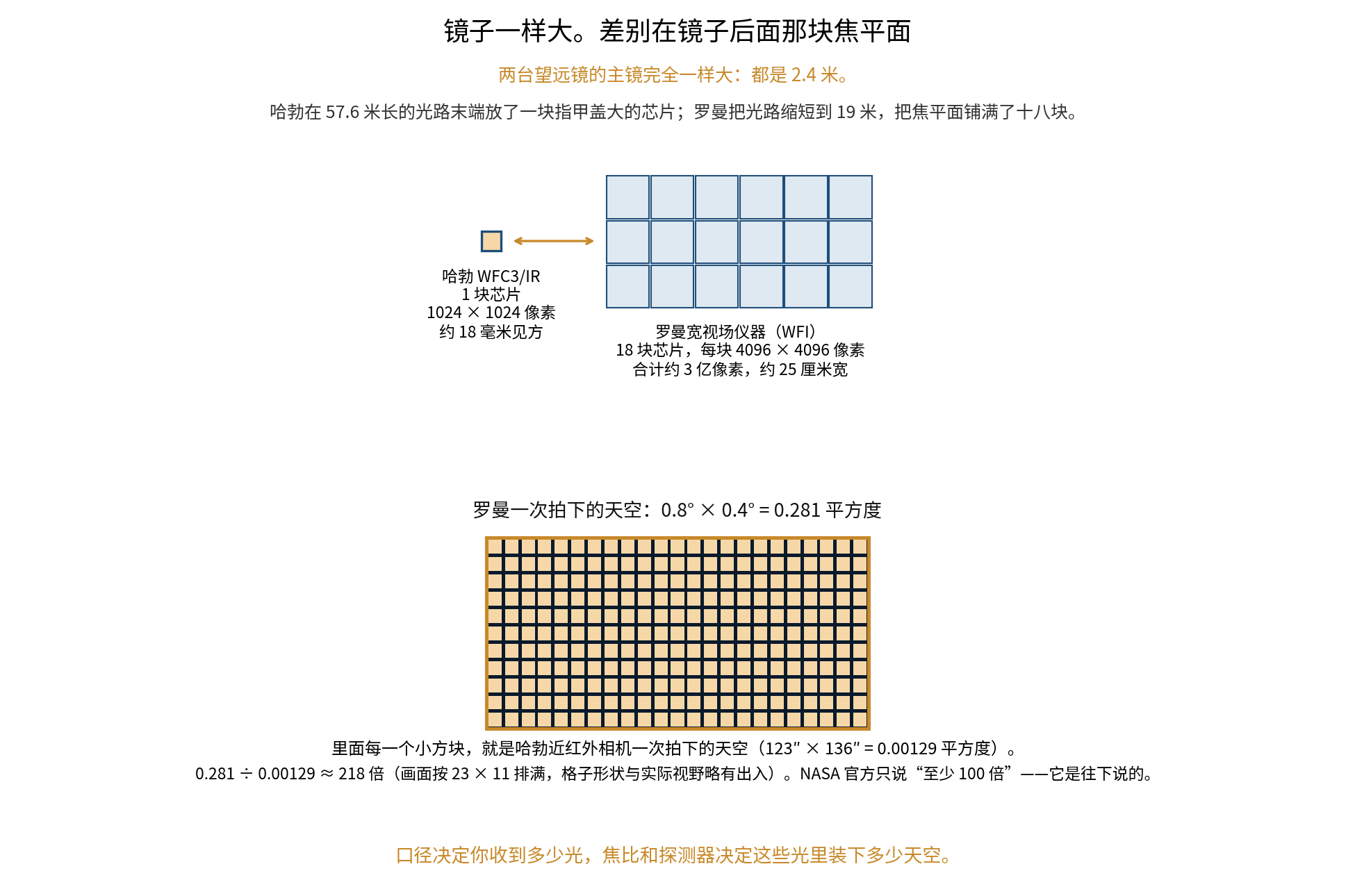
Hubble's near-infrared camera, WFC3/IR, uses one 1024 x 1024 detector. It has just over one million pixels and is little larger than a fingernail.
Roman's Wide Field Instrument, or WFI, uses 18 detectors, each 4096 x 4096 pixels, tiled across the focal plane for a total of about 300 million pixels.
NASA gives Roman's effective field of view, after accounting for gaps between the detectors, as 0.281 square degrees. Hubble's WFC3/IR covers 123 by 136 arcseconds, or 0.00129 square degrees.
Divide one by the other and the result is about 218.
NASA's "at least 100 times" is therefore conservative. Against Hubble's infrared camera, the raw figures put Roman closer to 200 times. There is no need to correct NASA; an institution understating its own promotional comparison is noteworthy in itself.
What, then, do the more curved primary and closer secondary accomplish? They make the enormous focal plane possible. Hubble folds light through a 57.6-meter optical path before forming an image, at f/24. Roman's path is only 19 meters, at f/7.9. A shorter path makes the same patch of sky occupy less space at the focal plane. That lets a detector array a little over 20 centimeters wide hold a field 0.8 by 0.4 degrees. At Hubble's f/24, the same 18 detectors would see only about one-ninth as much sky while magnifying each detail beyond what was useful.
In one sentence: aperture determines how much light arrives; focal ratio and detector area determine how much sky that light contains.
Hubble placed a fingernail-sized detector at the end of a 57-meter path. Roman shortened the path to 19 meters and tiled the focal plane with 18 detectors.
Several other figures are startling. Although the primary mirrors are equally large, Hubble's weighs 828 kilograms and Roman's only 186 kilograms, less than one-quarter as much. Roman's mirror is coated not with aluminum but with silver. The silver layer is less than 400 nanometers thick, which NASA describes as about 200 times thinner than a human hair. The average variation across its surface is 1.2 nanometers, more than twice as smooth as the mission requires.
The mirror's origin should be described in NASA's own terms. It was "transferred to NASA by the National Reconnaissance Office," and the team "modified the mirror's shape and surface to meet Roman's science goals." On June 4, 2012, the NRO announced that it was donating two complete 2.4-meter telescope assemblies to NASA. Both were new and unused, with their sensors and electronics removed. The familiar description "spy-satellite mirror" has never been confirmed by the NRO or NASA and is not used here.
Only one of those assemblies became Roman. The other remains in storage, with neither a mission nor funding. A complete Hubble-class optical system is sitting in a box.
Three Jobs for the Next Five Years
Roman's primary mission is five years, with support designed for a five-year extension. It will not orbit Earth. It is traveling to a halo orbit near the Sun-Earth system's second Lagrange point, L2, about 1.5 million kilometers away on Earth's night side.
Instead of circling Earth, it follows Earth around the Sun and stays near the extended Sun-Earth line, like a kite on a tether. From there, one sunshade can block the Sun, Earth and Moon at once. The trip takes three months, followed by three months of commissioning in orbit. NASA expects the first images in early 2027.
Roman will then concentrate on three programs.
1. A wide-area deep-space survey, lasting about 17 months. An intermediate tier covers 2,400 square degrees and an outer tier another 2,700. Together they exceed 5,000 square degrees, about 12 percent of the entire sky. Roman will measure the shapes and distances of hundreds of millions of galaxies to trace the history of cosmic expansion.
2. A high-latitude time-domain survey, using a cumulative six months of observing time over roughly two years. Its wide tier spans more than 18 square degrees, an area NASA compares to 90 full Moons, and returns to it every five days for two years. The survey is expected to find about 27,000 Type Ia supernovas, "roughly 10 times the combined total of all previous surveys," in NASA's words. With core-collapse and superluminous supernovas and tidal disruption events included, the total rises to about 100,000 cosmic explosions.
3. A Galactic bulge time-domain survey, lasting about 15 months. Six fields cover 1.7 square degrees, exactly six WFI fields of view, and Roman will revisit them every 12 minutes across six observing seasons. It will monitor hundreds of millions of stars.
That third program is not really a collection of photographs. An image every 12 minutes for months is a movie. The same instrument will spend other seasons mapping 5,000 square degrees of deep space. Its ability to work at both scales is one of Roman's defining strengths.
Finding Planets With Gravity, and a Chinese Name
The third program will search for exoplanets through gravitational microlensing.
When a foreground star passes almost exactly in front of a distant background star, its mass curves spacetime and focuses some of the background star's light. In NASA's phrase, it becomes "a natural magnifying glass," briefly making the background star brighter. If the foreground star has a planet, that planet adds a smaller, shorter bump to the brightening curve.
The distinctive point is that the planet is found through its gravity, not its light.
The method can therefore detect cold, distant planets and even worlds with no star at all, populations beyond the reach of Kepler and TESS. Peer-reviewed forecasts suggest Roman may find about 1,400 planets orbiting stars. About 200 may have masses below three Earth masses, and sensitivity could extend to roughly 0.02 Earth masses, comparable to Ganymede. Roman may also find about 250 free-floating planets, down to Mars mass, around 60 of them no more massive than Earth.
Now for the Chinese name.
The foundational paper proposing gravitational microlensing as a way to find planets was Mao and Paczyński's 1991 paper in The Astrophysical Journal, "Gravitational Microlensing by Double Stars and Planetary Systems."
The "Mao, S." on that paper is Shude Mao.
He was a researcher at the National Astronomical Observatories of the Chinese Academy of Sciences from 2010 to 2018 and became chair of Tsinghua University's Department of Astronomy in April 2019. Three decades after his foundational work, he also appeared among the authors of Penny et al. 2019, which forecast that Roman could find roughly 1,400 planets by this method.
A Chinese astronomer proposed the method in 1991. Thirty-five years later, a telescope named for America's first chief astronomer carried it into space. He also helped calculate how many planets it might find.
Roman has a fourth project, the coronagraph. NASA describes it as a system of masks, prisms, detectors and mirrors that can change shape, all working to block the glare of distant stars and photograph the planets beside them directly. It is a technology demonstration intended to perform two to three orders of magnitude better than any coronagraph previously flown. Its goal is to test technology for the future Habitable Worlds Observatory. Roman will image giant planets like Jupiter, but the direction of travel is clear.
1.4 Terabytes a Day, With No Proprietary Period
Roman will transmit about 1.4 terabytes of data each day, more than any previous NASA astrophysics mission. Hubble sends about 2.7 gigabytes a day and Webb 58 gigabytes. Roman will produce in one day roughly as much data as Hubble does in one year and four months.
NASA's FAQ makes an even more consequential statement:
"There are no proprietary data periods, and 100% of the observing time is community-driven and designated."
The traditional arrangement for a space telescope gives the team awarded observing time about a year of exclusive access before its data become public. Roman removes that interval. The Space Telescope Science Institute gave specific targets this year: Level 2 data about two days after downlink, Level 3 after five days, and Level 4 after seven days.
That means a middle-school student in Chengdu can download exactly the same pixels as a Princeton professor within a week of their reaching Earth.
A Few Numbers About the Budget
Roman nearly did not reach this day.
The 2010 U.S. astronomy decadal survey ranked it as the top priority among large space missions. It was later proposed for cancellation or deep cuts in several budget cycles. The fiscal year 2026 presidential budget request released in June 2025 allocated $156.6 million to Roman, against a previous planning figure of $376.5 million. The same request reduced NASA's Science Mission Directorate as a whole from $7.3 billion the previous year to $3.9 billion.
The fiscal year 2026 appropriations act passed on January 15, 2026, ultimately gave Roman $300 million.
Then the telescope launched about nine months ahead of its formal May 2027 readiness commitment. In the post-launch release, NASA Administrator Jared Isaacman described it as delivered "ahead of schedule and under budget."
The numbers need no further comment.
Finally
Hubble has worked for 35 years, showing us individual objects in extraordinary detail: one galaxy, one nebula, one star at the end of its life. Roman has a different task: to measure the sky in broad swaths.
Astronomy needs both. Someone must photograph one flower down to its finest hairs, and someone must survey the whole grassland, because some answers appear only when the sample becomes large enough.
The girl asked "Which lady would take mathematics instead of Latin?" helped push Hubble into the sky, then died at 93. Eight years later, a telescope bearing her name launched. Her name and 1,350,144 others are now traveling 1.5 million kilometers from Earth.
Had she been less stubborn, there would be no Roman Space Telescope today. Some outcomes really do turn on whether a teenager accepts the advice she is given.
Sources: NASA Astronomy Picture of the Day for August 31, 2026; NASA's Roman mission blog launch report of August 30, 2026; NASA's release NASA's Dark Universe-Seeking Nancy Grace Roman Space Telescope Launches; the Roman mission pages at science.nasa.gov, including Wide Field Instrument technical page v1.4, observatory technology, coronagraph, core survey and FAQ pages; NASA's 9 Things to Know; NASA's primary-mirror completion release; NASA's Nancy Grace Roman biography; the NASA Johnson Space Center Oral History Project interview with Nancy Grace Roman, September 15, 2000; ESA/Hubble's The "Mother of Hubble"; NASA's Hubble optical-system page; Space Telescope Science Institute WFC3 performance information and its 2026 announcement; IPAC's Roman WFI page; Mao and Paczyński, ApJ 374:L37 (1991); Penny et al., ApJS 241:3 (2019); Johnson et al., AJ 160:123 (2020); Tsinghua University's Department of Astronomy; American Astronomical Society budget briefs from June 2025 and January 2026; NASA's commemorative plaque and name-card release; NASA's Roman Galaxy Zoo page; NASA's Roman Space Observer game; and the Harvard-Smithsonian Center for Astrophysics Universe Education Forum's Einstein's Lens demonstration.