
A medal established in 1969, and a journey home without stepping on the gas.
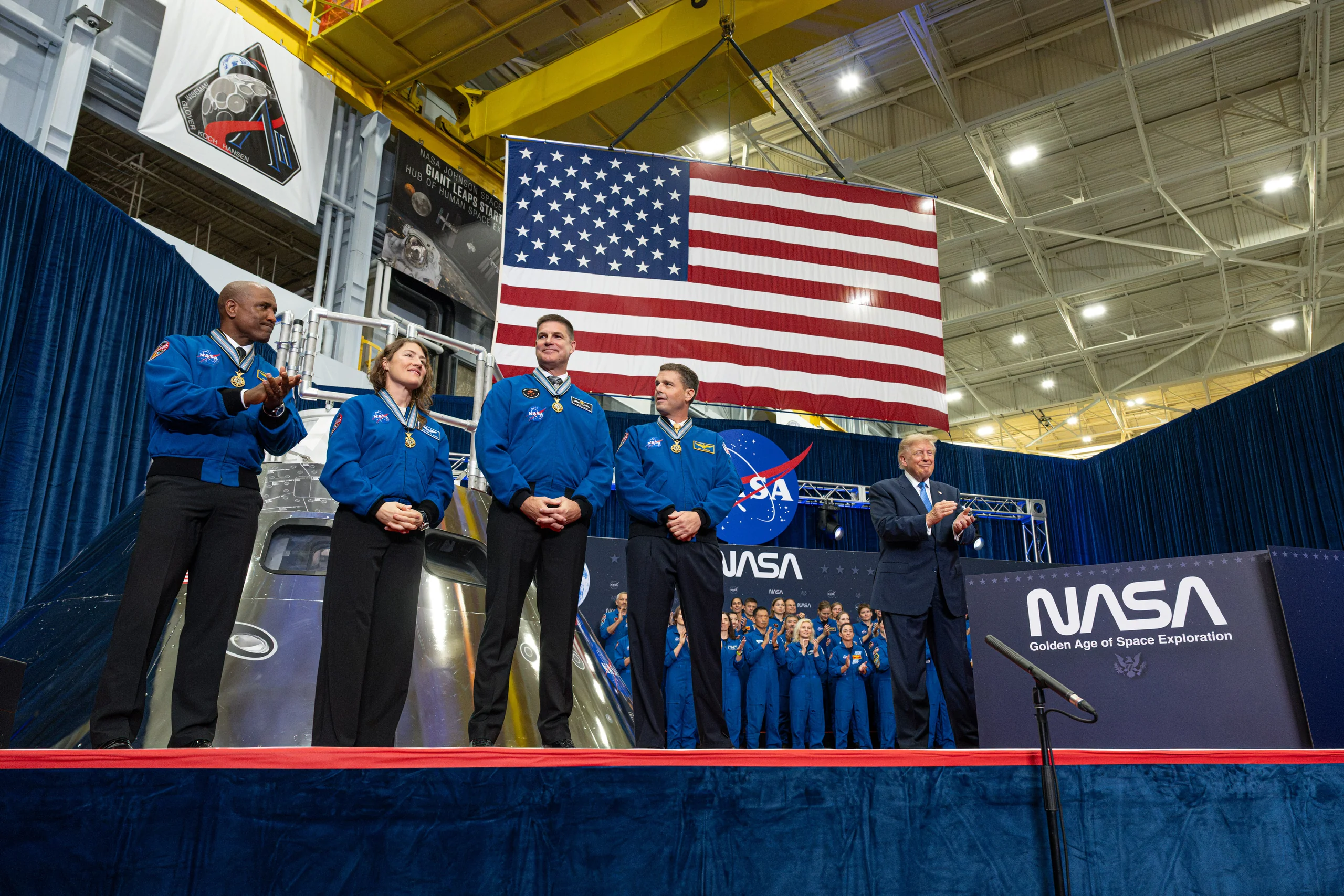
Image: NASA Image of the Day | Image credit: NASA/John Kraus | Image page
August 28, 2026, at NASA's Johnson Space Center in Houston. Four people stand onstage with new medals on their chests.
From left are NASA astronauts Victor Glover and Christina Koch, Canadian Space Agency astronaut Jeremy Hansen, and NASA astronaut Reid Wiseman. They received the Congressional Space Medal of Honor for their service on Artemis II.
The photograph itself is quiet. The real story unfolded four months earlier.
First, the Medal
Congress established it in 1969. The law makes it available to an astronaut who, in carrying out his or her duties, distinguishes himself or herself through exceptionally meritorious efforts and contributions to the welfare of the nation and humanity.
Since the beginning of the space program, 34 people have received it. Before these four, there had been 30 recipients: thirty people in fifty-seven years.
The first six were honored together in 1978: Neil Armstrong, Frank Borman, Charles Conrad, John Glenn, Virgil Grissom and Alan Shepard. Many later entries on the list are posthumous, including the crews of Apollo 1, Challenger and Columbia. The previous awards came in 2023, to the two astronauts who flew the first certified operational Crew Dragon mission in 2020. NASA noted then that they were the first recipients since 2006, after a seventeen-year gap.
One small detail is hidden in the language. The 1969 statute referred to "his duties" and "himself." NASA's 2026 caption says "himself or herself." The same provision gained two words over fifty-seven years.
But the Story Began Four Months Earlier
Artemis II had already flown.
At 6:35 p.m. Eastern time on April 1, 2026, or 6:35 a.m. Beijing time on April 2, a Space Launch System rocket lifted off from Pad 39B at Kennedy Space Center with more than 8.8 million pounds of thrust. The four astronauts sat at the top inside an Orion spacecraft they had named Integrity.
At 8:07 p.m. Eastern time on April 10, or 8:07 a.m. Beijing time on April 11, Orion splashed down in the Pacific off San Diego and was recovered by the USS John P. Murtha.
NASA's mission page gives the precise duration: 9 days, 1 hour, 32 minutes.
During those nine days, the crew rounded the far side of the Moon.
The Heart of This Story: They Did Not Fire the Engine to Come Home
There is one fact about the mission that deserves to be taught to every child.
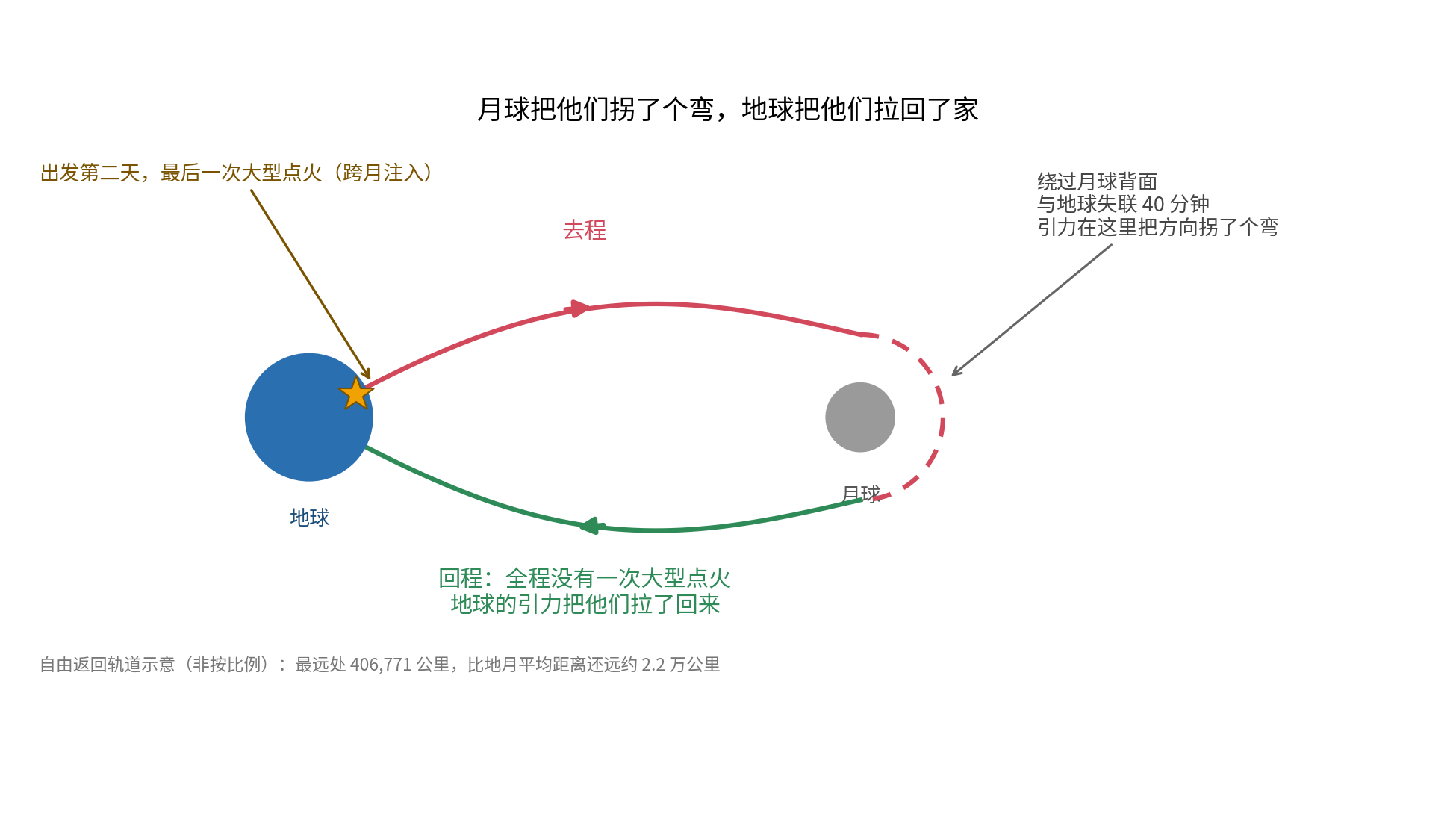
Traveling from the Moon back to Earth sounds as though it should require an engine burn to turn around, like pressing a car's accelerator. It did not.
NASA's mission handbook says it plainly. The return leg required no propulsive maneuver. The fuel-saving trajectory used the Earth-Moon gravitational field so that Earth's gravity naturally drew Orion home during the mission's free-return phase.
It is called a free-return trajectory.
The critical decision was made on departure. NASA's day-by-day itinerary calls the trans-lunar injection burn that sent Orion toward the Moon the mission's final major engine burn. After the second day, there was no more "accelerator" for the remaining eight days, only several tiny attitude corrections.
How did they return?
The Moon bent their path, and Earth pulled them home.
Orion flew toward the Moon, swung around its far side under lunar gravity, changed direction, then fell along a curve calculated in advance toward the Earth that had been pulling on it all along. The entire path had been drawn before launch, written into the computer and into Newton's equations.
This is an old kind of safety design. If the engine failed or electrical power was lost, doing nothing would still bring the spacecraft home.
The Farthest Humans Have Ever Traveled
On April 6, while rounding the far side of the Moon, the crew reached a point 252,756 miles, or 406,771 kilometers, from Earth.
That broke a record that had stood for fifty-six years. Apollo 13 had set the previous mark in 1970 at 248,655 miles, or 400,171 kilometers.
Curiously, the new distance is about twenty thousand kilometers greater than the average distance from Earth to the Moon. The astronauts did not stop at the Moon. They passed around its far side, with the Moon between them and Earth.
NASA pages give slightly different figures of 252,760 and 252,752 miles, a difference of only a few kilometers. This article uses 252,756, the most frequently reported figure and the one recorded in the astronauts' official biographies.
As they crossed that line, Hansen said from inside Integrity:
"Aboard Integrity, as we cross the line marking the farthest humans have ever traveled from Earth, we do so with respect for the extraordinary efforts and achievements of those who came before us in human space exploration."
Those Forty Minutes
As Orion passed behind the Moon, the crew lost contact with Earth for a full 40 minutes.
It was not a failure but part of the plan. The Moon itself stood in the way. The reason it always stands in the way is one of the most elegant pieces of physics in this story.
NASA has a page devoted to it called "Tidal Locking":
"The Moon does rotate, but the time it takes to spin once on its axis is exactly the same as the month it takes to orbit Earth."
As a result, the Moon never turns its back on us, like a dancer circling a partner while always facing that partner.
That is NASA's own analogy, and it is difficult to improve.
The same face of the Moon is the one visible throughout a person's lifetime. It was the face seen by their grandparents, and by people thirty thousand years ago. Humanity did not see a photograph of the other half until 1959, when the Soviet spacecraft Luna 3 flew around the far side and photographed it.
And when four people passed behind that half, Earth could not hear them. An entire Moon blocked the signal.
China Used the Same Physics to Do Something Else
This is the story's neatest echo.
In 2024, China planned to send Chang'e 6 to the far side of the Moon and bring back a rock sample. The same problem arose immediately. With the probe on the far side and Earth beyond the lunar horizon, how could they communicate?
An explanation republished by China's Ministry of Science and Technology says it directly: a probe on the lunar far side cannot communicate with Earth for tracking, control or data transmission because the Moon itself blocks the signal, so a relay satellite is required.
On March 20, 2024, a Long March 8 rocket launched Queqiao 2 from Wenchang, placing a satellite in between to act as a relay. Its official task was to provide Earth-Moon relay communications for Chang'e 4, Chang'e 6 and other missions.
The name is exact: Queqiao means "magpie bridge," a bridge hung in the sky because the two sides can never see each other.
With that bridge in place, Chang'e 6 launched on May 3, 2024, landed precisely in the South Pole-Aitken basin on the lunar far side on June 2, and returned its capsule to Siziwang Banner in Inner Mongolia at 2:07 p.m. on June 25. In the words of the China National Space Administration, it accomplished the world's first sample return from the far side of the Moon.
Then comes a genuine coincidence.
Among the lunar features photographed and publicly released by the Artemis II crew from above the far side were Vavilov crater, Ohm crater and the South Pole-Aitken basin.
A Chinese probe dug into the ground there. Two years later, four people flew above it and took its picture. Humanity saw the same place from two directions.
Near the Moon, They Put On Eclipse Glasses
The mission contains several other details that children may remember for a long time.
They watched Earth set. At 6:41 p.m. Eastern time on April 6, Earth - a lit crescent with white clouds and blue water above Oceania - sank below the lunar horizon. After Orion rounded the Moon, Earth rose again.
Earth can rise and set. That can never be seen from Earth.
They watched an eclipse lasting nearly an hour. Near the Moon, the crew observed an eclipse for almost an hour, including about 54 minutes of totality, while studying the solar corona. NASA's mission review includes one wonderfully ordinary detail: they used eclipse glasses.
They saw six meteor impacts flash on the Moon. The crew witnessed six flashes made by meteoroids striking the lunar surface. The Moon has no atmosphere to stop them.
They flew the spacecraft by hand. About three hours after launch, the four astronauts used hand controllers to maneuver Orion relative to the separated upper stage of the rocket. They moved slowly from about 300 feet, or 91 meters, to about 30 feet, or 9.1 meters, then repeated the exercise. It lasted roughly 70 minutes. NASA said the test would supply data for future rendezvous and docking, for one practical reason: near the Moon, there is no GPS.
They made an extremely long-distance call. On April 7, while Orion was 379,841 kilometers from Earth, the crew spoke for 15 minutes with the crew of the International Space Station. One of the people who answered was Jessica Meir, who in 2019 had joined Christina Koch for the first all-woman spacewalk. Seven years later, one was on the space station and the other near the Moon, and they spoke to each other.
Light takes 1.28 seconds to travel 384,400 kilometers. At that distance, someone saying hello would wait about 2.6 seconds to hear an answer, long enough for a child in a classroom to count "one, two." This delay was independently calculated from the speed of light; NASA did not publish the figure.
The Four People
Jeremy Hansen, born in 1976, is Canadian and formerly flew CF-18 fighter jets. He joined the Canadian astronaut corps in 2009.
Then he waited seventeen years.
This was his first spaceflight, and on his first trip to space he flew around the far side of the Moon. The Canadian Space Agency's official wording says he became the first Canadian to take part in a lunar mission and the first non-American to participate in one.
Christina Koch was selected in 2013. NASA records that her 328 continuous days in space set the record for the longest single spaceflight by a woman, only a little short of a full year. On October 18, 2019, she and Jessica Meir carried out history's first all-woman spacewalk, lasting 7 hours 17 minutes. On Artemis II, a woman traveled to the vicinity of the Moon for the first time.
Victor Glover was also selected in 2013, while serving as a legislative fellow in the US Senate. On his first spaceflight in November 2020, he launched aboard Crew Dragon Resilience, spent 168 days in orbit and completed four spacewalks.
Reid Wiseman, the commander, was selected in 2009. He spent 165 days aboard the International Space Station in 2014 and made two spacewalks. From 2020 to 2022, he served as chief of NASA's Astronaut Office.
Four people, three kinds of first, and one Canadian who waited seventeen years.
Why the First Flight Carried No People
There is another lesson in what did not happen.
In November 2022, Artemis I flew the same route without a crew, spending more than 25 days in space. After Orion returned, engineers found a problem: pieces of insulating material had come off the heat shield.
NASA announced the investigation's conclusion in December 2024. As the material, called Avcoat, heated during reentry, gases formed inside it and could not escape quickly enough, causing the material to crack and shed. The behavior was connected to Artemis I's skip-entry trajectory.
NASA kept the already installed heat shield for Artemis II but changed the return trajectory, while improving the material's manufacturing process for later missions so that its permeability would be more uniform.
The episode is its own best lesson: send an empty spacecraft first, collect the pieces when it returns, study them for two years, change the route home, and only then put people aboard.
The stakes were severe. Orion reentered at nearly 25,000 miles per hour, or 11 kilometers per second. In different materials, NASA gives the heat shield's surface temperature as anywhere from about 3,000 degrees Fahrenheit, or 1,650 degrees Celsius, to nearly 5,000 degrees Fahrenheit, or 2,760 degrees Celsius. Both are official figures. Parachutes then slowed the capsule to 17 miles per hour at splashdown, about 27 kilometers per hour, a little faster than a bicycle.
What Comes Next
Under NASA's current public plan, Artemis III will conduct a series of tests in Earth orbit in 2027, including rendezvous and docking practice with commercial landers. Artemis IV, planned for 2028, will be the first crewed landing near the lunar south pole. None of that has happened yet, and the schedule remains subject to NASA's later official announcements.
China's crewed lunar exploration program is also moving forward. A February 2026 update from the China Manned Space Agency said that development was progressing smoothly on the main flight hardware, including the Long March 10 launch vehicle, Mengzhou crew spacecraft and Lanyue lunar lander. Major tests already completed included Mengzhou's zero-altitude abort, Lanyue's landing and ascent, and a tethered firing test of Long March 10. The goal is China's first crewed lunar landing before 2030.
Sources: NASA Image of the Day for August 28, 2026; NASA's Artemis II mission page and press kit; NASA's day-by-day itinerary and flight-day blog; NASA History's list of Congressional Space Medal of Honor recipients; NASA Science's pages on tidal locking and International Observe the Moon Night; NASA's heat-shield investigation release; official astronaut biographies from the Canadian Space Agency; the China National Space Administration; the China Manned Space Agency; and the Ministry of Science and Technology of the People's Republic of China.