
A group portrait, and a path home that works even if you do nothing.
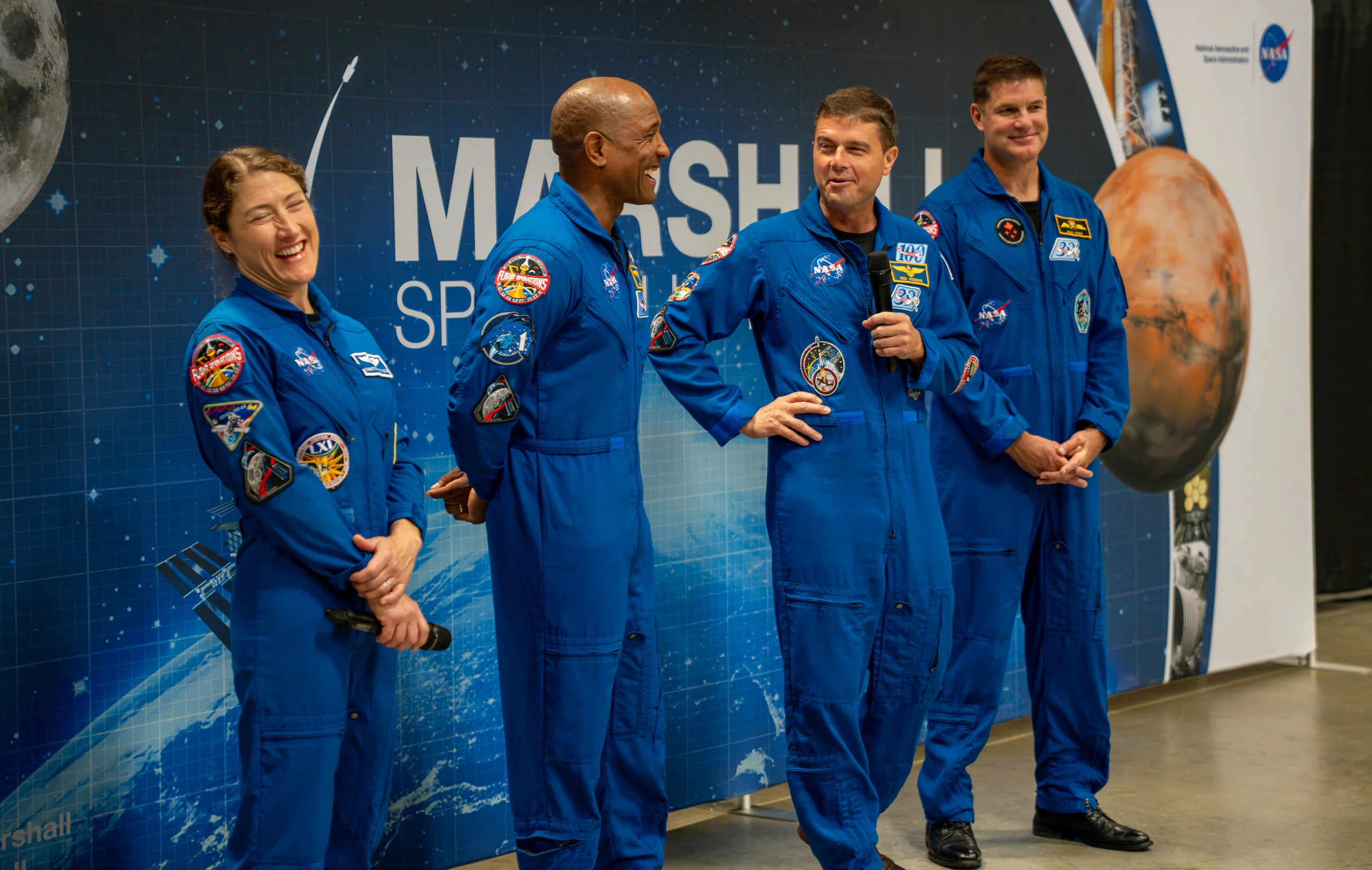
Image: NASA Image of the Day | Image credit: NASA/Brandon Hancock | Image page
On September 9, NASA selected this photograph as its Image of the Day.
The picture itself seems unremarkable: four people in blue flight suits covered in patches are smiling, two with microphones in hand. It was taken on September 1, 2026, at Marshall Space Flight Center in Huntsville, Alabama. NASA's caption is brief: the Artemis II crew came to meet the employees who supported their mission, share their firsthand experiences and reflect on their time in space.
"Reflect on their time in space." Notice that phrase.
Many people still think of Artemis II as an upcoming launch. It has already flown.
What Happened Five Months Ago
At 6:35 p.m. EDT on April 1, 2026 - 6:35 a.m. Beijing time on April 2 - an SLS rocket lifted off from Pad 39B at Kennedy Space Center. The spacecraft's call sign was Integrity.
On April 6, it swept past the far side of the Moon, coming within 4,067 miles (6,545 kilometers) of the surface. As it passed behind the Moon, the entire body blocked its radio signal, cutting the crew off from Earth for about 40 minutes.
That same day, the astronauts reached 252,756 miles (about 406,800 kilometers) from Earth. It was the farthest crewed flight in human history, surpassing the 248,655-mile record set by Apollo 13 in 1970.
As Canadian astronaut Jeremy Hansen crossed the line, he said from Integrity's cabin that they had now traveled farther from Earth than any humans before them.
They splashed down off San Diego on April 10. The mission lasted 9 days, 1 hour and 32 minutes and covered 695,081 miles, more than 1.1 million kilometers.
The Door That Stayed Shut for 53 Years
Now consider what that flight meant.
Apollo 17 splashed down on December 19, 1972, carrying Eugene Cernan, Harrison Schmitt and Ronald Evans home.
For the next 53 years and three months, no human being left low Earth orbit.
People did not stop going to space. Humans have occupied space stations continuously for decades. But those stations circle roughly 400 kilometers above Earth, about the distance from Beijing to Jinan measured vertically. Leaving Earth's immediate embrace and truly setting out toward the Moon was something humanity did through six landings and several lunar flybys, then stopped doing for 53 years.
The four people in this photograph reopened that door.
Another door remains closed: 53 years and eight months have now passed since Apollo 17 without another human setting foot on the Moon. Artemis II flew there, looked and returned. It did not land. It did not even enter lunar orbit.
Why It Had to Come Back Without Orbiting or Firing Its Main Engine
This is the part of the mission most worth explaining to a child, and almost everyone initially understands it backward.
Artemis II followed a free-return trajectory. Popular explanations often say the spacecraft used the Moon's gravity to "sling" itself back to Earth.
That is wrong, and taken literally it teaches the wrong physical intuition.
Here is the truth:
The spacecraft returned not because the Moon threw it home, but because it never escaped in the first place.
Imagine throwing a ball upward. Unless it reaches Earth's escape velocity, it must fall back, no matter how high it goes. Orion essentially did the same thing with an exceptionally high throw. After its engines fired, it was still moving below escape velocity and entered an extremely long, narrow elliptical orbit around Earth whose far end happened to reach lunar distance.
From the moment it departed, it was destined to fall home.
What did the Moon do? It aimed the fall.
Simply returning is not enough. A spacecraft must enter the atmosphere through a very narrow corridor. Too steep and it burns up; too shallow and it skips back out like a stone on water. Passing close behind the Moon lets lunar gravity bend the elongated orbit, aligning its returning end with that thin reentry corridor.
NASA's mission fact sheet says the same thing in more technical language: this fuel-efficient trajectory uses the Earth-Moon gravity field to ensure that Earth's gravity naturally pulls Orion home during the free-return portion.
In one sentence:
The Moon did not throw them home. Earth never truly let them go. The Moon did one thing: it pointed them toward the door.
"Free" means no further burn by the main engine is needed. Strictly speaking, both outbound and inbound legs still include small trajectory-correction burns, so this is not a zero-burn flight from end to end. But even if all those small burns failed, the people would still come home.
A 35-Second Burn
Why would NASA choose this route for its first crewed lunar flight?
Because 56 years ago, it brought three people home alive.
Apollo 13's oxygen tank exploded on the night of April 13, 1970. By then the crew had left the free-return trajectory: a routine midcourse correction for the planned landing had shifted the spacecraft away from the path that would bring it home without further action.
NASA's official history reduces the next task to a command:
The immediate task was to get back on a free-return trajectory.
Mission control calculated a 35-second burn, carried out five hours after the explosion.
Four days later, on April 17, 1970, the three astronauts splashed down alive in the Pacific.
Thirty-five seconds put three people back on the path that comes home even if they do nothing.
Fifty-six years later, for its first crewed flight toward the Moon, NASA kept the spacecraft on that path from beginning to end. It never left.
Why They Went to Huntsville
That brings us to the location in the photograph.
Marshall Space Flight Center in Huntsville opened on July 1, 1960, 66 years and two months ago. Its first director was Wernher von Braun, who served from July 1960 to January 1970. The Saturn rockets that first carried Americans to the Moon were developed here. NASA's own history page compares their engine power to 85 Hoover Dams. All 32 rockets in the Saturn family completed their missions successfully.
Today, Marshall houses the program office for the SLS rocket that carried the Artemis II crew away from Earth. NASA says the center leads development and oversees all work. The rocket stands 322 feet, or about 98 meters, tall and produces up to 8.8 million pounds of thrust at liftoff. Its core stage holds 733,000 gallons, about 2.77 million liters, of cryogenic liquid hydrogen and liquid oxygen. Four RS-25 engines work alongside two solid rocket boosters, and those boosters provide more than three-quarters of the total thrust.
So the answer is simple: Huntsville built the rocket that carried these four people away from Earth. They returned to the room that made it to say thank you.
Koch's words at the event carried exactly that meaning: this tour, she said, was about turning trust into gratitude, then into congratulations.
The Person at Far Left
The person holding a microphone at far left is Christina Koch.
Her biography reads like three lives joined together.
She earned dual bachelor's degrees in electrical engineering and physics from North Carolina State University, followed by a master's degree in electrical engineering.
Then she went to Antarctica. Not as a visitor: she served as a research associate with the United States Antarctic Program and lived at Amundsen-Scott South Pole Station for a full year, including the winter. In winter, even aircraft cannot reach it.
She launched from Baikonur on March 14, 2019, and returned on February 6, 2020. She spent 328 days in orbit, circled Earth 5,248 times and traveled 139 million miles - the record for the longest single spaceflight by a woman. She completed six spacewalks totaling 42 hours and 15 minutes.
On October 18, 2019, she and Jessica Meir spent 7 hours and 17 minutes outside replacing a failed battery charge-discharge unit. It was the first spacewalk in history in which both people outside were women.
One NASA blog number tells the story: it was the 43rd spacewalk involving a woman. For the previous 42, a man had always been beside her.
In April 2026, Koch traveled more than 400,000 kilometers from Earth and saw the Moon's far side with her own eyes. Back in Huntsville, she described the moment this way:
Seeing an unfamiliar "face" was profound. It was not a picture painted in the sky.
The place where she said it adds a lovely coincidence. According to local reporting, Koch attended Space Camp five times in Huntsville as a child, from 1992 through 1996.
A girl who went to Space Camp in Huntsville returned to the same city 30 years later carrying the record for humanity's farthest flight.
The Other Three
Reid Wiseman commanded the mission. Victor Glover was the pilot, a U.S. Navy captain who had previously spent 168 days aboard the International Space Station as pilot of Crew-1's Resilience and completed four spacewalks. He described splashdown day this way: they were having fun; there was water, Christina had M&M's, and everyone was excited.
The fourth crew member was Canadian Space Agency astronaut Jeremy Hansen. The agency's official account says he became the first Canadian to participate in a lunar mission and the first non-American to do so.
(One honest qualification: Chinese-language accounts often call Koch "the first woman to fly to the Moon." As a factual description this is true - no Apollo-era astronaut was a woman - but we checked NASA's official profile and its April 2026 update page by page, and NASA itself does not use that title. We therefore give the facts, not the label.)
Why September 9?
This photograph was taken September 1 and published by NASA eight days later. That is normal for Image of the Day, which is an editorially curated queue rather than a breaking-news feed. In the same batch, a photograph of the Venus occultation taken June 17 was not published until September 3, two and a half months later.
But on September 9, NASA did one other thing.
That same day, the agency announced that Commander Reid Wiseman and Pilot Victor Glover were moving to emeritus status.
NASA Administrator Jared Isaacman said he was pleased that both would continue sharing what they had learned with astronauts, flight controllers and engineers. Wiseman said there was no better place to work and no better colleagues than the people at the agency. Glover said NASA and human spaceflight remained meaningful parts of his life of service, and that he looked forward to continuing to cheer on his friends.
So this photograph of four people smiling together with microphones in hand was also a farewell to the crew as a four-person active-duty unit.
That is probably the real reason it appeared today.
China's Door
How close is China?
The target "before 2030" has a formal source. At the Shenzhou 16 mission press conference on May 30, 2023, China Manned Space Agency spokesperson Lin Xiqiang said:
The lunar-landing phase of China's crewed lunar exploration program has begun. The plan is to achieve the first landing of Chinese astronauts on the Moon before 2030.
Three major tests have since been completed, each documented in an official announcement.
On June 17, 2025, the Mengzhou crewed spacecraft completed a pad-abort flight test at Jiuquan. The China Academy of Space Technology reported that the abort motors fired, the spacecraft-and-tower combination rose from the pad, and about 20 seconds later the return capsule reached its planned altitude and landed safely on airbags. The test was declared a complete success.
On August 6, 2025, the Lanyue lunar lander completed a comprehensive landing-and-liftoff verification test at the extraterrestrial landing test site in Huailai, Hebei. The China Manned Space Agency called it China's first test of a crewed spacecraft landing on and lifting off from an extraterrestrial body, and a key milestone in development of the crewed lunar program.
On February 11, 2026, a Long March 10 rocket performed a low-altitude demonstration and verification flight at the Wenchang Spacecraft Launch Site while Mengzhou conducted a maximum-dynamic-pressure abort test. Xinhua listed four firsts: the first flight ignition of a Long March 10 in its initial prototype configuration; China's first maximum-dynamic-pressure spacecraft abort test; China's first sea splashdown of both a crewed return capsule and a rocket first stage; and the first ignition and flight mission from Wenchang's new launch pad. The rocket reached a maximum altitude of 105 kilometers, crossing the Karman line.
The China Manned Space Agency's latest statement, dated February 27, 2026, says development of major flight hardware including the Long March 10 launch vehicle, Mengzhou crewed spacecraft and Lanyue lunar lander is progressing smoothly toward the goal of the first Chinese crewed lunar landing before 2030.
One widely repeated report needs a correction. Many sources still say Chang'e 7 will launch in the second half of 2026. But on August 23, 2026, the China National Space Administration announced that the launch had been canceled. Its statement said that, in the interest of prudence, reliability and absolute assurance, a comprehensive assessment had found that Chang'e 7 did not meet the conditions for launch in its scheduled window that year. Officials gave no specific technical reason and announced no new window. Before that decision, the spacecraft had arrived at Wenchang in April and completed vertical transfer on August 19.
As for what China has already accomplished: Chang'e 6 returned 1,935.3 grams of samples from the Moon's far side, humanity's first such samples, landing at Siziwang Banner in Inner Mongolia on June 25, 2024.
The American schedule has also just changed. NASA revised the Artemis architecture on February 27, 2026. Artemis III is now scheduled for 2027, but it is no longer a landing mission. It will test systems and operations in low Earth orbit in preparation for an Artemis IV landing in 2028. The actual crewed landing now targets the lunar south pole in 2028. The many pages still saying Artemis III will land on the Moon in 2026 or 2027 are out of date.
Sources: NASA Image of the Day for September 9, 2026; NASA's Artemis II mission page and mission profile; NASA's launch-day blog and return release; NASA, NASA Names Two Artemis II Astronauts to Emeritus Program (September 9, 2026); NASA's Artemis architecture update (February 27, 2026); the Canadian Space Agency's Artemis II mission page; NASA's Apollo 13 mission details; NASA's Apollo 17 mission page; NASA's official Christina Koch biography (April 2026 edition); NASA's International Space Station blog (October 18, 2019, and February 6, 2020); NASA's Marshall Space Flight Center history; NASA's Space Launch System Facts (December 2025 edition); NASA Science's Moon phase page; NASA's Join Artemis educational material; the U.S. Naval Observatory's phases-of-the-Moon table; the China Manned Space Agency; the China National Space Administration; Xinhua; and the China Academy of Space Technology.