
Two eclipses in one photograph, and an explanation that takes only two line segments.
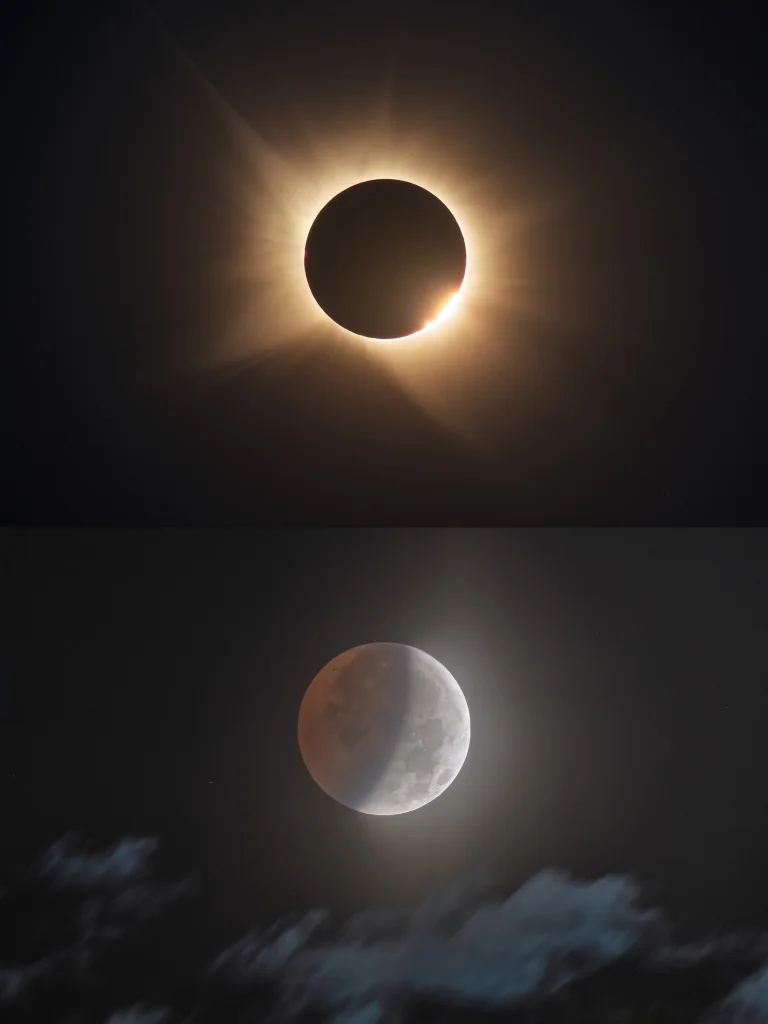
Image: NASA Astronomy Picture of the Day (APOD) | Image credit and copyright: Gwenaël Blanck | Today's page
Today's NASA Astronomy Picture of the Day is a two-in-one image.
The upper photograph shows the total solar eclipse of August 12, 2026, seen from Peñafiel, Spain, at the instant totality began. The Sun's last rays shine through valleys along the Moon's edge, forming a string of bright points called Baily's beads. Beyond them lies a golden corona.
The lower photograph shows a deep partial lunar eclipse 16 days later, on the night of August 27-28, seen from Sèvres, France. About half the lunar surface has entered Earth's shadow, turning dark and red.
Both are HDR composites. The inner and outer corona differ in brightness by thousands of times, as do the dim red Moon inside the umbra and the bright surface outside it. A single exposure cannot contain that range.
The photographer, Gwenaël Blanck, is a French aerospace engineer. On his website he describes himself as an amateur astronomer and photographer in his spare time and while traveling.
APOD's first sentence supplies the subject of the entire piece: eclipses often come in pairs.
Why Pairs?
Begin with a more basic question. If every month has a new moon, why is there not a solar eclipse every month?
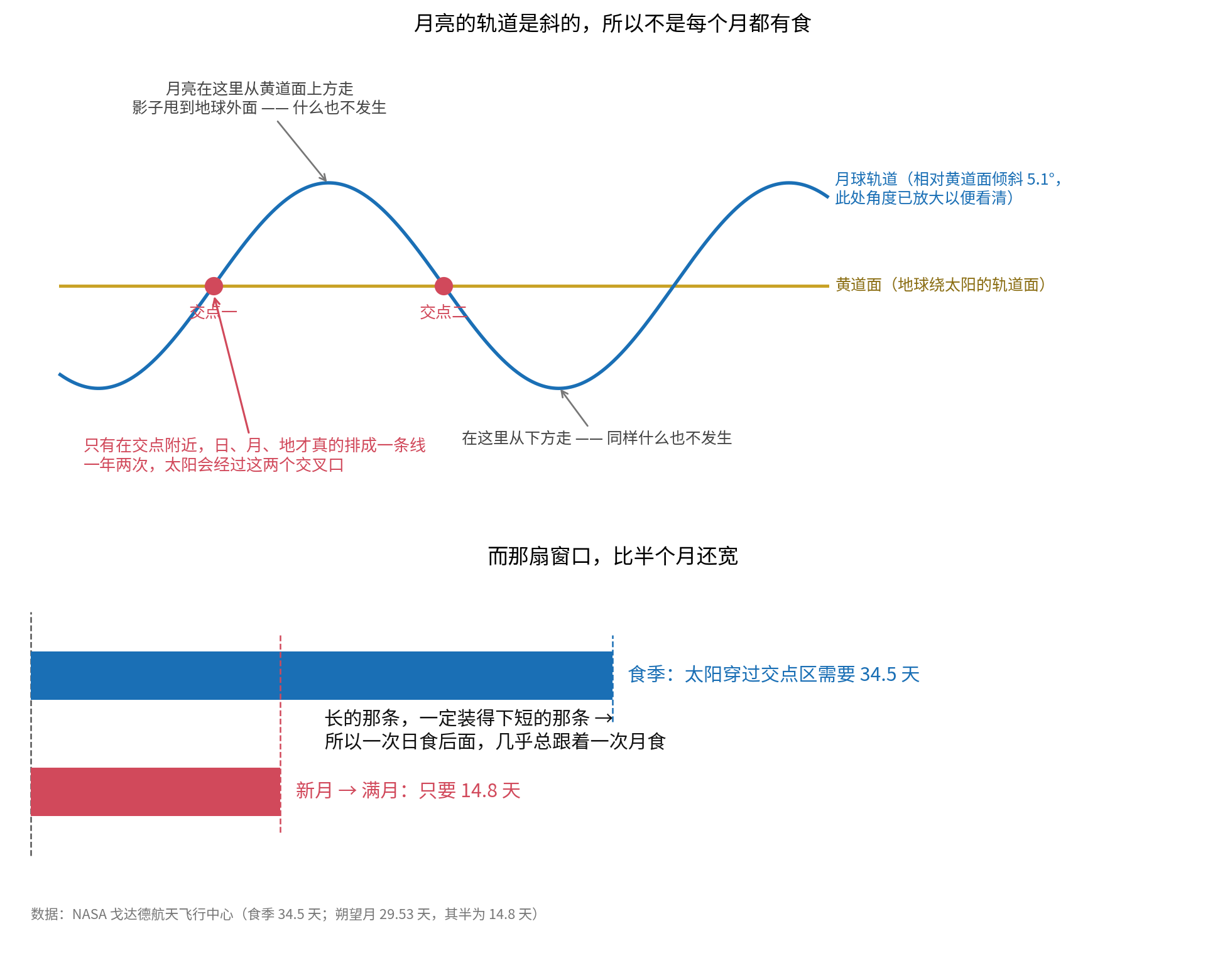
The Moon's path is tilted. NASA's Goddard Space Flight Center states that its orbit around Earth is inclined about 5.1 degrees to Earth's orbital plane around the Sun. The more precise mean is 5.145 degrees, and it oscillates slightly between 5.00 and 5.30 degrees.
Five degrees does not sound like much, but it is enough. At most new moons, the Moon passes above or below the Sun and its shadow misses Earth entirely.
Only when the Moon is near one of the two intersections between those orbital planes - the nodes - can all three bodies truly line up.
The next step is the key.
Earth travels around the Sun, so from our perspective the Sun circles the sky once a year. Twice each year it crosses the dangerous regions around the two nodes. NASA Goddard puts the relevant width precisely: the Sun takes 34.5 days to cross a 34-degree-wide eclipse zone centered on a node.
Those 34.5 days make an eclipse season. APOD rounds the figure to about 34 days; both descriptions are correct.
How long does the Moon take to travel from new to full? Half a synodic month, a little over 14 days.
Now place two spans side by side: 34.5 days and 14.8 days.
The longer span must contain the shorter one.
Once the Sun enters an eclipse season, the interval must include a new moon and will almost always include a full moon as well: one solar eclipse paired with one lunar eclipse. NASA Goddard expresses the logic firmly. Because the Moon's mean orbital period relative to the Sun is 29.53 days, every 34.5-day passage of the Sun through a nodal eclipse zone always contains one, and may contain two, solar eclipses.
The eclipses have not merely happened to cluster. The window is so wide that the Moon can hardly avoid it.
Two more numbers are useful. The midpoints of successive eclipse seasons are 173.3 days apart. An eclipse year is therefore about 18.6 days shorter than a calendar year, so eclipse seasons creep earlier through the calendar from one year to the next. This August pair will shift to February next year.
Why Is a Pair of Total Eclipses So Rare?
APOD is restrained on this point. Within one eclipse season, it is rare for the alignment at both new and full moon to be precise enough to produce both a total solar eclipse and a total lunar eclipse. A partial eclipse somewhere in the pair is much more common.
This pair is an excellent demonstration of almost, but not quite.
Astronomers use a value called gamma to describe how centrally an eclipse is aligned. The closer it is to zero, the more central the eclipse; as its absolute value approaches one, the eclipse becomes more grazing. The solar eclipse on August 12 had a gamma of 0.8977, making it a far-northern grazing eclipse. The lunar shadow only skimmed Earth's north, so the path of totality crossed the Arctic, Greenland and Iceland before finally reaching Spain.
The lunar eclipse on August 28 had an umbral magnitude of 0.9299 - only 7 percent short of totality. It missed by that much.
The last pair in which both eclipses truly were total came in 2015: the total solar eclipse on March 20 and the total lunar eclipse on April 4. That lunar eclipse had an umbral magnitude of only 1.001, and totality lasted just five minutes. It barely qualified.
That is the best footnote to how demanding a double-total pair really is.
Why the Solar Eclipse Is Golden
The upper photograph is warm, almost amber. This is not a filter.
In its official page for the event, Spain's National Geographic Institute issued a specific warning: throughout Spain the eclipse would take place at a very low altitude above the horizon, lower toward the east, so an entirely unobstructed western horizon was strongly recommended.
How low? For Valladolid province, where Peñafiel lies, the institute calculated a solar altitude of only 8 degrees at maximum eclipse.
At eight degrees, sunlight must pass obliquely through far more atmosphere before reaching the eye. Blue light is scattered away, leaving gold and red - the same process that colors a sunset at the sea.
Except this setting Sun had been bitten by the Moon.
Several other figures are worth keeping. Totality lasted at most 2 minutes 18 seconds. Greatest eclipse occurred over the ocean near Iceland. At that point the path of totality was 294 kilometers wide - the grazing angle made it broader than a typical total-eclipse path.
For Spain, the event was momentous. The institute's official wording calls it the first total solar eclipse visible from the Iberian Peninsula in more than a century. NASA Goddard's historical catalog supports the claim: the previous total eclipse listing Spain among its countries occurred on August 30, 1905.
Spain has two more close behind: another total solar eclipse on August 2, 2027, then an annular eclipse on January 26, 2028. Three years, three eclipses, one country.
The Moon's Shadow Has an Eighteen-Year Timetable
Eclipses also follow a longer rhythm called the Saros cycle.
NASA Goddard gives its length as about 6,585.32 days, or 18 years, 11 days and 8 hours. After that interval, the Sun, Moon and Earth return to nearly the same relative geometry, producing an eclipse much like the previous one.
The especially interesting part is the extra eight hours.
In eight hours Earth turns another third of a rotation, or 120 degrees. NASA Goddard states that this shifts each succeeding eclipse path westward by about 120 degrees.
Each Saros series is therefore a family slowly circling the planet. One appearance falls over Spain; 18 years later its relative lands across the Atlantic; 18 years after that it moves another third of the way west. Only after three events does it return to roughly the same longitude - 54 years later.
The two eclipses in today's image belong to different families. The solar eclipse is Saros 126; the lunar eclipse is Saros 138.
An Unequal Arrangement
One point about this photograph needs to be made especially clear.
NASA's educational page phrases it beautifully: although solar eclipses occur as often as lunar eclipses, each one is visible from such a small part of Earth that encountering one is much rarer.
A lunar eclipse is democratic. The same page says half the planet can see each one. No journey is required; wherever it is nighttime, the eclipse is overhead.
A total solar eclipse is different. The darkest part of the Moon's shadow on Earth is usually only 100 or 200 kilometers wide. Because the 2026 eclipse was grazing, its path broadened to 294 kilometers. The 2035 path that will cross Beijing will be only 93 kilometers wide.
This produces a widely repeated statistic: at any fixed location on Earth, the average interval between total solar eclipses is 375 years. The figure comes from Belgian astronomer Jean Meeus and was repeated in Sky & Telescope by former NASA eclipse expert Fred Espenak.
The second half of the statement is essential: this is a global average, not a promise for any particular place. Some locations wait centuries; others see two within a few decades.
Neither Eclipse Was Visible From China
That fact must be stated plainly.
NASA Goddard lists the visibility region for the August 28 partial lunar eclipse as the eastern Pacific, the Americas, Europe and Africa - not Asia. Greatest eclipse occurred at 04:14 UTC, or 12:14 p.m. Beijing time. The Moon was below the horizon in China in broad daylight.
The August 12 solar eclipse crossed the Arctic and Spain, so China was outside that path as well.
For readers in China, this APOD is a photograph of someone else's sky.
The second half of the story is better.
The Two Different Safety Rules
Solar and lunar eclipses have completely different viewing rules.
Looking directly at a solar eclipse can blind you. NASA says safe solar viewers must be thousands of times darker than ordinary sunglasses and comply with the ISO 12312-2 international standard. The American Astronomical Society is more categorical: the only safe way to look directly at an unobscured, partially eclipsed or annular Sun is through a special-purpose solar filter that meets that standard.
Three further warnings each reflect real injuries. Ordinary sunglasses are useless, however dark they appear; they transmit far more sunlight than the eye can tolerate. Eclipse glasses must not be used together with a camera, telescope or binoculars; NASA warns that concentrated sunlight can burn through the filter and seriously injure the eye. Every filter should be inspected first and discarded if scratched, punctured or torn.
There is only one exception. During the brief minute or two when the Moon completely covers the Sun's bright face, direct viewing is safe. It is unsafe at every other moment - during an annular eclipse and even during a 99 percent partial eclipse.
Pinhole projection offers a nearly cost-free alternative. A small hole in one card, held with the viewer's back to the Sun, projects a crescent image onto another surface. A box improves the image: foil with a pinhole covers an opening on one side, white paper lines the inside, and the image is observed through a separate opening. NASA's warning is short and important: never look at the Sun through the pinhole.
A lunar eclipse requires none of these precautions. It is simply the Moon inside Earth's shadow and is as safe to view directly as any ordinary full moon.
A Tabletop Eclipse
An international astronomy education program run by Leiden University describes a single apparatus that demonstrates both kinds of eclipse for children aged six and older.
Its materials are ordinary: a flashlight, an orange-sized foam ball for Earth, a ping-pong ball wrapped in foil for the Moon, 35 to 50 centimeters of stiff but bendable wire, two cardboard tubes, a sheet of cardboard, tape and glue.
The tubes form stands on the cardboard. The large ball sits atop one as Earth. The wire rises from Earth's top, bends twice, and holds the small Moon at the level of Earth's equator. A flashlight raised on books points toward the Earth.
Rotating the wire puts the Moon between the flashlight and Earth, casting a small dark spot: a solar eclipse. Half a turn later, the Moon enters Earth's shadow: a lunar eclipse.
One further adjustment reveals the article's central idea. Bend the wire by about five degrees and rotate it again. Most of the time, the little Moon passes above or below the larger ball and nothing happens. Only at two particular positions do the shadows align.
Those two positions are the nodes.
NASA Goddard's path table for September 2, 2035 provides a more exact version of the same geometry. Plotting its rows of coordinates on a map of China traces the shadow from Hotan to Liaodong and shows precisely which places lie inside the band.
Someone Understood It Nineteen Centuries Ago
The physics in the lower half of the photograph has an early Chinese footnote.
In the Eastern Han dynasty, Zhang Heng wrote in the Ling Xian: "Opposite the Sun, its light is often incomplete because Earth blocks it. This is called the dark void."
His meaning was that when the Moon lies opposite the Sun, its light can fail to appear full because Earth stands in the way. The resulting region was the "dark void." When the Moon entered it, a lunar eclipse occurred.
For the time, this was an extraordinary turn. An older popular explanation said that a toad had swallowed the Moon. Zhang Heng replaced a myth with a shadow.
The lower half of Blanck's photograph records that very dark void. Nineteen centuries later, it finally has a photograph.
China's Purple Mountain Observatory, the country's only institution devoted specifically to ephemeris astronomy and calendar calculation, maintains a calendar-query page with timely forecasts of celestial events, including solar and lunar eclipses. The precise daily time for raising the flag at Tiananmen Square is also calculated by an observatory.
Eclipse seasons creep earlier by 18.6 days each year. Every Saros cycle shifts an eclipse 120 degrees west. The Moon's orbit slowly swivels through the sky. The mechanism never pauses or takes an extra turn for anyone.
China saw neither eclipse in today's photograph.
But the same mechanism will hang a dark red full moon above Chinese children before dawn on New Year's Day 2029. It will place a ring of sunlight over Heilongjiang on the afternoon of Children's Day 2030. And at about 8:30 on the morning of September 2, 2035, it will darken Beijing for one minute and 50 seconds.
They are already on their way. Their dates have been calculated, and they will not be a day late.
Sources: NASA Astronomy Picture of the Day for August 29, 2026; NASA Goddard Space Flight Center's solar- and lunar-eclipse catalogs and path tables; NASA Science pages on eclipses and viewing safety; the American Astronomical Society Solar Eclipse Task Force; Spain's National Geographic Institute; Fred Espenak in Sky & Telescope; EarthSky; Britannica; UNAWE's Creating Eclipses in the Classroom; Guangming Science Popularization, citing Sun Xiaochun; and the Purple Mountain Observatory's calendar query.