
Today's National Geographic Photo of the Day shows the underside of a sea urchin. The angle is perfectly chosen: this is where an object first called a "lantern" 2,300 years ago can be found.
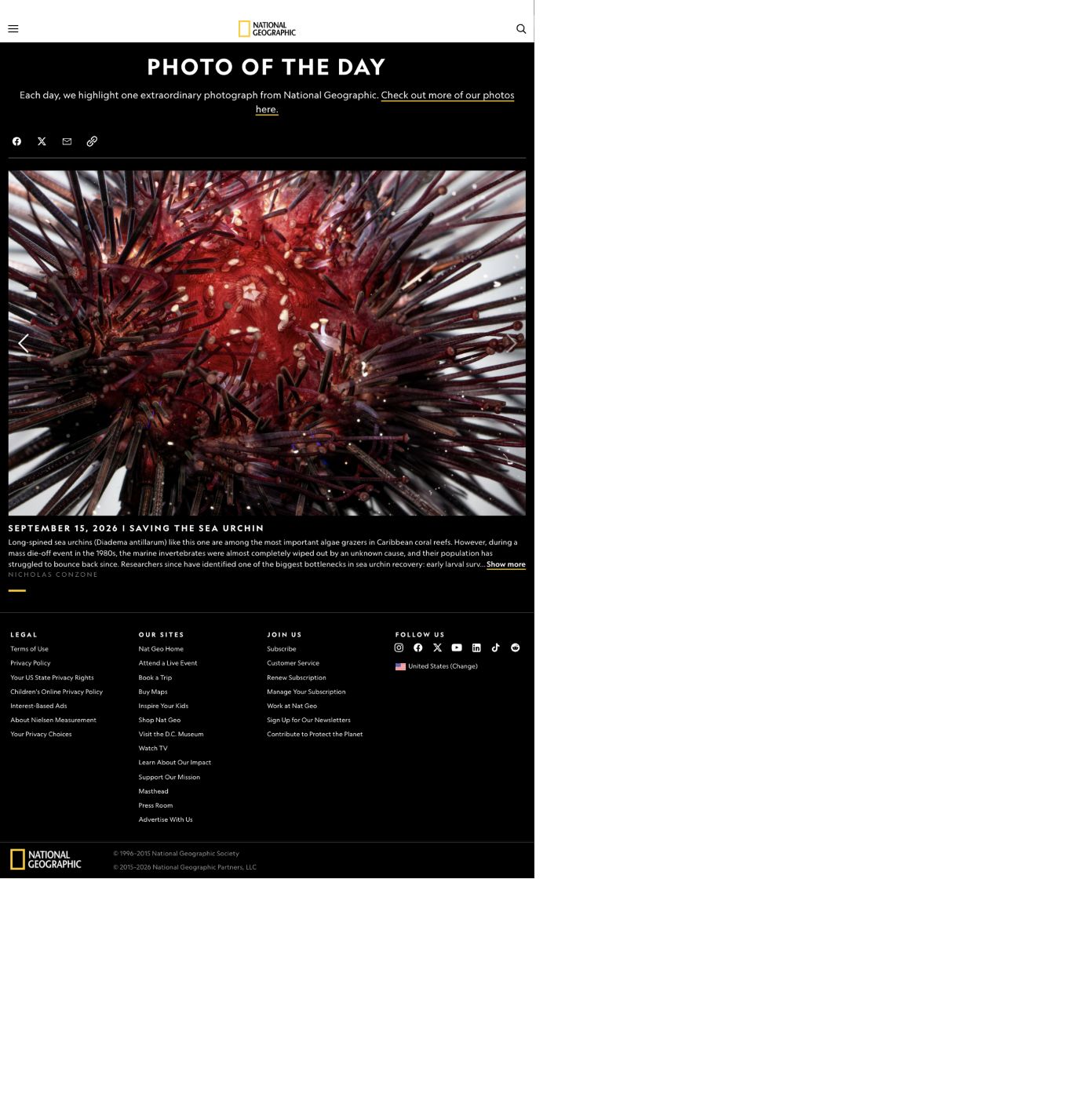
Screenshot: National Geographic Photo of the Day | Photograph: Nicholas Conzone | Original page
The caption says that the long-spined sea urchin, Diadema antillarum, is one of the most important grazers on Caribbean coral reefs. A mass mortality event in the 1980s nearly wiped it out. The cause is unknown, and the population has never recovered. Researchers later identified survival early in life as one of the greatest bottlenecks. At the Florida Aquarium "in Tampa," University of Florida scientists are testing a newly developed "baby formula."
Every sentence conceals a more interesting story. We will tell them in reverse.
The "Baby" Looks Nothing Like a Sea Urchin
Sea urchins are round and fivefold symmetrical. They look as if they must have been born as spheres.
They were not.
A sea urchin larva is called an echinopluteus. It is a tiny drifting creature with long, slender arms supported by calcium-rich skeletal rods, and it filter-feeds with bands of cilia. It is bilaterally symmetrical. It has a left and a right, like a worm, a fish, or you and me.
Echinoderms belong to the great branch of bilaterally symmetrical animals. Fivefold radial symmetry evolved secondarily within that branch. In other words, the sea urchin's ancestors had a left and a right, and its larva still does. It makes itself round later.
The change is violent. A 2019 University of Guelph study described sea urchin metamorphosis as a complete transformation in which almost every larval structure is removed and juvenile structures develop in its place.
The larva grows an adult rudiment on the left side of its body - in effect, building a tiny sea urchin inside itself. Once that urchin is nearly ready, the larva discards the rest of what it was.
It settles on the reef and absorbs its remaining larval appendages, changing from a bilateral planktonic creature into a radial animal that lives on the bottom.
The most perilous detail comes here: immediately after metamorphosis, the young urchin cannot open its mouth. Its muscles have not caught up, leaving the feeding apparatus effectively closed for four full days. It survives on the energy it stored as a larva.
The moment it becomes an urchin is the moment when it is hungriest and least able to eat.
The same study found that more than 90% of sea urchins fail to survive this stage in the laboratory, and probably in the sea as well.
The Florida "baby formula" is meant to answer the next question: what should the juveniles eat during the first few weeks after those four days?
The Truth About the "Formula" - and Two Words National Geographic Left Out
This was not merely a press release. The peer-reviewed paper, by Hudspeth and colleagues, appeared in Aquaculture Reports in 2026, with the University of Florida's Josh Patterson as corresponding author. The laboratory is at the Florida Aquarium's Coral Conservation and Research Center in Apollo Beach, not Tampa proper, making National Geographic's phrase "at the Florida Aquarium in Tampa" slightly imprecise.
The team compared four feeding regimes: a natural biofilm, a benthic diatom, flocculated live microalgae and an unfed control. Specific growth rates in the fed groups were four to ten times those of the unfed group. Survival rose from 15% to between 45% and 60%.
Patterson put it plainly: they were making a can of baby formula. Previously, people raising these urchins knew too little about feeding them, so the animals had to forage for whatever they could find in their tanks.
Two points need to be made clear.
First, this study covered the first three to five weeks after metamorphosis into juvenile urchins, not the planktonic larval stage. National Geographic places it immediately after the bottleneck of "early larval survival," making it sound as though it solved the larval problem. Those are entirely different stages of life.
Second, the caption says that "99% of sea urchins do not survive to adulthood." The University of Florida's original copy said that, "like many marine species, approximately 99%" do not. National Geographic removed both "like many marine species" and "approximately," turning a general point about marine life into a precise fact about this species.
Actual results vary enormously. In a 2021 study, only 100 juveniles survived from 80,000 stocked larvae, for overall survival of about 0.125%. A 2023 study using a shaker-flask method achieved 32% to 33% survival from larva to juvenile - a 264-fold improvement.
The caption's claim that a 1% improvement could double the population is mathematically sound only if "1%" means one percentage point, from 1% to 2%. An increase of 1% would take survival from 1% to 1.01%, which is very different.
Before It Settles, the Larva Has to "Smell" the Rock
After drifting for a month or two, a sea urchin larva will not settle just anywhere.
A 2023 study tested the inducing effects of different substrates. Beside calcified green algae, Halimeda, 58% of larvae settled. Beside crustose coralline algae, or CCA, 46% settled. In sterile seawater, none did. Ceramic tiles covered with biofilm performed significantly better than sterile tiles and also better than a structureless biofilm control. The larva needs structure and a chemical signal together.
It must touch an old, living reef surface covered in crustose coralline algae before it will dismantle itself and become an urchin.
Remember the crustose coralline algae. They will matter again.
Panama, January 1983
Now return to the epidemic.
In January 1983, near Galeta Island at the Caribbean entrance to the Panama Canal, Diadema antillarum began to die. Only this species was affected; other sea urchins were not.
Over the next 13 months, the mortality moved north along the Central American coast, through Costa Rica, Jamaica, Florida and the Bahamas to Bermuda. It also moved east to Colombia, Barbados, Curaçao, Venezuela and Dominica.
One detail is especially revealing: over long distances, the epidemic followed currents closely; at short range, its movement was erratic. That pattern led researchers to infer a waterborne pathogen, drifting wherever the water carried it.
Three mortality figures describe different things and should not be confused. On individual reefs, 93% to 100% of the animals died within two weeks of symptoms appearing. The density-weighted average across 14 sites was 98.06%. The estimate at one Jamaican site was nearly 99%.
When researchers surveyed 19 sites three decades later, average density had recovered to only 11.6% of its pre-mortality level. Recovery was wildly uneven: 53.7% on Jamaica's north coast, 1.18% in the Florida Keys and 0.69% in the Bahamas.
As for the cause, it remains unknown 43 years later.
A widely repeated claim needs correcting. A 2023 paper in Science Advances did identify a pathogen: a scuticociliate most closely related to Philaster apodigitiformis. It also satisfied Koch's postulates. Cultured isolates infected previously unexposed urchins, reproduced the field symptoms and were then isolated again from the animals.
But that work concerned the 2022 event, not the one in 1983.
The two outbreaks were also very different. The 1983 epidemic took 13 months and followed currents. The 2022 event covered 1,300 kilometers north to south and 2,500 kilometers east to west in four months, without following currents at all. The first detection in each jurisdiction was an average of only 1.9 kilometers from the nearest port; 11 of 25 initial sites lay within one kilometer. The evidence points toward ships.
The 1983 epidemic drifted with the water. The 2022 epidemic appeared to travel by ship.
Their symptoms were almost identical: loss of tube-foot control, sluggish spine responses followed by spine loss, and epidermal necrosis. But the team behind the 2022 study wrote cautiously in another paper that similar symptoms might indicate the same cause - or might simply show that an urchin has only so many ways to say "I am sick."
Testing museum specimens from the earlier period, they wrote, was a task for the future. As of 2024, it had not been done.
The Most Disruptive Layer: Lots of Urchins Was Never a Sign of Health
The caption calls Diadema "one of the most important grazers" on Caribbean reefs. In the Caribbean of 1983, that was true.
The reason it had become so important is uncomfortable.
In 1994, Terry Hughes published a study of Jamaican reefs in Science. His central judgment was that severe overfishing had already damaged the reefs by the late 1970s, before the damage was widely recognized. They had been weakened so thoroughly that the combined effects of two hurricanes and the urchin epidemic could push the whole system past a threshold and into algal dominance.
The paper made a still more disruptive point: on overfished reefs such as Jamaica's, the extraordinarily high abundance of D. antillarum was almost certainly a consequence of overexploited fisheries.
Originally, many herbivorous fish grazed the reef. By the late 1960s, Jamaica's fish biomass had already fallen by as much as 80%. With the fish gone, algae grew and urchins took their place. Densities reached ten per square meter not because the reef was healthy, but because people had eaten the competitors.
The urchin came on as a substitute. The 1983 epidemic killed a team that had no substitutes left.
The numbers are stark. On Jamaica's north coast, coral cover fell from 52% in 1977-1980 to 3% in 1990-1993. Macroalgal cover rose from 4% to 92%.
At a depth of 15 meters in Discovery Bay, Jamaica, non-coralline algal cover was 30.7% before the urchins died, 49.7% two weeks later, and 72.3% after four months.
In less than two weeks, the surface of the reef had changed.
Evidence from the reverse process is equally clear. A 2001 paper in the Proceedings of the National Academy of Sciences described eight kilometers of coastline. Where the urchins had recovered, they formed an "urchin zone" averaging 60 meters wide with little macroalgae. Compared with the algal zone outside it, urchin density was ten times higher and juvenile coral density as much as 11 times higher. A sharp boundary separated the two bands along the same coast.
One more fact belongs in the picture. A 2025 study in Hawaii found a bay with about 51 urchins per square meter, among the highest densities recorded anywhere. Net carbonate production there had fallen to 0.5 kilograms per square meter per year, compared with a historical value of about 15 kilograms on healthy Hawaiian reefs. The reef was accreting only 0.5 millimeters per year while local sea level rose 3.55 millimeters per year.
As an urchin's teeth scrape algae away, they also scrape away the reef itself. Too few is a problem, and so is too many. That is more honest than saying that saving urchins simply saves coral.
Why Today?
September 15 is not an official observance connected with oceans, coral reefs or echinoderms. Nor is 2026 an International Year of the Reef; those were held only in 1997, 2008 and 2018.
Biologically, however, the date is not empty.
The Caribbean full moon fell on August 28, 2026.
The Caribbean's principal reef-building corals, the closely related species of Orbicella, spawn four to eight days after the full moon. The three species stagger their release by half an hour to an hour after sunset to avoid hybridizing. In 2026, that puts the window between September 1 and 5. The elkhorn coral, Acropora palmata, had an earlier window, from August 30 to September 2, at roughly 9:45 to 11 p.m. local time.
After spawning, fertilized eggs become larvae and drift in search of somewhere to settle. A 2020 study found that Orbicella faveolata larvae became competent to settle three to five days after spawning, peaking on days six to ten and 20 to 27. Acropora palmata peaked on days eight to 15.
Put the sequence together:
August 28 full moon -> mass spawning in late August and early September -> larvae drift for 6 to 27 days in search of a foothold -> on September 15, 2026, those coral larvae are feeling their way across the reef, looking for clean rock on which to settle.
They are looking for rock covered in crustose coralline algae and free from a blanket of macroalgae.
The sea urchin larvae are looking for the same kind of rock.
Two utterly different animals - a cnidarian and an echinoderm, very distant relatives - are searching the same reef for the same signal. Whether that rock remains clean and uncovered by algae depends on whether something is grazing it.
That is the real sense of time behind today's photograph. It is not an anniversary. It is something happening in the sea now.
China's Sea Urchin Factories
Humans have already proved that they can keep juvenile sea urchins alive on an industrial scale.
For more than 30 years, that ability has largely served a different purpose.
The northern sea urchin, Strongylocentrotus intermedius, was introduced from Japan to northern China in 1989 and is now China's main farmed urchin species, concentrated along the coasts of Liaoning and Shandong. A 2019 paper in Aquaculture International recorded a striking figure: in 2017, one Dalian hatchery produced about 18 million genetically improved juvenile urchins.
The technical route closely resembles the one in Florida: microalgal feeds, settlement substrates and recirculating water systems. Chinese hatcheries have spent more than three decades learning how to feed larvae and juveniles.
The difference is not the technology but the destination. China raises sea urchins for their edible roe. Florida raises them to return to reefs and weed the corals.
The same kind of hatchery leads to a dining table on one side and a coral reef on the other.
(One caveat: every Chinese figure I found for total sea urchin aquaculture production came from a commercial consultancy rather than a primary statistical source, so none is cited here.)
The Mouth on the Underside
Today's photograph shows the underside, an informed choice. A sea urchin's mouth sits in the center of that surface, and the mouth has an illustrious name: Aristotle's lantern.
The history of the name is more interesting than the usual version.
In Book IV of History of Animals, Aristotle wrote that the feeding apparatus ran continuously from one end to the other, though it did not look continuous from outside, but "like a horn lantern with the panes removed." In the same passage, he described five hollow teeth with a fleshy, tongue-like structure between them.
Ancient Greek horn lanterns had five sides. That is what makes the comparison work: five faces and five teeth.
But Aristotle did not coin the name "Aristotle's lantern." The first clear use of it for the chewing apparatus was by Jacob Theodor Klein in 1734, more than two millennia later.
More intriguingly, scholars proposed in 2008 that Aristotle may not have been comparing the mouth to a lantern at all, but the test - the perforated spherical shell, like the frame of a lantern with its horn panes removed. They argued that the name should belong to the shell, not the jaws. The matter is unresolved. As early as 1983, another scholar noted that the Greek text had long been established; what remained missing was a scientifically plausible interpretation.
The accurate account is this: Aristotle did compare a sea urchin to a lantern, but scholars still disagree over whether he meant the mouth or the shell, and someone else coined the anatomical name 2,000 years later. One of the best-known terms in anatomical history may have been attached to the wrong place all along.
The "lantern" itself deserves attention. A 2019 study found that the tooth's outer layer consists of bundles of high-aspect-ratio fibers wrapped in organic sheaths. Calcite crystals in adjacent regions fracture along predetermined paths. Wear does not blunt the tooth; it sharpens it. The teeth also grow continuously throughout the animal's life, replacing what abrasion removes.
The harder they work, the sharper they become, and they never stop growing. That is why they can scrape rock.
At the center of the underside, the lantern opens through a small five-lobed aperture. The living lobes open and close. The same view also reveals the tube feet: fine, extensible suckers that move by hydraulic pressure.
One safety fact follows from the anatomy. The long spines of Diadema are venomous and extremely brittle, and can break off beneath the skin. Common sea urchins along China's coast, including the short-spined sea urchin and purple sea urchin, have shorter spines, but are still not animals to handle bare-handed.
Finally
The cause of the 1983 epidemic remains unknown. It may never be found unless someone tests museum specimens from the period, specimens that have now spent more than 40 years in formalin.
But the story has another half.
In the laboratory, survival from fertilized egg to a young urchin ready for release was once 0.125%. One method can now bring it to one-third. Between those figures lies years of work to understand how long this bilaterally symmetrical creature drifts, what it must sense before it settles, and why it cannot open its mouth for four days after it does.
It took hundreds of millions of years to learn how to make itself round. It took us 20 years to learn how to keep it from starving during those four days.
Sources
National Geographic Photo of the Day and Nicholas Conzone's photograph; Lessios, Annual Review of Marine Science 8:267-283 (2016); Hewson et al., Science Advances 9:eadg3200 (2023); Hylkema et al., Frontiers in Marine Science 9:1067449 (2023); Ritchie et al., ISME Journal 18:wrae024 (2024); Hughes, Science 265:1547-1551 (1994); Edmunds and Carpenter, PNAS 98:5067-5071 (2001); Liddell and Ohlhorst on benthic community change after the Jamaican urchin mortality; van Woesik et al., PLOS ONE (2025); Heyland and Fadl, University of Guelph (2019); Pilnick et al., Scientific Reports 11:11244 (2021); Wijers et al., Aquaculture 562:738855 (2023); Hudspeth et al., Aquaculture Reports 47:103430 (2026); University of Florida IFAS news release, February 18, 2026; a 2023 Marine Biology study of settlement induction in Diadema; Levitan et al., Evolution 58:308-323 (2004); Williams et al., Frontiers in Marine Science 10:1180996 (2023); Miller et al., PeerJ 8:e9705 (2020); Lawrence, Zhao and Chang, Aquaculture International 27:1-7 (2019); Aristotle, History of Animals, Book IV, translated by D'Arcy Thompson; Voultsiadou and Chintiroglou, Cahiers de Biologie Marine 49:299-302 (2008); Lennox, Journal of Hellenic Studies 103:147-151 (1983); Espinosa et al., Matter (2019); NOAA Coral Disease and Health Consortium page on white band disease; and the International Coral Reef Initiative's International Year of the Reef page.