
The eclipse fooled every animal beneath the Sun into believing that dusk had arrived.
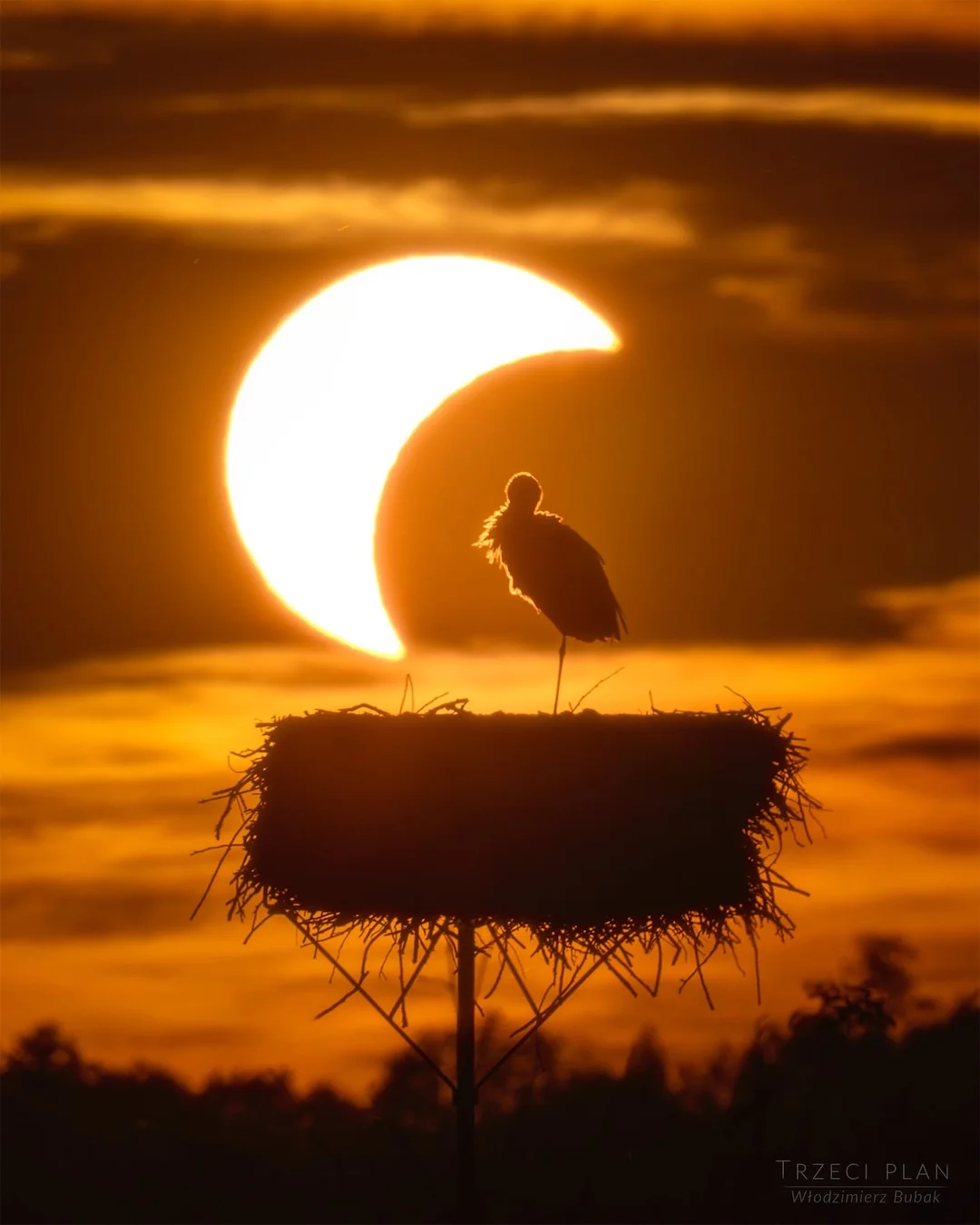
Image: NASA Astronomy Picture of the Day (APOD) | Image credit and copyright: Włodzimierz Bubak | Text: Cecilia Chirenti (NASA GSFC, UMCP, CRESST II) | Today's page
Today's NASA Astronomy Picture of the Day contains no nebula and no galaxy. There is only a bird.
A white stork stands in a high nest in Poland, one leg tucked up and its body folded into a sleeping posture. Above it, a bite is missing from the Sun: the partial phase of a solar eclipse. That is what makes the photograph so interesting. The bird does not know what is happening in the sky. It has simply been fooled.
Animals Do Not Understand Eclipses. They Understand Darkness
First, this is a solar eclipse: the Moon passes between the Sun and Earth and blocks the Sun. The red Moon in the previous article was a lunar eclipse, produced when Earth's shadow falls on the Moon. They are different events.
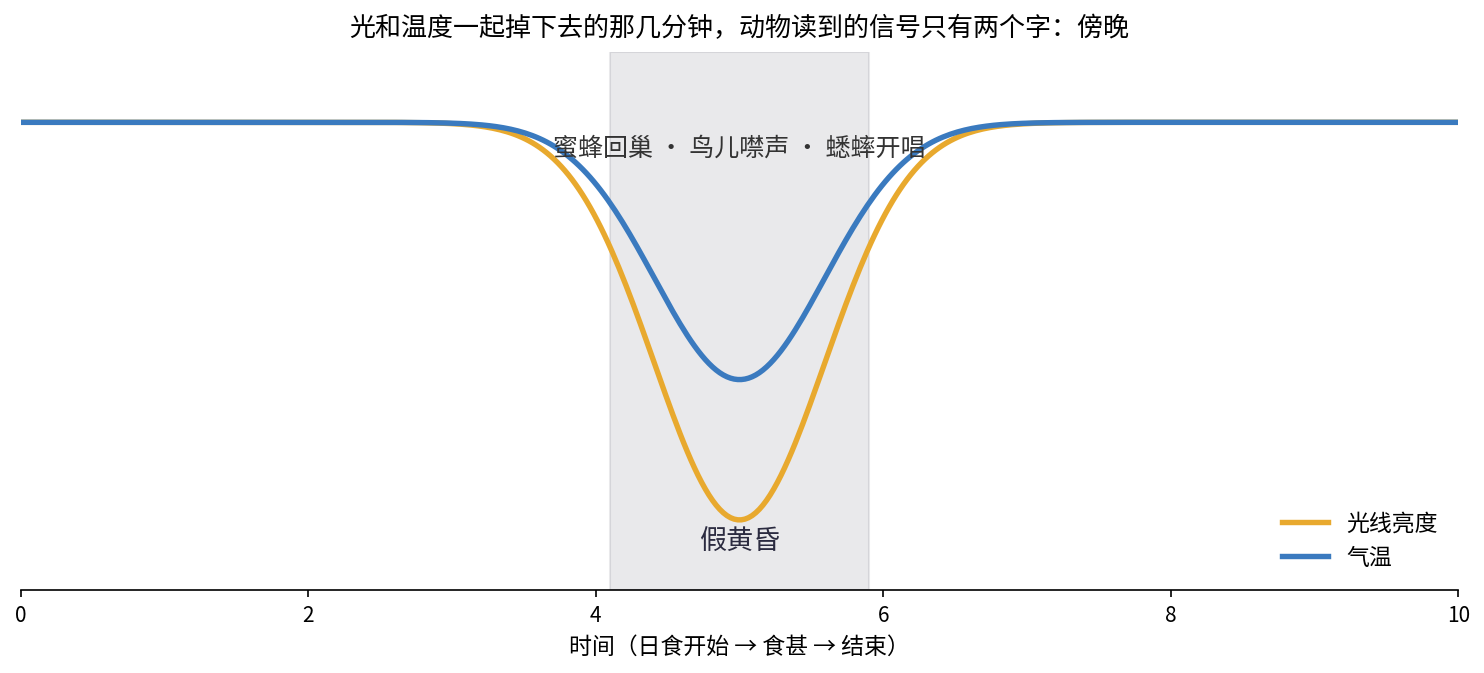
The most remarkable part of a solar eclipse is not in the sky but on the ground. As the Moon gradually consumes the Sun, daylight dims rapidly over a few minutes and the temperature falls with it, usually by 5 to 6 degrees Celsius. To an animal, those two signals - fading light and cooling air - normally arrive together at only one time: dusk.
Animals have internal clocks governing their daily rhythms. Those clocks do not read "eclipse." They read "time to sleep." The animals are not frightened; they have been deceived. A perfectly convincing false dusk descends at noon, and every creature beneath the Sun believes it.
They then do what they normally do in the evening. Daytime animals finish work: bees fly home, birds fall silent and chickens return to their roosts. Nocturnal animals wake: crickets and frogs begin to sing, while owls and bats emerge. When the Sun returns, the program runs in reverse. Many songbirds take it for the start of a new day and begin their dawn chorus again.
The white stork standing on one leg in the photograph has assumed a waterbird's standard "evening has come; time to rest" posture. At midday, it is preparing for sleep.
We Have Counted These Reactions
These are not folktales. Researchers have recorded them carefully.
Bees: During the 2017 total solar eclipse in the United States, scientist Candace Galen worked with more than 400 volunteers, many of them elementary-school students, to place 16 tiny microphones beside flowers and listen for the sound of bees in flight. The bees continued flying through the partial phase. During totality, however, the 16 stations recorded only a single buzz between them. Almost every bee had gone home. Galen said it was like "lights out at summer camp."
Zoo animals: During the same 2017 eclipse, researchers watched 17 species at a South Carolina zoo. About three quarters reacted. Aldabra giant tortoises suddenly began mating, giraffes galloped in circles, flamingos huddled together around their chicks, and a Komodo dragon that had barely moved for two days abruptly raced around its enclosure.
After another eclipse in 2024, the same researchers added an honest qualification. Instinctive behaviors such as returning home and resting really were triggered by the false dusk. But much of the animals' apparent anxiety was caused by the noise of the human crowds, not by the eclipse itself. With visitor numbers controlled and the surroundings quieter, the animals remained much calmer. The distinction matters: to observe an animal's most authentic response to an eclipse, the humans must first be quiet.
Go back further. During the 1932 eclipse over New England, the Boston Society of Natural History formed an "Eclipse Behavior Committee" and collected 498 reports from the public. Bees crowded the entrances to hives, cattle and birds returned to barns and nests, owls called, and crickets sang throughout totality. One naturalist's observation is still quoted: during totality, everything was silent except the crickets. Nearly a century ago, people were already taking notes.
The Bird Itself Deserves a Closer Look
Poland has one of the world's largest populations of white storks. Roughly one in every four European white storks makes its home there. They build large nests on roofs, chimneys and utility poles. In Poland, a stork nesting on a roof is considered good luck, and people even install platforms for them on poles. In late summer and early autumn each year, the birds depart for wintering grounds south of the Sahara. The stork still standing in its nest in August is poised just before that journey.
China's Own White Stork
China has its own version of this story, and its bird is rarer.
Europe has the white stork. East Asia has a close relative, the Oriental stork: larger, with a black bill and a ring of red skin around the eyes. It is an endangered species, with only several thousand left in the world. It breeds along the Heilong and Ussuri river basins on the China-Russia border, then moves south in large numbers to spend winter along the middle and lower Yangtze River. Its most important wintering ground is Poyang Lake in Jiangxi. In peak years, 3,000 to 4,000 Oriental storks gather there, a substantial share of the entire species, with about 60% settling inside the nature reserve.
Poland has its white storks, and Poyang Lake has China's own in winter. The birds at Poyang are far rarer than the one in this photograph, which makes the wetland beneath their feet all the more important to preserve.
Sources: NASA Astronomy Picture of the Day for September 3, 2026; academic population studies on white storks and Poland; the 2017 acoustic study of bees (Galen et al., 2018); the 2017 zoo-animal behavior study and its 2024 follow-up (Hartstone-Rose et al., Riverbanks and Fort Worth zoos); the 1932 survey of animal behavior during an eclipse (Boston Society of Natural History and Wheeler, 1935); NASA Eclipse Soundscapes and the California Academy of Sciences' Life Responds citizen-science project; timeanddate on the September 2, 2035 total solar eclipse over China; Zoological Research and National Forestry and Grassland Administration wetland materials on Oriental storks wintering at Poyang Lake.