
The sky gives you one ruler for free, and you already carry another. Learn to use them and you can decide for yourself what you just saw.
Today's NASA Astronomy Picture of the Day is not a still image but a video shot at 24 frames per second.
It is brief. The Sun on August 12, 2026, hangs low over Spain with a bite taken out of it by the Moon. Something streaks across the solar disk, then disappears.
Juan Pablo Castañeda recorded it on a plateau in Spain's Teruel province, not far north of the city of Teruel, at 40°34′30.3″ N, 1°12′28.8″ W. The local time was 20:28. The frame rate was 24 fps.
That was also the peak of the Perseid meteor shower.
So the question is: was it a meteor?
The NASA page begins with the unusual word "Whatdunit?" Then it invites us to lay out the evidence.
That is what makes this APOD so appealing. It does not simply announce the answer; it shows the investigation. Let us follow it, because the same method works whenever you look up tonight.
Evidence One: The Sky Gives You a Free Ruler
Here is a fact that may be surprising: the Sun and Moon look almost exactly the same size in the sky, each about half a degree across.
More precisely, the Sun is about 1.39 million kilometers in diameter, while the Earth-Sun distance varies over the year from 147.1 million to 152.1 million kilometers. That makes the Sun's angular diameter vary from 31.45 to 32.52 arcminutes. The Moon is 3,475 kilometers across and ranges from 356,500 to 406,700 kilometers away, producing an angular diameter between 29.37 and 33.51 arcminutes.
There are 60 arcminutes in one degree, so both are roughly half a degree wide. One aside: the Moon's variation is much greater than the Sun's. That is why the Moon sometimes covers the Sun completely in a total eclipse and sometimes leaves a ring in an annular eclipse.
Now bring that ruler down into your hand. With your arm fully extended, the Chandra X-ray Observatory's education page gives two useful benchmarks: your little finger is about 1 degree wide, and your fist about 10 degrees. Astronomy guides add two more: three fingers together span about 5 degrees, and a wide V between thumb and little finger about 20 degrees. Some institutions say 25 degrees because hands differ. The important thing is to straighten your arm.
At arm's length, the Sun is only half the width of your little finger.
The American Meteor Society offers more precise stellar rulers: the two pointer stars of the Big Dipper are 5 degrees apart; so are Castor and Pollux in Gemini. Orion's Belt spans 3 degrees, and the open side of the Big Dipper's bowl spans 10. Memorize those numbers and you always carry a ruler for the sky.
Evidence Two: The Bright Streak Is Too Short
APOD says the object covered less than half a degree in the sky, a path narrower than the Sun itself.
How long is a real meteor trail? Its luminous flight typically extends from a few kilometers to a few dozen kilometers. Most meteors burn at an altitude of about 100 kilometers. Convert those physical lengths into angles and the scale becomes clear:
- 3 kilometers → 1.7 degrees
- 5 kilometers → 2.9 degrees
- 10 kilometers → 5.7 degrees
- 20 kilometers → 11.4 degrees
A typical meteor therefore crosses several degrees of sky, about the width of three fingers; a bright one can sweep across a fist. Advice from the American Meteor Society confirms this from the other direction: novices routinely overestimate trail lengths, and "if you are regularly reporting paths longer than 10 degrees, you are overestimating."
A real meteor operates on a scale of several degrees. This object covered less than half a degree. It was shorter by an order of magnitude.
That is the first hard clue. But short does not automatically mean non-meteor: trails near the horizon or close to a shower's radiant can be short. We need more evidence.
Evidence Three: It Went Dark as Soon as It Left the Sun
APOD's second clue is understated, but it carries the most weight: the object's brightness did not extend far beyond the Sun. A meteor burning in the atmosphere does not need sunlight to be visible.
Pause there. What does that mean?
A meteor lights itself. It plunges into the atmosphere and begins glowing at a surface temperature of about 2,200 K, usually 80 to 90 kilometers up. Its light comes chiefly from iron spectral lines, emitted as metal vapor atoms stripped from its surface are excited by collisions and then radiatively relax. The energy is kinetic. The Sun's position in the sky is irrelevant. A meteor shines equally anywhere in the night sky.
A contrail borrows light. An aircraft engine releases hot, moist exhaust into cold, dry surrounding air. If the mixture crosses the water-saturation curve, vapor condenses on soot particles and freezes into ice crystals. In atmospheric science, that cloud-forming threshold is called the Schmidt-Appleman criterion. The crystals emit no light of their own; they can only reflect and scatter sunlight.
Ice crystals have a powerful preference for forward scattering. Papers give an asymmetry parameter of about 0.8, meaning that most of the light continues roughly in its original direction. The result is that a thin, newly formed contrail can look dazzling only within a few degrees of the Sun. Once it leaves the Sun's vicinity, it immediately becomes an almost invisible pale trace. The lower the Sun, the more strongly forward scattering dominates and the brighter the trail appears.
That modest observation becomes a verdict:
A meteor lights itself. An airplane is merely lit by the Sun. A bright line that "goes out" as it leaves the Sun is not emitting light; it is borrowing it.
Evidence Four: The Sun Was Only 6 Degrees High
APOD does not spell this one out, but it is hidden in the phrase "cross-referencing the location, time, and point in the sky." A flight database search needs more than where and when. It also needs the direction in the sky. Those words carry much of the case.
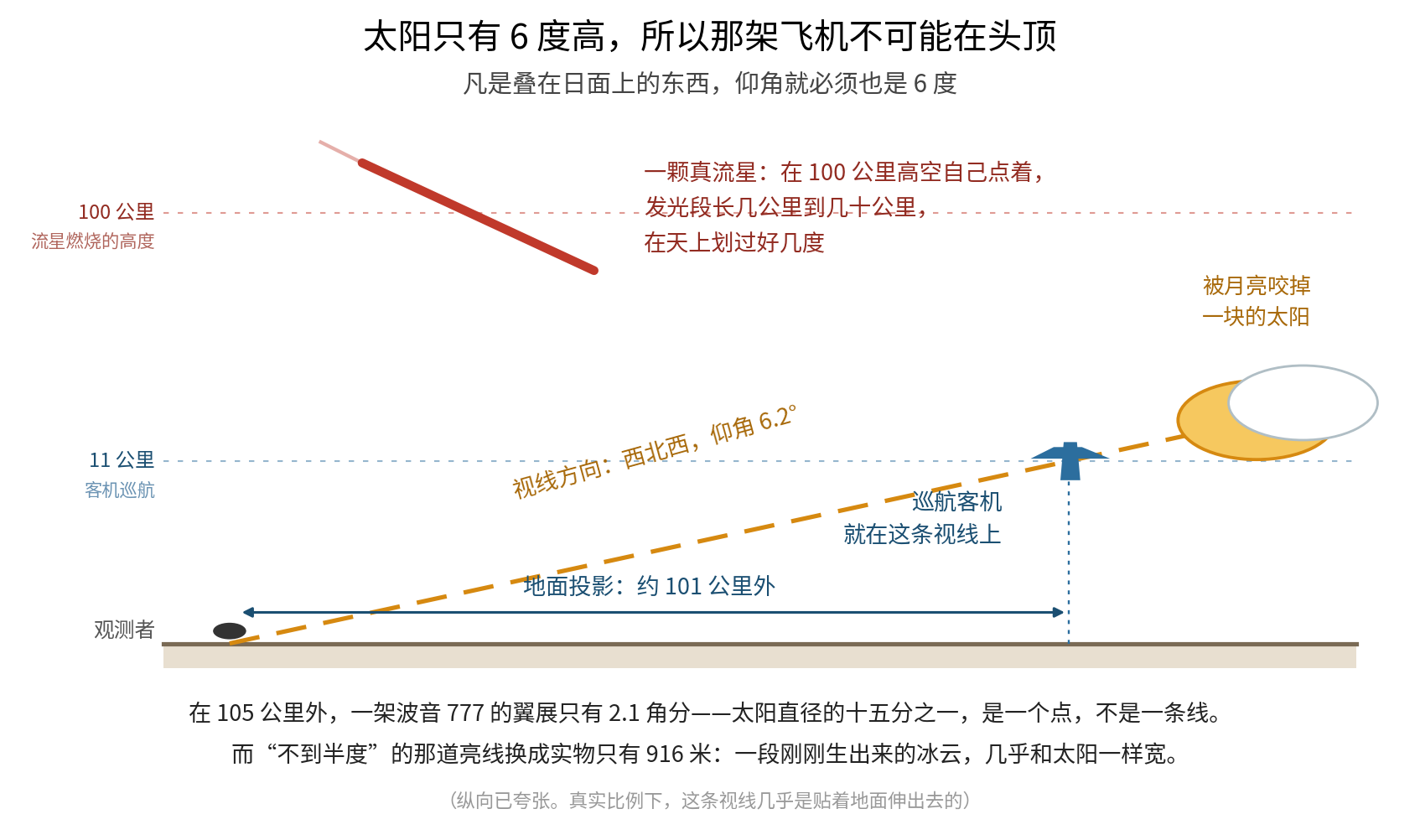
At 20:28 that day, Spain was on daylight saving time, two hours ahead of UTC. The moment was therefore 18:28 UTC and 02:28 Beijing time on August 13. Spain's National Geographic Institute said maximum eclipse occurred nationwide between 20:28 and 20:32, with the Sun between about 2 degrees high in Palma and about 12 degrees in A Coruña, and specifically advised observers to find an open western horizon. At the photographer's coordinates, the Sun was about 6.2 degrees high at azimuth 284 degrees, west-northwest and almost on the horizon.
Now for the geometry. Anything superimposed on the solar disk must also have been at an elevation of 6.2 degrees. If a cruising aircraft at roughly 10 kilometers altitude crossed the Sun, how far away was it?
- 10 kilometers high → 92.6 kilometers slant range
- 11 kilometers high → 101.9 kilometers slant range
- 12 kilometers high → 111.1 kilometers slant range
It was about 100 kilometers away. It was not overhead but far to the west-northwest. A search limited to "what flew above me?" would find nothing.
Continue from that distance and the other measurements suddenly agree. At 105 kilometers, the 64.8-meter wingspan of a Boeing 777 subtends just 2.1 arcminutes, one-fifteenth the Sun's diameter: a dot, not a line. The streak shorter than half a degree corresponds to a physical length of 916 meters at that distance. The Sun itself spans 977 meters there.
The "meteor" was really a newly formed ice cloud less than a kilometer long, almost exactly as wide as the Sun.
Evidence Five: 24 Frames per Second Is a Speedometer
The last clue is the most elegant. Why did APOD specifically tell us "24 frames per second"?
Because frame rate is a time scale. Once you know that frames are separated by 1/24 of a second, you can turn pixels traveled into degrees per second.
Perseid meteors travel at 59 kilometers per second. At a range of 105 kilometers, one would cross the sky at 32 degrees per second. In a single video frame it would travel 1.34 degrees, about two and a half solar widths. In a 24 fps recording, a meteor could appear in only one or two frames, each as a long streak.
A cruising airliner moving at 230 meters per second at the same range has an angular speed of 0.126 degrees per second. It moves just 19 arcseconds per frame, one-hundredth of the Sun's diameter. It needs hundreds of frames to crawl across the disk.
The speeds differ by a factor of 250.
The International Meteor Organization's observing handbook supplies the matching qualitative test: meteors usually last less than a second, and appear faster the farther they are from the radiant and the higher they are above the horizon. The American Meteor Society is more specific: most last just 0.2 to 0.3 seconds, so fast that observers see a flash rather than a moving object.
There is one more reversal. The Perseid radiant was in the northeast that day, while the Sun was only 6 degrees high in the west-northwest. If this had been a Perseid, it would have been far from the radiant and therefore among the fastest and longest-looking meteors, not the shortest and slowest.
The evidence is complete. Feed the location, time and direction into the flight database, and the culprit is caught: an airplane contrail.
A Field Guide to Take With You
Solving this case leaves us with a reusable set of tests. More things are misidentified in the sky than you might expect:
Satellites: slow and steadily bright, crossing the sky over several minutes. They are visible only after sunset and before sunrise, when they remain sunlit while the ground is dark. They disappear midway across the sky when they enter Earth's shadow. Solar panels can sometimes flare for a few seconds.
The International Space Station: brighter than Venus and able to cross the sky in minutes. The key test is that it does not blink. It may brighten as a whole, but not flash in a regular pattern. NASA's Spot the Station site lists passes over your location.
Reentering space debris: ESA says debris travels about 28,000 kilometers per hour before reentry and begins heating around 120 kilometers up. The luminous phase can last until ten minutes before impact, so it appears slow and often fragments into several pieces.
Aircraft: the cleanest test comes from airworthiness regulations. US regulation 14 CFR 25.1401 requires anti-collision lights to flash at least 40 and no more than 100 times per minute. Therefore:
What flashes is an artificial light. What does not flash is borrowed sunlight.
Some cases cannot be solved by physics alone. NASA recounts one in which multiple people reported a fireball over Lake Michigan. Investigation found an energy-drink publicity stunt: a person had jumped from an airplane carrying flares.
Why "Just an Airplane" Is a Good Ending
You may be disappointed that the culprit was a contrail. Do not be.
In February 2013, an asteroid exploded over Chelyabinsk, Russia. Almost no professional instrument happened to be pointed at that patch of sky, but Russian cars were full of inexpensive dashboard cameras installed to document accidents. Scientists combined those videos with security-camera footage and infrasound, seismic and satellite sensors to reconstruct the event.
The paper in Nature estimated a diameter of about 19 meters, an energy of 500 ± 100 kilotons of TNT and a mass of roughly 11,000 metric tons. A simultaneous paper in Science gave 19.8 ± 4.6 meters, 570 ± 150 kilotons and a pre-entry mass of about 13,000 metric tons. The two sets of figures agree within their stated uncertainties. More remarkably, researchers reconstructed the asteroid's orbit before impact: a semimajor axis of 1.76 astronomical units, eccentricity 0.581 and inclination 4.93 degrees.
A collection of cheap dashboard cameras bought for insurance disputes measured an asteroid's orbit. The material need not be professional. It needs timestamps, locations and enough independent views.
An even neater example came on February 28, 2021, when a fireball crossed the United Kingdom. Three camera networks caught it, and the American Meteor Society received more than a thousand public reports. The calculated fall area led searchers to find the meteorite the next morning on a home's driveway. More than 500 grams were recovered: a "very fresh, unweathered" carbonaceous chondrite now known as the Winchcombe meteorite.
Those two events and today's video use the same method. The only difference is that this time the answer was "airplane." A method capable of reaching that answer is trustworthy. If it said "meteor" every time, it would prove nothing.
Sources: NASA Astronomy Picture of the Day for August 19, 2026; the Ceplecha and Borovička review of meteor physics in Space Science Reviews; the International Meteor Organization's 2026 Meteor Shower Calendar and visual-observing handbook; the American Meteor Society's visual-observing tutorial; the Chandra X-ray Observatory angular-scale education page; NASA GLOBE and Federal Aviation Administration material on contrails; papers in Atmospheric Chemistry and Physics on the Schmidt-Appleman criterion and forward scattering by ice crystals; the Spanish National Geographic Institute's official page for the August 12, 2026 total solar eclipse; US regulation 14 CFR 25.1401; ESA guidance on space-debris reentry; NASA Spot the Station; Brown et al. in Nature (2013) and Popova et al. in Science (2013) on Chelyabinsk; FRIPON's account of the Winchcombe fireball and meteorite recovery; NASA's August 2026 skywatching guide; the official Stellarium site; and the National Astronomical Data Center's fireball-reporting system.