
How does a planet made of gas grow corners?
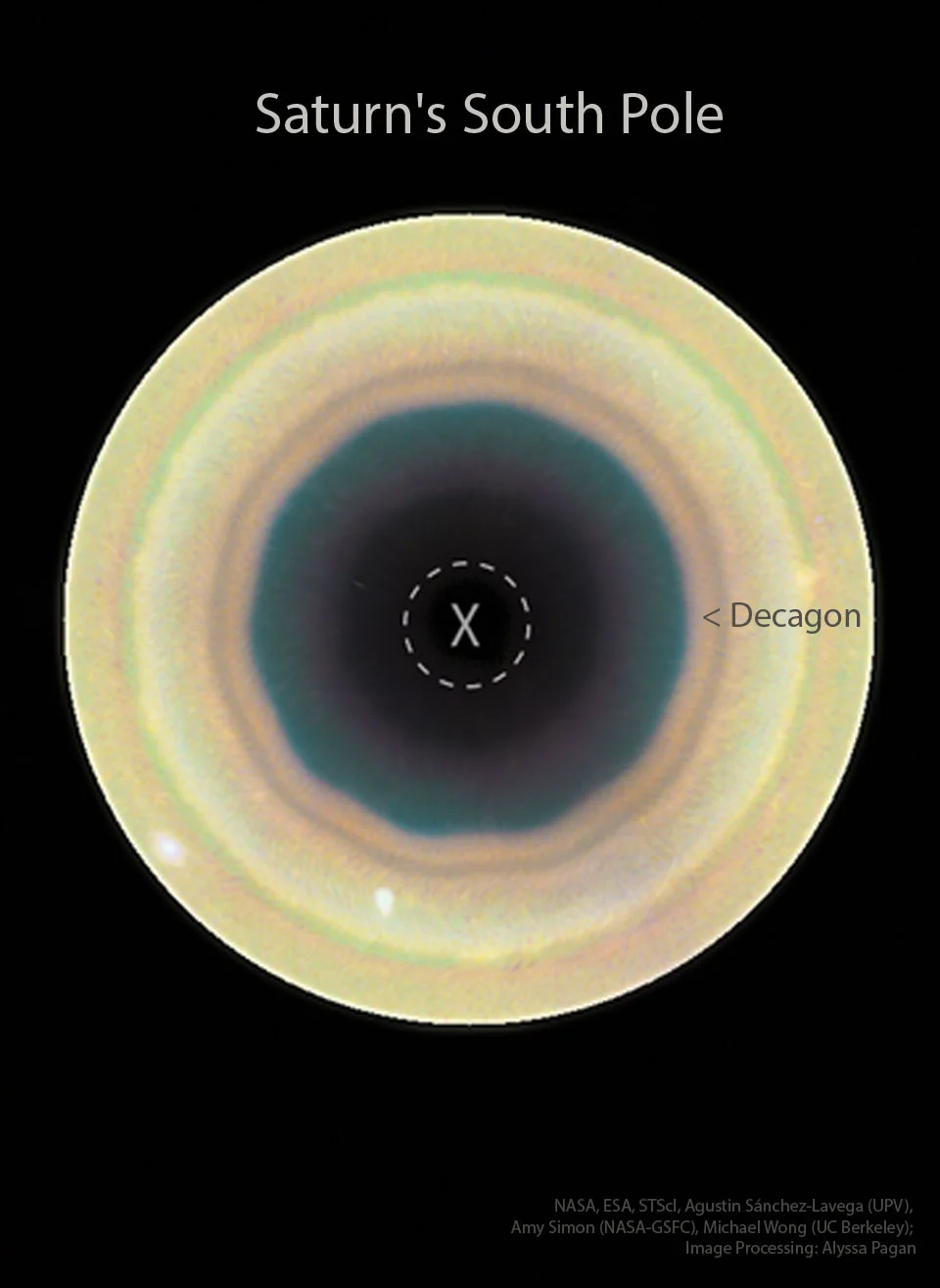
Image: NASA Astronomy Picture of the Day (APOD) | Image credit: NASA, ESA, STScI, HST; A. Sánchez-Lavega (UPV), A. Simon (NASA-GSFC), M. Wong (UC Berkeley); processing: A. Pagan (STScI) | Today's page
Begin with something small.
Clouds have no fixed shape. Look up and you see masses, tufts and threads, but never a triangular cloud or a square one. Wind has even less shape. It is one of the least orderly things we know.
Now look at the right half of today's image.
You are looking down on Saturn's south pole. A dark region lies at the center, encircled by bands of circulating cloud. Along the dark region's edge runs a remarkably clear outline: ten sides and ten corners.
NASA's official caption describes the left panel as a face-on view of Saturn, "a sphere, pale yellow in color around the equator with orange and pink at the mid-latitudes," surrounded beyond the equator by "prominent, horizontal rings." The right panel, labeled "South Pole of Saturn," shows concentric atmospheric bands, mostly brown and orange, around a dark central region with a ten-sided outline.
A field of wind has grown ten corners.
(APOD also says the south pole is "marked by an X." That X was added by APOD; Hubble did not photograph it. The distinction may save you from searching the image.)
This Is Not Old News. It Happened Last Week
The discovery is exceptionally fresh.
The paper, A decagon wave around Saturn's south pole, appeared in Science Advances, volume 12, issue 36, DOI 10.1126/sciadv.aee4251. Its lead author is Agustín Sánchez-Lavega of the University of the Basque Country, UPV/EHU.
Space Telescope Science Institute release 2026-022 was issued at 2 p.m. EDT on September 2, 2026. NASA, the University of the Basque Country and the Space Sciences Laboratory at the University of California, Berkeley, each published releases.
That was six days ago.
(There is one small date discrepancy worth exposing rather than hiding. STScI and Berkeley both give September 2. NASA's feature says the paper was published "Wednesday (Sept. 4, 2026)." But September 4, 2026, was a Friday; September 2 was Wednesday, as we confirmed with date. September 2 is therefore almost certainly correct, and NASA's "September 4" likely came from a page update that day. The safest wording is "early September 2026.")
The real weight of the news lies in its opposite: nothing was there before.
Three official statements grow stronger one by one.
The Basque team said, "We have been looking for a southern counterpart to Saturn's northern hexagon in Hubble images since 1990." From 1990 to 2026: 36 years.
NASA's feature says, "Images from NASA's Cassini spacecraft, which orbited Saturn from 2004 to 2017, also showed no sign of any long-term structure." A spacecraft watched for 13 years.
Sánchez-Lavega's response was: "We were really surprised by this discovery, which was totally unexpected, and opens a door to detailed study." Then he asked the question at the center of this story:
"The question is why it suddenly formed now when we've never seen it before?"
No one knows. We will return to that.
A Wave Around a Ring of Wind Must Close Exactly on Itself
To understand how a planet can grow corners, first replace the word "corner."
These are wave crests.
Near Saturn's pole is a polar jet, a band of high-speed wind circling a line of latitude. It runs faster than the air to either side. The new paper measures the jet's peak speed at about 400 kilometers per hour, consistent in the Basque and Berkeley releases, and places the decagon near 63 degrees south latitude.
Here is the critical step. When fast air flows directly beside slower air, the boundary between them is unstable. A 2010 Oxford team described the process particularly clearly:
"Depending on the strength of the imposed lateral shear, an instability may develop in the form of a wave-like disturbance through which the initial jet meanders, and the vortices gain their kinetic energy directly at the expense of the kinetic energy of the original zonal flow."
Notice the final clause: the wave steals energy from the wind itself.
It needs no heater, obstacle or external push. Put fast wind beside slow wind and the boundary begins to ripple; the ripple draws its strength from the flow. In fluid dynamics this is called barotropic instability. Roughly speaking, "barotropic" means that vertical temperature differences are not driving the process; the horizontal speed difference is enough.
Why should a wave become a polygon with a fixed number of sides?
Because a latitude circle is closed.
A wave traveling around a closed circle must meet its own starting point perfectly after one complete circuit. If it fails - arriving, say, half a wavelength out of step - it interferes with its own tail, cancels out and dissipates.
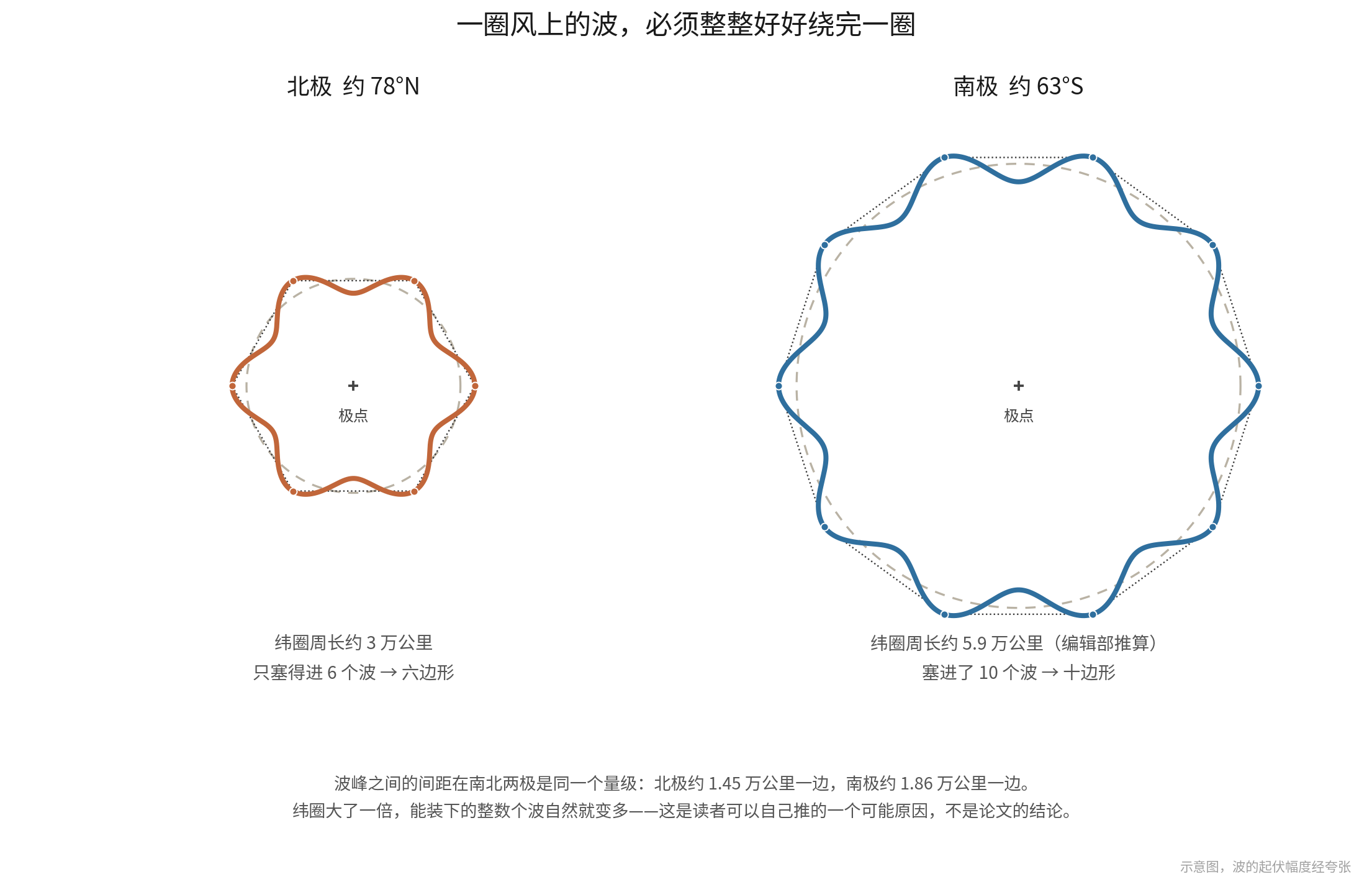
Only waves that fit a whole number of times around the circle survive: six, seven or ten, never six and a half.
Meteorologists call that integer the wavenumber.
The smaller latitude circle in the north fits six waves and forms a hexagon. The southern circle is much larger and fits ten, producing a decagon.
Now we need to brake.
The claim that a larger circle simply fits more waves is our own inference from the circumference of a latitude circle. It is not the paper's conclusion. As a check, we applied the same calculation to the latitude of the northern hexagon and obtained a side length of about 14,470 kilometers. The published measurement is about 14,500 kilometers, agreement within 0.2%, so the geometry itself is sound. But science still has no clean answer for why the southern pattern has ten sides rather than six.
The paper is more cautious. Using a shallow-water numerical model, the team found that a ten-sided wave could arise in one of two ways: a periodic disturbance in the jet, or an anticyclonic vortex to its north. The Berkeley release does report an anticyclonic vortex near 55 degrees south, just north of the jet.
The Oxford paper offers another, deeper clue. Its experiment found that wavenumber is "mainly determined by the Rossby number," then immediately added:
"The observed wavenumber is not uniquely determined by the Rossby and Ekman numbers, and several states of different wavenumber may be found in similar ranges of parameters, depending mainly on initial conditions."
Depending on initial conditions. Part of the number of sides may depend not on present conditions but on how the pattern began.
The planet remembers its beginning.
Sixteen Years Ago, a Laboratory Calculated That the South Should Have No Polygon
Here is the story's most dramatic turn.
In 2010, Peter Read's Oxford team published A laboratory model of Saturn's North Polar Hexagon in Icarus (Barbosa Aguiar, Read, Wordsworth, Salter and Yamazaki, volume 206, pages 755-763).
They built an experiment: a cylindrical tank 60 centimeters across and 10 centimeters deep, rotating at up to 4 radians per second. A narrow ring at the water's surface rotated at a different speed. Its outer radius was 15 centimeters and its radial width 2 centimeters. Dragging the surface water, the ring created a shear layer: a laboratory jet stream.
The researchers added fluorescein dye and watched what the jet became.
It became a polygon. Six sides appeared most often, but the tank also produced shapes with three through eight sides. A 60-centimeter vessel reproduced the pole of a planet.
One sentence in that paper became the perfect footnote to today's news. The team also conducted a barotropic linear-stability analysis of Saturn's actual zonal-wind profile and concluded:
"These results are consistent with the presence of the hexagon in the north and the absence of a counterpart in the south."
Consider its weight. In 2010, the theory explained not only why the north had a hexagon but why the south had none. That is an unusually clean scientific success: one model got both the presence and the absence right.
Sixteen years later, the south grew a decagon.
That does not mean the theory failed. It means the theory has been handed a harder problem. Either the wind profile in Saturn's southern hemisphere really changed, probably with the seasons, or the 2010 analysis omitted something. Both possibilities are more interesting than "we knew it all along."
Another detail matters. The tank made polygons with three to eight sides. Ten lies outside the published laboratory range. For now, even the experiment on Earth has not reproduced today's decagon.
One frequently shared "Saturn polygon kitchen experiment" is easy to confuse with this one but uses a different mechanism. In 2006 a Danish team published Polygons on a Rotating Fluid Surface in Physical Review Letters (Jansson et al., volume 96, 174502). Rotating the bottom of a stationary cylindrical container caused the free surface of the water to lose circular symmetry and form a rotating polygon, with up to six corners in water. The mechanism combined strong azimuthal shear from the stationary wall with free-surface waves. The paper never mentions Saturn.
It looks similar, but it is not the same. The next time you see a beautiful video of a polygonal rotating water surface, remember: it is Saturn's cousin, not Saturn.
Why the South Pole Became Visible Only Now
If the decagon was already there, why did we have to wait?
The answer lies in Saturn's seasons.
Saturn's rotation axis tilts 26.73 degrees relative to its orbit, according to NASA, comparable to Earth's 23.4 degrees. One orbit around the Sun takes 29.4 Earth years. Together, those numbers produce seasons about 7.4 years long, while each pole spends more than a decade in complete darkness.
NASA records the timetable. Northern polar night lasted from November 1995 to August 2009. The August 2009 equinox restored sunlight to the northern hemisphere. May 24, 2017, was northern summer solstice.
Then, on May 6, 2025, the Sun crossed Saturn's ring plane from north to south: another equinox. The southern hemisphere entered spring. Sunlight returned to the south pole, which also tilted back toward Earth.
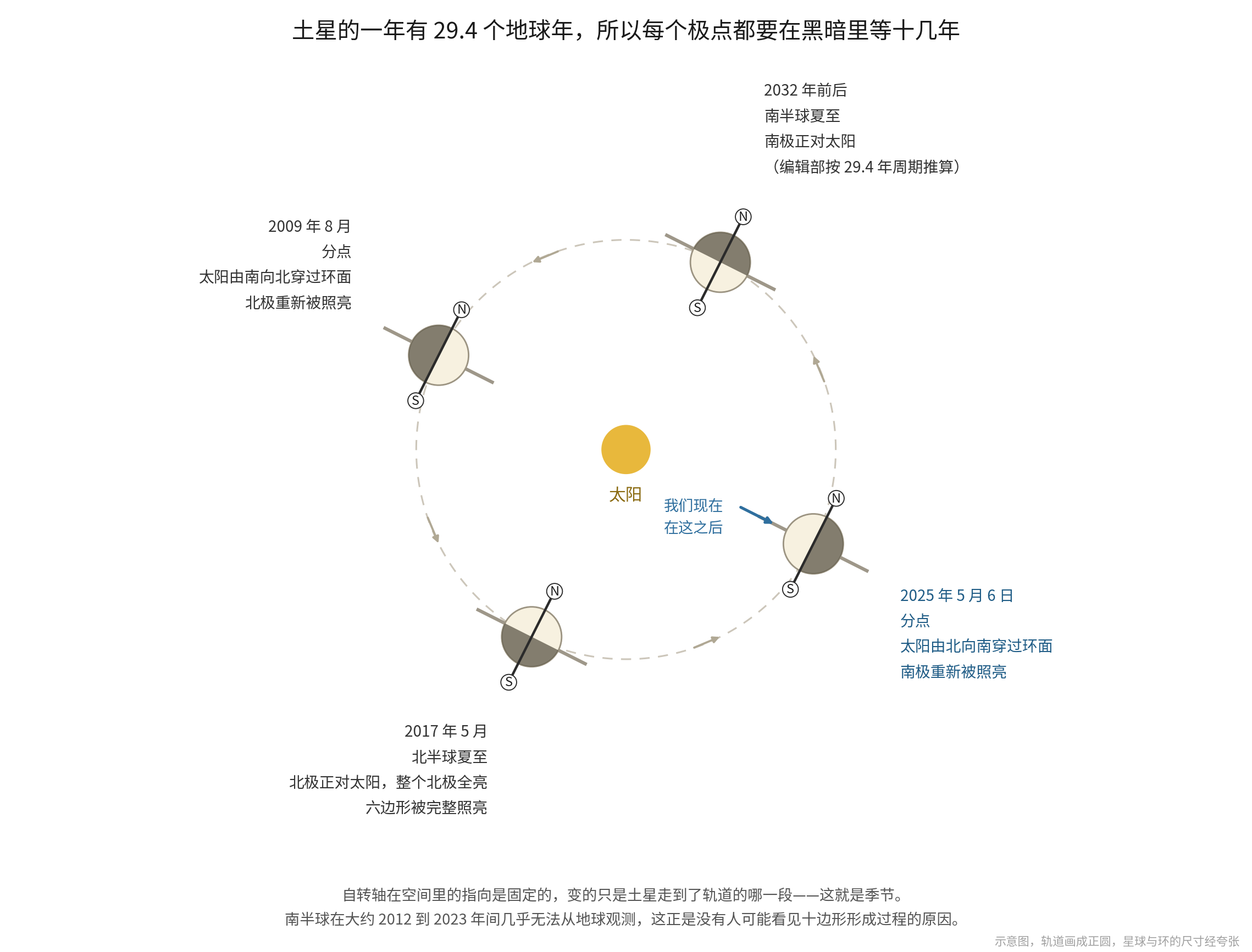
The discovery team says as much. EarthSky quotes them: "The discovery was possible because Saturn's changing seasons have gradually brought the planet's south pole back into view from Earth." According to Sci.News's account of the paper, the southern hemisphere was nearly impossible to observe from Earth from roughly 2012 to 2023. We could not verify that sentence in the paper itself or on NASA's official page, so it is attributed to Sci.News here.
That explains two things at once: why no one could watch the decagon form, and why Hubble's first "subtle hint of a ten-vertex polygon" appeared in 2023.
The window stayed closed for 11 years. When it opened again, the view had changed.
Several dates in 2025 are often conflated, even in popular-science coverage. Earth crossed Saturn's ring plane on March 23, 2025, when Saturn lay only 9.5 degrees from the Sun and was nearly impossible to observe. The Sun crossed the ring plane, Saturn's true equinox, on May 6, 2025. The rings reached their minimum tilt as seen from Earth on November 23, 2025, after which they began opening again. These were three events spread across more than six months. The Sun's crossing, not Earth's, determined whether the south pole received light.
The Northern Hexagon Is a Wall
Because we keep comparing the poles, the northern one deserves a clear account. It is the known half of this story.
Even its discovery date has three versions. Voyager 1 flew past Saturn in November 1980 and Voyager 2 in August 1981. David Godfrey recognized the hexagon in those data in 1987, and the paper appeared in Icarus in 1988. APOD's statement that it was discovered in Voyager data in 1987 is accurate. Berkeley's "discovered in 1980" and the Basque university's "since 1980-1981" refer instead to when the images were captured.
How large is it? NASA's Jet Propulsion Laboratory gave official figures in 2013: about 20,000 miles, or 30,000 kilometers, across, with edge winds reaching 200 miles per hour, or 322 kilometers per hour. Each side is about 14,500 kilometers long, roughly 2,000 kilometers longer than Earth's diameter. The whole hexagon is as wide as 2.35 Earths placed side by side.
How stable is it? "Every time we have looked over the past 40 years, the northern hexagon was there," a 2026 EarthSky report quotes, echoing APOD's statement that it has remained stable for more than four decades.
Its most beautiful property is this: it is a wall.
An official NASA image description says the hexagon acts as a barrier that prevents haze particles formed outside it from entering. During the north pole's 14-year polar night, the atmosphere within remained free of aerosols. After the August 2009 equinox, continuous sunlight began photochemical reactions and generated haze inside. Cassini watched the interior turn from bluish to golden between 2012 and 2016.
A ring of wind encloses a piece of sky and makes inside and outside different colors. You can watch the change happen in four years.
Something else sits at the hexagon's center. Cassini photographed a giant polar cyclone there in 2013. NASA published two sizes, both correct because they measure different features: the eye is 1,250 miles, or 2,000 kilometers, across, about 20 times the size of a typical hurricane eye on Earth; the entire storm is about 2,200 miles, or 3,500 kilometers, across, about twice the size of Earth's largest recorded hurricane. Clouds in the eyewall move at 330 miles per hour, or 150 meters per second.
Caltech's Andrew Ingersoll said, "We did a double take when we saw this vortex because it looks so much like a hurricane on Earth." He added, "The hurricanes on Earth typically last a week, but this has been here for decades."
Kunio Sayanagi of Hampton University supplied the reason: "This polar hurricane has nowhere else to go, and that's likely why it's stuck at the pole."
Earth's hurricanes make landfall and dissipate after hitting land or cold water. Saturn has no land. Once a storm settles at the pole, there is nowhere else for it to go.
What did Cassini see in the south? A spectacular polar vortex, certainly. NASA's 2006 figures gave winds of 550 kilometers per hour, or 350 miles per hour, with eyewall clouds rising 30 to 75 kilometers above the central clouds. The storm was about 8,000 kilometers across, and NASA called its Earthlike eyewall "a phenomenon never before seen on another planet."
But the official description contains no polygon or hexagon at all. It mentions only a "dark eye," spiraling cloud arms and a ring of thicker, brighter clouds.
(One warning: the English Wikipedia article is currently vague enough in its "South pole observations" section to suggest that Cassini saw the decagon. It did not. NASA's words are "no sign of any long-term structure.")
How Large Is the Decagon? No One Has Published a Number
This section may keep you from being fooled.
The new paper and official releases provide these figures: the pattern lies near 63 degrees south; the jet reaches about 400 kilometers per hour; the pattern drifts slowly relative to the planet's rotation at about 10 kilometers per hour; and each of its ten vertices oscillates with a period of roughly 32 days.
The corners move. This is not a rigid geometric figure but a trembling one, taking about a month for each oscillation.
Yet no official source has published its diameter. We had a research assistant list every number in the STScI release and NASA feature. Neither gives a width, diameter or Earth-size comparison.
The internet has already begun repeating a figure: "about 104,000 miles across."
Discard it. 104,000 miles is about 167,000 kilometers, while Saturn's own equatorial diameter is 120,500 kilometers. A cloud system lying on Saturn's surface cannot be 40% wider than the planet itself. The number is not merely unsourced; it is physically impossible.
Using the oblate geometry of Saturn's one-bar atmospheric level, we calculate that the latitude circle at 63 degrees south is about 59,300 kilometers in diameter, equivalent to 4.7 Earths side by side, with each side about 18,600 kilometers long. As noted above, the same calculation reproduces the published 14,500-kilometer side length in the north. This is a geometric estimate, not a figure from the paper.
Sometimes the honest answer is, "That number does not exist yet." It is more useful than a beautiful false one.
Saturn's Rings Are a Seismometer
One digression, because it is too good to omit.
How long is a day on Saturn?
NASA's planetary fact page says 10.7 hours. But the precise number puzzled scientists for decades. NASA explains why directly: "The gas giant has no solid surface with landmarks to track, and it has an unusual magnetic field that hides the planet's rotation rate."
Saturn's magnetic field is almost perfectly aligned with its rotation axis. The method that works for Earth and Jupiter - track a signal sweeping around with the rotation - fails there. Different measurements consequently disagreed. Voyager in 1981 obtained 10 hours 39 minutes 23 seconds from the magnetic field. Cassini's magnetic estimates wandered between 10:36 and 10:48. Godfrey measured the northern hexagon's own rotation period in 1990 as 10 hours 39 minutes 24 seconds.
In 2019, the answer came from the last place anyone expected: Saturn's rings.
Christopher Mankovich and colleagues at Caltech used ring seismology to derive 10 hours 33 minutes 38 seconds.
Mankovich explained the mechanism: "Particles throughout the rings can't help but feel these oscillations in the gravity field. At specific locations in the rings, these oscillations catch ring particles at just the right time in their orbits to gradually build up energy." NASA summarized it this way: the rings respond to vibrations within the planet itself and act like seismometers measuring motion caused by earthquakes.
Saturn trembles inside. Its rings record the trembling. Humanity read the rings and learned how long the planet's day lasts.
One further detail is almost eerie. The northern hexagon's period, 10 hours 39 minutes 24 seconds, is nearly identical to Voyager's old radio period, which we now know is not Saturn's true rotation period. The two differ from the modern value by 345 seconds. The hexagon does not simply move with the clouds; it is anchored to something deeper. That is exactly why it is interesting.
The First Person to See It Was in an Australian Mining Town
The best part of the story comes last.
NASA's release contains this sentence:
"Trevor Barry and Jean-Paul Oger noticed a faint, wavy band along the south polar region," beginning "in 2024."
Neither is a professional astronomer. They are amateur observers who image Saturn through home telescopes and submit the results to PVOL, the Planetary Virtual Observatory and Laboratory database. Sánchez-Lavega first noticed the decagon in ground-based images submitted to PVOL, according to Berkeley's release.
Trevor Barry lives in Broken Hill, New South Wales, Australia. He is a miner.
In an Australian Broadcasting Corporation report on September 7, he recalled: "From 2024, mid-2024, I imaged what I described to my professor as a ripple pressing down, some bright spots forming a ripple, pressing down into Saturn's south polar belt."
Then came a sentence that makes you smile before it catches in your throat:
"All the other authors are professors or doctors, and then there's Trevor, a miner from Broken Hill."
He added, "I'm very happy that Broken Hill got a mention in the paper."
Barry designed and built his telescope himself. He made its heavy German equatorial mount at the local Technical and Further Education college. According to a 2023 ABC report, his observatory dome took about ten years to build from everyday materials, including two halves of rainwater tanks welded together and a secondhand washing-machine motor.
Amy Simon of NASA Goddard, principal investigator for Hubble's OPAL program, said: "He is one of our best Saturn observers. He sends us very, very detailed reports, his images are really good, and he tracks these things over long periods."
A used washing-machine motor, a section of rainwater tank, a mining town and a byline in Science Advances.
A Chinese Thread: Suixing and Zhenxing
In ancient China, Saturn was called Zhenxing, the Star of Settlement, also written as the Star of Filling.
The reason was both simple and clever. The Records of the Grand Historian, in its "Treatise on the Celestial Offices," records that Saturn advanced through one of the 28 lunar mansions each year and took about 28 years to complete the circuit. The characters for filling and settlement referred to the planet filling, or guarding, one mansion per year. Saturn's true orbital period is 29.4 years. Two millennia ago, naked eyes and patience came within a year and a half.
(This statement rests on the ancient text itself. We asked a research assistant to find an official popular-science source from the Chinese Academy of Sciences, National Astronomical Observatories or Beijing Planetarium, and none was found, so no institution is attached to it.)
Planetary-atmosphere research in China is now continuing that line.
A 2025 review in Reviews of Geophysics and Planetary Physics, volume 56, issue 1, carries an unusually apt Chinese title: Four Ji of Suixing: Looking Back on 50 Years of Jupiter Atmospheric Exploration by Song Xinyi, Yang Jun and Wei Yong, pages 67-82, DOI 10.19975/j.dqyxx.2024-011. Suixing, the Year Star, was the ancient Chinese name for Jupiter because it takes roughly 12 years to cross the sky, while one ji was a 12-year span. Four ji neatly name the 50 years of exploration.
Among the paper's keywords are jets and polar vortices.
Those are the two ingredients of today's decagon: a jet and a polar vortex. A Chinese review titled with a term two millennia old discusses the jets and vortices in giant-planet atmospheres.
Its conclusion points forward. The March 3, 2025, overseas edition of People's Daily, in "Reaching for the Stars: China's New Deep-Space Expedition," said that China would launch Tianwen 3 and Tianwen 4 around 2028 and 2030 respectively, and that Tianwen 4 would study Jupiter and its moons as well as Jupiter's space environment and internal structure. Accounts of the mission architecture have varied over the years, with earlier reports also mentioning Uranus; this is the description used by the 2025 People's Daily article.
When Tianwen 4 reaches Jupiter, it will be looking at this same family of things: jets, vortices and polygons.
One final note about APOD appears in today's own caption. The main APOD site is moving from apod.nasa.gov to science.nasa.gov/apod. The migration is taking place through August and September 2026, and NASA asks readers to update bookmarks and other links before the end of September. We confirmed the immediate effect: the old-style address apod.nasa.gov/apod/ap260908.html already returns 404. This article therefore links to the new address.
A feature that has posted one image every day since June 16, 1995, is moving house.
Finally
Return to Sánchez-Lavega's question: why now?
Berkeley's Michael Wong said, "A few years ago, this structure wasn't there. It shows the importance of regular observations of the outer planets."
Amy Simon said, "We've never seen anything like this in Saturn's southern hemisphere. This structure is different - it appears to be strengthening, giving us a rare opportunity to watch a giant atmospheric pattern develop."
It appears to be strengthening. Those are the four words to keep.
We are not looking at a commemorative photograph. We are watching an event in progress, and it has only just begun. Humanity has watched the northern hexagon for more than 40 years, but we met it fully grown. This time, we have arrived near the start.
Why ten sides? Why now? For the moment, the answer is that no one knows.
A miner's observatory, made from two sections of rainwater tank and a washing-machine motor, photographed a ripple in 2024. Hubble resolved it on August 29, 2025. The paper appeared six days ago. The pattern is still changing.
Next year it may still have ten sides. It may have nine, or eleven. It may dissolve, leaving the south pole empty again.
Whatever happens, someone in a backyard may see it first.
Sources: NASA Astronomy Picture of the Day for September 8, 2026; NASA/api.nasa.gov; Space Telescope Science Institute release 2026-022; NASA's Hubble feature and image resource page; the University of the Basque Country (UPV/EHU); the Space Sciences Laboratory at the University of California, Berkeley; Sánchez-Lavega et al., Science Advances 12(36); Barbosa Aguiar, Read et al., Icarus 206 (2010); Jansson et al., Physical Review Letters 96 (2006); Godfrey, Icarus 76 (1988) and Science 247 (1990); Mankovich et al., The Astrophysical Journal 871 (2019); Yadav and Bloxham, Proceedings of the National Academy of Sciences 117 (2020); NASA Jet Propulsion Laboratory material on the south polar vortex (2006), the north polar hurricane and hexagon (2013); NASA's Saturn fact sheet and "What Time Is It on Saturn?" feature; NASA, "Changing Colors in Saturn's North"; Hueso et al., Planetary and Space Science (2017) on PVOL; MIT's "Weather in a Tank" course; Royal Museums Greenwich; BBC Sky at Night Magazine; EarthSky; Sci.News; Australian Broadcasting Corporation reports from 2023 and 2026; the British Astronomical Association Saturn Section; the Astronomical Association of Queensland; the Records of the Grand Historian, "Treatise on the Celestial Offices"; Reviews of Geophysics and Planetary Physics 56 (2025), Song Xinyi, Yang Jun and Wei Yong; and the overseas edition of People's Daily, March 3, 2025.