
Not one frame of today's film was drawn by a computer, and it takes you toward something so thin that it almost should not exist.
Today's NASA Astronomy Picture of the Day is not a still image. It is a film.
The camera approaches Saturn. The planet grows larger as cloud-wrapped Titan sweeps past the bottom of the frame. Then the camera passes tiny Mimas, its enormous Herschel crater sharply visible. Saturn's rings fill the screen; the viewpoint crosses their thin plane, and their dark shadow falls across the planet itself. Finally, the mysterious ice-geyser moon Enceladus appears in the distance. The camera rushes toward it, and the clip ends.
The images came from Cassini. It took thousands of photographs while approaching Saturn in 2004 and hundreds of thousands more after entering orbit. The person who assembled them into this film made a choice that renders the result more interesting than the technique alone.
Not One Frame Was Computer-Generated
The clip belongs to an IMAX film project called In Saturn's Rings. Its creator is Victoria Srace Stone, who made the film under the name Stephen van Vuuren, the name used in today's APOD credit. According to the official website, the full film consists of 7.5 million real photographs from space missions and historical archives, "animated to full motion without CGI, 3D modeling, or simulations."
How do still photographs begin to move? Through the old craft of multiplane photo animation: an image is divided into layers, and the layers move at different speeds to create depth through parallax. The creator says the technique developed from the 2.5D animation in the documentary The Kid Stays in the Picture. Some shots use one photograph per frame, but many frames are enormous mosaics assembled seamlessly from thousands of photographs and then animated to produce the sensation of flight.
One figure captures the labor involved. The production history records that a single panorama of the rings used more than 400 photographs. Working ten hours a day, six or seven days a week, the creator spent four months on it.
It is worth pausing there. The smooth sensation of flying past Saturn was not calculated by a graphics card. Someone aligned four hundred real photographs one by one, joined their edges, erased their seams and worked for more than a hundred days. Not one pixel in this film was imagined. Every part of Saturn you see was genuinely observed by a machine hundreds of millions of kilometers away.
Now for the Thing So Thin It Should Not Exist
The easiest misconception about Saturn's rings comes from the word "ring." It suggests a band like a piece of jewelry or a tire, with weight and thickness.
It is nothing like that. It is a sheet of paper.
NASA's official figures put the main ring system at about 280,000 kilometers across, while its thickness is "only about 30 feet (10 meters)." The rings consist almost entirely of chunks of water ice ranging from smaller than grains of sand to the size of mountains.
The ratio between 280,000 kilometers and 10 meters is 28.2 million to one. A technical caveat: the literal wording on NASA's page says the ring system "extends up to 282,000 kilometers from the planet," which reads as though the number were a radius. But the actual diameter of the main ring system out to the F ring is about 280,000 kilometers, and the figure is commonly treated as a diameter. I use it that way here; the diagram below also includes the alternative result if it is read as a radius.
The ratio is too extreme to picture directly, so scale it down to something at hand:
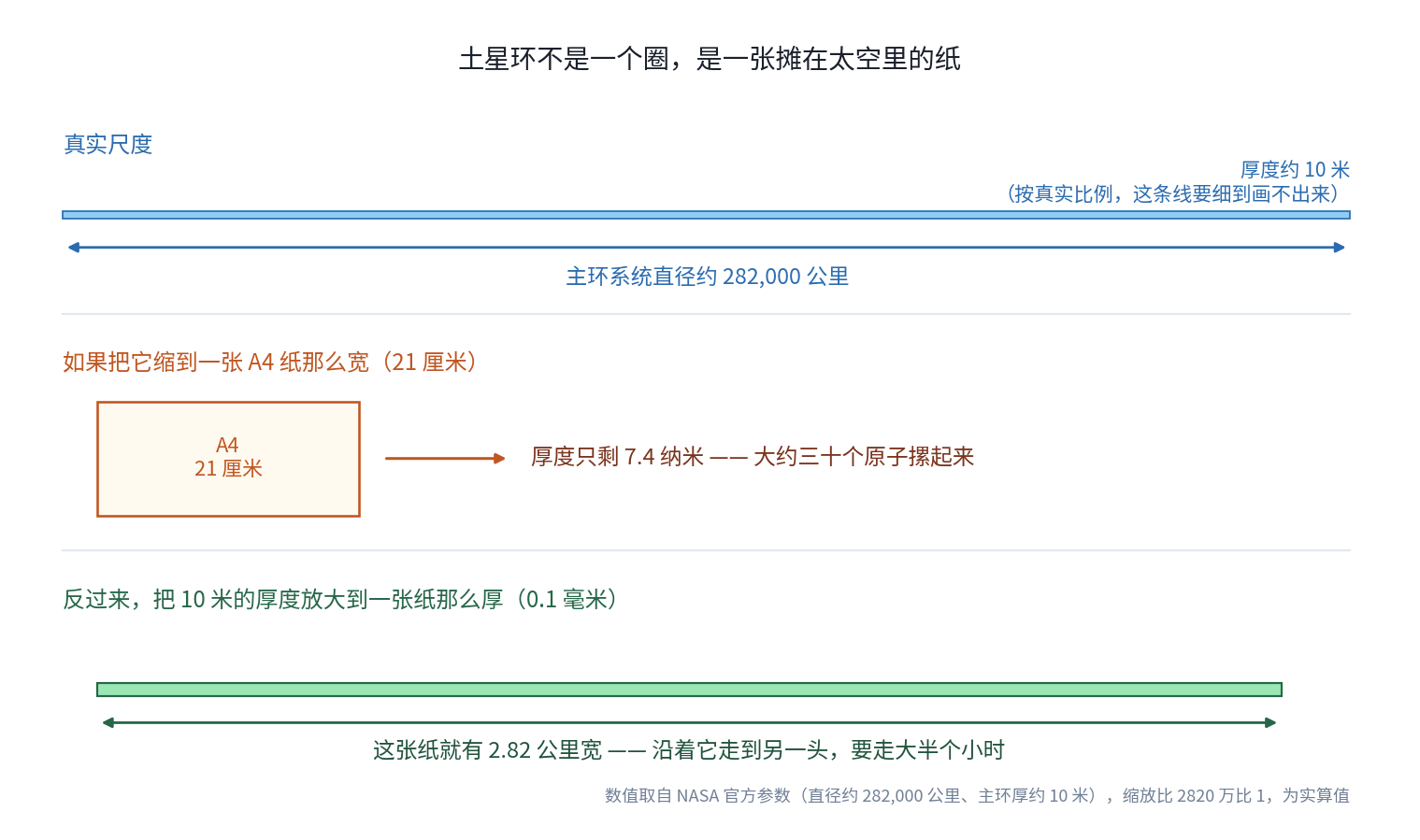
Shrink the entire ring system to the 21-centimeter width of an A4 sheet and its thickness falls to 7.4 nanometers, about thirty atoms stacked together. Reverse the comparison: enlarge the rings' 10-meter thickness to that of ordinary paper, 0.1 millimeters, and the sheet becomes 2.82 kilometers wide. Walking from one edge to the other would take more than half an hour.
The next time you see a picture of Saturn, replace the word "ring" with this: a sheet spread across space, its face as wide as two Earth-Moon distances and its thickness no greater than a single story of a building.
Its thinness and the possibility of flying through it are two sides of the same fact.
Flying Through a Sheet of Paper
Cassini crossed the ring plane many times. Two crossings deserve separate attention.
The first came just after it arrived. During orbital insertion in 2004, a JPL mission briefing specified that Cassini would cross a known gap between the F and G rings twice: upward before its engine burn and downward afterward. About 85 minutes before the insertion burn, it would turn its four-meter high-gain antenna to face forward as a shield. Humanity's most straightforward protection for a spacecraft was, in effect, to hold up a pot lid.
The last came when it went to its death. During the 2017 Grand Finale, Cassini completed 22 orbits, diving on each one through the gap between Saturn and its innermost ring. That gap is 2,400 kilometers wide. At its closest, the spacecraft passed only 1,628 kilometers above Saturn's cloud tops, moving relative to the planet at up to 123,600 kilometers per hour.
Together, these facts make the geometry clear. A ring only ten meters thick is crossed in an instant, while a 2,400-kilometer gate can be aimed at precisely by a spacecraft four meters wide. The hard part was never passing through. It was calculating exactly when to do it.
The Ring's Shadow Is Saturn's Calendar
One detail in the film can vanish in a moment: the rings cast a dark shadow on Saturn itself.
That shadow is not decoration. It is Saturn's seasonal indicator.
Saturn's rotation axis is tilted by 26.73 degrees, compared with Earth's 23.4 degrees, and the planet takes 29.4 Earth years to orbit the Sun. Its poles therefore experience "nearly 15 Earth years of winter darkness followed by 15 years of continuous sunlight." The rings act like a vast awning that cools the atmosphere below. As Saturn moves around the Sun, that shadow moves with it.
Cassini caught evidence of this machinery in motion. At Saturn's equinox in August 2009, sunlight struck the rings edge-on and their shadow contracted to a narrow line around the planet's waist. Project scientist Leigh Fletcher put it plainly: "Once the shadow disappeared, the atmosphere heated up quickly." Between 2004 and the 2009 equinox, Saturn's northern mid-latitude stratosphere warmed by 6 to 8 kelvins, and the whole northern hemisphere changed from blue to yellow-brown.
The movement of one shadow changed the color of half a planet. It is my favorite detail in the film.
One common description can be made more exact. NASA says this illumination geometry occurs "every half-Saturn year, or about every 15 Earth years." The real dates are uneven: November 1995, August 2009, May 2025 and January 2039, separated by 13.7, 15.7 and 13.7 years. Add neighboring pairs and the result is exactly 29.46 years, one Saturn year. Saturn's eccentric orbit causes the difference because the planet moves faster near perihelion. Its spring and summer are therefore unequal in length to its autumn and winter, by more than Earth's seasons are. "About 15 years" is an average, not a metronome.
The Rings Are Opening Now
This directly affects what you can see this year.
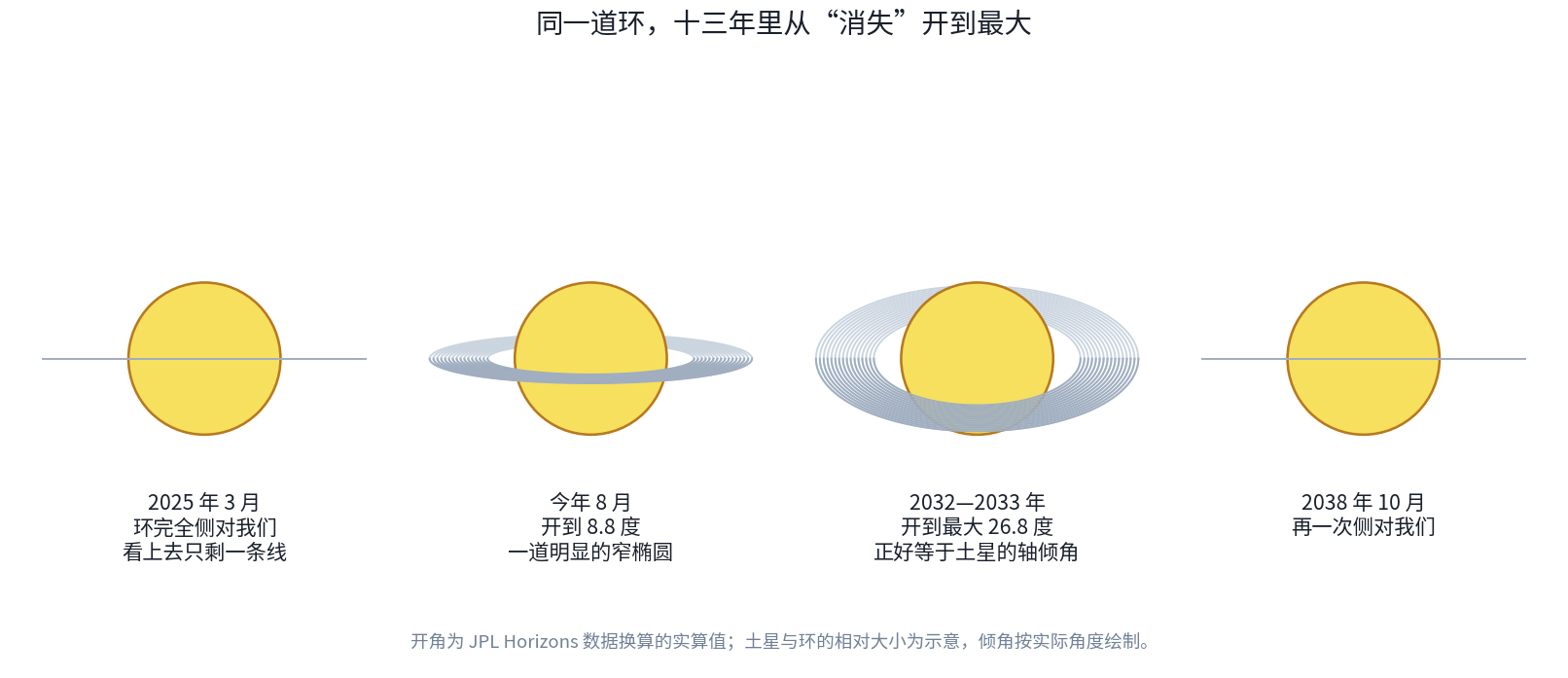
In March 2025, Earth crossed Saturn's ring plane. From our perspective, the rings disappeared completely, collapsing into a line. They have been opening ever since. My conversion of JPL Horizons data gives a ring opening of about 8.8 degrees in late August this year and about 7.5 degrees at opposition in October, with a small oscillation during the year. They will reach their maximum opening of about 26.8 degrees in 2032-2033. That figure matches Saturn's axial tilt of 26.73 degrees because they are, in fact, the same angle. The agreement served as a check on the full conversion, and it matched.
The next disappearance of the rings will come on October 15, 2038.
This is not the most spectacular year for observing Saturn, but neither is it 2025, when there was almost nothing to see. At 8.8 degrees, the rings form a clearly visible narrow ellipse. Any small telescope can distinguish them from a line.
Every Moon in the Film Misbehaves
Each moon that passes through the film later became a mystery.
Titan, the cloud-wrapped one, has an atmosphere about 95% nitrogen and 5% methane. Surface pressure is roughly 60% greater than Earth's. NASA compares it to the pressure a person would feel 15 meters below the surface of an ocean on Earth. At -179°C, the surface is cold enough for water ice to play the role of rock. Yet this world contains a liquid cycle uncannily like Earth's: liquid methane and ethane fall from clouds, flow across the surface, fill lakes and seas, then evaporate back into the sky. Cassini found three seas and hundreds of small lakes there.
On January 14, 2005, the European Space Agency's Huygens probe landed on Titan. ESA calls it "the first probe to land on a world in the outer Solar System." Its descent lasted longer than estimated before the mission: 2 hours, 27 minutes and 50 seconds. Twenty-one years later, it remains humanity's only landing on a world in the outer Solar System. ESA's sentence says "first"; "only" is what a count of the intervening calendar tells us.
Mimas, the moon with the enormous impact scar, has a mean diameter of only 394 kilometers, while Herschel crater is 130 kilometers wide. One crater spans a third of the whole world's diameter. Its walls rise about 5 kilometers and its central peak about 6. It resembles the Death Star from Star Wars, a likeness NASA itself has used in an image title.
NASA's Mimas page still says that the moon "appears to be frozen solid." A paper published in Nature in February 2024 argued the opposite. Lainey and colleagues reanalyzed Cassini measurements of the drift of Mimas's orbital periapsis and concluded that a global ocean lies beneath its cratered ice shell, 20 to 30 kilometers below the surface. The decay of its orbital eccentricity further suggests that the ocean may be less than 25 million years old and still evolving. The boundary between ice and water may have come within 30 kilometers of the surface less than two or three million years ago, too recently to leave signs of activity above.
This deserves its own sentence because it matters more than the conclusion itself: the result did not come from a new photograph but from recalculating old data gathered between 2004 and 2017. A moon that looks the most dead may conceal the youngest ocean in the Saturn system. NASA's website has not yet changed its wording. Science is not a finished book but a draft under constant revision.
Cassini's Real Surprise Was the Smallest Moon
The moon at the end of the film is Enceladus, only 500 kilometers wide, about the width of Arizona, with a surface temperature of -201°C. Cassini was not originally expected to spend much time on it.
Then one discovery after another escaped the plan.
In February 2005, the magnetometer found something "pushing" against Saturn's magnetic field. That July, images of the south pole revealed unexpectedly young, complex terrain almost entirely free of impact craters, along with a huge plume of water vapor and warm fractures. In October 2007, scientists confirmed that jets emerged from fissures informally known as "tiger stripes," exactly where Cassini's infrared spectrometer measured the highest temperatures. Ice-water particles and gas burst from them at about 800 miles per hour.
In 2014, JPL counted 101 distinct geysers concentrated along the four main tiger-stripe fractures and reached an elegant conclusion: the only plausible source of the material producing the geysers was the sea now known to exist beneath the ice shell. Even better, the presumed direction of cause and effect was reversed. Heat did not make the geysers; the geysers made the heat.
In September 2015, the answer became firm. Researchers analyzed more than seven years of images and detected an extremely small but measurable wobble in Enceladus. One paper author explained that if the surface and core were rigidly connected, the core would act as dead weight and suppress the wobble below the observed amount. The conclusion was direct: "This proves that there must be a global layer of liquid separating the surface from the core."
Then came the search for "food." In 2017, Cassini detected abundant molecular hydrogen in the plume, 0.4% to 1.4% by volume, pointing to ongoing hydrothermal processes. The abundance of hydrogen makes methanogenesis in the ocean thermodynamically possible. In 2018, Nature reported large organic molecules with masses greater than 200 atomic mass units in the plume; most organics detected earlier had been below 50. In June 2023, another Nature paper delivered perhaps the most startling result: the phosphate concentration in Enceladus's ocean is at least 100 times that of Earth's oceans. As one researcher said, "This is the first time this essential element has been discovered in an ocean beyond Earth."
The James Webb Space Telescope measured how far the water vapor extends in 2023: a plume as long as about 10,000 kilometers, equal to 40 Enceladus radii or more than 20 Enceladus diameters laid end to end. Its temperature was only 25 kelvins, and it erupted at about 300 kilograms per second. NASA converted that to a more vivid scale: about 79 gallons every second, enough to fill an Olympic-size swimming pool in about two hours. My calculation gives 2.31 hours; a garden hose would take more than two weeks. About 30% of the water remains near Saturn in a "fuzzy doughnut," while the other 70% spreads through the Saturn system.
One distinction must be kept clear. Webb specifically searched on this occasion for the non-water gases carbon dioxide, carbon monoxide, methane, ethane and methanol, and detected none of them. Cassini found organic molecules at close range; Webb did not confirm them. The instruments observed from different distances with different sensitivities, and their conclusions cannot be mixed.
Why Cassini Had to Die
On September 15, 2017, Cassini was deliberately guided into Saturn's atmosphere and destroyed.
It was not discarded merely because a spacecraft without fuel had no further use. NASA and JPL stated the reason clearly: the intentional plunge was designed to ensure that Saturn's moons, especially Enceladus with its subsurface ocean and signs of hydrothermal activity, remained pristine for future exploration. Having found a place that might offer conditions for life, Cassini could not be allowed even a remote chance of crashing there. A spacecraft's final mission was to protect its own discovery.
The ending was tougher than it sounds. NASA's reconstruction says that Cassini entered the atmosphere at an altitude of about 1,900 kilometers, firing its thrusters to maintain its orientation as it fell and transmitted its final scientific data. It held out against Saturn's atmosphere for 91 seconds, with its thrusters at 100% capacity for the final 20.
Earth heard the signal end 83 minutes after the spacecraft had actually broken apart, the time its radio transmission took to travel from Saturn. At 7:55 a.m. Eastern time, the voice that vanished from the screens at JPL had been sent more than an hour earlier. It was already gone before we knew.
Its Chinese Name Is a Model You Can Check
In Sima Qian's Records of the Grand Historian, Saturn is called the Filling Star, a name later commonly written as the Guarding Star. The brief entry hides a model expressed as exact fractions:
"Each year the Filling Star fills one lunar mansion... In a year it travels thirteen and five one-hundred-twelfths degrees; in a day, one twenty-eighth of a degree; in twenty-eight years, it circles the heavens."
The three statements are not separate approximations. Using the ancient Chinese circumference of the sky, 365.25 degrees: 365.25 / 28 = 13.0446 degrees, while 13 + 5/112 = 13.0446 degrees. They agree exactly. Three forms express the same number. One transcription I found gives "ten and five one-hundred-twelfths degrees." The three statements themselves expose the copying error: at 10.0446 degrees a year, a full circuit would take 36 years, contradicting "twenty-eight years." A text's internal consistency can itself be a tool for correcting it.
How accurate is the model?
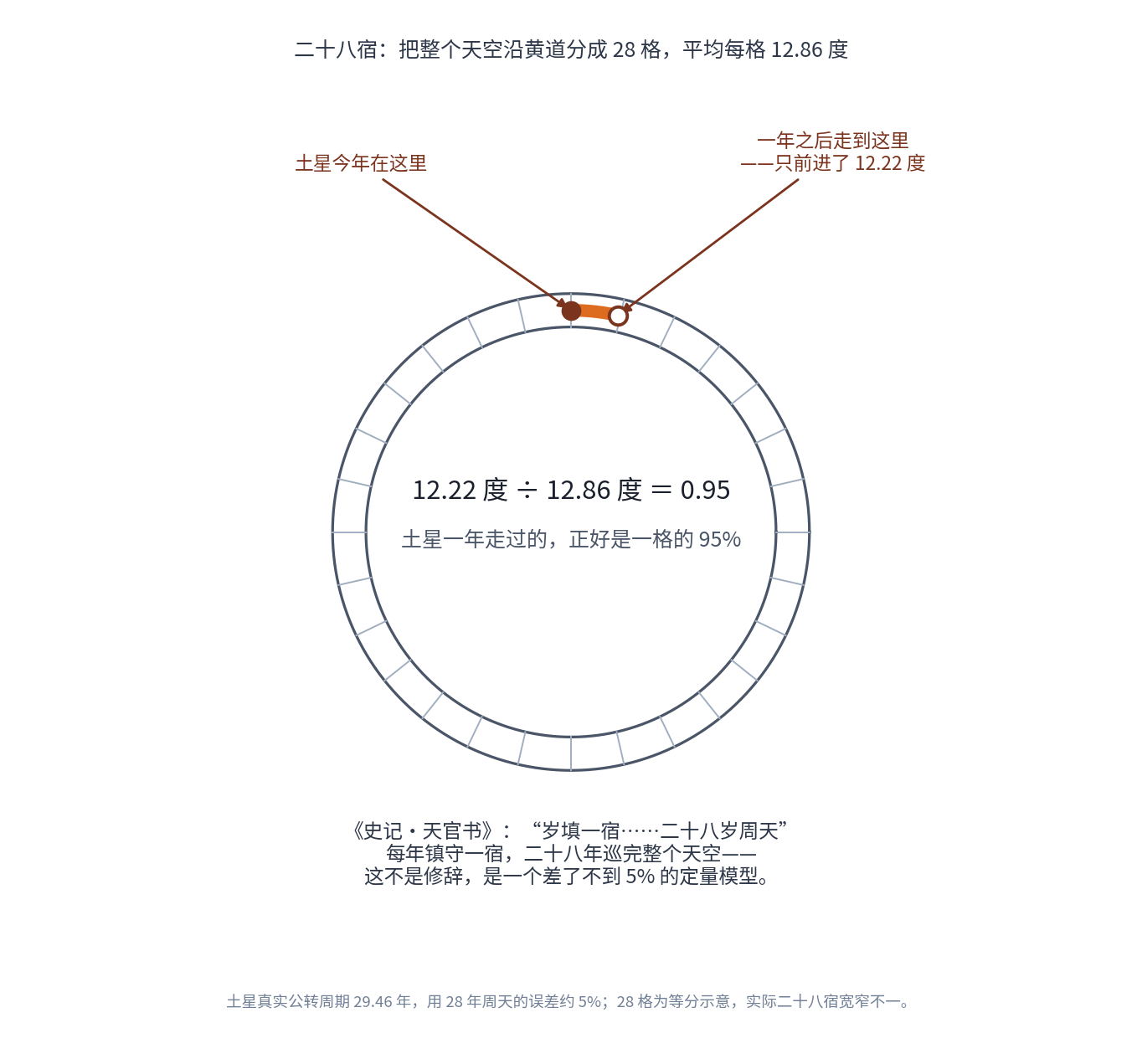
Saturn's real orbital period is 29.46 years, not 28, an error of about 5%. But measured with the scale ancient observers actually used, the model becomes elegant. Saturn advances 12.22 degrees across the sky each year, while the average width of one of the twenty-eight lunar mansions is 12.86 degrees. It travels exactly 95% of one mansion per year.
With the naked eye for position and the mansions for a scale, "filling one mansion a year" was the most natural and useful approximation available. Only after almost thirty years would the lag accumulate to more than one mansion and become apparent. The older form of the name, "Filling," is interchangeable with "Guarding" and carries the sense of holding a post. Saturn guards one mansion a year and completes its patrol of the sky in twenty-eight. The planet's name is its equation of motion.
Finally
Cassini spent almost twenty years in space - 19 years and 335 days, exactly thirty days short - orbited Saturn 294 times, took 453,048 photographs, produced 3,948 scientific papers and discovered two seas.
What it left us was a simple shape: a sheet of paper, 280,000 kilometers wide and 10 meters thick. The shadow of that sheet can change the color of half a planet.
After nine tonight, that sheet rises in the eastern sky. You cannot see that it is a sheet; to the naked eye it is only a steady point of light. But look once tonight, then tomorrow, the day after and again next week, and you will see it move.
It crosses one mansion a year. Looking at it takes one second.
Image: NASA Astronomy Picture of the Day (APOD) · Video Credit & Copyright: Cassini Imaging Team, ISS, JPL, NASA, ESA, S. Van Vuuren et al.; Music: Adagio for Strings (NY Philharmonic) · Today's page. Today is a video day, so the main APOD image is not embedded in the article; all diagrams are original to this article.
Sources: NASA Astronomy Picture of the Day for August 23, 2026; NASA science pages on Saturn and its rings; NASA's Cassini mission overview and Grand Finale figures; JPL's reports on Cassini's arrival at Saturn, the 101 geysers, the global ocean on Enceladus, and the building blocks for life in its ocean; NASA's reports on Saturn's seasons and reconstruction of Cassini's plunge; NASA fact pages on Titan and Mimas; ESA's report on Huygens landing on Titan; Waite et al. (2017), Science; Postberg et al. (2018 and 2023), Nature; Villanueva et al. (2023), Nature Astronomy; Lainey et al. (2024), Nature; the official In Saturn's Rings website; LF Examiner's project reporting; in-the-sky.org on Saturn's opposition and ring-plane crossings; Sky & Telescope's Saturn observing guide; JPL Horizons ephemerides; and Sima Qian's Records of the Grand Historian, "Treatise on the Celestial Offices." Ring proportions, opening angles, rise and set times, mission duration, and the twenty-eight-mansion calculation were independently recalculated.