
A ball rolls through the O in Google. Behind the small animation is a mathematical problem.

Image: Google Doodle, UEFA Men's Champions League 2026 Begins | Official page
On September 8, a ball appeared in the familiar colored Google logo.
It rolls in from the left and passes through the middle O. The official page explains the design directly: today's artwork shows a football rolling through the O in Google to recreate a commentator's cry of "Gooooooal!"
One O, one long shout. It may be the most economical way to fit football into a six-letter word.
The page also says what the Doodle celebrates: the start of the UEFA Champions League. After a fierce qualifying campaign, Europe's 36 best teams will compete in hopes of reaching the final in Madrid, Spain. It ends by wishing every player and team good luck.
No artist is credited, as is often the case with Google's sports Doodles. It is not an interactive game, only a GIF animation. Google does not publish the field identifying the countries where this Doodle appeared, so none are guessed here.
The league phase began on September 17 in each of the previous two seasons, but UEFA's official calendar clearly places matchday one of the 2026/27 league phase on September 8-10, 2026, Tuesday through Thursday, beginning today. This season starts almost a week earlier than recent ones.
This article, however, is not about the football. It is about the least conspicuous number in Google's description: 36.
Behind that number is an elegant mathematical problem. Its answer was devised in 1895 by a Swiss village schoolteacher for people playing chess.
First, How Many Matches Do 36 Teams Need?
Suppose there are 36 teams and the goal is a credible ranking. The most straightforward method is for every team to play every other team once, a single round robin.
The number of pairings is C(36,2), or 630 matches. If every pair meets both home and away, the total is 1,260.
At two matchdays a week and a dozen or more games on each day, 630 matches would take a full year - and the players still have domestic leagues, domestic cups and international fixtures.
A complete round robin is impossible. Its fairness is impractical.
What about the opposite extreme, single elimination? A 36-team knockout can produce a champion in six rounds and only 35 matches. But then almost nothing is known about the other 35 teams. Half go home after one game.
The real question is whether far fewer games than a round robin can still produce a credible ranking.
The answer is yes. UEFA now uses a version of that method.
Eight Matches Each, 144 in All
Beginning with the 2024/25 season, the Champions League abandoned the 32-team, eight-group format it had used for more than 30 years. According to UEFA's rules, the replacement works like this:
All 36 teams enter a single league table. Each plays eight matches against eight different opponents, four at home and four away. The draw divides clubs into four pots according to their coefficients at the start of the season. Each team draws two opponents from every pot: two of the strongest, two from the next tier, two weaker and two from the lowest tier. Teams cannot face another club from their own country, and can face no more than two opponents from any one country.
After eight rounds, the table's 36 rows divide three ways:
- First through eighth advance directly to the round of 16.
- Ninth through 24th enter a two-leg playoff for the remaining round-of-16 places.
- Twenty-fifth through 36th are eliminated and do not drop into the Europa League.
That last rule matters. Under the old system, a third-place team in a group could continue in the Europa League as a consolation. That route has gone. For the bottom 12, the European season ends there.
The total is 36 x 8 / 2, or 144 matches.
That is 144 instead of 630: 22.9% of a full round robin, less than one quarter.
It still produces far more variety. The old format's eight groups of four yielded only 48 distinct pairings, each played home and away to make 96 matches. Every match in the new 144-game league phase is a distinct pairing. That is exactly three times as many different matchups.
UEFA has disclosed a figure showing that the change was not improvised: the format followed six years of planning, testing, mathematical modeling and algorithms. Its stated goals were greater fairness and variety among opponents, stronger competitive balance, more unpredictability, more meaningful matches and more meetings between leading teams.
UEFA also explained why the draw became a hybrid of people drawing balls and a computer assigning opponents. A wholly manual draw would require a ball for every possible opponent. In its own words: "We would need 1,000 balls!"
The "Swiss System" Began in Zurich in 1895
First, a point about terminology.
UEFA itself never uses the term "Swiss system." Its format page contains neither Swiss model nor Swiss system. The official name is simply the league phase. "Swiss system" is the popular label used by media and supporters: technically apt, but not UEFA's wording.
Where did the term come from?
Chess historical accounts give a date and place: June 15, 1895, in Zurich, at the fifth Swiss Chess Championship. The person credited with proposing the format was Dr. Julius Müller, a teacher from Brugg, about 20 kilometers outside Zurich.
Chess was growing popular in the late 19th century. Organizers faced a practical problem: too many players, fixed time and no desire to send half the field home after one loss.
Müller's solution rests on one idea:
Do not use a full round robin or immediate elimination. In each round, pair players whose records so far are similar.
Winners meet winners; players who have lost meet others who have lost. After several rounds, the strongest sort themselves against one another while weaker players still get competitive games. Everyone plays throughout and everyone receives a ranking, at far lower cost than a round robin.
Only one source was found for this origin story: a 2020 ChessBase article marking 125 years of the Swiss system. The year and city are credible, but this should be treated as a historical account rather than unassailable fact.
The Beautiful Rule: Double the Players, Add One Round
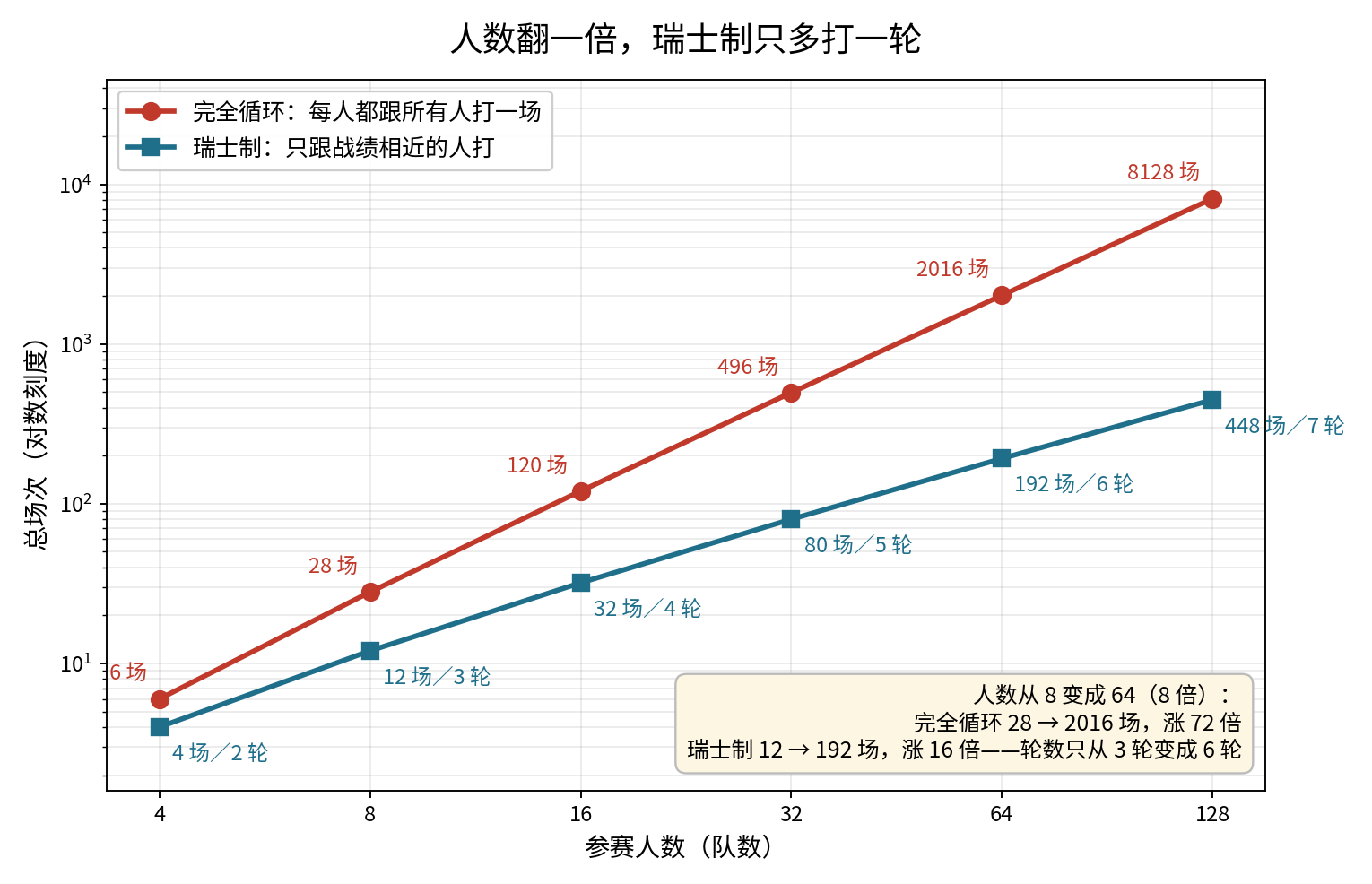
How many rounds does a Swiss tournament need? Roughly the number of times the field can be divided by two before reaching one, written mathematically as ceil(log2(players)).
Here are several examples:
| Players | Swiss rounds | Swiss matches | Round-robin matches |
|---|---|---|---|
| 4 | 2 | 4 | 6 |
| 8 | 3 | 12 | 28 |
| 16 | 4 | 32 | 120 |
| 32 | 5 | 80 | 496 |
| 64 | 6 | 192 | 2,016 |
Look at the first two columns.
Eight players need three rounds, 16 need four, 32 need five and 64 need six. Double the players, add only one round.
The round-robin column explodes. From eight players to 64, the field grows eightfold but the number of round-robin matches jumps from 28 to 2,016, a 72-fold increase. Over the same interval, the Swiss total rises from 12 matches to 192, or 16-fold, while the number of rounds merely doubles from three to six.
That is why chess, bridge and esports tournaments around the world use the system. It is one of the rare arrangements in which a much larger field raises the cost comparatively slowly.
There is an honest qualification, and it raises another good question.
The calculation gives ceil(log2(36)) = 6. In theory, 36 teams need only six rounds. The Champions League plays eight, two more.
Why?
Because log2 gives the minimum needed to identify a winner. The Champions League requires far more. It must rank all 36 teams credibly from first to 36th, because the table determines who advances directly in places 1-8, who enters the playoff in places 9-24 and whose season ends in places 25-36.
Producing a complete ranking is harder than finding one champion. It takes more rounds.
Did It Work? Data From the First Season
The new format was controversial when introduced. UEFA later published measured data from its first season, 2024/25, and several figures support its case:
- Teams in the weakest pot, pot 4, raised their average points per match from 0.7 under the group system to about 1.0. They were no longer merely practice opposition.
- The largest coefficient difference between two opponents was 19 points; under the old format in 2022/23, it had reached 53.5. The widest mismatches narrowed sharply.
- The league phase averaged 3.26 goals per match, the highest figure on record, exceeding the previous 3.21 from 2019/20.
- On the final matchday, there were 64 goals in one day, 3.55 per game, or about one every 90 seconds; 35 of the 36 teams changed position that day.
That final figure is evidence that the format reduced meaningless late fixtures. In the old group stage, many final-round matches involved teams already through or already eliminated. In a 36-row table, almost nobody has nothing to play for on the last day, because the contest is not only to qualify but to land on the correct side of the line between eighth and ninth.
UEFA's simulation also produced a practical estimate: advancing would require about 7.6 points on average, roughly two wins and two draws.
This season's eighth round is especially revealing. UEFA's schedule compresses all 18 matches into a single day, January 27, 2027, with simultaneous kickoffs. It is the designed climax of the format.
The Competition Exists Because a Journalist Objected
The Champions League itself began with an argument.
In 1954, England's Wolverhampton Wanderers defeated Budapest Honvéd, then regarded as one of the world's strongest teams. UEFA's own account says the British press promptly proclaimed Wolves "champions of the world."
Gabriel Hanot, editor of France's L'Équipe and a former French international, objected. In December 1954, he argued in the paper that the idea of a world club championship, or at least a European one, deserved to be launched, and that the paper intended to take the risk.
His point was simple: if a club called itself world champion, it should prove it in a real competition.
His colleague Jacques Ferran drafted regulations for a 16-club, home-and-away tournament. L'Équipe approached FIFA and then UEFA, which had existed for only a few months. On June 21, 1955, UEFA's Executive Committee met in Paris and approved the project. Its minutes recorded that the cup would indeed be organized by the European Union itself.
The European Champion Clubs' Cup began in Lisbon on September 4, 1955, with Sporting CP drawing 3-3 against Partizan Belgrade. Seven of the 16 teams in that first competition were national league champions. On June 13, 1956, at the Parc des Princes in Paris, Real Madrid defeated Reims 4-3. Héctor Rial scored the first winning goal in the history of the competition's finals.
It became the UEFA Champions League in the 1992/93 season.
The arithmetic places 2026/27 as the 72nd edition, counting 1955/56 as the first; the 35th season under the Champions League name; and the third under the new format.
There is also a neat coincidence. The first match in the competition's history was on September 4, 1955. This season's first is September 8, 2026: 71 years and four days later.
The Final Is in Madrid, but Not at the Bernabéu
Google's description mentions a final in Madrid. One likely misconception needs correcting.
The 2027 Champions League final will be played at Madrid's Estadio Metropolitano, not the Bernabéu, on Saturday, June 5, 2027. The stadium holds about 70,000 people and will host the final for the second time, after 2019.
The Bernabéu has staged four finals, in 1957, 1969, 1980 and 2010. Adding the two at the Metropolitano, Madrid will have hosted the European Cup or Champions League final six times.
The stadium's name has a small trap. UEFA competition documents remove sponsor names under its rules and call it Estadio Metropolitano; the club currently uses a different commercial name. The UEFA name is the appropriate one for the final.
Madrid's weight in the competition extends beyond venues. Real Madrid has won 15 titles, more than any other club, including the first five tournaments from 1956 through 1960. Its city rival Atlético Madrid plays at the venue for the 2027 final. To date, 24 clubs from 10 countries have lifted the trophy.
From today to that Saturday are 269 days. The match has not yet been played, and UEFA has not announced a kickoff time; no result is predicted here.
Chinese Children Already Use This Algorithm
A Chinese child who has entered a chess tournament has used the same basic method now employed by the Champions League.
Regulations for China's 2026 National Chess Open state:
"The competition uses a nine-round Swiss system, with two rounds per day."
The organizers are the Board and Card Games Administrative Center of the General Administration of Sport and the Chinese Chess Association. Its four stops are in Ji'an, Jiangxi; Shenzhen, Guangdong; Suzhou, Jiangsu; and Hohhot, Inner Mongolia.
The Champions League plays eight rounds with 36 teams; the National Chess Open plays nine. The organizing principle is the same, although one is football and the other chess.
The regulations were found on a reposting platform. The text is the association's original set of rules, but the original page on the association website could not be retrieved.
Go supplies both a perfect counterexample and a synonym.
The counterexample is the 2026 National Go Championship men's A-level team competition, which uses a single round robin. The regulations say that 16 teams play 15 rounds. That is manageable in Go. Scale the same system to 36 teams, however, and the result is 630 matches - exactly the burden the Champions League cannot accept.
The synonym is the standard term used in Chinese Go and xiangqi: the Swiss system is commonly called a points-pairing system. The regulations for China's 2026 National Go Qualification Tournament contain a line that illustrates the mathematics perfectly:
"Provisionally 13 rounds; the precise number of rounds will be determined by the number of entrants."
The number of rounds follows the number of players. It rises as the field grows, but rises very slowly. The rules for the tournament often described as the entrance examination for China's young Go players are themselves demonstrating the log2 relationship.
No explicit first-party association definition equating "points-pairing system" with "Swiss system" could be found, so the statement is limited to the term commonly used in Go.
One practical item for Chinese football supporters: Asia is moving in the same direction. According to the Asian Football Confederation, the 2026/27 AFC Champions League Elite has expanded to 32 teams, the first expansion since its 2024/25 reform. The league-stage draw was held in Kuala Lumpur on August 18, 2026, and the competition begins on September 14, 2026, six days after the European Champions League. The participating Chinese Super League clubs could not be verified on the AFC website, so none are named.
Sources: the official Google Doodles page; official UEFA material on the 2026/27 calendar and format, the league-phase draw, kickoff times, first-season data for the new format, the 2027 final venue, historical champions, the June 21, 1955 resolution and the 1955/56 season; ChessBase, 125 Years of the Swiss System; regulations for the Chinese Chess Association's 2026 National Chess Open; Chinese Weiqi Association regulations for the 2026 National Go Championship and National Go Qualification Tournament; the Asian Football Confederation on the AFC Champions League Elite; and Atlético Madrid's official stadium-tour page.