
Two cubs tussle on the ice in Norway's Svalbard archipelago. At this very moment, Arctic sea ice is passing through the few days around its annual low.
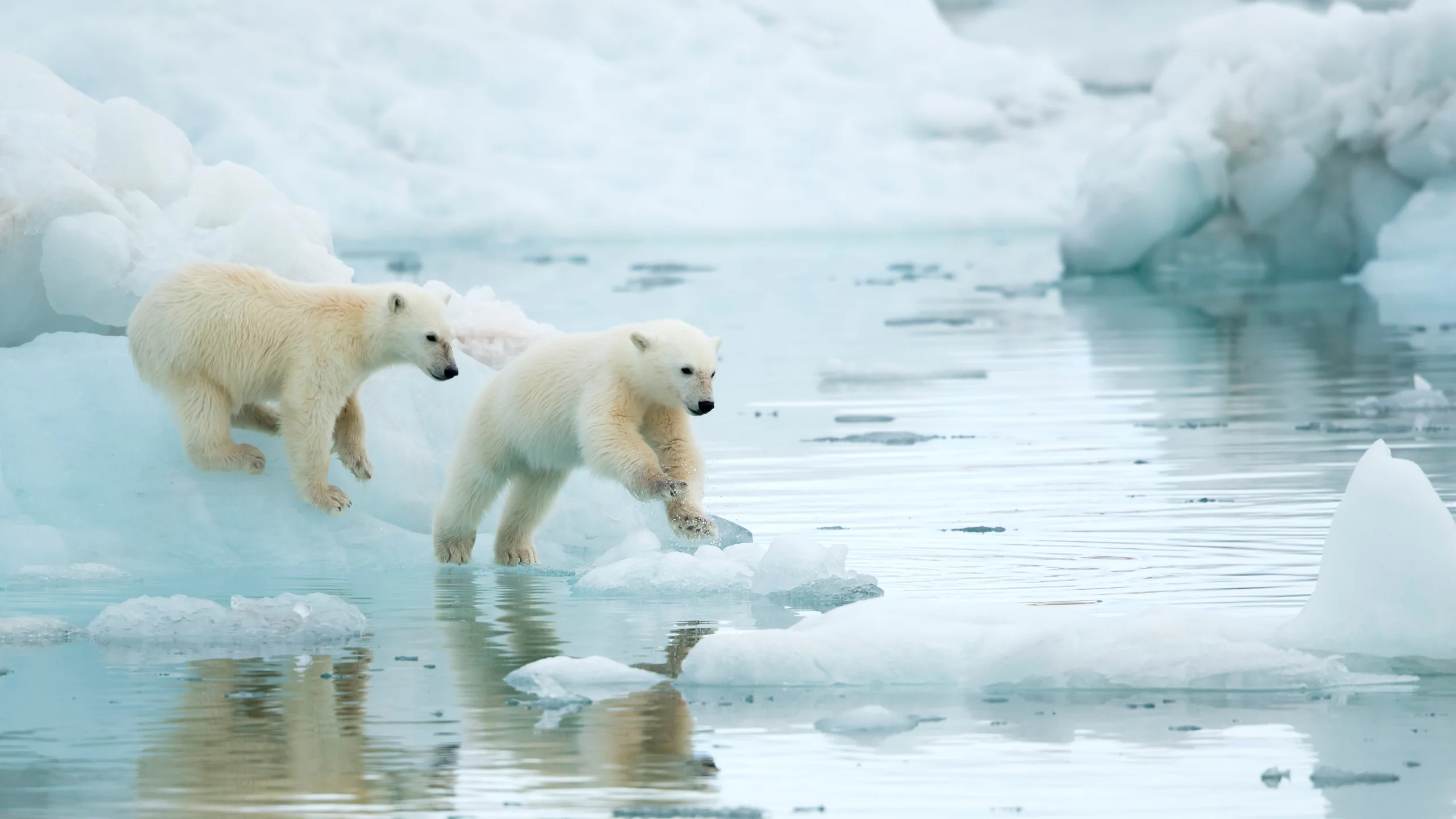
Image: Bing Daily Wallpaper | Polar bear cubs playing in Svalbard, Norway (© Danny Green/Nature Picture Library)
Open Bing's homepage today and two young polar bears are wrestling on the ice. One pins the other; the second twists to push back. They look like two children rolling in the snow, except for the dazzling white surface beneath them. It is not a snowfield, and it is not land.
It is the sea.
This is the most important fact in the article: the Arctic is not a continent covered in ice. It is an ocean covered in ice. Antarctica is the opposite, a true continent buried beneath an ice sheet several kilometers thick. Under the white layer beneath these cubs there is no soil at all, only the Arctic Ocean, thousands of meters deep. The ice is the ocean's lid.
Once you think of it as a lid, many things fall into place.
They Are Not Playing in a Snowfield, but on a Roof
The polar bear's scientific name is Ursus maritimus, Latin for "sea bear." This is not poetic naming. The U.S. Fish and Wildlife Service states plainly on its species page that polar bears "are classified as marine mammals." Like seals and whales, they are protected under the Marine Mammal Protection Act. A thick-furred land predator that cannot swim indefinitely belongs, in law, to the same category as a whale.
Why? Because its food lies beneath the lid.
Polar bears mainly eat ringed seals. Seals live in the ocean but must surface to breathe, so they maintain breathing holes through the ice and dig snow-covered lairs above it in which to give birth. Every polar bear hunting strategy works from above the lid, attacking what is below it.
In 1986, two Norwegian researchers conducted a laborious and solid piece of fieldwork in Hornsund, Svalbard: they followed bear tracks and counted the outcomes. Bears dug open 62 subnivean seal lairs and succeeded only six times. The researchers recorded ten attempts in which a bear stalked across the ice and then charged, over distances from 15 to 80 meters and an average of 41 meters. Only one of the ten succeeded. Thirteen attacks on snow-covered breathing holes had a miserable success rate of just 1.7%.
The only strategy with a respectable success rate was breaking into seal birth lairs: four successes in 12 attempts, or 33%.
But what does a birth lair require? Stable ice that remains long enough, thick enough and covered with deep enough snow.
When the sea ice disappears, a bear does not merely have to eat somewhere else. Its entire repertoire stops working at once.
Why September
Arctic sea ice reaches its annual maximum each March and shrinks to its annual minimum each September. It is the simplest rhythm of Earth's axial tilt: summer heat takes months to finish doing its work, so the ice does not reach its low point until the Sun has already begun moving south.
Today is September 16. At this moment, Arctic sea ice is probably at, or has just passed, its lowest point of the year.
There is a further twist: officials have not yet made the call. The U.S. National Snow and Ice Data Center announces the maximum in March and the minimum in September, but as of today its latest analysis is still dated September 3. The line is bottoming out, and no one has formally said, "This was the minimum."
The latest official figure available is for August. In August 2026, average Arctic sea ice extent was 5.56 million square kilometers, the seventh lowest in the satellite record. NSIDC added a more revealing comparison: throughout the summer of 2026, the line closely followed the path of 2012, only diverging in August.
What happened in 2012? It remains the record-low year. Its minimum arrived on September 17, tomorrow's date, at only 3.39 million square kilometers.
There is another comparison. NASA says this March's annual "maximum" tied 2025 as the lowest winter peak observed in the satellite era. Both ends of the year are being redefined.
Sea Ice Extent and Sea Ice Area
"Sea ice extent" and "sea ice area" are different measures.
NSIDC defines them by dividing the Arctic Ocean into grid cells. Extent counts cells: if at least 15% of a cell is covered by ice, the whole cell counts as ice-covered. Area counts the ice itself: in that same cell, it counts only the 15%.
Extent is therefore always greater than area for the same patch of ocean. News reports usually give extent. That is not sleight of hand. With microwave remote sensing, deciding whether a cell has ice is more stable and comparable than estimating its exact percentage. And from a bear's point of view, both 15% broken ice and 100% solid ice provide something to stand on.
How These Cubs Reached the Ice
There is an especially vulnerable period in a polar bear's life: the stage shown in the photograph.
According to the Norwegian Polar Institute, pregnant females dig maternity dens in snowdrifts in late autumn, give birth in midwinter, and remain inside until March or April. Cubs are born hairless and weigh only about half a kilogram, roughly the weight of a can of soda. By the time they emerge in spring, they weigh about 10 kilograms. A litter usually has one or two cubs, which remain with their mother for a full two years before they are weaned.
The crucial point is this: Svalbard's bears do not den on sea ice. They den on islands. Deep snowbanks on the slopes and plateaus of eastern islands such as Kongsøya, Svenskøya and Hopen make the best maternity wards.
How does a female reach those islands? She walks over sea ice.
That closes the mechanism. Norway's official Environmental Monitoring of Svalbard and Jan Mayen program, MOSJ, tracks one chillingly dispassionate indicator: "The number of days with sea ice concentration above 60% has a strong effect on the number of females denning on Kongsøya; when there are too few suitable days, fewer females enter dens."
The Norwegian Polar Institute has gone further. Ice around Hopen has become exceptional in recent years, it says, and Hopen is no longer considered a good denning area.
When the sea ice arrives a month late, the maternity ward has not melted. The road to it has disappeared.
Beneath Their Feet Is One of Earth's Fastest-Warming Surfaces
Svalbard lies between 74 and 81 degrees north, and glaciers cover more than half its area. Statistics Norway's figures for this year count 2,512 residents in Longyearbyen and Ny-Ålesund combined, 392 in Barentsburg and Pyramiden, and 10 in Hornsund. Fewer than three thousand people live across the archipelago.
How quickly is it warming? Two papers fit together.
A 2022 paper in Communications Earth & Environment calculated that the entire Arctic had warmed at nearly four times the global average over the preceding 43 years. The most extreme area was the sea near Novaya Zemlya, where the local rate reached seven times the global average.
Another paper in Scientific Reports focused on the northern Barents Sea, immediately east of Svalbard. Using measured local air temperatures rather than reanalysis data, it found annual warming of as much as 2.7 degrees Celsius per decade, rising to 4.0 degrees Celsius per decade in autumn. The authors' comparison is stark: 2 to 2.5 times the Arctic average, and 5 to 7 times the global average.
The place where these two bears are rolling around is one of the fastest-warming patches on Earth's surface.
A Counterintuitive Fact I Will Not Hide
From those numbers, it is tempting to conclude that Svalbard's polar bear population must be plummeting. The data do not support that conclusion.
The official status table from the IUCN Polar Bear Specialist Group still gives the Barents Sea population estimate from a 2004 survey: 2,644 bears, with a 95% confidence interval of 1,899-3,592. A 2015 reassessment found a "non-significant increase" from 2004. Norway's MOSJ points to an even more awkward result: after reaching a low in 2000, the bears' body condition improved over the following 20 years, despite a significant reduction in available sea ice.
How can that be?
Population abundance is a lagging indicator. Russia banned hunting in 1957 and Norway followed in 1973; before then, these bears were heavily hunted. The stability or even growth visible now owes much to half a century of recovery after those bans. Climate pressure is still rising, but it does not first appear in the total count.
It appears at the smallest end of the population.
A 2020 paper in Nature Climate Change calculated how long different polar bears can fast during ice-free periods before a particular group begins to fail. Mothers with cubs reach reproductive failure first, after 117 days of fasting. Mothers with yearlings reach the threshold at 185 days. Adult males begin to suffer reduced survival at 200 days, mothers with cubs themselves at 228 days, and solitary adult females at 255 days. These thresholds vary with a population's distributions of body mass and length; this set comes from a scenario based on a western Hudson Bay reference population.
Notice the order. Cubs are lost at 117 days; large adult males can last until 200. By the time adult bears begin to die, cubs have already stopped being born. The first thing lost as the sea ice changes is precisely what appears in today's photograph.
A Chinese Flag in a Tiny Village
Ny-Ålesund, at 78 degrees 55 minutes north, sits in northwestern Svalbard. Only a few dozen people live in the village, yet it contains 14 research stations belonging to 10 countries: the United Kingdom, Norway, Japan, Germany, France, South Korea, India, the Netherlands, Italy and China.
China's station is the Yellow River Station, inaugurated on July 28, 2004. According to the Chinese Foreign Ministry's announcement at the time, it occupies a two-story, roughly 500-square-meter building with laboratories, offices, bedrooms and a rooftop observation platform, accommodating 20 to 25 people. The first team consisted of 11 members led by Yang Huigen.
It was China's first Arctic research station and, after Great Wall and Zhongshan stations in Antarctica, its third polar station.
There are many such buildings here. Not far from the Yellow River Station, the white dome of Norway's Zeppelin Observatory stands on a mountain, continuously measuring greenhouse gases, ozone and aerosols. A public webcam updates every ten minutes, so anyone can look at the current sky at 78 degrees 55 minutes north.
In Svalbard, People Are Required to Give Way
One regulation says more than any lyrical ending could.
New environmental rules for Svalbard took effect on January 1, 2025. They impose firm minimum distances on visitors: 300 meters from a polar bear, rising to 500 meters from March 1 through June 30. The distance from walrus haul-outs is 150 meters. From April through August, drones are banned within 500 meters of bird cliffs and vessels are limited to five knots there.
But one sentence is especially striking: "If you discover a bear nearby, you are obliged to retreat."
It is not advice. It is an obligation.
On one of the fastest-warming archipelagos on Earth, humans have written themselves a rule: when you see one, you leave.
Sources: NSIDC, Arctic Zigs; Antarctic Zags, and the Charctic tool; NASA, Arctic Winter Sea Ice 2026; Isaksen et al., 2022, Scientific Reports, DOI 10.1038/s41598-022-13568-5; Rantanen et al., 2022, Communications Earth & Environment, DOI 10.1038/s43247-022-00498-3; Molnár et al., 2020, Nature Climate Change, DOI 10.1038/s41558-020-0818-9; Gjertz and Lydersen, 1986, Polar Research; the Norwegian Polar Institute species pages and MOSJ monitoring pages; the IUCN Polar Bear Specialist Group's 2024 status table; Statistics Norway's Svalbard population figures; the Governor of Svalbard's announcement of the 2025 environmental rules; the Chinese Foreign Ministry announcement on the Yellow River Station; the UK National Polar Office page on Ny-Ålesund; and Danny Green's website.