
A strange dog in green, white and red crouches on Google's Mexican homepage today. Its origins are younger than they look, and the morning it commemorates is less certain than you might think.
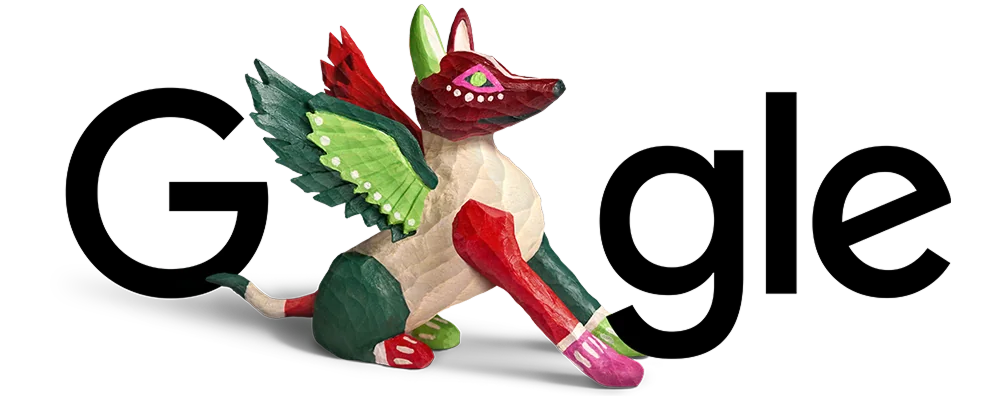
Image: Google Doodle, Mexico Independence Day 2026 | Official page: https://doodles.google/doodle/mexico-independence-day-2026/
Google's description of today's Doodle contains a single sentence: it depicts a Xoloitzcuintle in the form of an alebrije, Mexico's national dog painted in the colors of the flag.
The two intimidating words refer to two very specific things. We will unpack them first, then return to that morning in 1810.
A Monster Dreamed in a Fever
An alebrije looks as though it crawled out of an ancient myth: an animal's body, a bird's wings, a serpent's tail, every surface covered in almost painfully vivid patterns.
But it is only 90 years old.
In 1936, Mexico City cartonería artisan Pedro Linares López fell gravely ill and slipped into a feverish coma. He later said he dreamed of a forest-like place where the trees, rocks and clouds had turned into monsters. Among them, a voice kept repeating a word that did not exist: "Alebrije."
When he awoke, he used the materials of his trade - newspaper, paste and wire - to make the creatures he had seen, one by one.
That was the Mexico City version, made of paper. The Oaxacan carved-wood alebrijes now more familiar around the world came much later. In the 1980s, British filmmaker Judith Bronowski organized traveling craft-demonstration workshops and brought Linares to Oaxaca. The region already had a woodcarving tradition, and artisan Manuel Jiménez was the first to transfer the forms to local copal wood.
This object, now treated around the world as an ancient Mexican symbol, is really the product of a word one man heard in a fever and an international workshop more than 40 years later.
A Dog That Helps the Dead Cross a River
The Xoloitzcuintle is Mexico's hairless dog. The xolo in its name is associated with the Aztec deity Xólotl. In pre-Hispanic belief, the dog's duty was specific: after its owner died, it accompanied the person into the underworld and helped them cross the river Chiconahuapan. Xolos were therefore often buried with their owners.
Its legal status today is still developing. Mexico City designated it a cultural symbol in 2016. On April 15, 2026, Mexico's Chamber of Deputies voted 433 in favor, none against and four abstaining to establish October 27 as National Xoloitzcuintle Day. The measure still awaits Senate approval.
A dog that once carried people across a river was preserved by a unanimous national vote. Today it has changed into green, white and red on Google's homepage.
Back to That Morning
Mexico's national day commemorates September 16, 1810.
It was a Sunday in the town of Dolores, in the Viceroyalty of New Spain. Today the place is called Dolores Hidalgo, in the state of Guanajuato. Its church, the Baroque Parish of Our Lady of Sorrows, was completed in 1778.
The man standing there was Miguel Hidalgo y Costilla. He was born on May 8, 1753, ordained in 1778 and took charge of the parish of Dolores in 1803. That morning, he was 57 years old.
One easily missed detail: he was no ordinary country priest. He had served as rector of the College of San Nicolás in Morelia. In today's terms, a former university president was serving as parish priest in a small town.
Carlos Herrejón Peredo, Mexico's leading Hidalgo scholar, places the moment at about 6 a.m. An alternative time of 2:30 a.m. appears in English-language scholarship; both versions remain in circulation. Hidalgo ordered the church bell rung.
The bell normally summoned people to Mass.
No One Knows What He Said
This is the most surprising fact in the story, and it is no obscure scholarly quibble. The Encyclopaedia Britannica states it plainly: the exact text of Mexico's most famous speech is not known.
Michael Meyer, an author of a standard U.S. textbook on Mexican history, puts it more sharply: there are nearly as many versions as there are historians who recount it.
The earliest surviving eyewitness account comes from Juan Aldama, the man who rode in that night with the warning and was present at the scene. His version reads:
"My children! Come with me! Help me defend the fatherland! The gachupines want to hand it over to the godless French. Oppression is over! Tribute is over! Those who follow on horseback will receive one peso; those on foot, half a peso."
Notice the last line.
This was not a speech. It was recruitment on the spot, with a price named aloud. One peso for a rider, half a peso for a person on foot - a tostón, or four reales. A 57-year-old priest stood in his church courtyard and offered a specific sum to farmers arriving for Mass, buying an uprising from them.
History later polished that moment until it gleamed. In its original form, it came with a price list.
They Could Not Yet Have Shouted "Viva México"
Every year today, Mexico's president stands on the balcony of the National Palace and shouts "¡Viva México!" three times.
In 1810, those words probably were not heard in the courtyard - not for lack of patriotism, but because "México" was not yet the name of a country.
It was the name of a city. Before independence, the territory was the Viceroyalty of New Spain. Its Spanish-speaking inhabitants were called americanos, while mexicano referred specifically to residents of Mexico City.
In rural Guanajuato that morning, shouting "¡Viva México!" would have meant something close to "Long live Mexico City" - almost meaningless to the farmers who had just been summoned from bed.
"Mexico" began taking shape as a national name only after the Declaration of Independence of September 28, 1821. Even then there was a period of choosing: América Septentrional, Nación Mexicana, Anáhuac and other names were all proposed before the 1824 Constitution settled on Estados Unidos Mexicanos, the United Mexican States.
So the three cries from the balcony today use the name of a country that did not yet exist to commemorate the morning that created it.
Two Horses, Two People, One Night
The uprising was not supposed to begin on September 16. The conspirators in Querétaro had planned it for October 1.
The plan was exposed in mid-September. In Querétaro, the provincial magistrate Miguel Domínguez was himself one of the conspirators. When trouble came, his first act was to lock his wife upstairs, fearing she would interfere.
Her name was Josefa Ortiz.
Locked above, she did the only thing she could: she knocked on the wall. On the other side lived the prison warden, Ignacio Pérez.
Pérez rode north through the night, but not all the way to Dolores. He reached San Miguel, now San Miguel de Allende, and passed the warning to Juan Aldama. Aldama rode the final leg, arriving in Dolores before dawn on September 16 with the bad news for Allende and Hidalgo.
Within hours, the bell rang.
The famous banner of the Virgin of Guadalupe was not present at the beginning either. According to Herrejón's research, Hidalgo took it from the sacristy of the Sanctuary of Atotonilco when the procession passed there, several hours after the cry.
He Did Not Live to See the Day
On January 17, 1811, the insurgent army suffered a crushing defeat at the Battle of Calderón Bridge near Guadalajara. Hidalgo fled north and was ambushed and captured in Coahuila.
He was sentenced to death on July 26.
At six in the morning on July 29, in a corridor of Chihuahua's Royal Hospital, the Church performed the ritual of degradation from holy orders. One step was painfully specific: the palms of his hands and the tips of his fingers were scraped, symbolically stripping away his right to touch the Eucharist.
First they scraped "priest" from his body. The next day the state shot the man who remained: 7 a.m. on July 30, in Chihuahua.
His body was then decapitated and dismembered. On October 14, 1811, the heads of Hidalgo, Allende, Aldama and Jiménez were placed in newly forged iron cages and hung from the four corners of the granary in Guanajuato known as the Alhóndiga de Granaditas.
They remained there for nine and a half years. On March 28, 1821, Anastasio Bustamante, then still an officer in the royalist army, ordered the heads removed, placed in fine wooden boxes and buried.
Mexico gained independence six months later. On September 27, 1821, the Army of the Three Guarantees entered Mexico City in triumph. On September 28, the Sovereign Junta declared the Mexican Empire independent.
Between the cry and the army lay 11 years and 11 days.
That is what makes Mexico's national day unusual. It commemorates not the day of success, but the day of beginning. It celebrates a man who failed: shot and beheaded a decade before victory, his head displayed on a granary for nine and a half years.
The Bell Went Up One Day Before the Celebration
The bell above the balcony today really is old.
Its proper name is the Esquilón de San José. Cast on July 28, 1768, it stands 1.77 meters tall, measures 1.05 meters across the mouth, has walls nine centimeters thick and weighs 780 kilograms. The official and mainstream account identifies it as the bell Hidalgo rang that morning.
In 1896, President Porfirio Díaz ordered it moved from Dolores to Mexico City. It traveled on a float escorted by a military procession. It was installed above the central balcony of the National Palace on September 14, 1896, just one day before that year's ceremony.
Why does the ceremony take place the night before, rather than at six in the morning on September 16? Historian Enrique Ortiz offers an endearingly practical explanation. The change appears to date from the 1830s and was probably made because few people are awake at six or seven in the morning.
What Happened Last Night, and What Will Happen Today
The 2026 ceremony has already ended.
At 10:57 p.m. Mexico City time on September 15 - 12:57 p.m. today in Beijing - President Claudia Sheinbaum stepped onto the central balcony of the National Palace. She wore a black floral dress modeled on traditional tehuana clothing and the presidential sash. The ceremony began at 11 p.m. It was the second Grito of her term. Mexico City's Secretariat of Government put attendance in the Zócalo at more than 300,000.
She gave 21 cries of "Viva." The first honored independence, the second Hidalgo, and the third Josefa Ortiz Téllez-Girón, the woman locked upstairs by her own husband with only a wall to knock on. The official wording used her birth surname, not the familiar married form "de Domínguez." The list continued with Morelos, Leona Vicario, Vicente Guerrero, Gertrudis Bocanegra, Guadalupe Victoria and Antonia Nava; then the Indigenous and Afro-Mexican peoples, migrant sisters and brothers, dignity, freedom, equality, justice and democracy. The final three cries were "¡Viva México!"
A military parade is scheduled for later today:
- Start: September 16 at 10 a.m. Mexico City time, or midnight on September 17 in Beijing
- Route: Zócalo -> Calle 5 de Mayo -> Eje Central Lázaro Cárdenas -> Avenida Juárez -> Paseo de la Reforma -> Campo Marte
- Television: Mexico's public Canal 22, 10 a.m.-1 p.m. local time
- Official livestream and replay: the Mexican government's YouTube channel, https://www.youtube.com/@gobiernodemexico
Except where noted, these are Mexico City times. The city remains at UTC-6 year-round, 14 hours behind Beijing.
The parade will include more than 15,000 members of the armed forces, 536 vehicles, 46 motorcycles, 16 vessels, 424 horses, 142 dogs, and 106 aircraft, 99 of them participating in flyovers.
One hundred and forty-two dogs. Google drew one on its homepage today; 142 real ones will cross the Zócalo.
There May Be a Mexico City Silver Dollar in a Chinese Drawer
A rarely mentioned connection between this Doodle and China is made of metal.
The Mexican Mint, Casa de Moneda de México, was founded on May 11, 1535. It is the oldest mint in the Americas. Its eight-real silver coins circulated across the Pacific from the 16th century into the 19th.
The route was the Manila galleon, sailing between Acapulco and Manila from 1565 to 1815. The Spanish called the vessel the Nao de China - the China Ship. It carried silver west and Chinese silk and porcelain east. The Metropolitan Museum of Art estimates that as much as one-third of the silver mined in New Spain and Peru flowed to the Far East.
The Shanghai Museum's own collection notes include one important sentence: "In 1732, the Mexican Mint began mechanically striking pillar dollars." In China they were called benyang, "native dollars," because their reverse bore the two Pillars of Hercules and two hemispheres. By the late Qianlong reign, they were the principal silver coins in circulation along China's coast; they remained common during the Daoguang and Xianfeng reigns.
The coin that succeeded them carried an eagle. The Mexican eagle dollar was first struck in 1824, after independence. The National Museum of China's collection description is direct: the obverse shows "an eagle with spread wings standing on a cactus, a snake clutched in its talons" - Mexico's national emblem. On the reverse is a radiant liberty cap.
Its first documented appearance in China was in 1854. Three years later, in January 1857, Shanghai's foreign banking community defined the Shanghai tael and changed its silver-dollar accounts from Spanish to Mexican dollars.
The story can be put this way: for three centuries, the silver dollars in Chinese hands came primarily from a single mint in Mexico City. At first they carried a Spanish king's head and two pillars; later, an eagle.
Sources: the official Google Doodle page; Banco de México's biographical page on Hidalgo; the Encyclopaedia Britannica entry on the Grito de Dolores; research by Carlos Herrejón Peredo, as reported by Informador and BBC Mundo; Gene Rhea Tucker, 2011, Names: A Journal of Onomastics 59(3); Mexican National Human Rights Commission historical pages for July 30, 1811 and September 27, 1821; La Jornada, Historia de una campana (September 13, 2026); reporting by Infobae and N+ on the 2026 Grito and military parade; the Metropolitan Museum of Art, The Manila Galleon Trade; the Shanghai Museum collection page for Spanish silver dollars; the National Museum of China collection page for Mexican silver dollars; Bailey and Zhao, 2025, Financial History Review 32; Smarthistory, Frontispiece of the Codex Mendoza; the University of Oxford's Bodleian Libraries digital collections; and the Mexican Chamber of Deputies, Law on the National Coat of Arms, Flag and Anthem.