
It is not bathing or scratching an itch. It is putting air back into its fur coat.
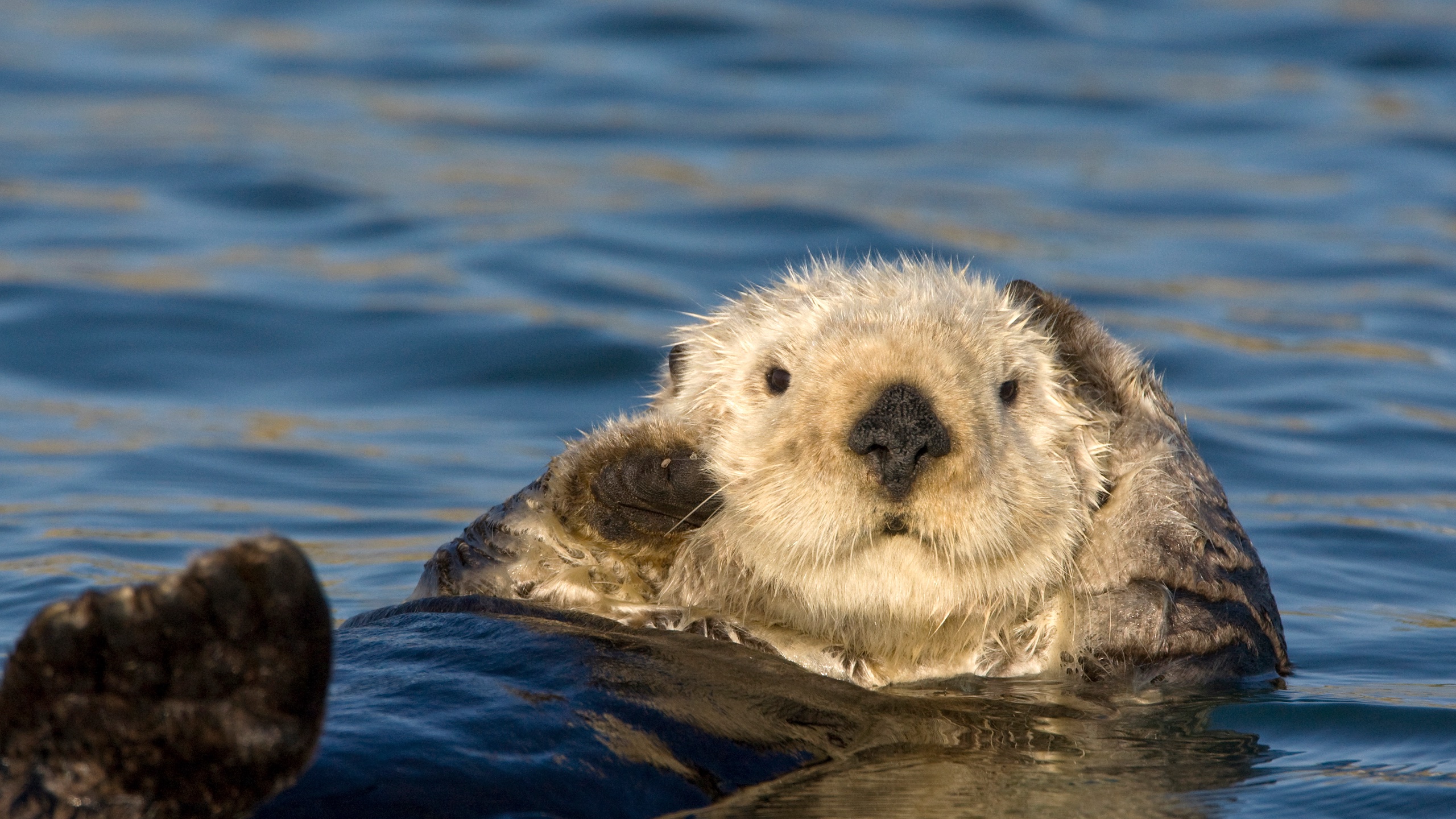
Image: Bing Daily Wallpaper | A sea otter grooming in Monterey Bay, California, United States (© Suzi Eszterhas/Minden Pictures) | Original page
On Bing's homepage today, a sea otter floats on its back, both front paws pressed to its chest, rubbing away with complete concentration.
It might seem to be scratching an itch or washing its face. The work is more urgent than that. This is essential maintenance, occupying nearly a fifth of its daylight hours, more than twice the time it spends feeding. A study of northern sea otters' daytime behavior in Washington State recorded 62.3% resting, 19.7% grooming and 7.6% foraging.
When a wild animal devotes that much of its day to its appearance, beauty is unlikely to be the point.
A Coat That Must Stay Dry
One easily overlooked fact explains much of what follows: sea otters are the only marine mammals without blubber.
Seals have it. Sea lions have it. Whales have it. Nearly all the mammals that returned to the sea took a similar evolutionary route, exchanging fur for a thick layer of fat beneath the skin. Blubber provides a streamlined shape, buoyancy and an energy reserve. Sea otters kept their fur.
Why? Cal Poly biologist Heather Liwanag has offered a vivid explanation: if a sea otter depended on blubber for warmth, the layer it needed would be bigger than the animal itself. Otters are too small. Small bodies lose heat quickly, and enough fat to make up the difference would be an absurd burden.
So they retained fur, and developed the densest coat on Earth.
The numbers can seem contradictory. Chinese accounts commonly cite 100,000 hairs per square centimeter; English accounts often say a million per square inch. These are opposite ends of the same range. Guinness World Records gives 100,000 to 160,000 hairs per square centimeter, equivalent to about 650,000 to 1.03 million per square inch. One version takes the lower limit; the other takes the upper.
Both often leave out another fact on the same page: hair density varies sixfold across an otter's body. It is greatest on the rump and flanks, lowest on the legs and cheeks, where it can fall to 26,000 hairs per square centimeter. The world's densest coat is tailored, thick where it needs to be and thinner elsewhere.
For comparison, the chinchilla has the densest fur of any land animal. Its thickest patch, on the rump, holds about 25,000 hairs per square centimeter, roughly matching a sea otter's cheeks.
The Insulation Is the Air Inside
How can fur stand in for fat?
The crucial insulation is the layer of air the fur traps.
A sea otter's coat has two layers. The outer guard hairs are long and stiff, with oval scales on their surfaces that interlock like roof tiles. Beneath them, soft, crimped underfur holds countless tiny air pockets. The guard hairs keep water out; the underfur keeps air in. Together they maintain a dry layer next to the skin.
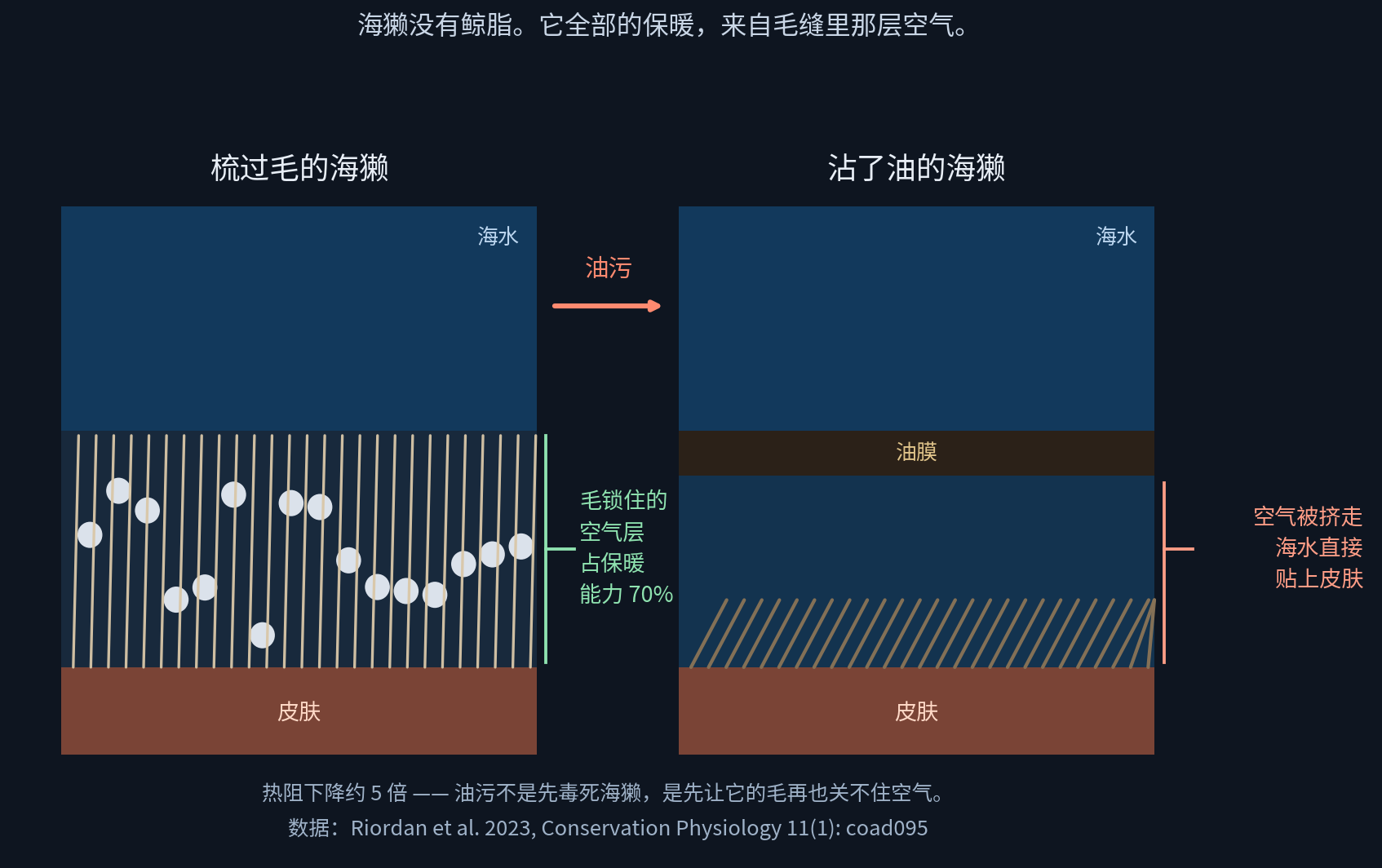
A 2023 study in Conservation Physiology measured what that air contributes: 70% of the animal's total insulation. Most of the barrier against icy water is therefore a layer of immobilized air. A down jacket works on the same principle, except that an otter has to maintain its own insulation every day.
Grooming does two jobs. It spreads oils secreted by the skin through the coat to keep it water resistant, then works fresh air into the underfur. As the Monterey Bay Aquarium describes it, grooming fluffs the coat back up and fills it with insulating air bubbles.
The otter is replenishing its own air supply.
This coat comes with a remarkable energy bill. A sea otter's resting metabolic rate is about three times the predicted rate for a mammal of its size. Its body is a heater that never switches off. Fueling it requires food equal to a quarter of its body weight each day: 11 to 16 pounds of crabs, sea urchins, clams and abalone.
A 2021 paper in Science identified a source of that heat. Mitochondria in sea otter skeletal muscle show high levels of "thermogenic proton leak." In plain language, the muscles release heat even when they are doing no work, supplying warmth throughout the body. This is not shivering, which is a different mechanism. The heat leaks out quietly and continuously.
Why This Image Today?
Bing links the photograph to a search for Sea Otter Awareness Week. The timing is deliberate: today is the second day of the 2026 event.
Its 24th edition runs from Sunday, September 20, to Saturday, September 26, the last full week of September. Defenders of Wildlife organizes it with Sea Otter Savvy, the Monterey Bay Aquarium, California State Parks, the Elakha Alliance and other partners. Jim Curland, then working on marine programs at Defenders of Wildlife, founded it in 2003.
The 2026 theme is "Rooted in Resilience."
That resilience has a very specific history.
Starting Again with Fewer Than 2,000
Before the commercial fur trade began in the mid-18th century, an estimated 150,000 to 300,000 sea otters lived along the North Pacific coast. By the time an international treaty ended commercial hunting in 1911, fewer than 2,000 remained worldwide, scattered among 13 remnant groups, each estimated at 10 to 100 animals.
California's population was thought to have been extinct for decades. Then, on June 20, 1938, Life published a photograph of a large raft of otters near Bixby Bridge in Big Sur, describing it as one of the rarest sights on Earth. Later survey records put that raft at 50 to 90 animals.
The Monterey Bay Aquarium's timeline uses a revealing phrase: "The public learns." It does not say "rediscovered." Local people may well have known the otters were there all along. What happened in 1938 was public exposure. Big Sur's inaccessible cliffs had sheltered them from hunters.
Southern sea otters were listed as threatened under the U.S. Endangered Species Act in January 1977. The U.S. Fish and Wildlife Service describes their population as fluctuating around 3,000 in recent years, with about 13% of their historical range reoccupied. The delisting threshold is a three-year average above 3,090, a figure they are still hovering around.
The U.S. Geological Survey conducted a range-wide census in 2024, but the results have not yet been released and the statistical model is being updated. The latest formally published count remains 2,962, from 2019.
Oil Strips the Air Away
The trapped air also explains why an oil spill is so devastating to sea otters.
Poisoning is the obvious danger. Oil is toxic, and otters swallow it while grooming. But the first and fastest threat is physical: oil mats the fur, forces the air out and lets seawater reach the skin. Once the layer responsible for 70% of their insulation disappears, otters can become hypothermic within hours.
The 2023 study tested oiled pelts and found that their thermal resistance fell to about one-fifth of its original value. Pups were just as vulnerable as adults.
After the 1989 Exxon Valdez spill in Prince William Sound, official estimates put acute sea otter deaths as high as 2,650, about 40% of the local population of roughly 6,500. In all, 871 carcasses were recovered. The population was not declared recovered until after the 2013 survey, 24 years later.
Grooming and oiling act on the same mechanism in opposite ways. One restores the air each day. The other drives it out all at once.
One Otter, an Entire Forest
Sea otters have another role that makes them a staple of ecology textbooks.
In 1974, James Estes and John Palmisano published "Sea Otters: Their Role in Structuring Nearshore Communities" in Science. Comparing waters with and without otters in the Aleutian Islands, they traced a chain of effects: otters eat sea urchins, fewer urchins graze the kelp, kelp forests grow, and hundreds or thousands of other species gain a home. This is the trophic cascade described in countless textbooks since.
The chain also runs in reverse. Without otters, urchins can graze the seabed into an "urchin barren." A 2019 study in Scientific Reports documented a northern California collapse: bull kelp canopy declined by more than 90% along over 350 kilometers of coast, purple urchins increased 60-fold in 2015, and the recreational abalone fishery, valued at about $44 million, closed in 2018.
An essential caveat: that coast was already outside the southern sea otter's current range, whose northern limit is San Mateo County. This was not a collapse caused by otters disappearing. It offers a comparison for what can happen without their buffering influence. A marine heatwave and multiple other stresses were the immediate causes.
Elkhorn Slough, at the northern end of Monterey Bay, offers a more intricate example. A 2013 study in PNAS found that after otters returned, eelgrass beds expanded by 600% from a historical low of 2 hectares. The cascade had four trophic levels: otters ate crabs; fewer crabs meant more small invertebrates grazing on epiphytic algae; those grazers cleaned the algae from eelgrass leaves; and sunlight reached the plants again. Nitrogen pollution from agricultural runoff had been smothering the beds. Otters helped pull them back from the other end of the food web.
China's Otters, Mostly Out of Sight
China has no sea otters, but it has three other otter species: the Eurasian otter, Asian small-clawed otter and smooth-coated otter. All are under Class II national protection.
Their position is more precarious than many people realize. A review published in Oryx in 2018 found 210 historical otter localities in China, but only 19 with confirmed records during 2006-2016. No trace of the smooth-coated otter had been found for nearly three decades. The authors concluded that surviving populations were confined to three kinds of places: well-protected nature reserves, sparsely populated river headwaters on the Qinghai-Tibet Plateau, and remote border areas.
There are brighter exceptions, sometimes in surprising places.
Yushu, Qinghai, provides the strongest example. Eurasian otters live in the stretches of the Batang and Zhaqu rivers that run through the city, appearing regularly each day despite passing pedestrians and traffic. Researchers walked about 400 kilometers of transects and recorded roughly 400 latrine sites. Across 21 camera-trap deployments, otters appeared at 14 sites, with nearly 1,000 detections in more than 1,300 camera-days. In a city of a little over 200,000 people, otters tumble in rivers downtown.
The figures from Hong Kong are sobering. A fecal-DNA survey in 2018-2019 identified only seven otters across Inner Deep Bay, including Mai Po. Hong Kong Wetland Park did not confirm their presence within the park through droppings until 2024.
Kinmen holds Taiwan's only stable population. Between 2020 and 2024, the minimum number of individuals identified each year ranged from 78 to 139, with the total population estimated at about 200. There has been no reliable evidence of otters on Taiwan's main island since the 1990s. In Shenzhen, a Eurasian otter was photographed at Futian Mangrove Ecological Park in October 2020, the first local record in about a decade. On Jintang Island in Zhoushan, Zhejiang, monitoring has identified at least 26 individuals in what is currently the largest and most stable known otter habitat in eastern China.
Sources
Defenders of Wildlife, Sea Otter Awareness Week page and 2026 news release; Sea Otter Savvy, viewing guidelines and disturbance research; Monterey Bay Aquarium, sea otter page and conservation timeline; NOAA Ocean Today; National Park Service, sea otter page; U.S. Fish and Wildlife Service, southern sea otter page; U.S. Marine Mammal Commission; Guinness World Records, densest fur record; Riordan et al. (2023), Conservation Physiology; Wright, Davis et al. (2021), Science; Estes and Palmisano (1974), Science; Rogers-Bennett and Catton (2019), Scientific Reports; Hughes et al. (2013), PNAS; Barrett et al. (2025), Journal of Wildlife Management; Walker et al. (2008), Aquatic Mammals; Exxon Valdez Oil Spill Trustee Council; U.S. Geological Survey, Western Ecological Research Center (WERC); China's National Forestry and Grassland Administration website; Shan Shui Conservation Center; Li and Chan (2018), Oryx; Kadoorie Farm and Botanic Garden; Hong Kong Wetland Park; Taiwan Ministry of Agriculture, Forestry and Nature Conservation Agency, Eurasian Otter Conservation Action Plan, second edition; Chuanguan News.