
Three silhouettes crowd the face of the Sun. Only one arrived by chance.
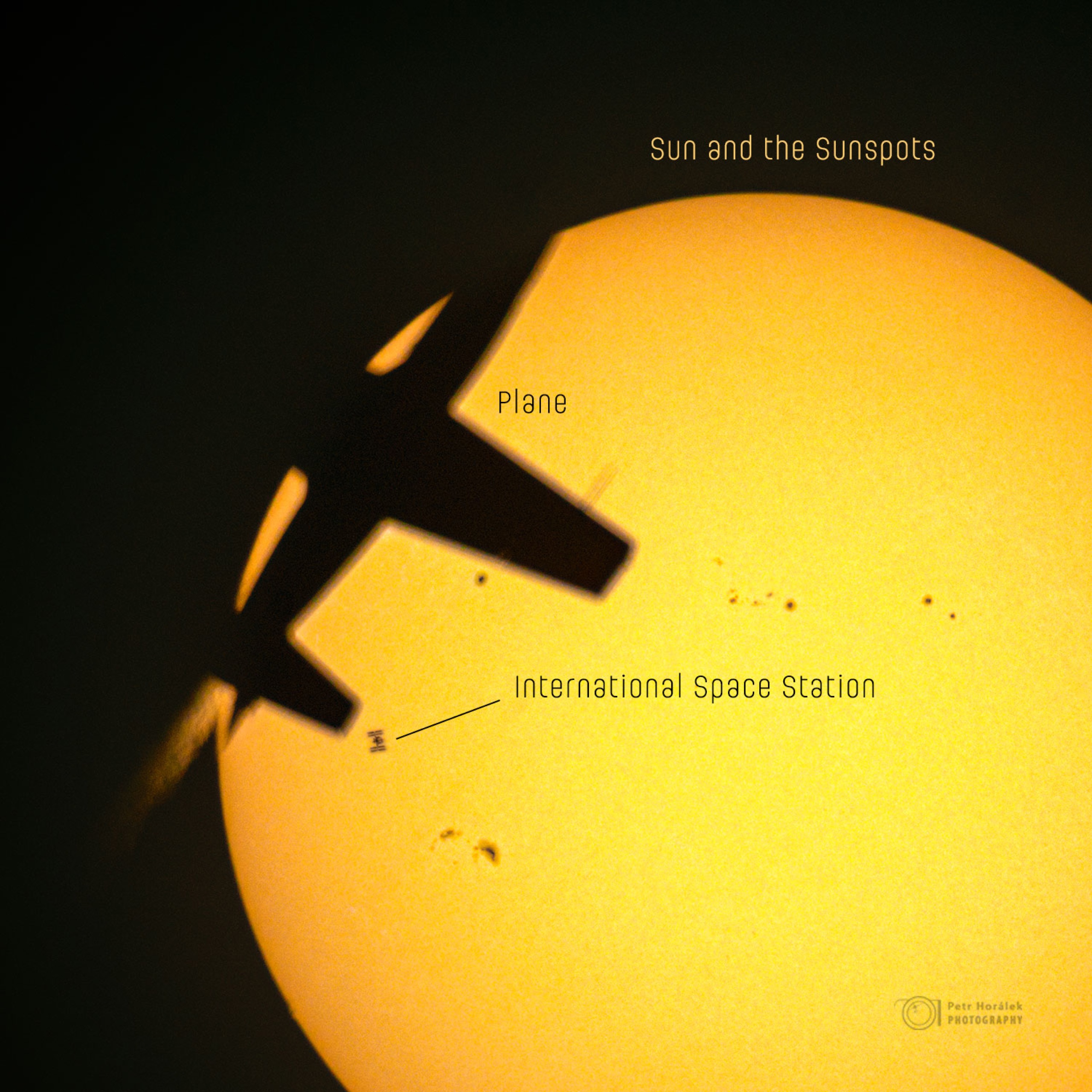
Image: NASA Astronomy Picture of the Day (APOD) | Image Credit & Copyright: Petr Horalek / Inst. Physics Opava | Original page
The Sun is an orange disk dotted with dark marks. There are three kinds: sunspots, a small, intricately shaped shadow just left of center, and an airplane.
Only one was unexpected.
The sunspots were already visible before the shoot. These concentrations of magnetic field lines can linger on the solar disk for weeks.
The intricate little shadow was the International Space Station. The seemingly most improbable part of the photograph was calculated in advance.
The surprise was the plane.
A strip 4.8 kilometers wide
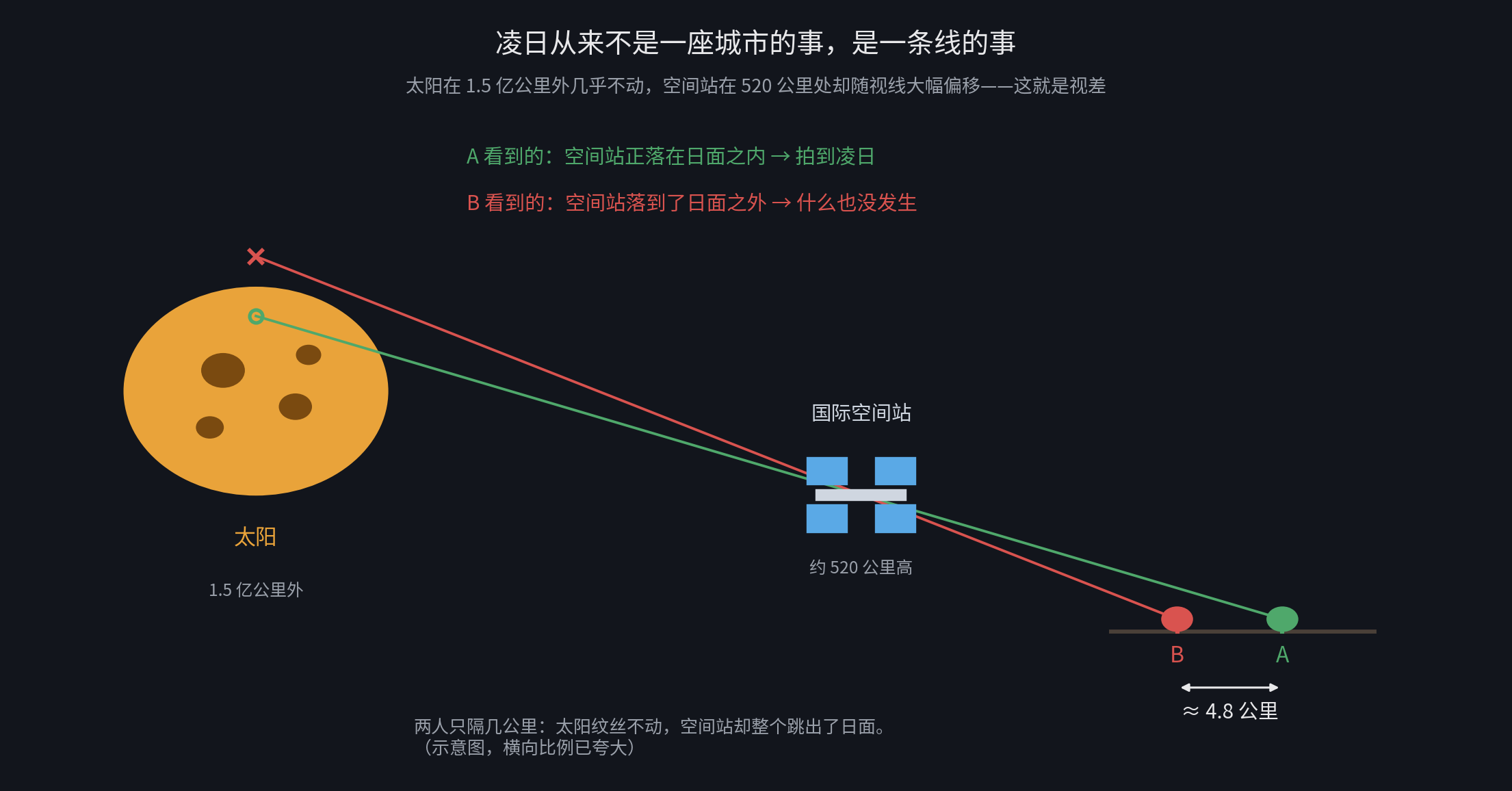
The station orbits a little over 400 kilometers above Earth. The Sun is 150 million kilometers away, more than 300,000 times farther. That enormous difference makes a familiar effect decisive: parallax.
A nearby tree appears to jump against distant mountains when viewed first through one eye, then the other. The nearby object shifts; the distant background barely moves. Here, the station is the tree and the Sun is the mountain.
A small change in the observer's position therefore moves the station substantially across the sky while leaving the Sun almost unchanged. To see its silhouette cross the solar disk, a photographer must stand inside a very narrow strip.
How narrow? The Sun's apparent diameter that day was about 1,890 arcseconds, or 0.009163 radians. The station was roughly 520 kilometers from the photographer:
0.009163 × 520 kilometers ≈ 4.8 kilometers.
That is the strip's full width. To catch a crossing near the middle of the Sun, the photographer needed to be within about half a kilometer of the centerline. Two or three kilometers off course, there would be no transit to see.
A report that a city will see an ISS solar transit really describes a narrow line near that city.
0.66 seconds
The second constraint is even tighter.
The station's speed follows from the basic circular-orbit equation: divide Earth's gravitational parameter, 398600.4, by the orbital radius, Earth's 6,371-kilometer radius plus 420 kilometers of altitude, then take the square root. The result is 7.66 kilometers per second. NASA's public-facing description, "five miles per second," is the rounded version.
At a distance of 520 kilometers, that works out to an angular speed of about 0.77 degrees per second. The Sun's apparent diameter is only 0.525 degrees.
Divide one by the other: 0.68 seconds.
The photographer gives the measured duration as 0.67 seconds. His institute in Opava reports 0.66 seconds, a difference of one hundredth of a second between two accounts of the same photographer's observation. The elementary calculation comes within 3% of the measured duration.
A blink takes roughly 0.1 to 0.4 seconds. In the time it takes to blink twice, the transit can be over.
His exposure was 1/16000 of a second, or 62.5 microseconds. Of that 0.66-second passage, the photograph captured only about one ten-thousandth.
The right place at the right instant
Public data and a website make this possible.
One of the most widely used prediction tools is Transit Finder, created by Poland's Bartosz Wojczyński. Given latitude, longitude, elevation, and a travel radius, it lists upcoming transits nearby. It covers the Hubble Space Telescope and China's Tiangong space station as well as the ISS.
Its help page supplies two crucial limits:
A few hours before a transit, the predicted time is accurate to a fraction of a second, and the centerline to about 100 meters.
Predictions more than 10 to 14 days ahead are only rough estimates.
The accuracy falls away because the station's orbit changes daily.
Even at its altitude, thin traces of atmosphere create drag. Periodically, a cargo spacecraft gives the station a push, called a reboost. On March 13 this year, a Progress spacecraft fired its engines for 10 minutes and 30 seconds, raising the orbit's apogee by half a mile and its perigee by nine-tenths of a mile.
A burn changes the orbital period slightly. Over a dozen or so days, that difference can put the station tens of seconds ahead of or behind its expected position. Tens of seconds multiplied by 7.66 kilometers per second means hundreds of kilometers of positional error. The transit strip is only 4.8 kilometers wide.
CelesTrak, which tracks orbital elements, puts the practical requirement plainly: data for objects in low orbit need updating several times a day. Stable satellites in higher orbits may need updates only once or twice a week.
The recipe for this photograph was public orbital data, a website, a map, a fresh calculation a few hours before departure, and a tripod on one particular spot along a field. Some of astronomy's most romantic photographs depend on its most exacting arithmetic.
Then came the plane
It was Monday morning, June 8, 2026, near Prasek, a village of just over 600 people in northeastern Czechia's Hradec Králové Region, about 100 kilometers from Prague.
The photographer had set up a 10-inch Dobsonian telescope with a 1.2-meter focal length, a 1.4x teleconverter, and a Nikon Z6III. A solar filter covered the front. He was waiting for those 0.66 seconds.
Then a plane entered the frame.
"This was not planned. The probability was really extremely low," he wrote on his website.
The next development was better still. After he posted the image, the Pardubice Flight Training Center (Centrum leteckého výcviku Pardubice) recognized its own aircraft: an L-39 Skyfox trainer. At the instant of the photograph, it was flying upside down.
Two kilometers away, an inverted training jet had accidentally staged its own miniature partial solar eclipse. The pilot would have had no idea until the photograph appeared online.
About that "one in 30 million"
Chinese media accounts often repeat this number as if it were an exact result. It is the photographer's rough estimate, not a peer-reviewed calculation.
He identified three inputs: the Sun's angular size, the 0.67-second transit, and the broad area of sky the aircraft crossed. But he did not publish the full calculation. NASA also attributes the estimate to the photographer.
Is the order of magnitude plausible? Yes. From one fixed location, an ISS solar transit happens roughly two or three times a year, each lasting less than a second. Spread those moments across a year's 31.56 million seconds, and the chance of a randomly timed solar photograph catching the ISS is already on the order of one in 15 million.
Is the combined event exactly one in 30 million? We do not know. It is an estimate with a plausible scale and an unpublished method.
The Sun's freckles
The dark patches are sunspots, regions of concentrated magnetic fields more than 2,000 degrees cooler than their surroundings. That temperature difference makes them look dark. NASA's educational material gives their span as 1,600 to 160,000 kilometers.
Earth is 12,742 kilometers across. A sunspot group spanning 50,000 kilometers could fit 3.9 Earths side by side; one at the upper end of that range could fit 12.6. The dark cores of those apparent freckles could swallow Earth whole.
For the day of the photograph, the Royal Observatory of Belgium's solar bulletin reported an estimated international sunspot number of 148, nearly ten numbered active regions on the disk, and a largest flare of class C7.2.
Solar Cycle 25's observed peak came in October 2024, with a smoothed sunspot number of 161. That differs from the NOAA prediction panel's earlier forecast of a July 2025 peak at 115. Activity substantially exceeded that forecast, and by June 2026 the Sun was in the cycle's declining phase.
Declining does not mean quiet. Some of a cycle's fiercest flares and geomagnetic storms occur after the peak.
How small was the station?
The ISS measures 109 meters from end to end; its truss alone is 94 meters long. At 520 kilometers, its angular size is:
109 meters ÷ 520000 meters × 206265 = 43.2 arcseconds.
The Sun spanned 1,890 arcseconds that day, giving a ratio of 1 to 43.8.
If the Sun were a basketball 24 centimeters across, the station would be a grain of rice 5.5 millimeters long against its surface.
At arm's length, about 60 centimeters from the eye, the Sun would span 5.5 millimeters, the size of a mung bean. The station would be a 0.13-millimeter speck on that bean, roughly twice the width of a human hair.
In reality, that speck is as long as a football field, and the "bean" has a diameter 12.7 million times the station's length. Their apparent sizes differ by only about 44 times because one is 520 kilometers away and the other is 150 million kilometers away.
The essential precaution: never look directly at the Sun
For viewing through a telescope, binoculars, or a camera lens, a purpose-made solar filter must cover the very front of the instrument.
The American Astronomical Society's eclipse-safety guidance emphasizes the word front. NASA is explicit: viewing any part of the Sun through a camera lens, binoculars, or a telescope without a special-purpose solar filter secured over the front will instantly cause severe eye injury.
An eyepiece filter is dangerous. The AAS specifically warns against the screw-in "solar filters" supplied with some inexpensive telescopes. The objective has already concentrated the sunlight by the time it reaches the filter, which can burn through or shatter.
Eclipse glasses do not make an unfiltered telescope safe. NASA warns that concentrated sunlight can burn through the glasses' filters and cause serious eye injury.
Color film, X-ray film, smoked glass, CDs, and sunglasses are not substitutes. Neither are photographic neutral-density or polarizing filters. These materials block visible light but provide little protection against infrared. The retina has no pain receptors; by the time something feels wrong, the damage is done. Suitable eclipse viewers should meet ISO 12312-2.
Chinese amateur photographers add a practical lesson that protects both eyes and equipment: fit the filter before aiming at the Sun; remove the camera before taking the filter off. Reversing that order can burn the shutter curtain.
China's own transit strip
Tiangong crosses the Sun and Moon too, and Chinese amateur astronomers have built a community, tools, and a body of photographs around those passages.
At 4:26:23 a.m. on August 14, 2022, members of the Chongqing Astronomical Society photographed the Chinese space station crossing the Moon from Yubei District. The entire transit lasted 0.72 seconds. At noon on January 16, 2026, a reporter photographed a solar transit from Fengtai Garden in Beijing. Beijing Daily said the camera position was "set up using measured position data from Tianwentong." That Chinese mini program and app includes space station pass predictions and calculations for solar and lunar transits.
Tiangong's solar-transit strip is narrower still. Published figures put its lower orbit at roughly 380 to 390 kilometers, with an inclination of about 41 degrees. Using the same calculation:
0.009163 × 390 kilometers ≈ 3.6 kilometers.
A lower orbit narrows the strip while making the station appear larger than it would farther away, and its transit faster. Tiangong's main structure is about 55.6 meters long, spanning roughly 29 arcseconds at 390 kilometers.
Another central figure is Liu Boyang, who holds a doctorate in astronomy. In 2022, he wrote his own optical tracking software and hauled his equipment across much of China, photographing all twelve configurations of the station during construction from the ground. His images became a kind of growing-up album, reported by both the China National Space Administration and Beijing Daily.
The geometry, tools, and ways to miss the shot are the same: clouds, a position a few hundred meters off, or outdated orbital data. Here, the photographers are waiting for their own country's space station.
Sources
- NASA Astronomy Picture of the Day, September 22, 2026: Original page.
- Petr Horálek's website, "One to 30 Million Shot."
- Science outreach site of the Institute of Physics in Opava, Silesian University, Czechia, September 22, 2026 report.
- NASA, International Space Station Facts and Figures; Johnson Space Center's educational page on station orbits; ISS blog reboost record for March 13, 2026; Earth Observatory report on an ISS solar transit; sunspot educational page; Sun Fact Sheet; and Spot the Station.
- NOAA, Solar Cycle Progression page.
- Royal Observatory of Belgium, solar activity bulletin for June 8, 2026.
- CelesTrak, orbital-elements FAQ; Transit Finder help page.
- American Astronomical Society, eclipse eye safety and optical equipment guidance; NASA, eclipse safety guidance; Baader AstroSolar, official product page.
- Heavens-Above.
- The Paper, 2022 report on the Chinese space station's lunar transit observed in Chongqing.
- Beijing Daily, January 16, 2026 report on a Chinese space station solar transit.
- China National Space Administration and Beijing Daily, reports on Liu Boyang's photographs of the Chinese space station's twelve configurations.
- Xunxingke, "A Step-by-Step Guide to Photographing Space Station Transits of the Sun and Moon."