
At 8:05 this morning, the Sun reached an ecliptic longitude of 180 degrees. The altar in this photograph, however, belonged to another day.
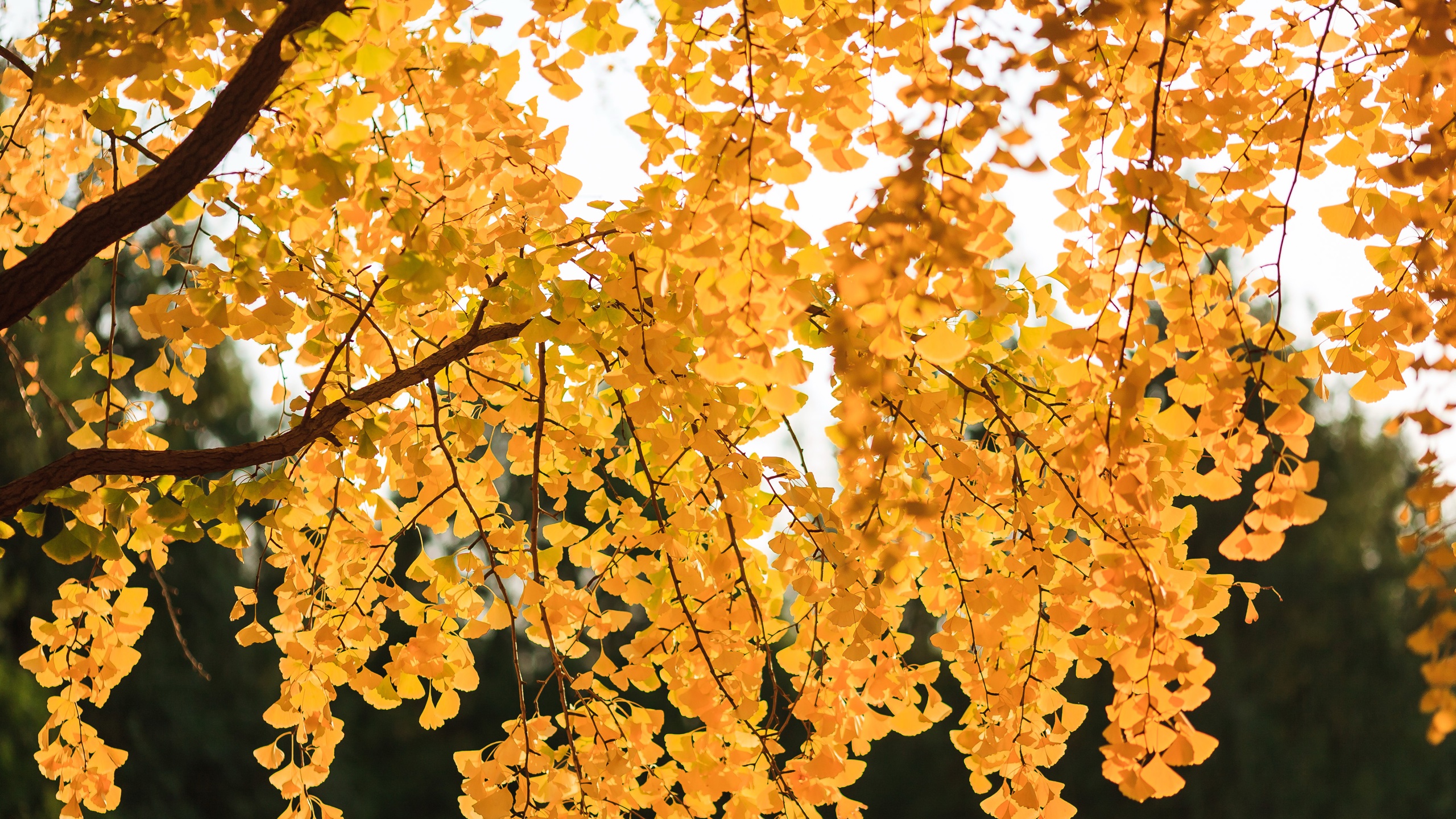
Image: Bing Daily Wallpaper | Autumn scenery in Ditan Park, Beijing, China (© by Wei/Adobestock) | Original page

At 8:05 this morning, the point directly beneath the Sun crossed the equator from the Northern Hemisphere and continued south. That instant was the autumn equinox.
Bing's Chinese homepage marked it with autumn at Beijing's Temple of Earth, or Ditan: a quiet expanse of yellow filtered through sunlight. The accompanying label was simply "autumn equinox."
It seems a natural pairing. Ditan is one of Beijing's best-known autumn settings, and the equinox marks the season's midpoint in the traditional Chinese calendar.
But turn the calendar back 496 years and the pairing becomes stranger. On the autumn equinox, the emperor did not go to the Temple of Earth.
A city arranged as a calendar
Ditan was built in 1530, the ninth year of the Ming dynasty's Jiajing reign. Beijing's municipal government describes it as the place where Ming and Qing emperors worshipped the deity of Earth, Huangdiqi. Covering 37.4 hectares, it is China's largest surviving altar dedicated to Earth.
Its appointed day, however, was the summer solstice.
The altar for the autumn equinox stood on the other side of the city. Yuetan, the Altar of the Moon, was originally called Xiyuetan, the Altar of the Evening Moon. It was built in the same year as Ditan, under the same emperor, in the same construction campaign. Its deity was Yeming, "Night Brightness": the Moon. Ming ritual prescribed worship of Yeming at Xiyuetan on the autumn equinox.
With the Forbidden City at its center, old Beijing thus formed a map: the Altar of the Sun to the east, the Altar of the Moon to the west, the Temple of Earth to the north, and the Temple of Heaven to the south. Four directions corresponded to the year's four great astronomical turning points.
At the spring equinox, when the Sun rose due east, the emperor's ritual route led east to greet it with a morning sacrifice. At the autumn equinox, with day and night once again balanced, the route led west for an evening offering to the Moon. At the summer solstice, the longest day and the height of yang, it led north to honor Earth. At the winter solstice, the shortest day and the rebirth of yang, it led south to honor Heaven. Four annual rites, each with its appointed direction.
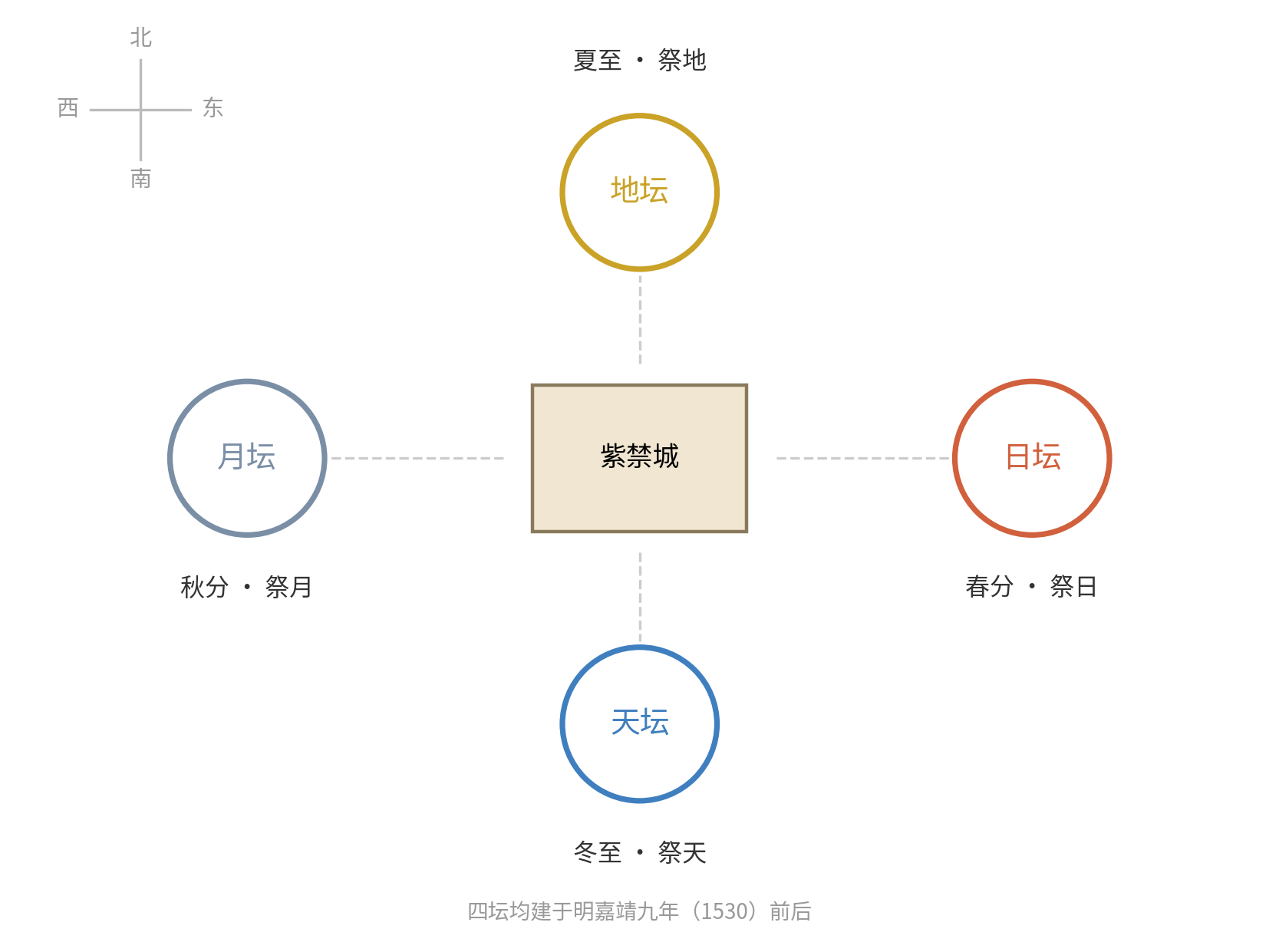
Why these four days? Before precise clocks, they were the four dates that could be determined directly from shadows and the direction of sunrise, without consulting an almanac. The sky itself supplied the reference. Fixing those moments to the city's four directions made Beijing a calibrated instrument.
Today's photograph catches the right season at an altar dedicated to a different turning point.
A moon festival the Moon would not cooperate with
Equinox moon worship predates the Ming dynasty by many centuries. The Book of Rites says: "The Son of Heaven greets the Sun on spring mornings and the Moon on autumn evenings." Tang dynasty writer Liu Zongyuan was more explicit: "According to ritual, the Moon is worshipped on the evening of the autumn equinox. At that time day and night are equal; the Sun is at its midday height, and the lunar spirit has already emerged."
The reasoning was that the Moon's presence had begun to emerge even while the Sun still stood high. Yin and yang were evenly matched, making this the ideal day for the rite.
There was one unavoidable problem: the equinox follows the Sun. The Moon does not.
On the equinox, the Moon might be a thin crescent or a half disk. In an article published by Nanjing University, scholar Hou Yinguo cites an old mocking line: "Laugh at them worshipping a Moon that is not even full."
Popular custom found another date. On the fifteenth day of the eighth lunar month, the Moon would be full. Worship and moon-gazing gradually came together at the Mid-Autumn Festival. The moon festival celebrated today moved from the equinox, for the simple reason that its Moon needed to be round.
Imperial ritual kept its older schedule until the end of the Qing dynasty. The emperor personally conducted the moon sacrifice once every three years; military officials deputized in the intervening years. Rites for Heaven and Earth ranked as "great sacrifices," while those for the Sun and Moon were "medium sacrifices." In ritual standing, the Moon still came behind the Sun.
Are day and night really equal today?
The Chinese name qiufen means both a division of autumn and a division of day from night. Almost every account describes the day as having equal hours of light and darkness.
That is not quite what happens.
Wang Kechao, who oversees science outreach at the Chinese Academy of Sciences' Purple Mountain Observatory, gives Beijing's daylight on this year's autumn equinox as about 12 hours and 8 minutes, describing it as a full eight minutes longer than the night.
Two effects account for those minutes, both involving what counts as sunrise.
First, the Sun is a disk, not a point. Sunrise begins when its upper edge clears the horizon, rather than when its center does. That adds a few minutes.
Second, Earth's atmosphere acts as a lens. Sunlight entering the air at an angle bends, lifting the Sun's apparent position. Its center can still be below the horizon when it becomes visible.
The Sun seen at sunrise is not quite where it appears to be. Its center is still below the horizon; the air has lifted its image into view.
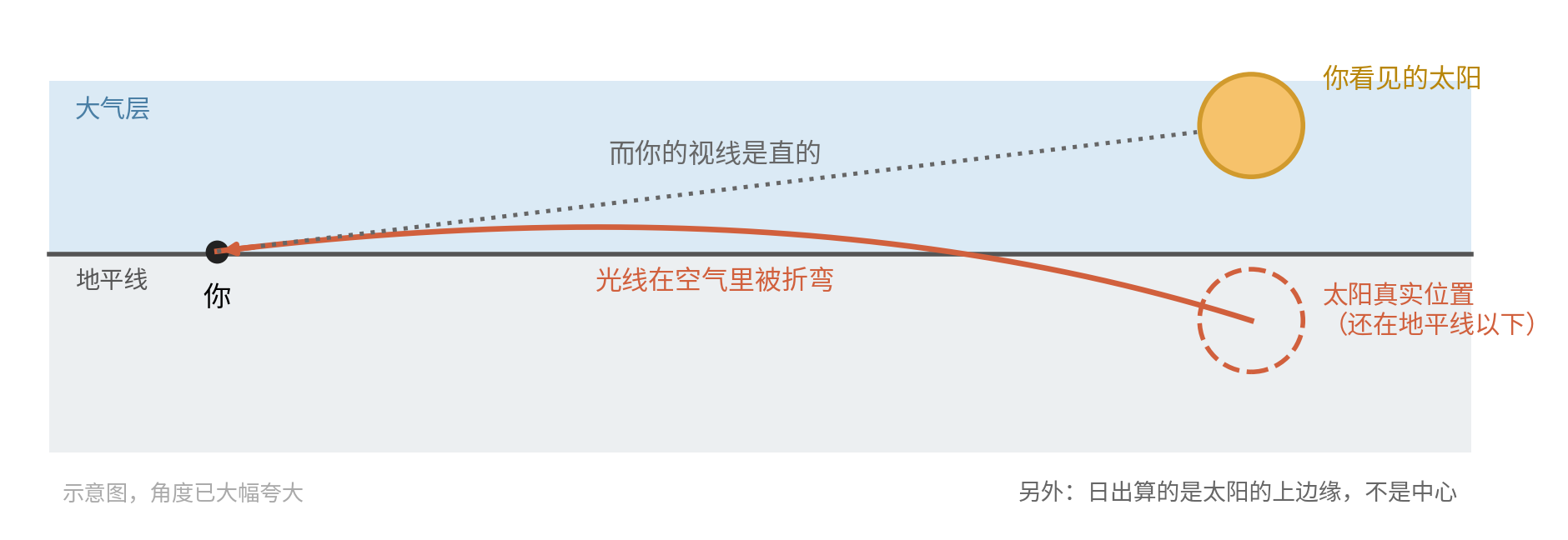
Together, these effects push the date of truly equal day and night a few days later. The equinox marks the Sun's passage directly over the equator. Equal daylight and darkness are a different event, with a layer of air helping separate the two.
From an emperor's altar to a farmers' festival
The autumn equinox has a much younger role as well.
On June 7, 2018, China's State Council issued approval document No. 80 of 2018, establishing the annual autumn equinox as the Chinese Farmers' Harvest Festival, beginning that year. It was the first festival created specifically for farmers since the founding of the People's Republic of China.
The timing was practical. Around the equinox, the autumn harvest is at its busiest across much of the country, from the northeast to southern China.
The approval's wording contains an easily misunderstood detail: it calls the date the "autumn equinox of the lunar calendar." But the equinox is not a lunar date. It is the instant the Sun reaches an ecliptic longitude of 180 degrees, a point in a solar calendar. It falls reliably between September 22 and 24 in the Gregorian calendar while moving around in the traditional lunar months. The twenty-four solar terms belong to the solar half of China's traditional calendar.
An altar to Earth, an altar to the Moon, an astronomical instant, and a farmers' festival all meet on the same date. A solar term can hold astronomy, ritual, and agriculture together, while remaining as tangible as the Sun outside the window at dusk.
Sources
- People's Government of Beijing Municipality: Temple of Earth.
- Visit Beijing: Beijing's Altar of the Moon and the Annual Worship of Yeming.
- Nanjing University: Was Moon Worship Held at the Autumn Equinox or Mid-Autumn?.
- China.com, republishing Xinhua: What Does the Autumn Equinox Divide? Day, Night, and a Busy Farming Season.
- Chinese Government: State Council Approval Establishing the Chinese Farmers' Harvest Festival.