
Google's homepage in several Asian countries and regions marks the Mid-Autumn Festival today. The lasting story belongs to the object inside the Doodle: a world that has shown humanity the same face for thousands of years.
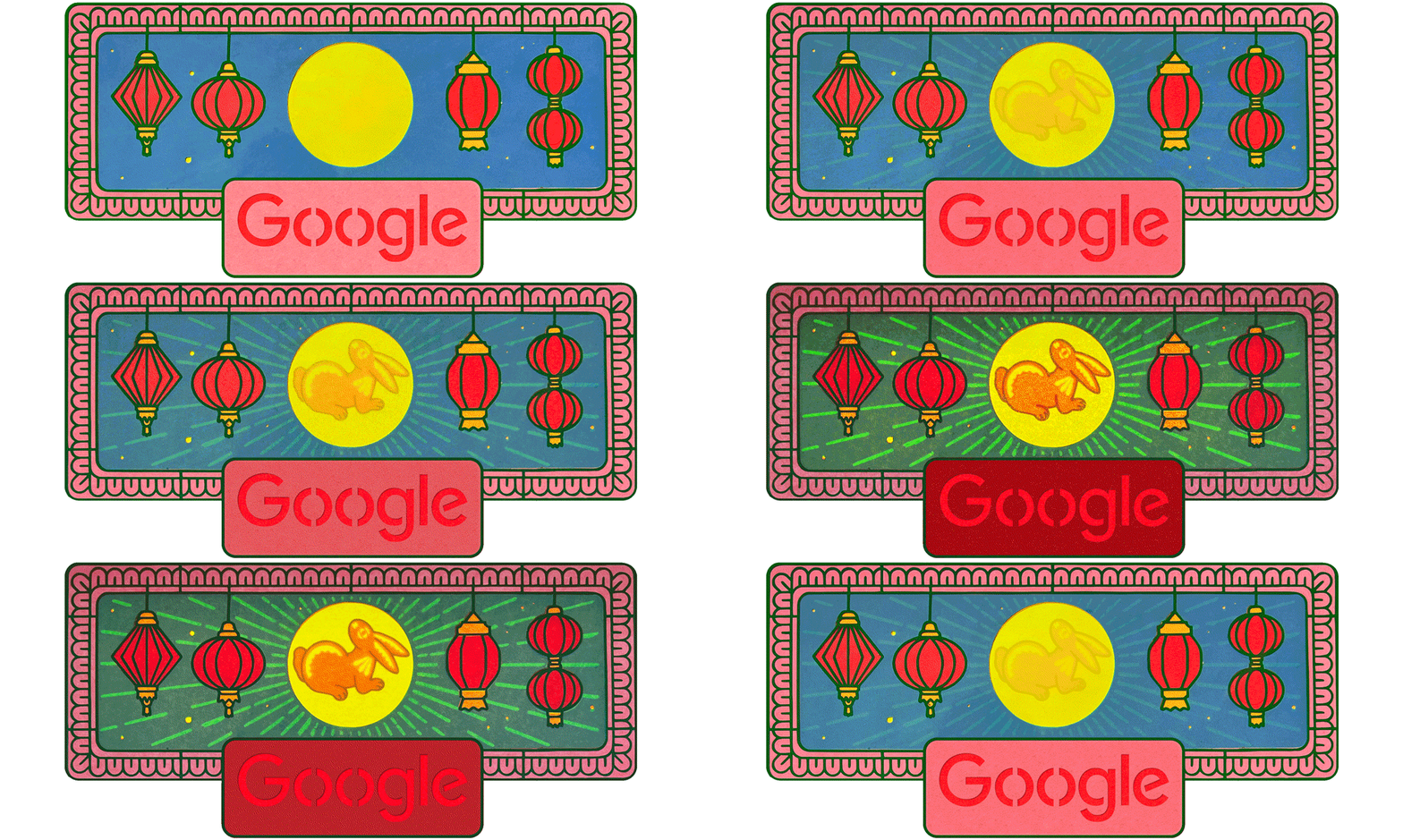
Image: Google Doodle, Mid-Autumn Festival 2026 | Original page
Today is the Mid-Autumn Festival. Google's annual Doodle appears on its homepage in several Asian countries and regions. The official description is brief: the festival marks the beginning of the autumn harvest, bringing people together to light lanterns, eat mooncakes, and watch fireworks.
Tomorrow, the Doodle will disappear. The moon inside it will keep the same face.
For thousands of years, people looking up from Chang'an, Kyoto, Tenochtitlan, or the coast of Brittany have seen the same lunar markings. The Moon has never turned around to show Earth its other side.
That sounds too familiar to be remarkable. Yet Earth rotates, bringing different parts of its surface into sunlight. Mars rotates. Venus rotates. Why does the Moon apparently refuse?
It Does Turn, Exactly on Schedule
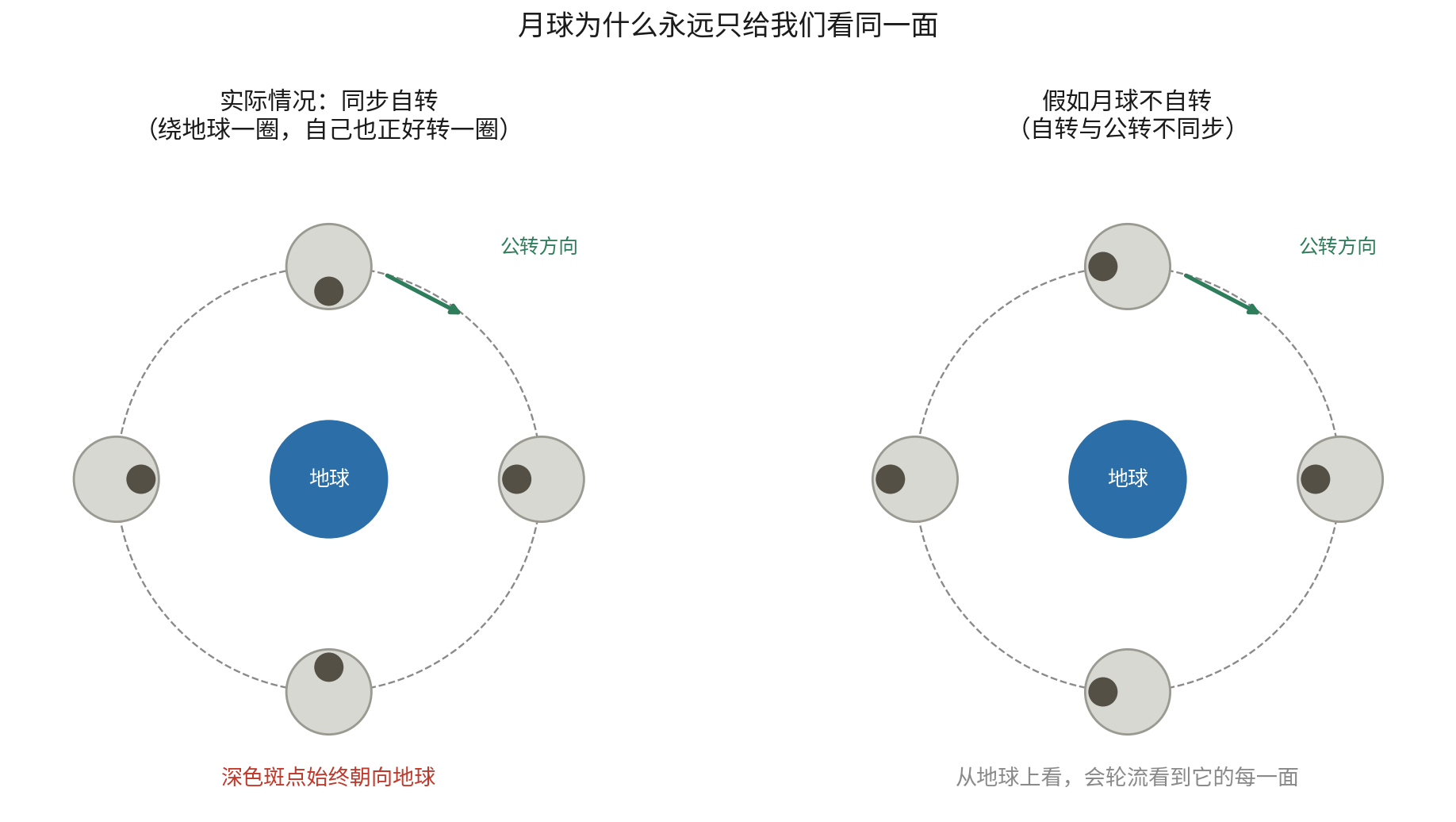
The Moon rotates on its axis in exactly the time it takes to orbit Earth. NASA describes this as synchronous tidal locking.
Imagine walking around a post while always facing it. To someone watching from outside, you plainly turn: your face points in every direction during the circuit. To the post, you show only your face. The Moon does the same.
It did not begin this way. NASA's explanation starts with Earth's gravity stretching the Moon slightly into a football shape, with a bulge at each end. Rock takes time to deform, so the bulges do not remain precisely aligned with Earth. Earth's pull on that displaced mass exerts a torque, like a hand gently braking a spinning ball. Deformation produces heat, dissipating energy. The Moon's spin slows until it matches its orbital motion, removing the relative motion that the braking acts on.
How long did it take? NASA gives an order of magnitude: large moons generally synchronize within hundreds of thousands of orbital periods. Converting that directly into years would be misleading. The early Moon was much closer to Earth, and its orbit took far less than today's month.
We Actually See 59%
There is a pleasing complication. Although one side faces us, the portion of the lunar surface visible from Earth over time is 59%, according to NASA's observing guide.
The extra nine percentage points come from libration, with three contributions.
First, the Moon's elliptical orbit makes its orbital speed vary: faster when closer, slower when farther away. Its rotation remains steady. The mismatch lets us peek around its sides by about 7 degrees 54 arcminutes, an effect called libration in longitude. Second, the Moon's equatorial plane tilts by 6.68 degrees relative to its orbital plane. This makes it appear to nod, exposing a little more around each pole, with libration in latitude reaching about 6 degrees 50 arcminutes. Finally, Earth's own radius gives an observer slightly different viewing angles in the evening and before dawn, adding less than one degree. NASA describes the first two effects as the Moon slowly shaking and nodding its head.
That uneven speed around an elliptical orbit will return later to explain a surprise about this year's festival moon.
What the Dark Patches Are
The dark regions are called maria, Latin for "seas." The name survives from antiquity, though these plains contain no water. They formed when basaltic lava spread across the surface billions of years ago. Their composition makes them reflect less light than the surrounding highlands. Maria cover about 16% of the Moon's total surface.
Their distribution is strikingly uneven: dark lava plains cover about 31% of the near side, but only about 1% of the far side.
The usual explanation is that the far side's crust is thicker, by an average of about 20 kilometers, making it harder for magma to reach the surface. That explanation has merit, but it is incomplete. The far side's South Pole-Aitken basin contains the Moon's lowest terrain and thinnest crust, yet has very little basalt filling. Research has long indicated that crustal thickness cannot be the sole control on the distribution of maria. A more recent explanation combines the difference in crustal thickness with accelerated thickening of the lithosphere following the enormous South Pole-Aitken impact.
We have stared at those markings for millennia. Only recently have we begun to explain more clearly why they look as they do.
One Pattern, Many Pictures
With the Moon always facing us, civilizations have spent thousands of years examining the same pattern. Each has found a different picture in the same inkblot.
One of the earliest Chinese references is itself a scholarly puzzle. "Heavenly Questions," in the Songs of Chu, asks why the night's light dies and returns to life, and what it gains by carrying a gutu in its belly. The word is commonly understood as a rabbit, but Wen Yiduo argued that it meant a toad. On the T-shaped silk painting from the Han tombs at Mawangdui in Changsha, both a rabbit and a toad inhabit the Moon. The first creature Chinese observers placed there may not have been a rabbit at all.
Japan sees a rabbit pounding rice cakes. An educational page from Gunma Astronomical Observatory sets out three readings at once: Japanese observers see the rice-cake rabbit, Chinese observers a crab raising large claws, and Western Europeans a beautiful woman. Yet that account of what "the Chinese" see is already a distortion. Even another culture's interpretation changes in the retelling.
In Buddhist tradition, Jataka tale 316 tells of a hare that leaps into a fire to feed a mendicant. To commemorate the sacrifice, Sakra places the hare's image on the lunar disk. This is a separate story from the tale of self-sacrifice to feed a tiger.
Europe has its "man in the moon," carrying a large bundle of firewood and sometimes accompanied by a small dog. In Germanic tradition, he was banished there for gathering wood on the Sabbath. The mapping of his face is fairly consistent: Mare Imbrium and Mare Serenitatis form the eyes, Sinus Aestuum the nose, and Mare Nubium and Mare Cognitum the open mouth.
The Aztec version is rougher. In the Florentine Codex, the gods mock the Moon by throwing a rabbit at its face, leaving the rabbit's image there forever.
The list continues: Korea's rice-cake-pounding rabbit; the Maya Moon goddess holding a rabbit; a woman with a Ngaio tree in Maori tradition; Brazil's dragon-slaying Saint George and his horse; the Malay Peninsula's hunchback twisting rope beneath an upside-down banyan, with a rat biting through the rope; and the name "Ali" written on the lunar surface in Shi'a tradition.
There is a revealing inconsistency in the rabbit stories. Sources disagree about which maria make up the animal. One astronomy teaching page makes Oceanus Procellarum the head and Mare Frigoris the ears. Another makes Mare Serenitatis the head and Mare Tranquillitatis, Mare Fecunditatis, and Mare Nectaris the ears. The man in the moon's facial features are mapped much more consistently. The disagreement exposes how much of the picture we supply ourselves.
The brain's tendency to find meaningful images in ambiguous patterns is called pareidolia. Harvard researchers describe us as continually seeking meaning in noise and filling things with information. Functional MRI experiments show that meaningless scribbles can activate the same brain regions as genuinely meaningful images.
The Moon has said nothing for thousands of years. We have done all the talking.
Then We Went Around the Back
For hundreds of thousands of years, humanity knew only one face. A little over six decades of exploration transformed that view.
At 03:30 UTC on October 7, 1959, the Soviet spacecraft Luna 3 began taking photographs during a flyby. In 40 minutes it took 29 images, covering about 70% of the far side. NASA's archive describes them plainly: noisy and low in resolution, but with many features recognizable. One of their first revelations was the asymmetry still under discussion today: the far side has very few maria.
On January 3, 2019, Chang'e 4 touched down in Von Karman crater within the South Pole-Aitken basin, making humanity's first soft landing on the lunar far side. It needed a relay satellite first. Queqiao, launched on May 21, 2018, occupied a halo orbit near the Earth-Moon L2 Lagrange point, one of the few vantage points with a view of both Earth and the entire lunar far side.
Tidal locking makes that detour necessary: the far side always faces away from Earth, so radio signals have no direct route home. A mechanical arrangement established billions of years ago determined the orbit chosen for a satellite in 2018.
At 14:07 on June 25, 2024, Chang'e 6's return capsule landed in Siziwang Banner, Inner Mongolia, carrying 1,935.3 grams of far-side samples. Dating the basalt identified two episodes of volcanism: one about 4.203 billion years ago, and the main episode about 2.807 billion years ago. Far-side volcanic activity therefore spanned more than 1.4 billion years. In July 2025, the Chinese Academy of Sciences presented four papers featured on the cover of Nature, based on these samples. They showed that the far side's ancient magnetic field strengthened again around 2.8 billion years ago, challenging the idea of a steadily declining field. They also found substantially less water in the far-side mantle than in the near-side mantle, revealing another division inside the Moon.
The familiar face and the hidden face differ beneath the surface, too.
Why Today, and When the Moon Is Actually Full
The 2026 Mid-Autumn Festival falls on Friday, September 25. China's State Council General Office has designated September 25-27 as a three-day holiday, with no compensating workdays.
The festival night does not coincide with the exact full moon.
Purple Mountain Observatory gives the moment as 00:49 Beijing time on September 27, the seventeenth day of the eighth lunar month. The Hong Kong Observatory and the Royal Observatory Greenwich give consistent timings; Greenwich lists it on the evening of September 26 in local time.
The Chinese saying has the moon of the fifteenth becoming full on the sixteenth. This year, it waits until the seventeenth.
How unusual is that? Purple Mountain Observatory's figures for the 21st century put 48% of full moons on the sixteenth lunar day, 38% on the fifteenth, and only 14% on the seventeenth.
The reason returns us to the elliptical orbit: the Moon's speed varies. The interval from new moon to full moon can range from 13.90 to 15.61 days. This cycle takes about 15.56 days, near the upper end, pushing the full moon into the seventeenth.
The same orbital eccentricity thus helps us see beyond the Moon's nominal half and delays this year's full moon. It contributes to those extra nine percentage points of visible surface as well as to the festival's late full moon.
Tonight's Moon is 98.3% illuminated, a difference from 100% that is imperceptible to the naked eye. Purple Mountain Observatory identifies the evening of September 26, the sixteenth lunar day, after moonrise, as the best viewing period for this cycle.
The ephemeris gives the following times in Beijing time, using Beijing as the location; local circumstances vary:
- Moonrise: about 17:18 on September 25, south of due east; about 17:40 on September 26; about 18:04 on September 27.
- Full moon: 00:49 on September 27.
- Purple Mountain Observatory also notes that Saturn will appear in the southeastern sky tonight, below and to the left of the Moon.
This is not a supermoon. At full moon, the Earth-Moon distance will be about 379,400 kilometers, only about 1.3% less than the average of 384,400 kilometers. September's perigee occurred on September 6, a full 20 days before the full moon.
NASA's observing guide adds one counterintuitive point: full moon is the worst phase for seeing craters and mountains. Sunlight falls almost straight down, leaving few shadows to reveal relief. At other phases, terrain near the terminator, the boundary between lunar day and night, casts long shadows.
The dark markings work differently. Their visibility depends on differences in reflectivity, rather than shadows. The same night that flattens the craters brings out the rabbit.
Sources
NASA, "Tidal Locking" and its Moon observing guide; NASA's Goddard Scientific Visualization Studio, libration and lunar-phase visualizations; NASA NSSDCA, Luna 3 mission archive; China National Space Administration, Chang'e 6 mission announcements; Chinese Academy of Sciences, Chang'e 6 sample research announcements; Nature, dating of Chang'e 6 far-side basalts; Purple Mountain Observatory via China News Service, on the 2026 full moon and 21st-century full-moon statistics; Royal Observatory Greenwich, 2026 full-moon table; the General Office of China's State Council, 2026 public holiday arrangements; Gunma Astronomical Observatory's educational page; an English translation of Jataka tale 316, the Sasa Jataka; Book 7 of the Florentine Codex; Gushiwen's annotations to "Heavenly Questions"; China Reading Weekly, on the interpretation of gutu; and National Geographic, on the cognitive science of lunar pareidolia.