
Black sand, green water and reddish-brown volcanic rock crowd onto a single stretch of coast. The colors need no enhancement: this is a volcano cut open by the sea.
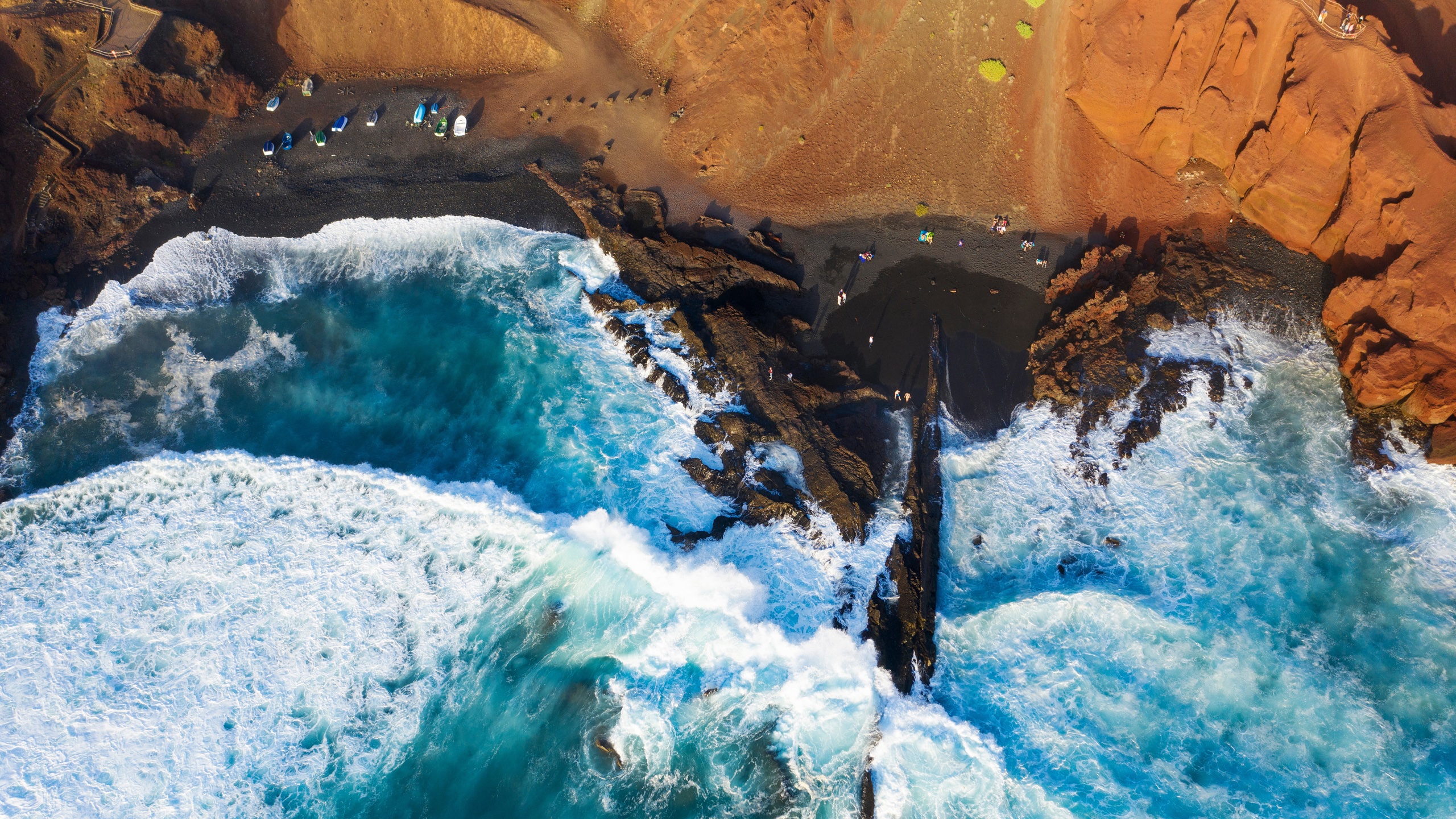
Image: Bing Daily Wallpaper | Aerial view of a black lava beach, El Golfo, Lanzarote, Canary Islands, Spain | Photograph: Westend61/Adobe Stock | Original page
From the air, Lanzarote in Spain's Canary Islands seems to force three unrelated colors together: the deep blue of the Atlantic, the black of volcanic debris, and a small patch of almost fluorescent green.
The green water is Charco de los Clicos, often called the Green Lagoon. It sits inside the crater of El Golfo, separated from the ocean by a barrier of sand and gravel. Seawater still seeps through underground fissures; tiny organisms in the water give the lagoon its striking color.
Why Only Half the Volcano Remains
El Golfo is a Surtseyan volcanic formation. The defining feature of this kind of eruption is magma meeting water in a shallow sea.
Hot magma rapidly turns seawater to steam. Violent phreatomagmatic explosions tear magma and rock into small fragments, which fall in layers to build a low cone of tuff. The Lanzarote and Chinijo Islands Geopark records both wet and dry pyroclastic deposits here, along with cross-bedding and other structures shaped by the interaction of erupting material and water.
After the eruption, waves took over. The Atlantic repeatedly battered the seaward flank until nearly half the volcano was gone. The crater, once enclosed, lay open like a bowl with one side sliced away.
The curved black beach in the photograph marks the meeting of that bowl and the ocean. Its dark grains are volcanic rock repeatedly broken and rounded by waves, rather than ordinary quartz sand.
The Green Comes from Life
The lagoon's color might suggest sulfur or some rare mineral. Local official accounts instead attribute it to algae and other microorganisms in the water.
That explains the photograph's strongest contrast. Black and reddish-brown come from magma cooling, breaking apart and oxidizing. Green comes from life growing in saltwater after the volcanic activity ended. The coastline brings two very different processes into the same frame.
A pale barrier of sand and gravel lies between the lagoon and the sea. Even as waves dismantle the old volcano, they push debris back toward shore, building the ridge that separates the waters. El Golfo preserves evidence of eruption, erosion and deposition all at once.
A Cross Section Still Taking Shape
Lanzarote and its neighboring islands form a UNESCO Global Geopark. More than 15 million years of volcanic activity, erosion and deposition can be traced across a relatively compact landscape.
El Golfo is a particularly clear natural cross section. Waves have exposed layers once hidden inside the cone. Water has collected in the crater to form a lagoon. Eroded material has accumulated as a black beach and a barrier ridge.
The photograph looks like a chance collision of colors. Magma, seawater and time brought them together.