
No star is exploding in this photograph. Its five glowing arcs are the echoes of explosions that have lingered for thousands, even tens of thousands, of years.
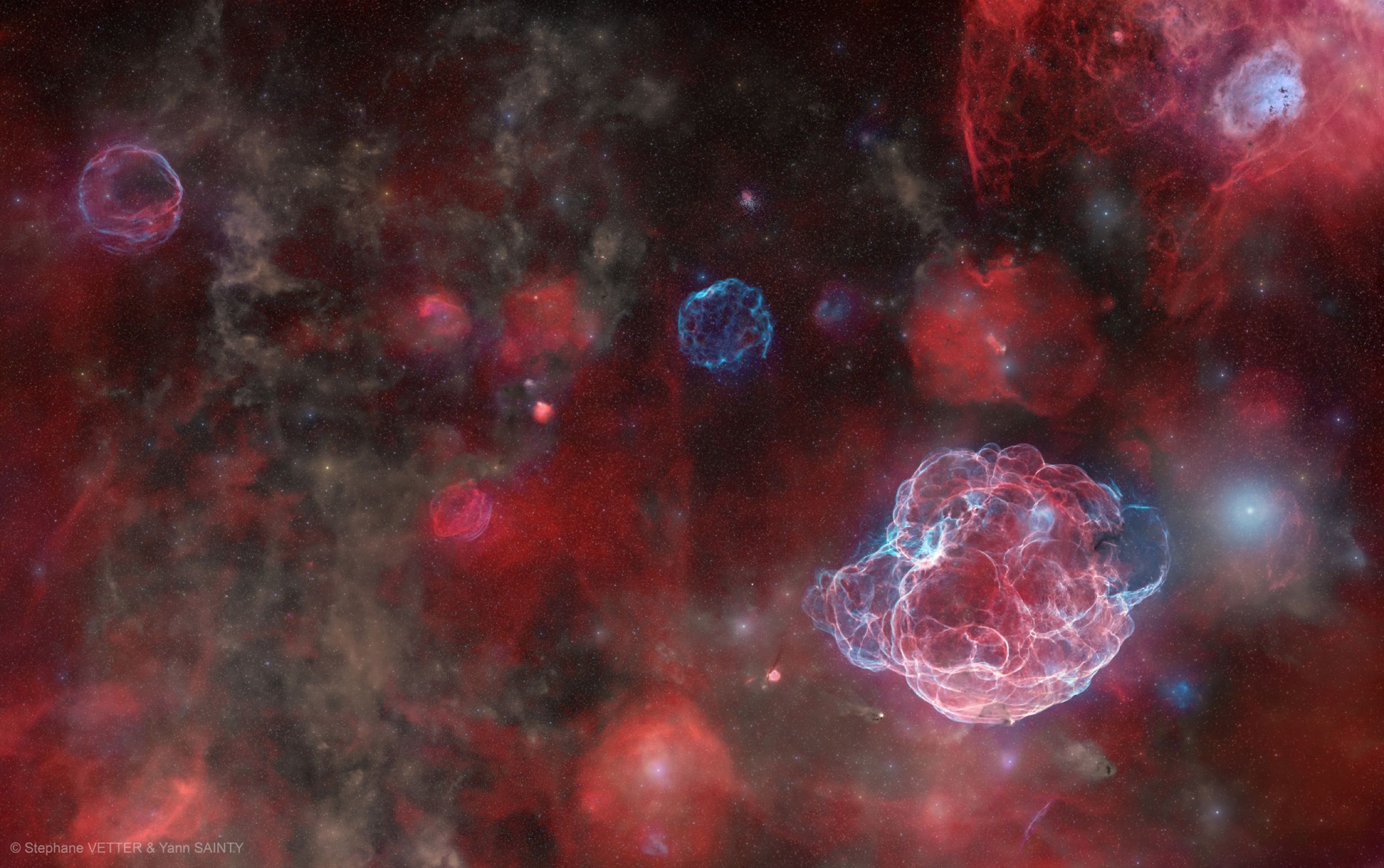
Image: NASA Astronomy Picture of the Day (APOD) | Photograph: Stephane Vetter, Yann Sainty | Original page
NASA's Astronomy Picture of the Day for September 24, 2026, gathers five supernova remnants toward the constellation Auriga into a single frame.
Made with about 200 hours of exposure at Oukaimeden Observatory in Morocco, the image covers an area of sky equivalent to roughly a thousand full moons. It also includes the open star cluster M37 and the Tadpole Nebula.
From Left to Right, Five Stellar Deaths
APOD identifies the five remnants, in order, as G181.1+9.5, G182.4+4.3, G179.0+2.6, G180.0-1.7 and G178.2-4.2.
The most conspicuous, G180.0-1.7 near the middle, has a more familiar name: Sh2-240, or the Spaghetti Nebula. Its filaments bend and overlap like a handful of noodles spread out on a plate. The others are fainter. Some show only an incomplete arc and become easier to distinguish in a deep image covering a wide field.
These structures come from the explosions that end the lives of massive stars. Shock waves race through the interstellar medium, compressing, heating and ionizing the sparse gas around them. Long after each explosion ends, its expanding shell of gas continues to glow.
What the Red and Blue Reveal
This is a narrowband image. Red primarily traces H-alpha emission from hydrogen atoms; blue primarily traces emission from doubly ionized oxygen. The colors distinguish where different elements emit light within the shock waves.
Supernova remnants rarely have perfectly circular edges. Their shock waves encounter interstellar gas of uneven density, slowing and brightening in denser regions while expanding farther through thinner ones. The surrounding material reshapes an initially roughly spherical shock into arcs, sheets and filaments.
The most distant remnants in this image lie thousands of light-years from Earth, and their ages can reach tens of thousands of years. These were not five simultaneous explosions. The photograph projects five histories, at different distances and of different ages, onto the same stretch of sky.
Why Spend 200 Hours on One Image?
Each remnant is large and faint. Its total light may be considerable, but that light is spread over an enormous area of sky, leaving very little brightness per unit area. Long exposures gradually collect the weak emission-line light almost lost in the background.
About 200 hours of accumulated exposure bring these five tenuous shells together as a complete landscape for the first time. A star's explosive death is brief; the shock wave it leaves behind can mark the Milky Way for tens of thousands of years.
Sources
NASA Astronomy Picture of the Day, "The Ghosts of Five Supernovas": Original page.