
A galaxy changes shape not just because gravity is strong, but because it varies from place to place.
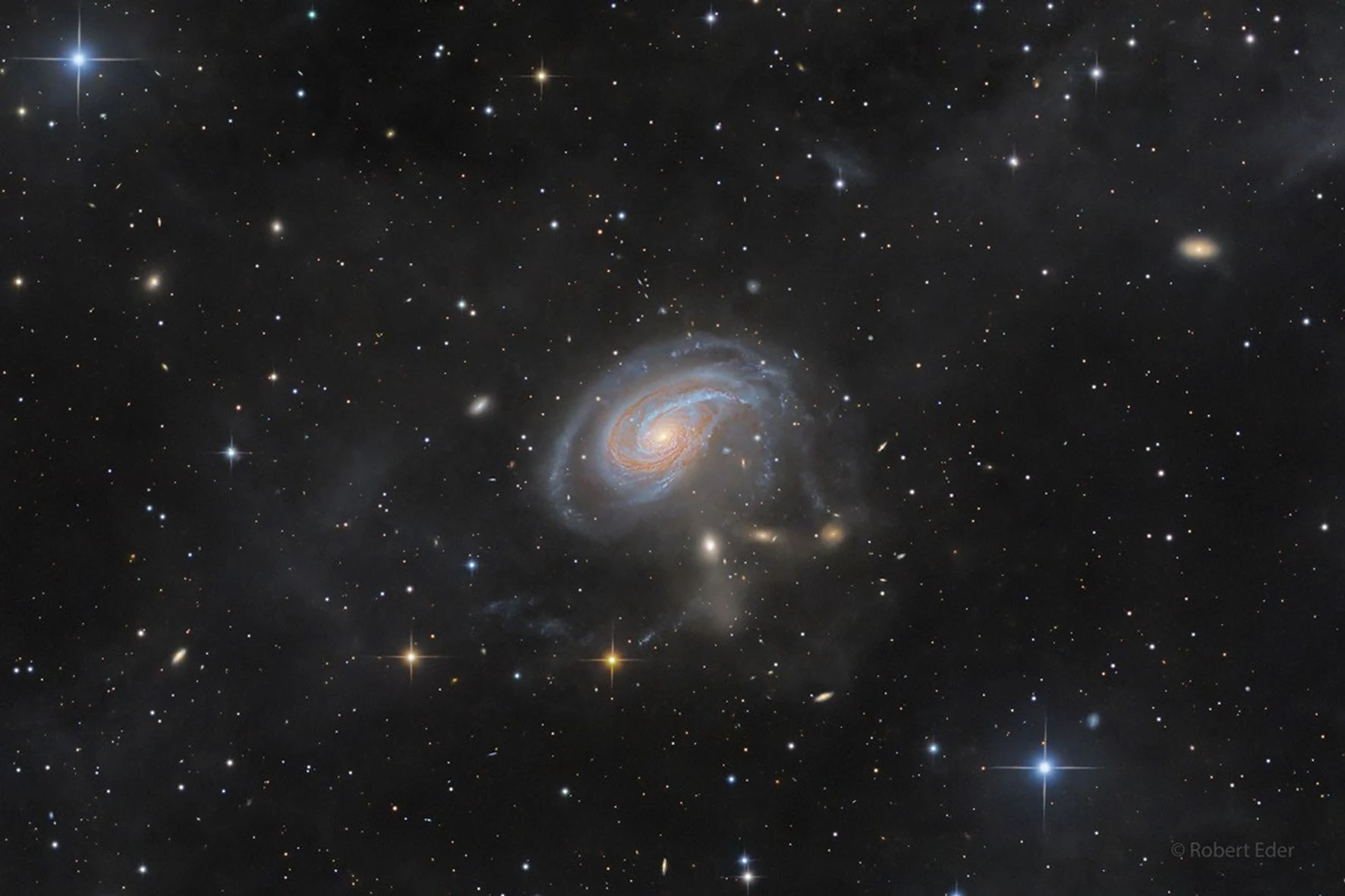
Image: NASA Astronomy Picture of the Day | Credit & Copyright: Robert Eder | Original page
NGC 772, also cataloged as Arp 78, lies about 100 million light-years away toward Aries and spans roughly 200,000 light-years. One outer spiral arm is especially prominent, with young blue star clusters along its dust lanes.
NASA attributes the arm's appearance to gravitational tides on a galactic scale, likely caused by an interaction with the smaller companion NGC 770. "Likely" matters. A photograph is not a complete record of the galaxies' orbits.
The Difference Gravity Makes
The side nearer a companion feels a stronger pull than the far side. The whole galaxy accelerates, but its different parts do not accelerate equally. Subtract the motion of the center and the remaining differences can stretch the material. That is a tidal effect, not a separate kind of force.
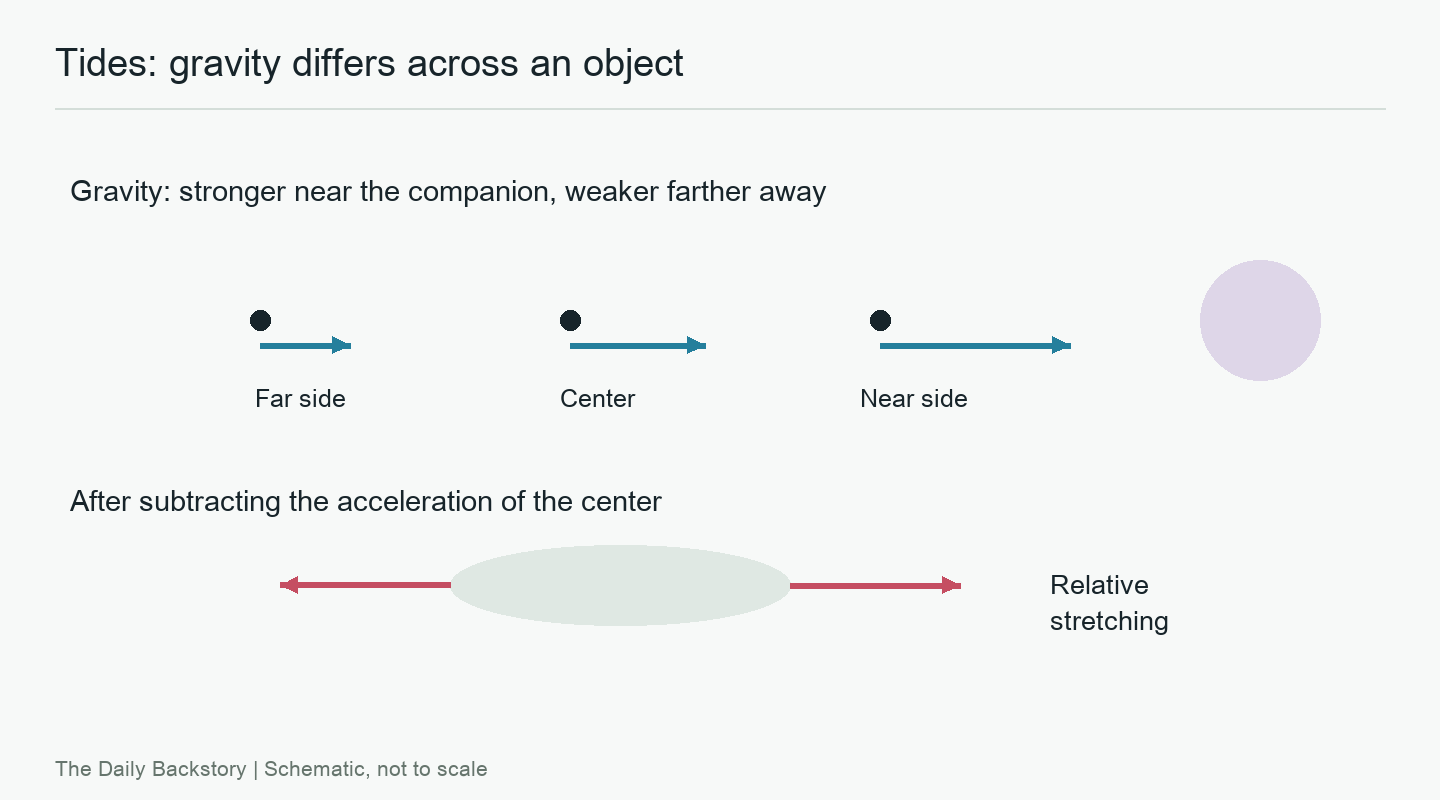
Diagram: The Daily Backstory; schematic, not to scale.
When an object's size is small compared with its distance from the companion, the tidal effect falls approximately with the inverse cube of distance, faster than ordinary gravitational acceleration. Real galaxy interactions also depend on orbits, gas and dark matter. One distorted arm cannot tell us how many encounters occurred.
NGC 770 has a complicated history of its own. In 2005, Geha and colleagues reported a central region rotating opposite to the main galaxy and suggested that swallowing a smaller, gas-rich galaxy was a plausible explanation.
Gas beyond the Photograph
Interactions can also strip out diffuse neutral hydrogen. It is inconspicuous in visible light but measurable through its 21-centimeter radio emission.
In 2022, Xu and colleagues used China's FAST telescope to discover a neutral-hydrogen structure around a different group, Stephan's Quintet. It extends about 0.6 megaparsecs, roughly 2 million light-years. The researchers suggested that its diffuse component could preserve evidence of interactions more than a billion years ago. They also raised a puzzle: how could such tenuous gas remain neutral for so long?
That was not an observation of NGC 772. It illustrates a complementary way of reading interactions. Optical images show luminous stars and clusters; radio measurements add a wider, fainter gas component. To understand a long gravitational encounter, it can help to look in a different kind of light.
Sources
NASA: Original page; Geha and colleagues: NGC 770's counterrotating core; Xu and colleagues: neutral hydrogen around Stephan's Quintet.