
The sound it needs is a rustle beneath the grass. One possible source of interference is much closer: its own wings.
National Geographic's Photo of the Day for October 2, 2026 shows a short-eared owl over the salt marshes of British Columbia's Fraser River Delta. At dusk, the bird turns in flight, its yellow eyes meeting the photographer's lens.
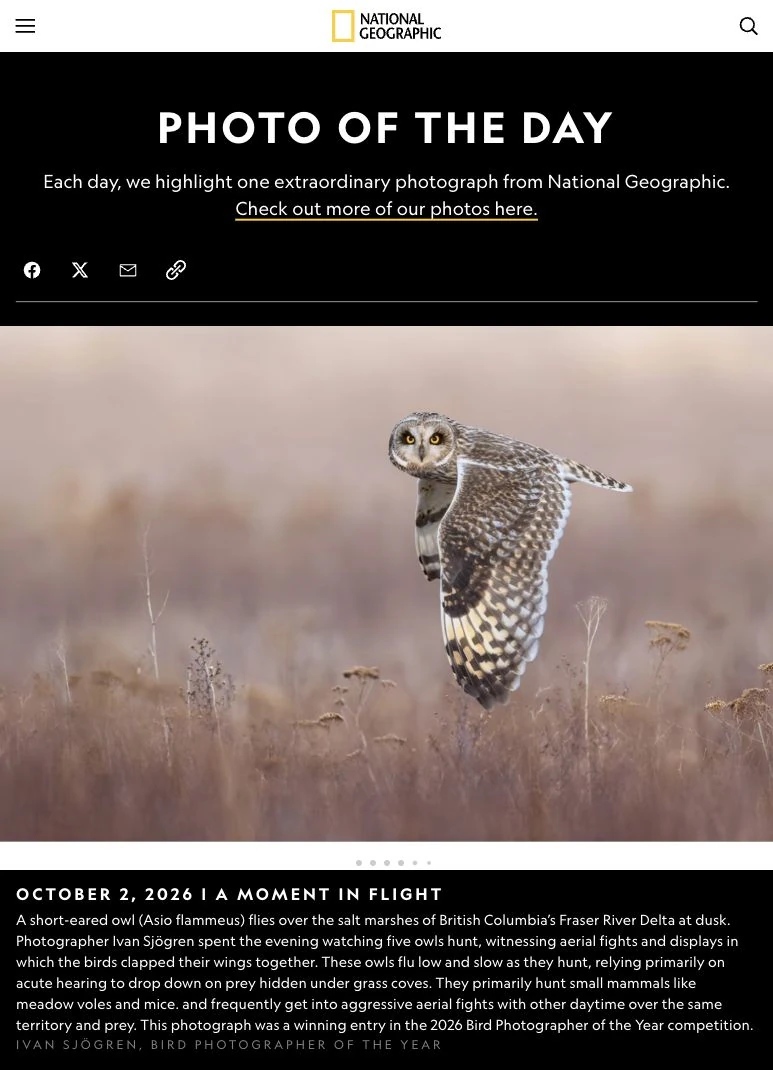
Image: screenshot of National Geographic's webpage. Photograph: Ivan Sjögren / Bird Photographer of the Year. Photograph copyright remains with its rights holder. Original page
Ivan Sjögren watched five short-eared owls hunt that evening, witnessing aerial disputes and displays in which the birds clapped their wings together. National Geographic calls the photograph "A Moment in Flight." In the official 2026 Bird Photographer of the Year results, it appears as "Eye-to-Eye with a Short-Eared Owl," the gold winner in Birds in Flight.
Listening Beneath the Grass
The short-eared owl, Asio flammeus, favors open country: grassland, wetlands and tundra. It often hunts around dusk and can also hunt in daylight. Waiting on a perch is only part of the picture; searching on the wing is an important hunting strategy.
National Geographic's caption describes the owls flying low and slowly, relying primarily on acute hearing before dropping onto voles and mice concealed beneath grass. What looks like drifting through the evening is a search.
Grass can block a view of prey while still letting its sounds through. That does not mean an owl ignores its eyes, or that we know exactly how accurately this bird locates every sound. Much classic sound-localization research used barn owls. Their experimental performance cannot simply be assigned to a different species.
Two Reasons to Be Quiet
Wings generate sound as air moves past them; feathers can also make noise as they rub together. For a predator listening for faint prey sounds, its own flight noise may interfere. Researchers call that interference self-masking.
Two explanations for quiet owl flight follow. The stealth hypothesis proposes that quieter flight helps prevent prey from noticing an approaching predator. The self-masking hypothesis proposes that quieter wings help the owl hear its prey.
The explanations can coexist. In their 2020 review, Christopher J. Clark, Krista LePiane and Lori Liu judged the evidence then to favor self-masking slightly, while emphasizing that the question remained unsettled. Quiet flight may protect both the owl's approach and its ability to listen.
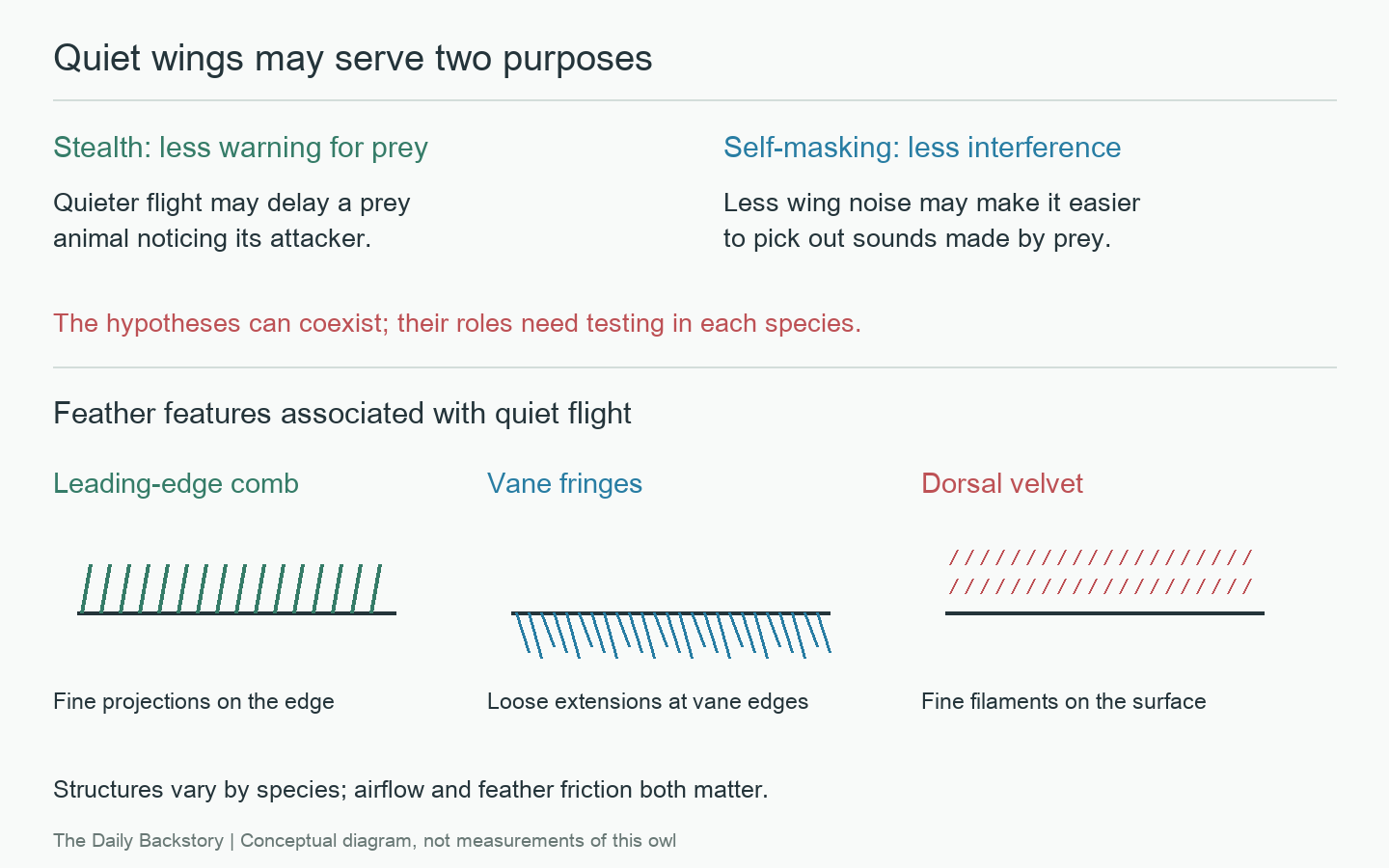
Illustration: The Daily Backstory, based on research into quiet owl flight. This is a conceptual diagram, not an acoustic measurement of the photographed owl.
Feathers Are More Than a Filter
Three features recur in descriptions of quiet owl wings: comb-like projections along the leading edge of certain flight feathers, loose fringes at feather-vane edges, and a velvety surface. Hermann Wagner and colleagues' 2017 review examined these features, along with the role of large wings that allow slow flight.
There is no simple rule that all three push every flight sound below 1 kilohertz. Their form and effects vary among species. Nor is noise from airflow the same as noise from feathers rubbing. The 2020 review specifically explored the possibility that velvet and fringes reduce frictional sound, challenging explanations that attribute their effects entirely to airflow.
The photograph records a low-flying owl, not its sound. Its posture, habitat and prey offer clues to the meaning of quiet flight. They are not an acoustic experiment.
An Owl Also Needs Somewhere to Stay
Feather adaptations cannot compensate for disappearing habitat. In its 2021 assessment, the Committee on the Status of Endangered Wildlife in Canada, or COSEWIC, assessed the Canadian short-eared owl population as Threatened, an increase from its earlier Special Concern designation. That is a dated committee assessment, distinct from a global conservation category or a legal listing.
The report identified conversion of grassland to crops, intensive agriculture, urbanization and invasive plants among threats to nesting and wintering habitat. A patch of land that looks unused may be a place where an owl feeds and rests.
China's grassland management offers another perspective on predators. A 2024 report from the National Forestry and Grassland Administration described artificial raptor nests and perches in Ningxia as a way of supporting rodents' natural enemies.
That is not evidence that every owl benefits from a tall hunting perch, or that short-eared owls alone control rodent outbreaks. It illustrates a broader idea: predators and rodents already belong to the same food web. Restoring opportunities for predators to use a landscape can be part of managing it.
This owl needs more than feathers that quiet its flight. It needs prey beneath the grass, cover on the ground and open space in which to search at dusk. Only there can its quiet wings do their work.
Sources and Context
The photograph, location and field observations come from National Geographic's Original page; the award was checked against the competition's official results. Flight mechanisms draw on the 2017 wing-structure review and 2020 evolutionary and ecological review. Conservation context uses the explicitly dated 2021 COSEWIC report; the Chinese example comes from the National Forestry and Grassland Administration.