
A descent lasting less than an hour was rehearsed six times on Earth.
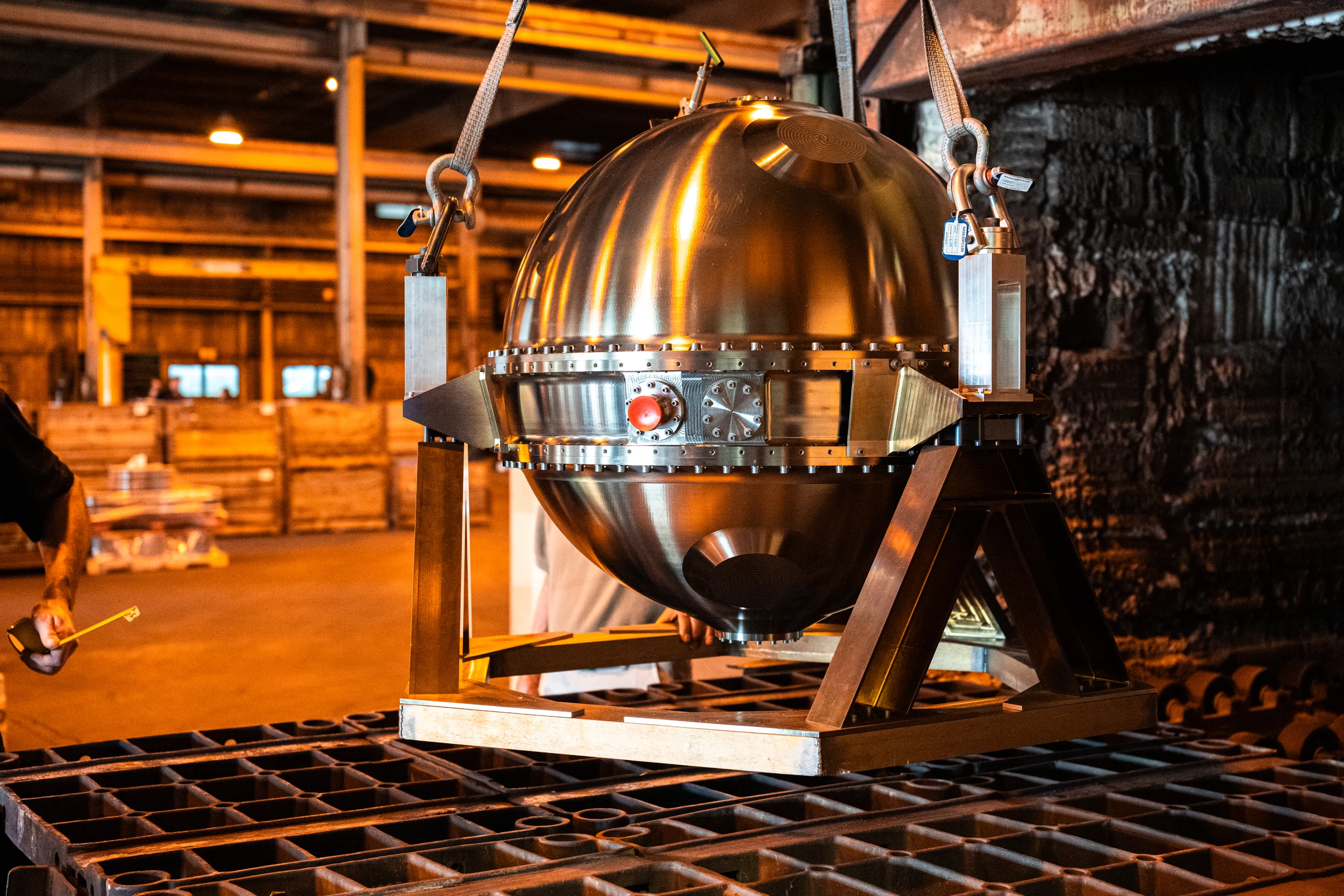
Image: NASA Image of the Day | Credit: NASA/Mike Guinto | Original page
NASA's image page, updated October 2, describes a DAVINCI engineering model that passed a major thermal test. The photograph is dated August 28. It is not a record of a probe already arriving on Venus.
Testing ran from August 28 to September 10 at Rex Heat Treat in Bedford, Pennsylvania. Each cycle took about an hour to heat the model to 869 degrees Fahrenheit, or 465 degrees Celsius. Six cycles were completed, with simulated instrument hardware inside and more than 100 thermal sensors monitoring conditions.
Heat and Pressure Are Different Problems
NASA gives Venus's surface temperature as about 467 degrees Celsius and its pressure as roughly 93 times Earth's at sea level. It compares the pressure to a depth of about 930 meters in Earth's ocean. That is an illustrative approximation, not an exact seawater-depth conversion.
The atmosphere is predominantly carbon dioxide, with sulfuric acid in its clouds. DAVINCI's sphere uses strong, lightweight, corrosion-resistant titanium. Protecting the instruments also requires a complete thermal design, not merely a harder shell.
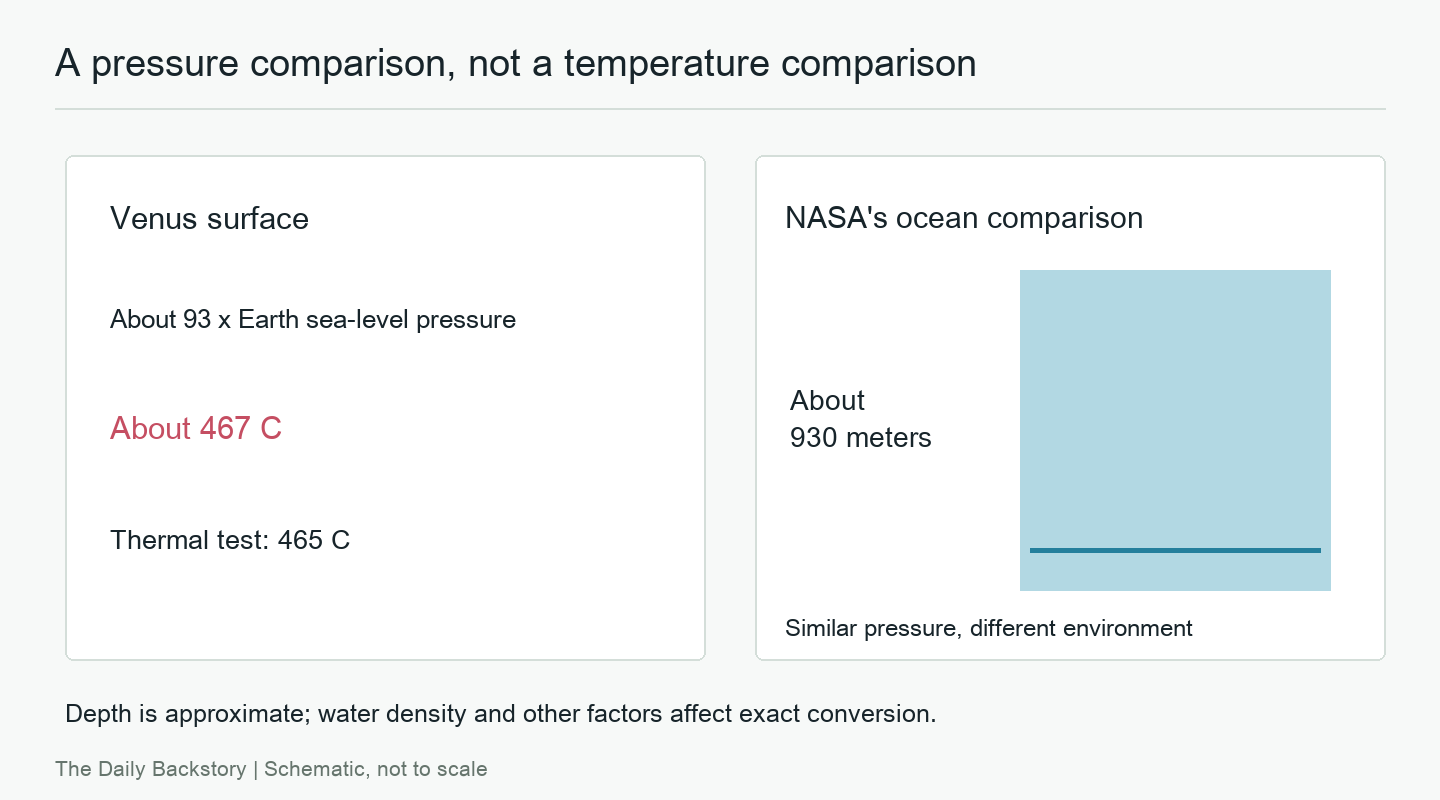
Diagram: The Daily Backstory; NASA's approximate pressure comparison, not to scale.
During an expected 55- to 60-minute descent, the probe will measure atmospheric composition, isotope ratios, temperature, pressure and winds, and photograph the Alpha Regio highlands beneath the clouds. The carrier spacecraft will receive and relay the data.
The ratio of hydrogen to deuterium is one clue to water's history, because lighter hydrogen escapes more readily. It cannot independently reveal an ancient ocean's volume. Interpretation requires models of atmospheric escape and planetary evolution.
A Different Pressure Shell in the Deep Sea
China's crewed submersible Fendouzhe reached 10,909 meters in the Mariana Trench on November 10, 2020. Both deep-sea and Venus hardware must withstand high external pressure, with the pressure at that ocean depth much greater still.
Their environments are not interchangeable. Deep water is generally cold; Venus's surface is extremely hot. A pressure vessel and thermal protection solve different problems. These six cycles tested protection during the planned heating schedule, not every pressure and environmental qualification.
NASA's Venus account notes Soviet landers that operated for about two hours after landing. DAVINCI's focus is descent science, not setting a surface-endurance record.
Sources
NASA: Original page, DAVINCI thermal testing, Venus facts and mission overview; China's state assets commission: Fendouzhe's 10,909-meter dive.