
A rainbow does not always end neatly at its violet edge. Sometimes several fainter arcs are tucked just inside it.
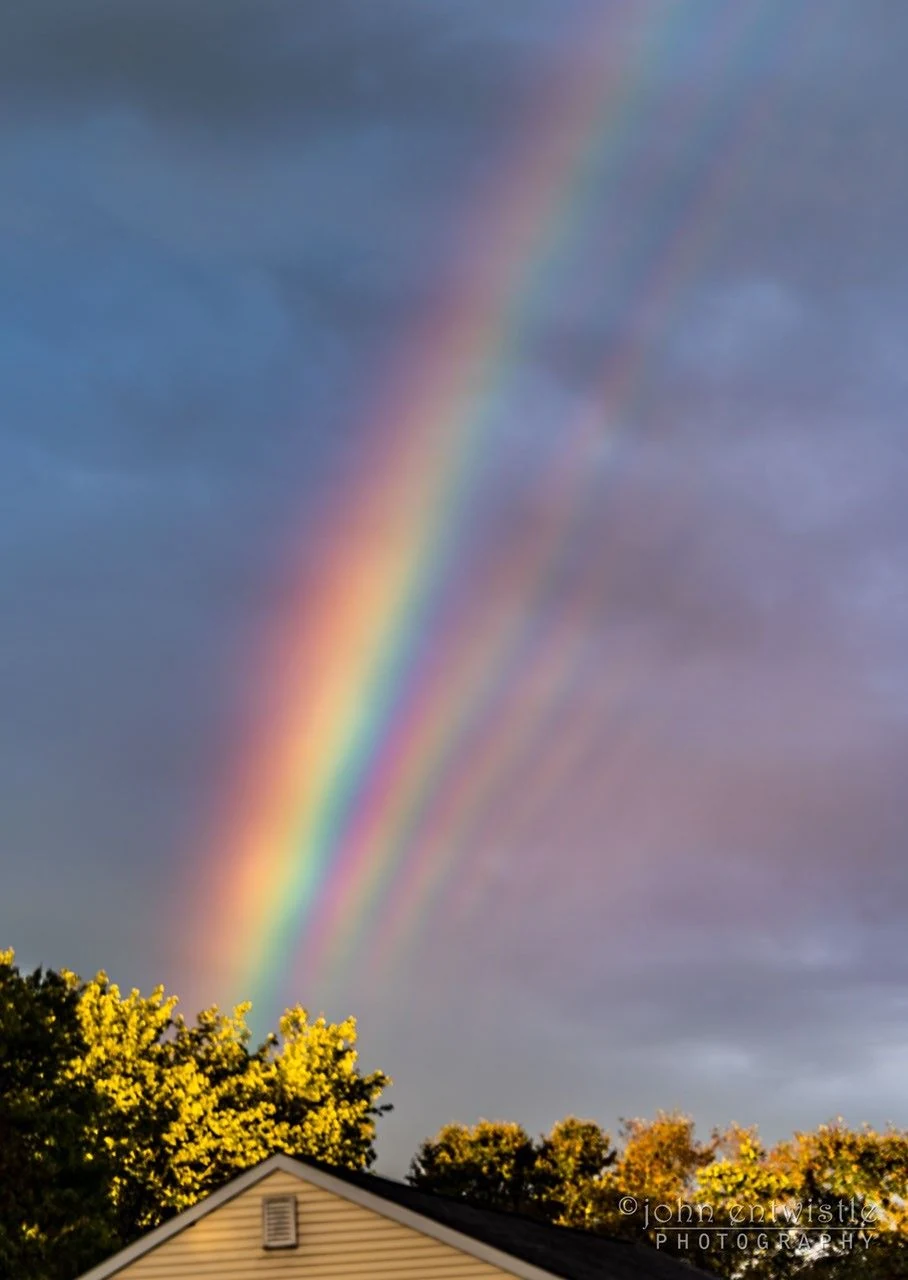
Image: NASA Astronomy Picture of the Day | Credit & Copyright: John Entwistle | Original page
This photograph records weather from 2018, not today. NASA describes the remnants of Hurricane Florence passing over the Jersey Shore, followed by sunshine on one side of the sky and an unusual collection of rainbows on the other.
Entwistle and his daughter watched them fade in and out for about half an hour. The single frame selected for today's APOD captured at least five bows.
The faint arcs inside the main rainbow are called supernumerary bows. They are not camera ghosts. Nor are they simply the result of light bouncing several times inside a drop; additional internal reflections are associated with the secondary rainbow outside the primary. The key to these inner arcs is interference.
One Direction, Two Paths
The familiar explanation of a primary rainbow starts with a water drop. Sunlight refracts as it enters, reflects once inside, and refracts again as it leaves. Different wavelengths bend by different amounts, producing the colors we recognize.
That account of geometric optics explains much about the main bow. It is not enough to explain the alternating faint bands inside it.
Near the rainbow angle, two different paths through a drop can send light in the same outgoing direction. Light traveling along them has different optical path lengths.
Because light behaves as a wave, we cannot simply add the two intensities. When their phases align, the combined amplitude grows. When they oppose each other, it diminishes. The path difference changes with angle, so a small shift in viewing direction takes us through enhancement, suppression and enhancement again.
Supernumerary bows are the bands left by that alternation. White light contains many wavelengths, whose interference conditions differ. That is why the faint arcs have colors as well as variations in brightness.
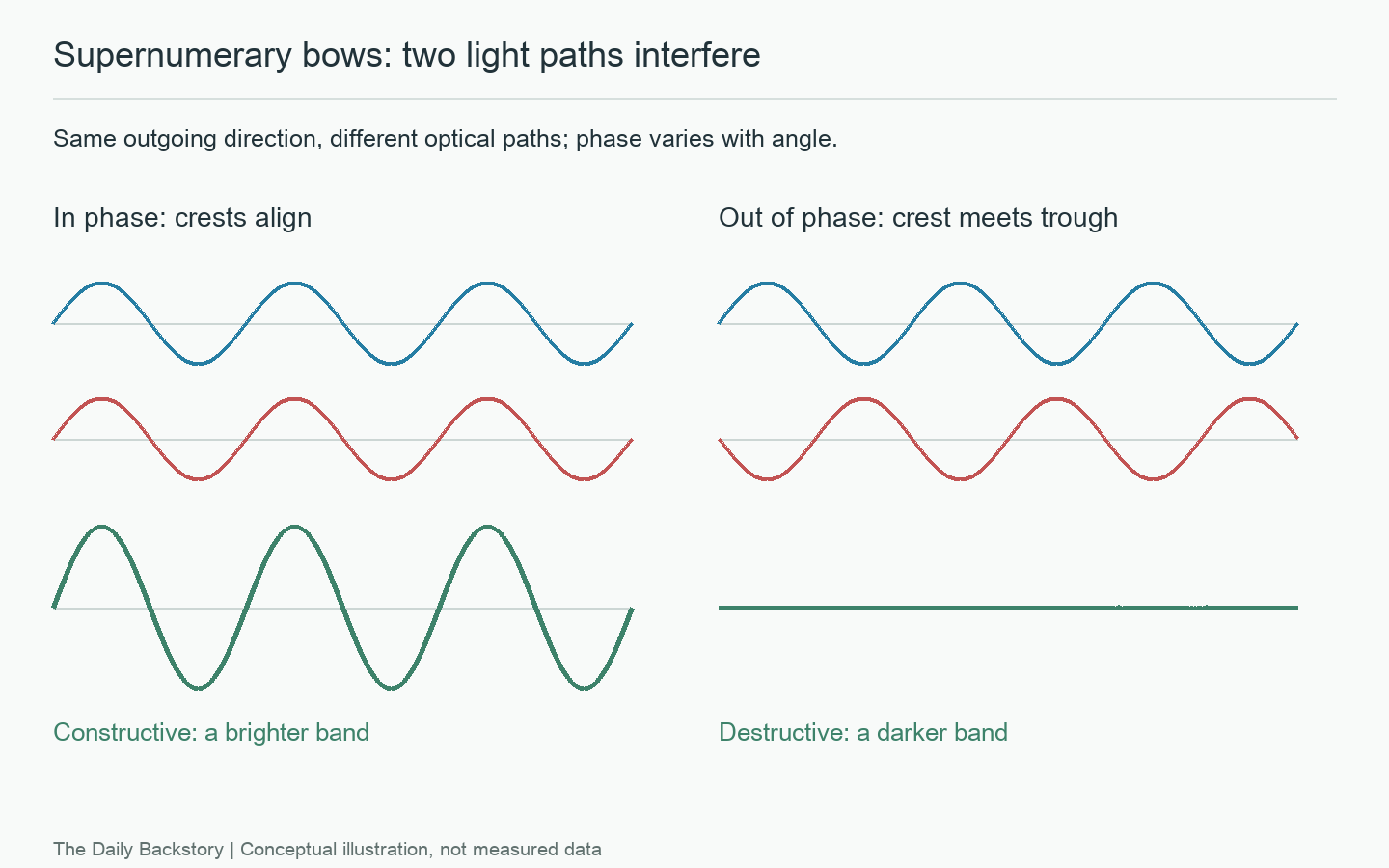
Diagram: The Daily Backstory; equal-amplitude waves illustrate constructive and destructive interference. This is not a calculation of a real rainbow's brightness or colors.
Why Drop Size Matters
NASA describes well-defined supernumerary bows forming in nearly uniform droplets, typically less than a millimeter across.
Drops of different sizes put their fringes at different angles. A broad mix of sizes overlays many fringe patterns, which can blur the fine detail. More rain does not necessarily mean more extra bows.
Drop size also affects the spacing and visibility of the bands. A hurricane itself does not guarantee supernumerary rainbows. This photograph records a particular, favorable combination of sunlight and droplets.
A Faint Arc Can Test a Theory
The bows' place in scientific history is larger than their brightness might suggest. NASA identifies the early nineteenth-century recognition of supernumerary rainbows as part of the early evidence for light's wave nature.
Treating light only as geometric rays lets us trace reflection and refraction, but leaves these interference fringes unexplained. Accounting for optical path differences and phase provides a fuller picture.
A rainbow photograph does not settle every question in modern optics. It does show how an easily overlooked detail can put a theory to the test.
Shen Kuo Changed His Position
Long before that, the Northern Song scholar Shen Kuo treated a rainbow as something to observe and question.
In the Dream Pool Essays, he recalls a rainbow after rain while traveling as an envoy to the Khitan. Near Yong'an Mountain, it appeared to reach into a stream. He sent someone to the opposite bank and recorded a revealing difference: looking east from the west side, the rainbow was visible; looking west from the east side, it was not.
He explicitly noted that this was an evening rainbow. The Sun was in the west. With his back to it, an observer could see light returning from droplets to the east. The rainbow was not a fixed object sitting in the stream. Its appearance depended on the positions of the observer, the Sun and the drops.
Shen also passed along Sun Yanxian's explanation that a rainbow comes from sunlight in rain. His account did not explain the interference behind supernumerary bows. It did carefully distinguish the conditions under which something could be seen from those under which it could not.
Changing position and accounting for wave phase belong to the same habit of inquiry: recording what is visible, then asking why it is visible from here.
Sources
NASA: Original page; Atmospheric Optics: supernumerary bow formation; Atmospheric Optics: the effect of drop size; Shen Kuo's rainbow account in the Dream Pool Essays (Chinese).