
For World Teachers' Day, Bing chose a photograph of penguins leaving the ice. The lesson lies in what happens beyond the shore.
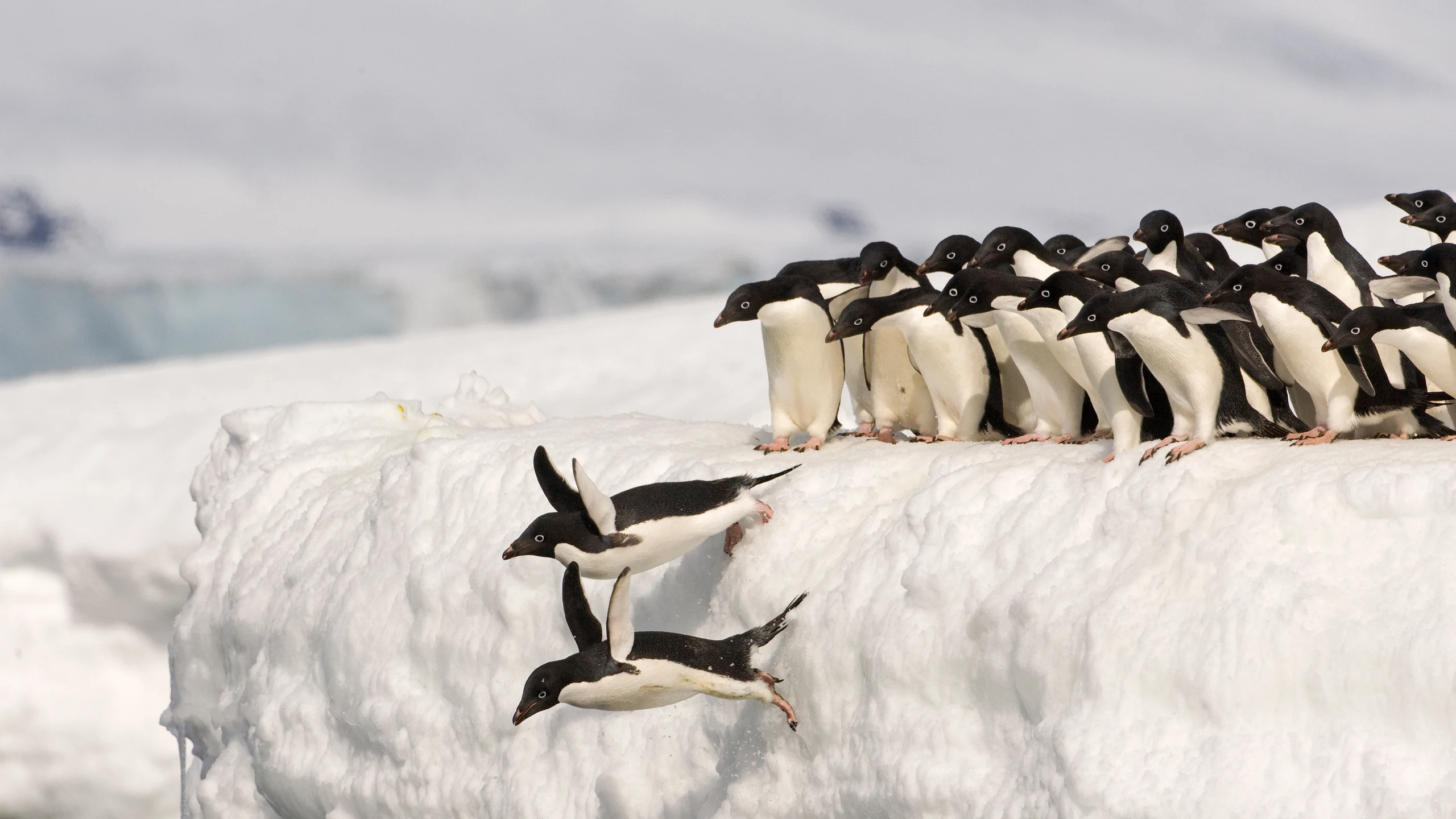
Image: Bing Daily Wallpaper | Copyright: Otto Plantema/Minden Pictures | Original page. Microsoft provides these photographs for wallpaper use.
This year also marks sixty years since the 1966 ILO/UNESCO Recommendation concerning the Status of Teachers. The recommendation sets international benchmarks for teachers' rights, responsibilities, preparation and working conditions. World Teachers' Day has been celebrated on October 5 since 1994.
Penguins have no equivalent of a classroom. That does not make everything they do an unlearned skill. Their journeys are a good reason to distinguish what we can observe from what we merely assume.
Leaving the Pebble Nest
Adelie penguins stand about seventy centimeters tall and weigh three to six kilograms. A white ring around each eye breaks up their black-and-white coloring.
They breed on exposed coastal rock around Antarctica. Pebbles make the nest, and a well-drained site matters when snow melts. Neighbors' stones are sometimes stolen to improve the construction.
By mid-November, a nest usually holds two eggs. Parents alternate incubation and feeding duties. Once chicks are about three weeks old, they can gather together for warmth and protection while both adults forage.
At seven to nine weeks, the young birds are ready for the sea. Most will not return to their breeding colony until they are three to five years old and capable of breeding, according to the Australian Antarctic Division.
The interval between departure and return is a substantial part of a young bird's life. It does not, by itself, prove that penguins never learn from one another.
Two Boundaries in the Winter Sea
Work led by Grant Ballard followed penguins from two Ross Island colonies during 2003-2005. Published in Ecology in 2010, the study examined where birds from these very southern colonies spent winter.
They rarely moved beyond the northern edge of the main pack ice. Their winter locations had sea-ice concentrations of 75-85%, roughly 500 kilometers inside the edge. They also had two to seven hours of twilight, defined here by the Sun being less than six degrees below the horizon.
That is twilight, not a claim of hours of full daylight. The study builds on the idea that Adelies need both pack ice and some ambient light: ice provides a resting platform, while light matters for visual hunting.
The average migration covered 12,760 kilometers, with the longest reaching 17,600. These are total journey distances, not one-way figures to double. They also describe the studied populations, rather than every Adelie colony around Antarctica.
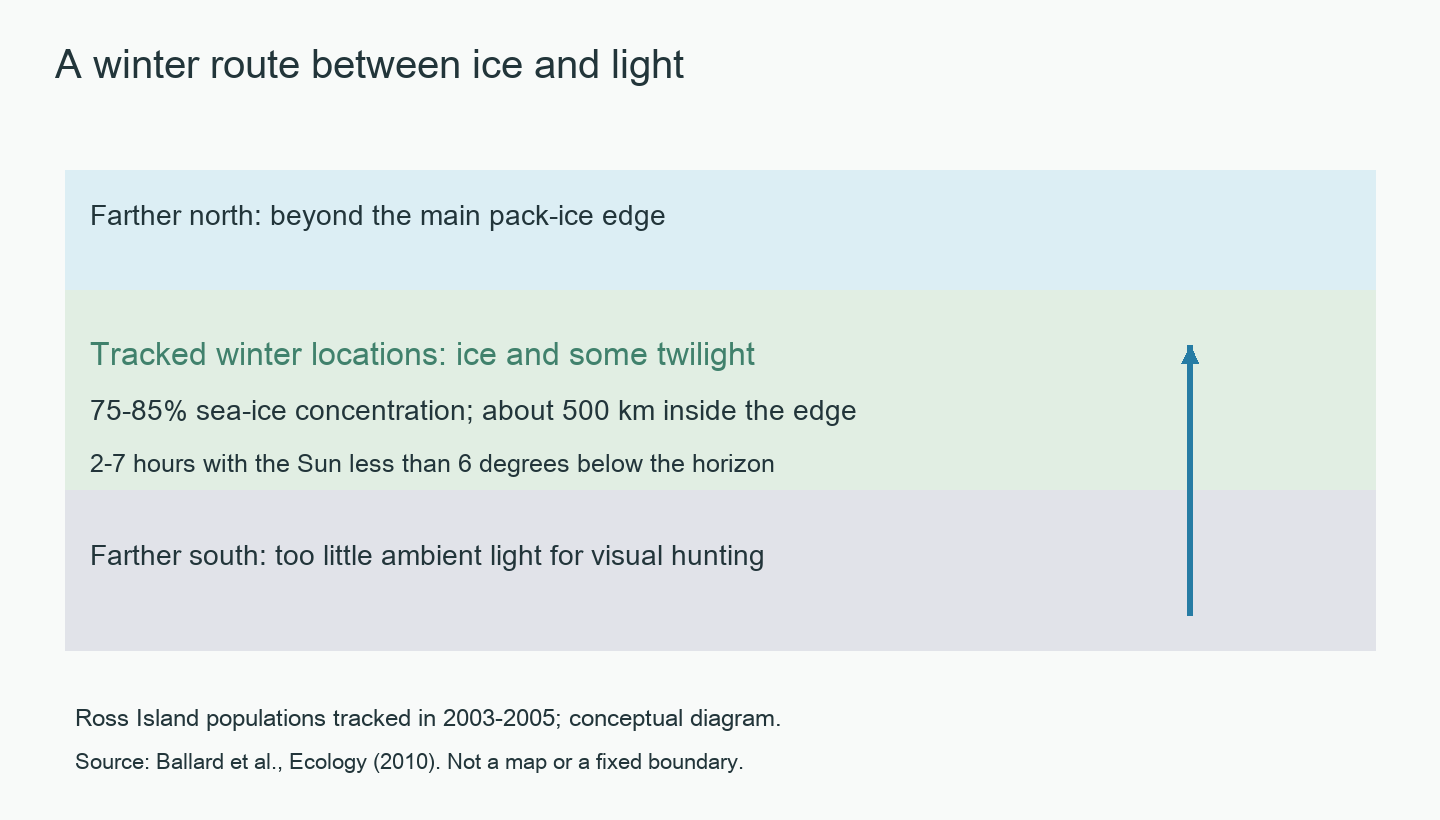
Diagram: The Daily Backstory, based on Ballard and colleagues' 2010 study. The bands illustrate constraints, not fixed geographical boundaries.
The sea ice itself moves. A later study by Dennis Jongsomjit and colleagues, published in Ecology in 2024, compared penguin movements with satellite-derived ice drift. Birds traveled farther when their movement aligned with the ice; the assistance varied with route.
That supports an influence of drifting ice on migration. It is an inference from tracking data, not a film of penguins riding an ice conveyor belt.
Another Journey, Starting in Beijing
Light also helps researchers follow a very different migrant: the Beijing swift.
Between 2014 and 2018, researchers fitted breeding swifts at the Summer Palace with light-level geolocators weighing 0.67 grams. Changes in daylight allowed them to reconstruct annual routes from twenty-five individuals.
The birds left Beijing around mid-July, traveled northwest through Mongolia and northern Xinjiang, then crossed central Asia and the Red Sea. After spending time around central Africa, they reached their wintering areas in southwestern Africa around early November.
Autumn migration averaged 14,733 kilometers over 111 days; spring migration averaged 13,572 kilometers over sixty-four days. These durations include slower movement and stopover periods, not uninterrupted travel at a single speed.
The penguin study shows how ice and light constrain winter locations. The swift study reveals a route through continents. Neither alone explains exactly how a young bird acquires its navigational abilities.
On a day devoted to teachers, that distinction is a useful one. Tracking tells us where a bird went. Understanding how it found its way requires another question.
Sources
Bing: Original page; UNESCO: World Teachers' Day; Australian Antarctic Division: Adelie penguins; WWF: Adelie penguin facts; Ballard et al.: winter migration, Ecology (2010); Jongsomjit et al.: sea-ice movement, Ecology (2024); Zhao et al.: the Beijing swift's migration, Movement Ecology (2022).