
October 4, Lincoln Financial Field in Philadelphia. An astronaut who traveled around the far side of the Moon six months earlier is leading football fans in song.
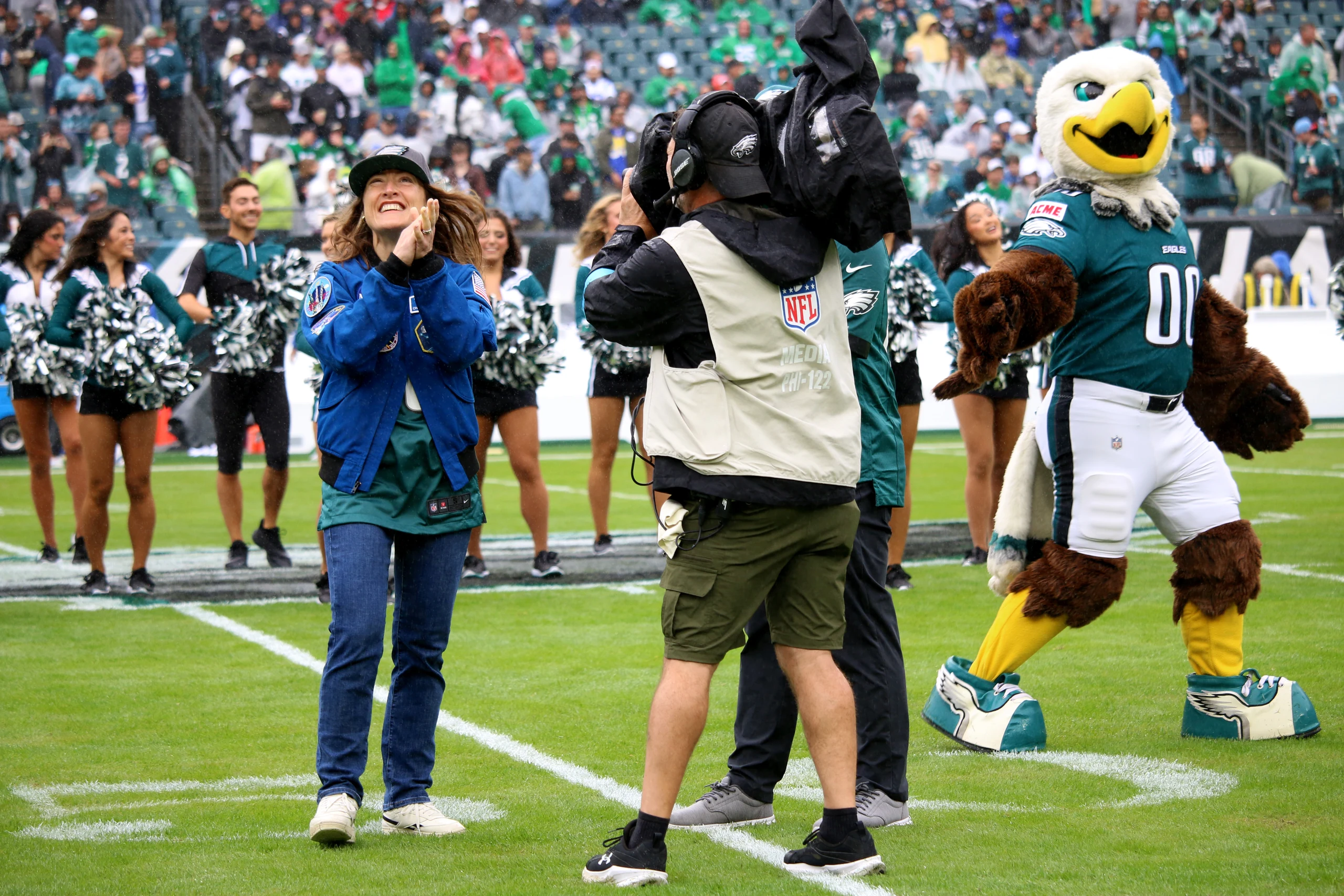
Image: NASA/Thalia Patrinos | Original page.
NASA says Koch led the Eagles Fight Song during the Philadelphia Eagles' game against the Los Angeles Rams. The appearance was part of the agency's Inspiration Tour, connecting spaceflight with a wider public.
An ordinary moment depends on an extraordinary journey home.
Farther Away, Then Back Again
Artemis II launched from Kennedy Space Center on April 1, 2026. Its crew comprised Reid Wiseman, Victor Glover, Christina Koch and the Canadian Space Agency's Jeremy Hansen.
They flew past the Moon without landing or entering lunar orbit. At their farthest point, they were 252,756 miles from Earth, about 406,771 kilometers, exceeding the human-distance record held by Apollo 13.
Orion splashed down off San Diego on April 10 after nearly ten days in flight. NASA's revised total journey distance is 695,081 miles, about 1.12 million kilometers.
A free-return trajectory uses Earth and Moon gravity to shape a route back toward Earth. But "free return" does not mean "no more engine burns." Actual flights still schedule trajectory corrections. NASA's April 10 flight-day report included the final correction maneuver before entry.
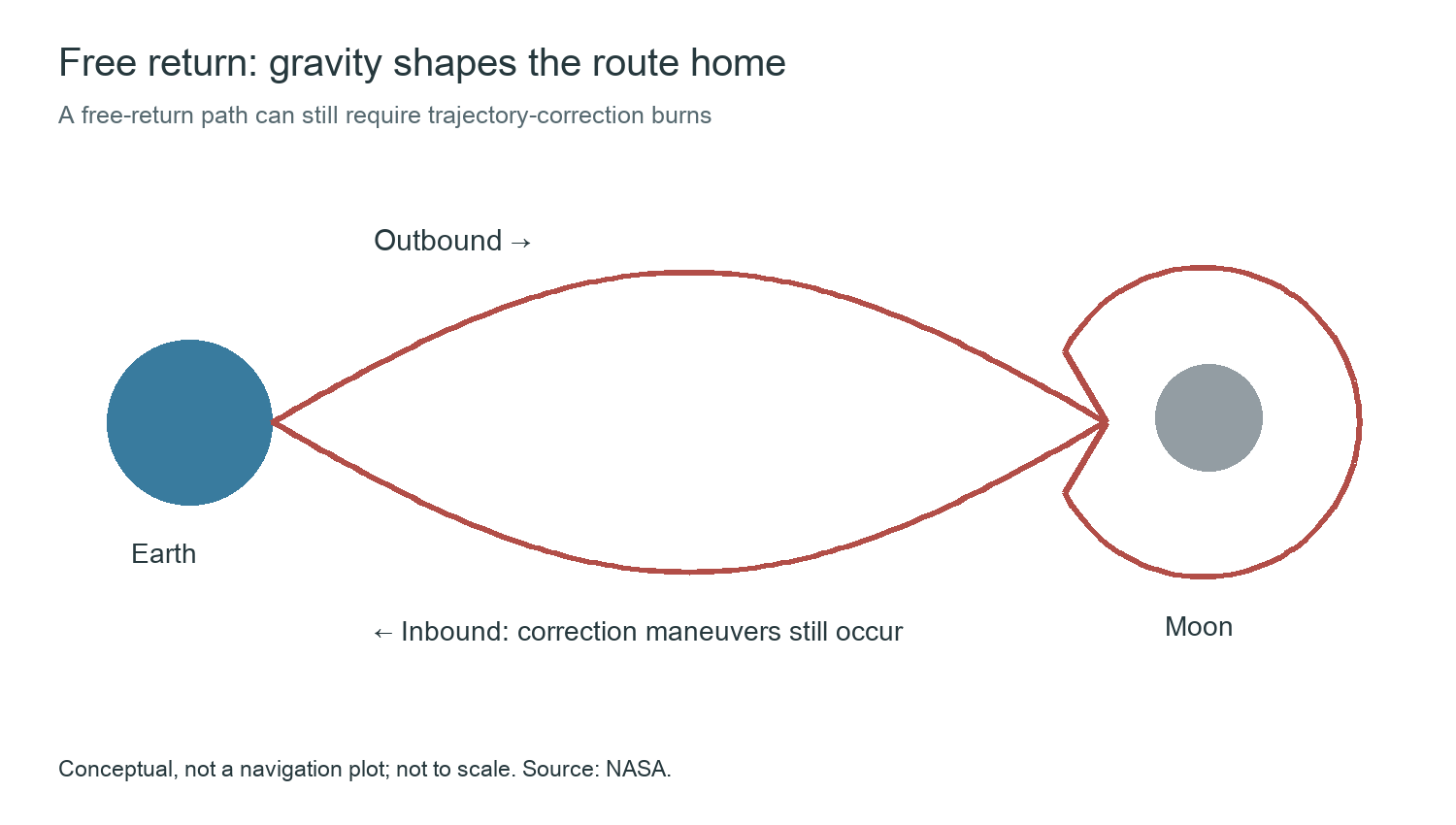
Diagram: The Daily Backstory, based on NASA mission information. Conceptual illustration, not a navigation plot and not to scale.
The Hard Part Is Inside the Atmosphere
Returning from the Moon, Orion meets the atmosphere at about 25,000 miles per hour. It must slow down while protecting the crew from extreme heating.
The heat shield's size alone does not explain how that protection works.
After the uncrewed Artemis I returned in 2022, NASA found unexpected loss of charred material from its Avcoat heat shield. Investigators established that gases generated within the ablative material could not vent sufficiently. Pressure built, cracking the char layer and freeing pieces of it.
Artemis I had used a skip-entry trajectory. During the interval between atmospheric dips, lower heating slowed the formation of permeable char while gases continued to form. More permeable areas of the shield did not show the same cracking and loss, an important clue in the investigation.
For Artemis II, NASA retained the already-built shield and changed the entry trajectory to reduce the conditions that caused cracking. A NASA technical report states that the crewed flight used a modified trajectory without the skip entry. Later shields incorporate improvements to Avcoat's uniformity and permeability.
The crew therefore did not return behind the newly improved material. This flight changed the operating conditions; subsequent flights receive the material changes.
Initial inspections found that Artemis II's thermal protection performed as expected, with significantly less char loss in both quantity and size. Significantly less is a different claim from none.
Other Long Journeys
Koch was an engineer before becoming a NASA astronaut in 2013. Her earlier International Space Station flight lasted 328 consecutive days, a record for a woman on a single spaceflight. She also participated in the first all-female spacewalk. Across her two missions, she has spent 338 days in space.
Before either flight, she wintered at the Amundsen-Scott South Pole Station and worked at Palmer Station in Antarctica, Summit Station in Greenland and Utqiagvik in Alaska. Instruments, remote stations and long stays were familiar before she left Earth.
Spaceflight Meets Another Classroom
On September 9, China's space station hosted a Tiangong Classroom session for students in Hong Kong and Macao. The Hong Kong government's speech for the event described payload specialist Lai Ka-ying's planned introduction to the deployment of the Tianyun camera, developed by the Hong Kong University of Science and Technology to monitor greenhouse gases globally.
A classroom linked to an orbiting laboratory and a song at a Philadelphia stadium are different kinds of public encounter with spaceflight. One brings the work to students; the other brings someone who has done that work into a crowd of fans.
On the football field, Koch was no longer performing a feat of space exploration. She had come home. That was what allowed her to stand among ordinary people and do an ordinary thing.
Sources
NASA: Artemis II crew returns to Earth; NASA: flight day ten and the final correction burn; NASA: Artemis I heat-shield investigation; NASA: initial Artemis II assessments; NASA technical report: the heat-shield investigation and modified entry trajectory; NASA: Christina Koch biography; Hong Kong government: Tiangong Classroom speech.