
Snow traces the ridgeline, while a golden forest still lights up the slopes below. Bing's October 16 photograph looks toward Mount Sneffels in the San Juan Mountains near Ridgway, Colorado. Pale trunks and bright foliage stand among darker conifers.
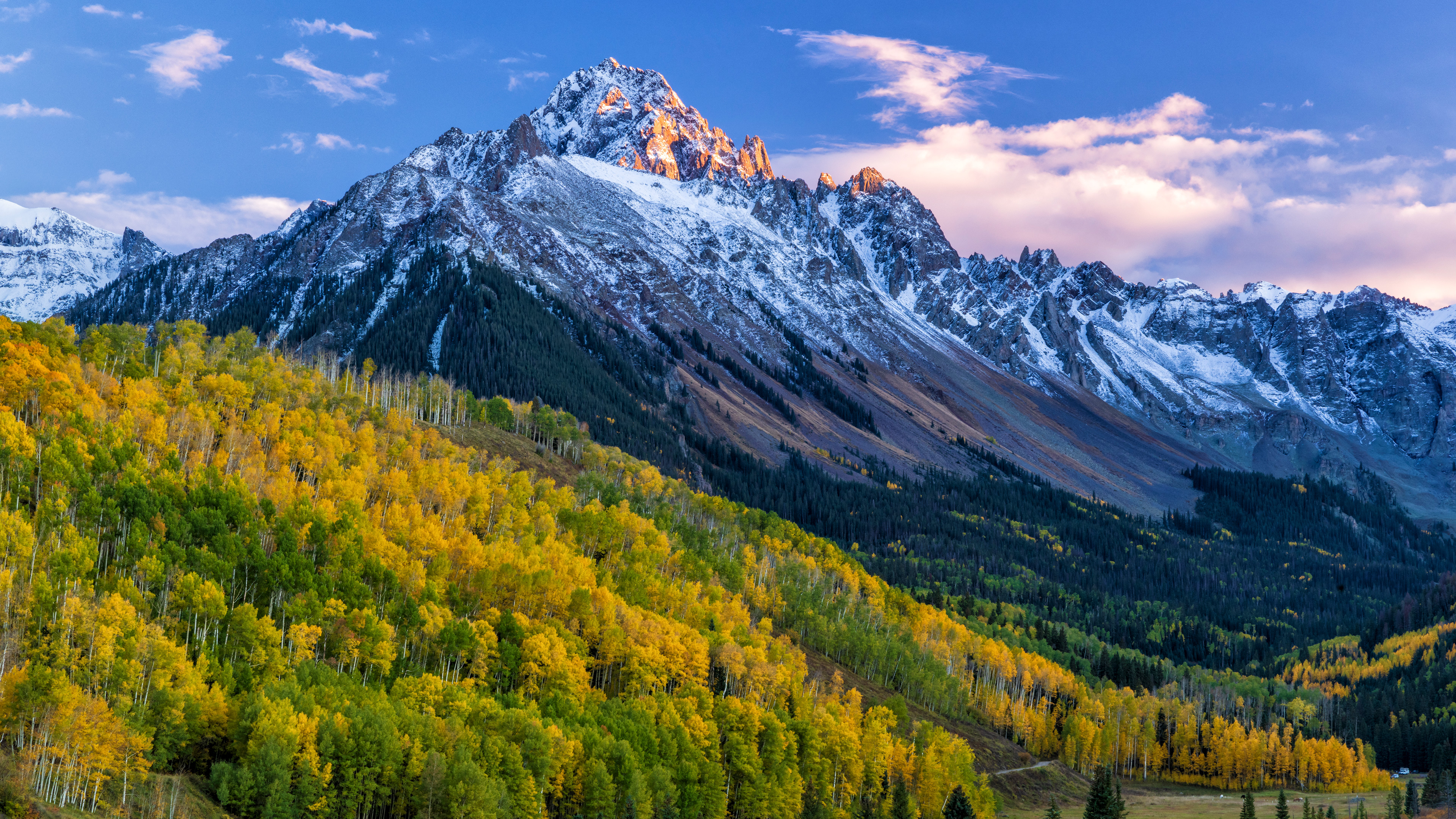
Image: Bing Wallpaper. Mount Sneffels, San Juan Mountains near Ridgway, Colorado, USA (© lightphoto/Getty Images). Original page.
Golden aspens are a familiar part of autumn in the Rockies. Before counting every trunk as an independent tree, consider what may connect them underground. The U.S. Forest Service's guide to aspen explains that these trees reproduce from seeds, but also commonly send up new shoots along spreading lateral roots. Many genetically identical stems sharing a root system form a clone.
A grove can contain one clone or several. The photograph alone cannot establish that the entire woodland is one individual. Neighboring clones may differ in leaf shape, the timing of spring growth, autumn color and when their leaves change. Patches of gold and green can sometimes hint at boundaries that are hidden beneath the soil.
Aspen leaves offer another detail worth looking for at close range. Their little stalks, or petioles, are flattened along their length, perpendicular to the leaf blades. Even a light breeze can set the leaves trembling. That movement gives quaking aspen its name.
The Forest Service also describes aspen as a sun-loving pioneer. It can regenerate rapidly in open areas after disturbances such as fire. Without disturbance, more shade-tolerant conifers may gradually replace it. The contrasting colors on the mountainside belong to a forest that keeps changing.
On your next walk through aspens, look at a fallen leaf's stalk and compare how neighboring crowns change color. There is no need to dig up roots. A breeze, a few fallen leaves and a patch of contrasting foliage offer a good place to start reading the forest's hidden connections.