
Two rugged masses meet at a narrow neck. Red and blue edges run around cliffs and ridges, preparing a slightly different view for each eye. With suitable red-blue glasses, comet 67P can acquire depth on an ordinary screen.
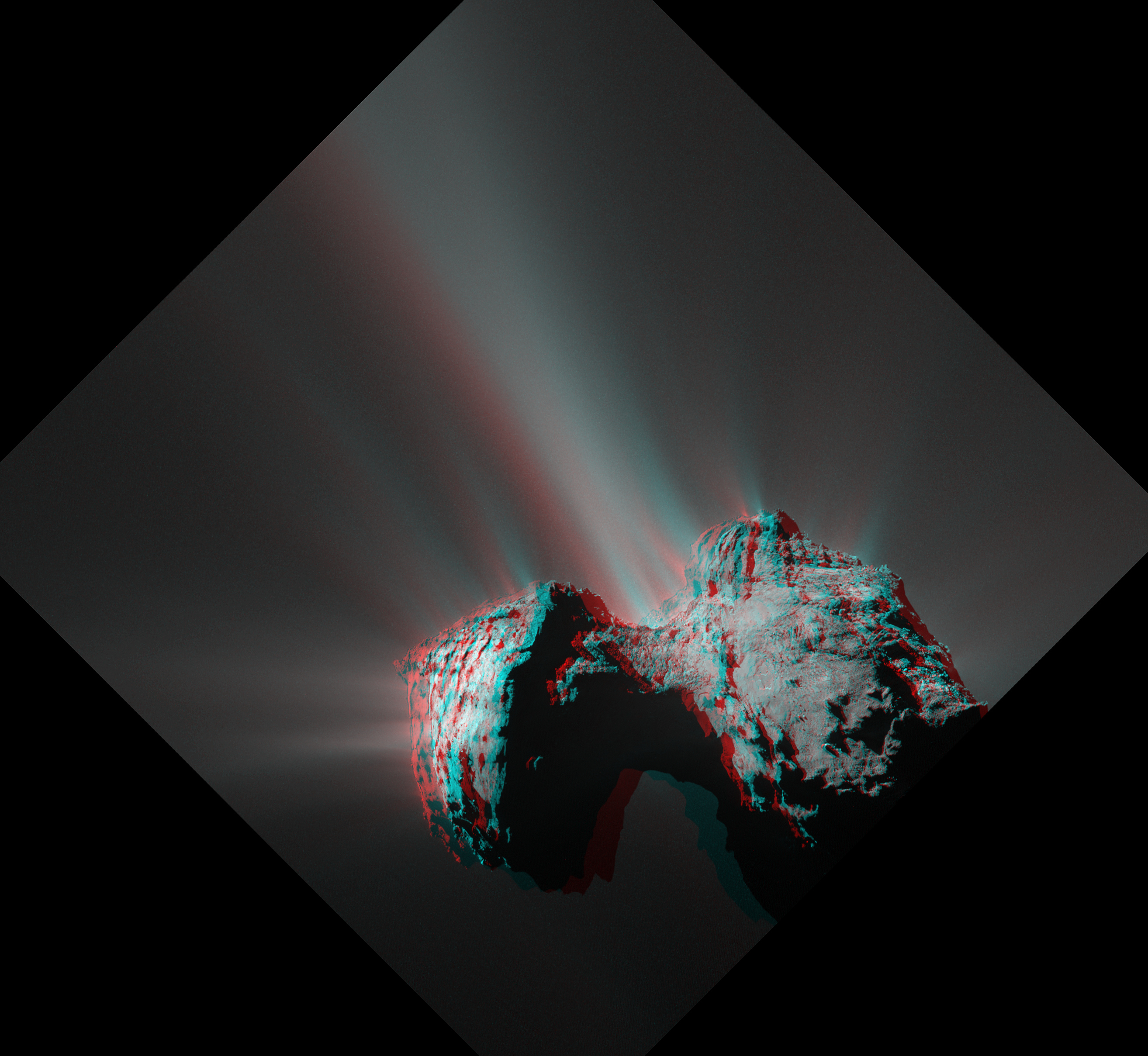
Image: ESA, Rosetta, MPS, OSIRIS. Stereo anaglyph: Philippe Lamy and The Team. Original page.
NASA's October 17 APOD offers a different way to look at older observations. Rosetta's OSIRIS narrow-angle camera took the two source images on July 25, 2015, from about 184 kilometers away. The larger lobe is roughly 4 kilometers across and the smaller one about 2.5 kilometers, joined by a slender neck.
Two viewpoints from one camera
Your eyes look at an object from slightly different positions. Your brain uses that difference to judge depth. A stereo anaglyph applies the same principle: two suitable views are encoded into red and blue color channels, and filter glasses separate them for the viewer. The colors are a viewing tool, rather than the comet's natural appearance.
The team's catalog paper explains that many Rosetta image sequences, taken a few minutes apart, were suitable for stereo reconstruction. Changes in the relative positions of camera and target supplied different viewpoints; the camera did not need a second eye. The paper's updated version describes more than 1,820 anaglyphs, each documented with observing parameters that help researchers interpret the nucleus's terrain.
The faint beams above the nucleus are signs of cometary activity. Sunlight warms ice, which sublimates directly into gas and carries dust away from the surface. The images were taken as 67P approached its August 13, 2015, perihelion, its closest point to the Sun.
Loss of material is only part of the story of the comet's changing shape. Its form and rotation also produce mechanical stresses. ESA's account of research into those stresses distinguishes these processes; the narrow neck cannot simply be explained as a place the Sun has burned away.
Rosetta ended its mission in a controlled descent to the surface on September 30, 2016. Its viewpoints remain available. With red-blue glasses, explore the team's stereo catalog, comparing cliffs, hollows and the neck at different distances. Without glasses, hold up a finger and alternately close each eye. Notice how the finger shifts against a distant background: you have just tried the starting point of stereo vision.