
A circular surface fills the blue water above the camera, its interlocking blocks forming an intricate pattern. This is the underside of Orion, newly returned from a journey around the Moon with four astronauts aboard.
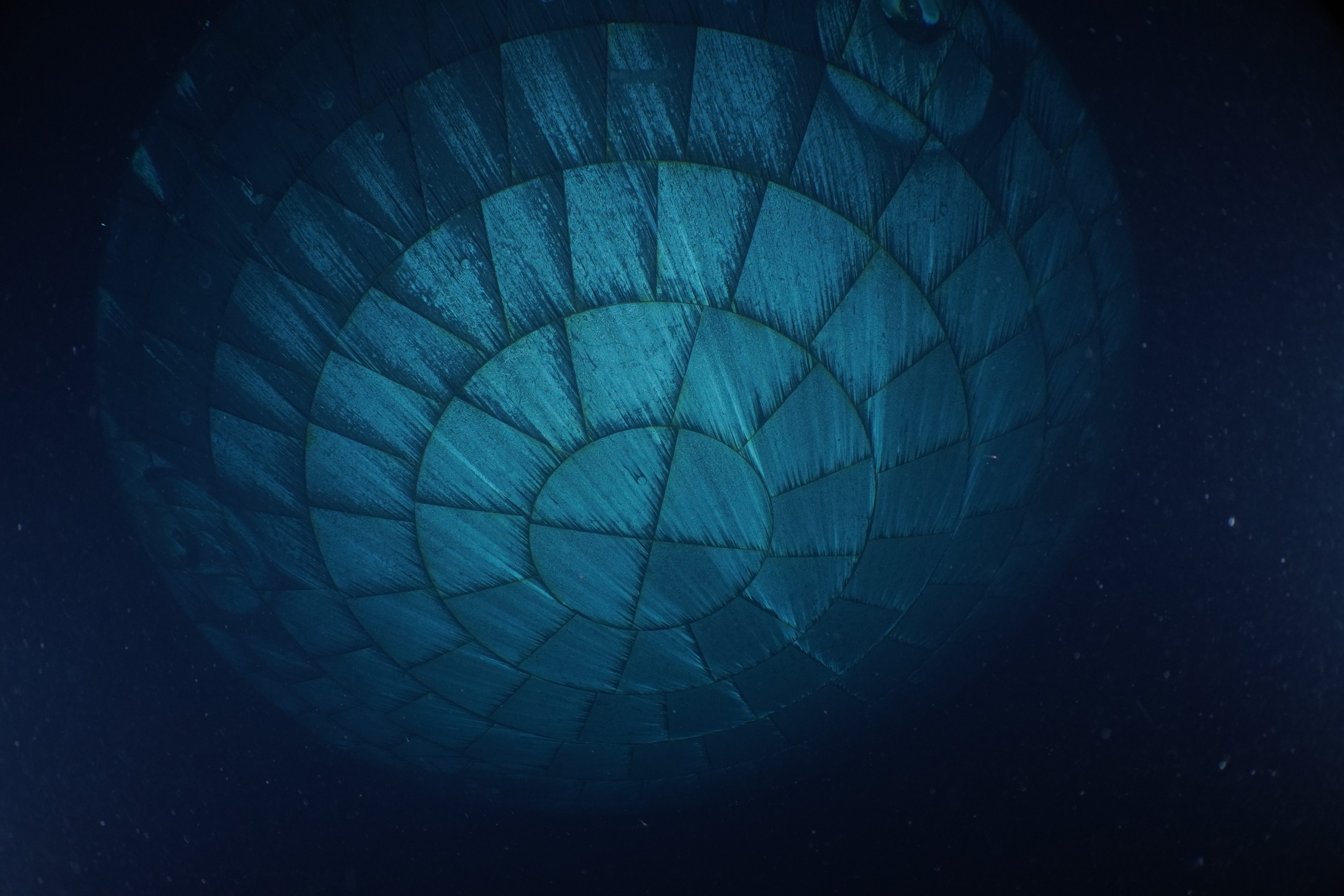
Image: US Navy. Original page.
NASA published the photograph on October 16. U.S. Navy divers took it shortly after Artemis II splashed down on April 10, 2026. The image records the recovery scene; the engineering assessment took months of further work.
A shield designed to change
Orion's heat shield contains 186 individually shaped blocks of an ablative material called Avcoat. An ablator protects the structure underneath by breaking down and being consumed as it heats, carrying energy away. It is not expected to return looking new. Engineers need to know how it wore away, whether that matched predictions, and whether temperatures inside stayed within acceptable limits.
NASA's post-flight analysis reports peak external temperatures above 4,000 degrees Fahrenheit, about 2,200 degrees Celsius, while the cabin remained in the mid-70s Fahrenheit, roughly 24 degrees Celsius. The thermal protection system kept those two environments apart.
The earlier, uncrewed Artemis I flight experienced unexpected loss of charred material. NASA's investigation found that gases generated inside the material could not escape as expected. Pressure accumulated, producing cracks and localized shedding. Normal ablation and uneven loss of chunks are different behaviors, even though both change the surface.
For Artemis II, NASA adjusted the entry trajectory, shortening the allowable downrange distance to reduce time spent in the relevant temperature range. Engineers found nine spots of char loss, compared with 103 on Artemis I. That is a count of locations, not a measurement of lost area or a claim of zero damage. NASA concluded that the system performed in line with engineering predictions.
The underwater photograph was a starting point. Later work included laser scans compared with pre-flight measurements, sample extraction and internal X-ray examinations. A shield that brings people home cannot be assessed by appearance alone. Open the analysis page and compare this underwater view with the shield after removal. Look for block seams and circular features associated with connections to the service module; there is more to read than the darkest patches.