
Orange points glow against a gray background. Fine black threads twist between them, gathering into something like a spider's web. NASA's October 25 Astronomy Picture of the Day gives the universe a distinctly shadowy appearance.
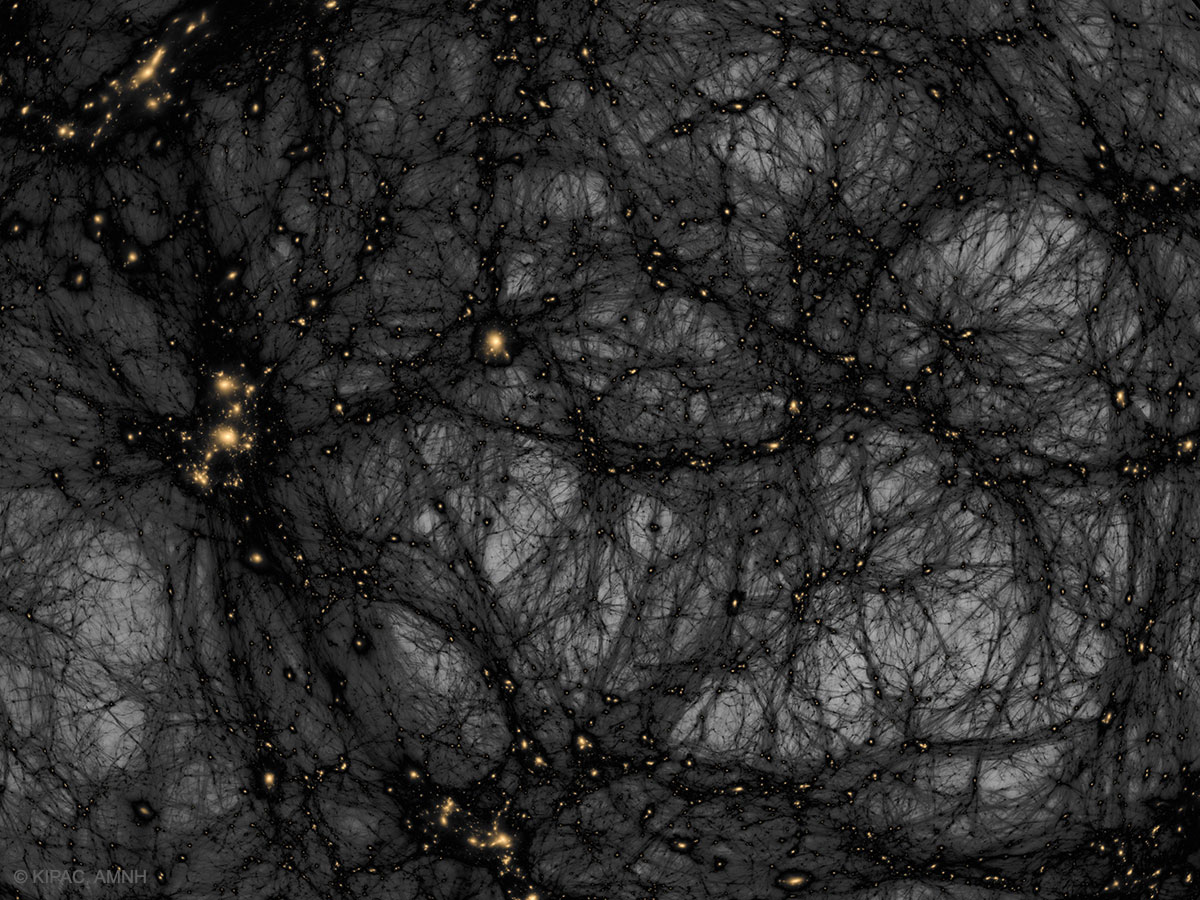
Illustration credit & copyright: Tom Abel & Ralf Kaehler (KIPAC, SLAC), AMNH. Original page.
This is a frame from a computer simulation featured in the American Museum of Natural History's Hayden Planetarium show Dark Universe. It is not a telescope photograph or a newly measured map of the cosmos. In this rendering, black represents dark matter and orange marks clumps of familiar, ordinary matter.
Black Is a Label
The name "dark matter" can suggest something like coal. Coal looks black because it absorbs visible light. Dark matter has not been identified by light that it emits, reflects, or absorbs.
Instead, astronomers study its gravitational influence. NASA's overview describes evidence from motions within galaxies, the mass of galaxy clusters, and the bending and distortion of distant galaxies' light as it passes foreground matter. Gravitational lensing works like a distorting magnifier: the shapes of background objects help reveal how mass is distributed in front of them.
These observations support the presence of a great deal of unseen matter. They have not yet established which particles make it up. The black in this illustration is therefore a visual label, not a claim that visible black ribbons drift through space.
Letting Gravity Build the Web
A simulation starts with small variations in how matter is distributed. A slightly denser region draws in more material through gravity, amplifying the difference. Against the background of an expanding universe, matter gathers into sheets, filaments, and denser clumps, with less crowded regions between them.
Researchers supply initial conditions and physical laws, advance the calculation through time, and turn its results into an image. They can compare a simulated universe with observations statistically, asking how strongly matter clusters and on what scales. That does not make every simulated thread a counterpart of a particular known filament in the real universe.
Turning the calculation into a picture is a scientific problem too. In their 2012 visualization paper, Ralf Kaehler, Oliver Hahn, and Tom Abel describe connecting simulation particles into small tetrahedral cells, each with four triangular faces. As gravity deforms the cells, their changing shapes help reveal density. Graphics processors help render the result. The particles sample the distribution of matter in a calculation; they are not individual dark-matter particles that an instrument has detected.
Two Different Kinds of Dark
Dark matter and dark energy have similar names but different roles. Dark matter's gravity helps matter gather. Dark energy is the name scientists give to the unknown cause behind the accelerating expansion of the universe. The black filaments do not represent dark energy, and cosmic expansion does not mean that every galaxy is being uniformly inflated from within.
Try reading the image in two passes. First, follow a thin filament to a junction and compare the orange points there with those in the pale-gray regions. Then ask which features came from the calculation and which colors were chosen to make those features understandable. Separating those questions is a useful first step toward reading a scientific image.