
Mike Lippert stands on a ladder with his helmet under one arm and the canopy open behind him. The white fuselage stretches beyond the right edge of the photograph, leaving its nose out of view. He is about to fly NASA's X-59 for the first time.
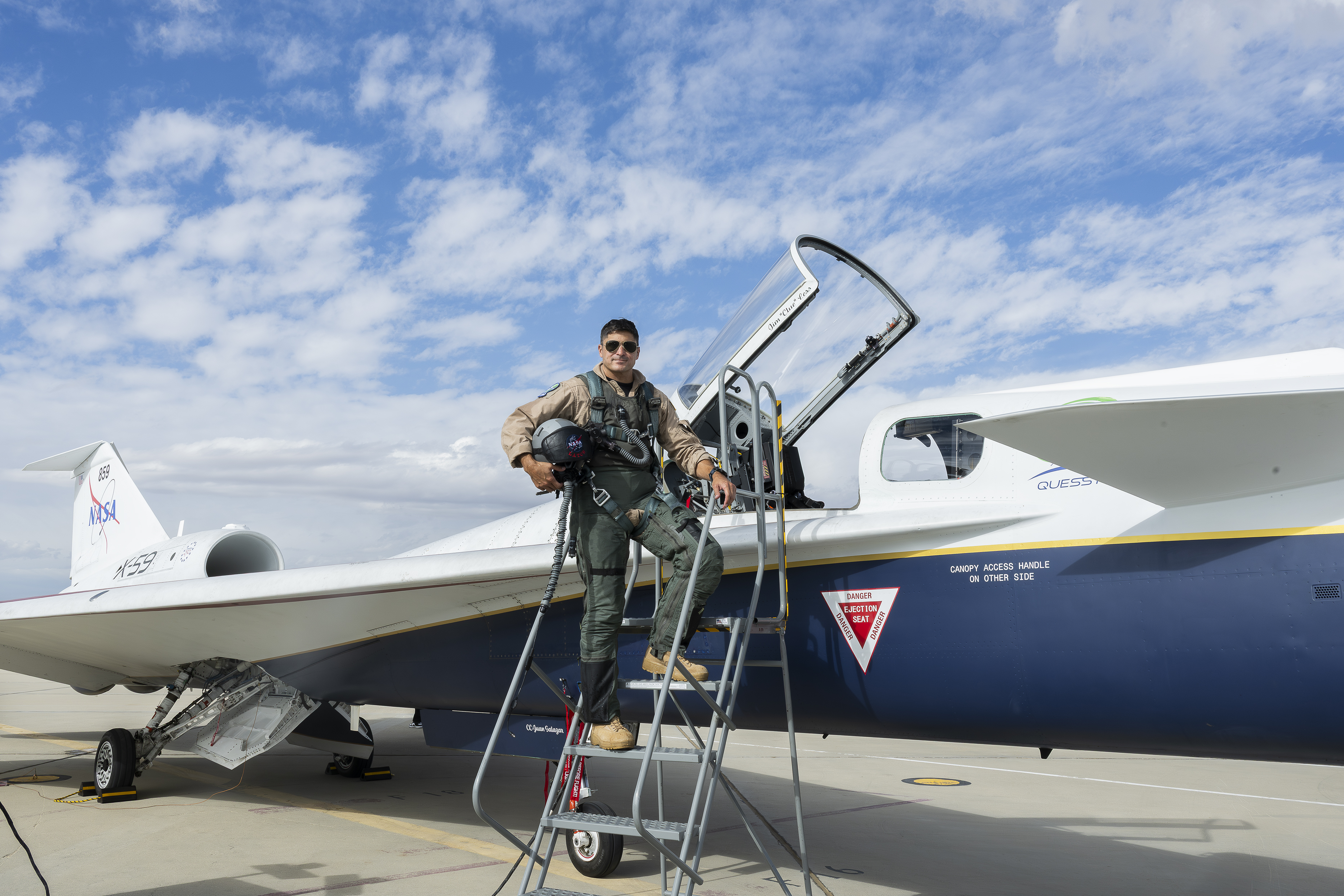
Image: NASA/Carla Escamilla. Original page.
NASA selected the photograph as its October 26 Image of the Day. The photograph and flight date to October 21. Lippert took off from NASA's Armstrong Flight Research Center in Edwards, California, and landed about an hour later. It was his first X-59 flight, rather than the aircraft's first flight.
NASA's October 22 flight report records a maximum speed of Mach 1.4 and an altitude of 55,000 feet, about 16.8 kilometers. Lippert had more than 21 years of experience flying high-performance aircraft, including 11 as a test pilot, but this was his first time piloting an X-plane. Months of preparation included simulator training, his first X-59 engine run in August, and training alongside Nils Larson and Jim "Clue" Less.
Spreading Out the Pressure Changes
An aircraft traveling faster than sound produces shock waves. As they propagate, they can merge into abrupt pressure changes heard on the ground as sonic booms. This is not a single bang made once when an aircraft crosses an invisible wall. A supersonic aircraft sends the disturbance toward different places along its route.
The X-59 is a research aircraft for NASA's Quesst mission. NASA's design guide explains that its shape is intended to spread out the shock waves, reducing the loud boom usually heard on the ground to a softer thump. Its long nose and the arrangement of its wings and body help control pressure changes in the surrounding air.
The engine sits above the fuselage. NASA describes that position as directing its noise away from people on the ground; it does not mean the engine points its thrust upward.
These are design intentions and effects to measure, rather than a claim of silent flight. A portrait beside the cockpit cannot establish the noise heard on the ground during this particular flight.
A Forward View Without a Conventional Windscreen
The long nose creates another practical problem: forward visibility. The X-59's eXternal Vision System, or XVS, brings information from cameras and other equipment to a cockpit display. NASA describes it as a combination of sensors, computers, and high-definition displays replacing a conventional forward-facing window.
Side windows remain, as the photograph shows. The distinction matters: an aircraft without a conventional forward windscreen still has windows. It is a useful habit when looking at engineering photographs to separate the structures in view from the systems outside the frame.
NASA also plans to combine ground sound measurements with community responses. People will hear the aircraft and report their reactions. The resulting data will inform national and international regulators considering acceptable noise thresholds for commercial supersonic flight over land. Collecting research data and approving a future passenger service are separate steps.
The Quesst mission page offers flight updates, videos, and STEM activities. Find a photograph of the whole aircraft and follow the nose back to the cockpit; then look for the engine above the body. Return to this portrait afterward. The pilot is the most familiar part of a machine whose unusual shape is helping engineers work on sound.