
Above the sea, a luminous tangle spreads like a jellyfish's bell. The clouds below remain dark. Photographer John Kraus captured the aftermath of a rocket launch on the morning of October 13.
Image: NASA Image of the Day. Credit: NASA/John Kraus. Original page.
Daylight arrives earlier up high
The Falcon 9 lifted off at 6:33 a.m. EDT on October 13 from Space Launch Complex 40 at Cape Canaveral Space Force Station, Florida. It carried a Dragon spacecraft on SpaceX's 35th commercial resupply services mission for NASA. The agency featured this photograph on October 14.
The bright plume does not mean that the entire cloud is burning. NASA's image description explains that near sunrise or sunset, sunlight can illuminate a high exhaust plume against the dark sky, producing the "jellyfish."
Earth is curved. Someone on the ground can still be in the planet's shadow while material high above has reached sunlight. The reverse happens in the evening: the ground enters darkness while high clouds remain sunlit. When a cloud glows, it helps to ask what is lighting it.
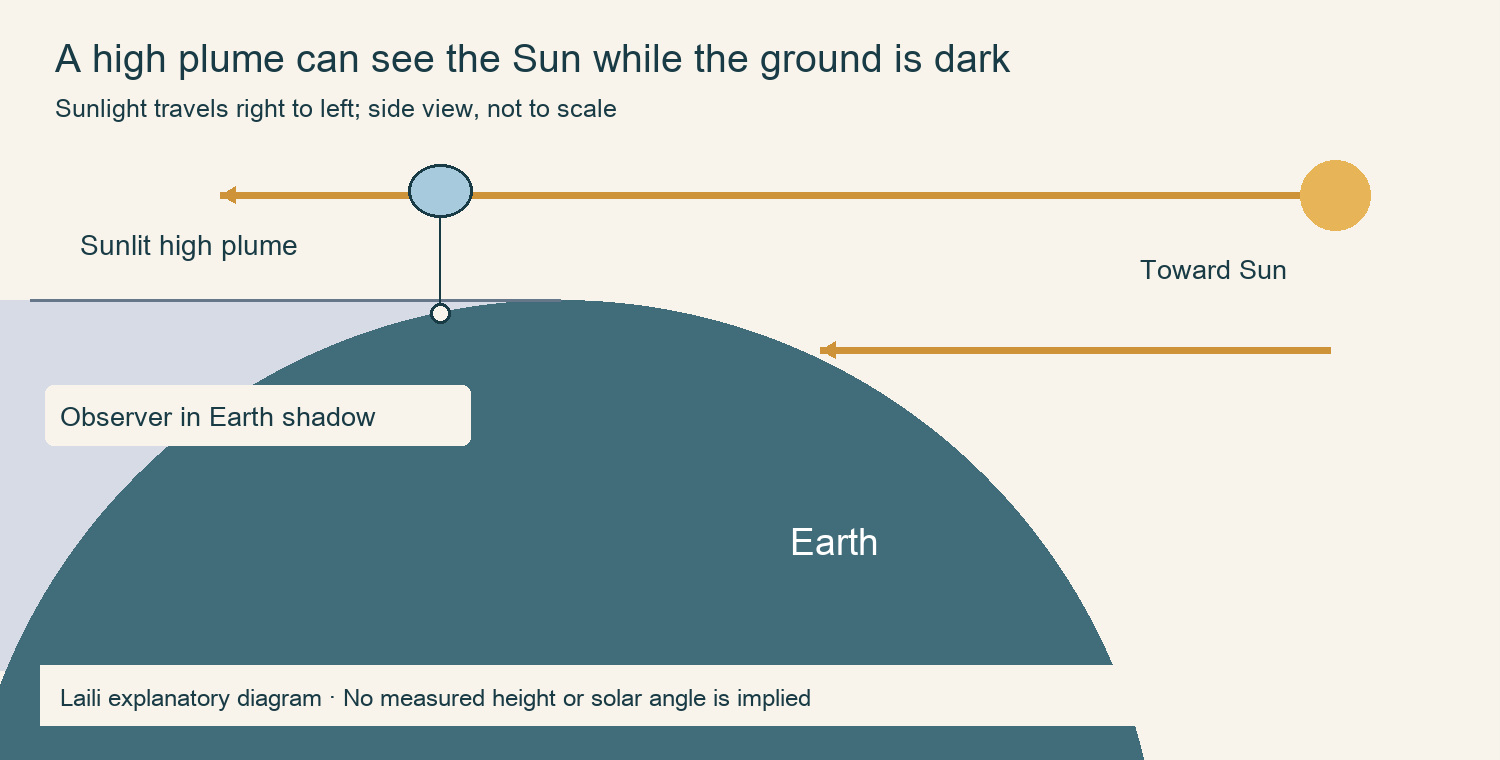
Diagram: The Daily Backstory. High material can enter sunlight before the ground does. This schematic does not give a measured height or solar angle for the photograph.
The shape also depends on the spreading exhaust and the motion of air aloft. The photograph alone cannot assign a height or wind speed to each filament, and a jellyfish shape is not enough to identify every luminous phenomenon in the sky.
Experiments need comparisons
The spacecraft carried research, supplies and equipment. NASA's research preview describes four health and biology investigations, involving small cultured brain-tissue models, fungal disease in crops, onboard sample analysis and monitoring of antibiotic-resistant bacteria.
A cultured brain model is a limited representation of tissue. Researchers plan to keep models aboard the station for about five weeks and compare them with identical models on Earth, looking for changes at the cellular level. The plant investigation similarly compares fungus-infected plants grown on Earth and aboard the station.
Beyond the launch photograph lies the patient work of distinguishing changes associated with a different environment from changes that would have happened anyway.
The ISS National Laboratory's launch account also describes cardiac spheroids containing blood-vessel networks, used to investigate how cancer therapies affect heart function, and organoids made from patient-donated colorectal cancer cells, used to compare chemotherapy responses. These models bring particular biological questions into orbit. Applying the results to treatment will require further work.
You can practice reading the same geometry without waiting for a launch. When high clouds shine near twilight, notice the Sun's direction and compare the brightness of low and high clouds. Avoid looking directly at the Sun. The changing light on clouds is enough to begin seeing the sky in three dimensions.