
A blue cloud bends into what some people see as a face. That resemblance gave IC 2118 its nickname, the Witch Head Nebula. NASA's November 9 Astronomy Picture of the Day shows the cloud beside the bright star Rigel in Orion.
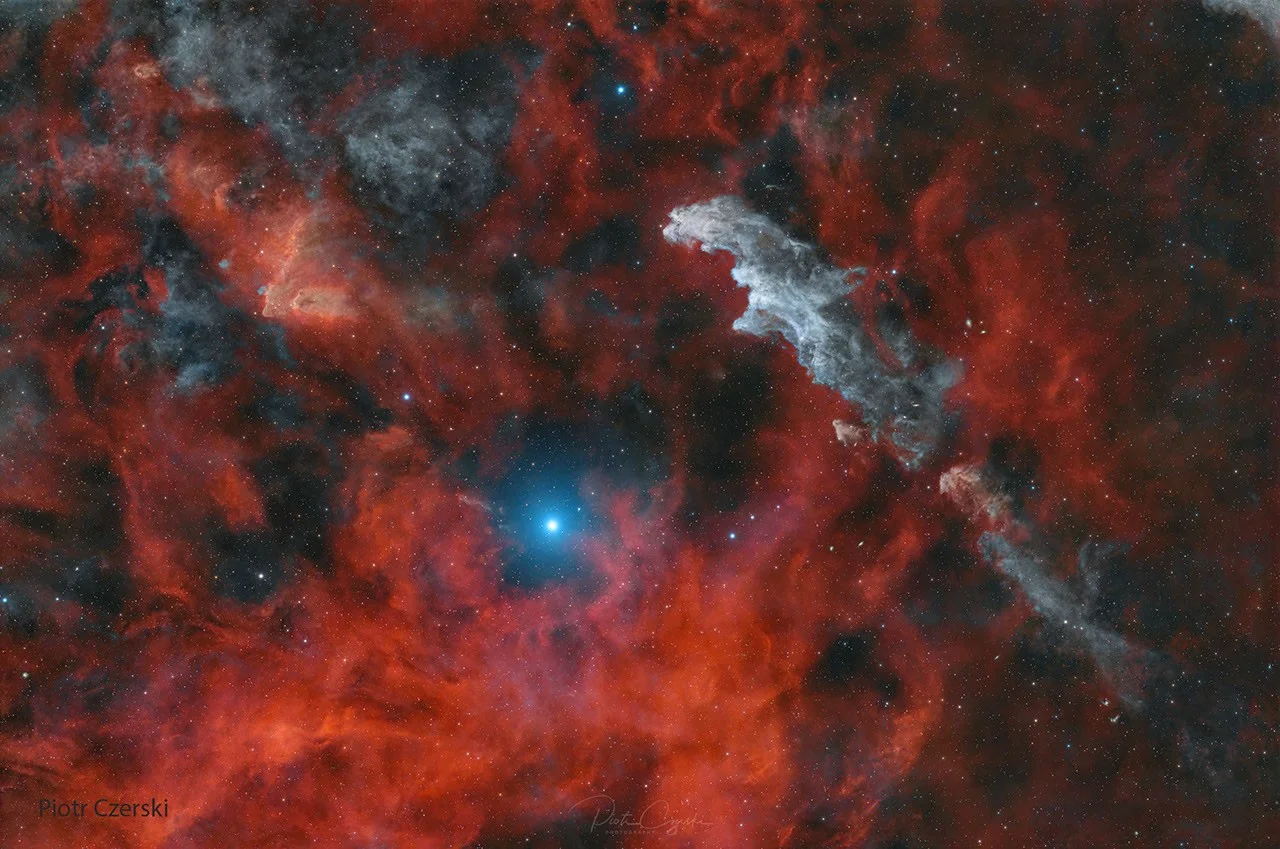
Image: NASA Astronomy Picture of the Day · Credit & Copyright: Piotr Czerski · Original page
The nebula spans about 50 light-years. It is made of gas and dust, part of which has been eroded by nearby Rigel. The star appears just below the center of the image and is among Orion's brightest.
Why does the cloud look blue? Rigel supplies intense blue starlight. Dust grains in the nebula scatter that blue light more effectively than red, sending more of it toward the camera. Earth's daytime sky also owes its blue to stronger scattering of shorter-wavelength light, but there the main scatterers are nitrogen and oxygen molecules. The two settings should not be treated as physically identical.
People can disagree about which way the imagined witch faces. The interaction between light and dust is something astronomers can test. To find the region in the real sky, begin with Orion and bright Rigel. The nebula is far fainter than the richly colored photograph suggests to the naked eye.