
Some parts of this star field glow blue; others look as though someone has rubbed out the stars. Today's NASA Astronomy Picture of the Day takes us toward Cepheus, where interstellar dust supplies the shapes we imagine as ghosts.
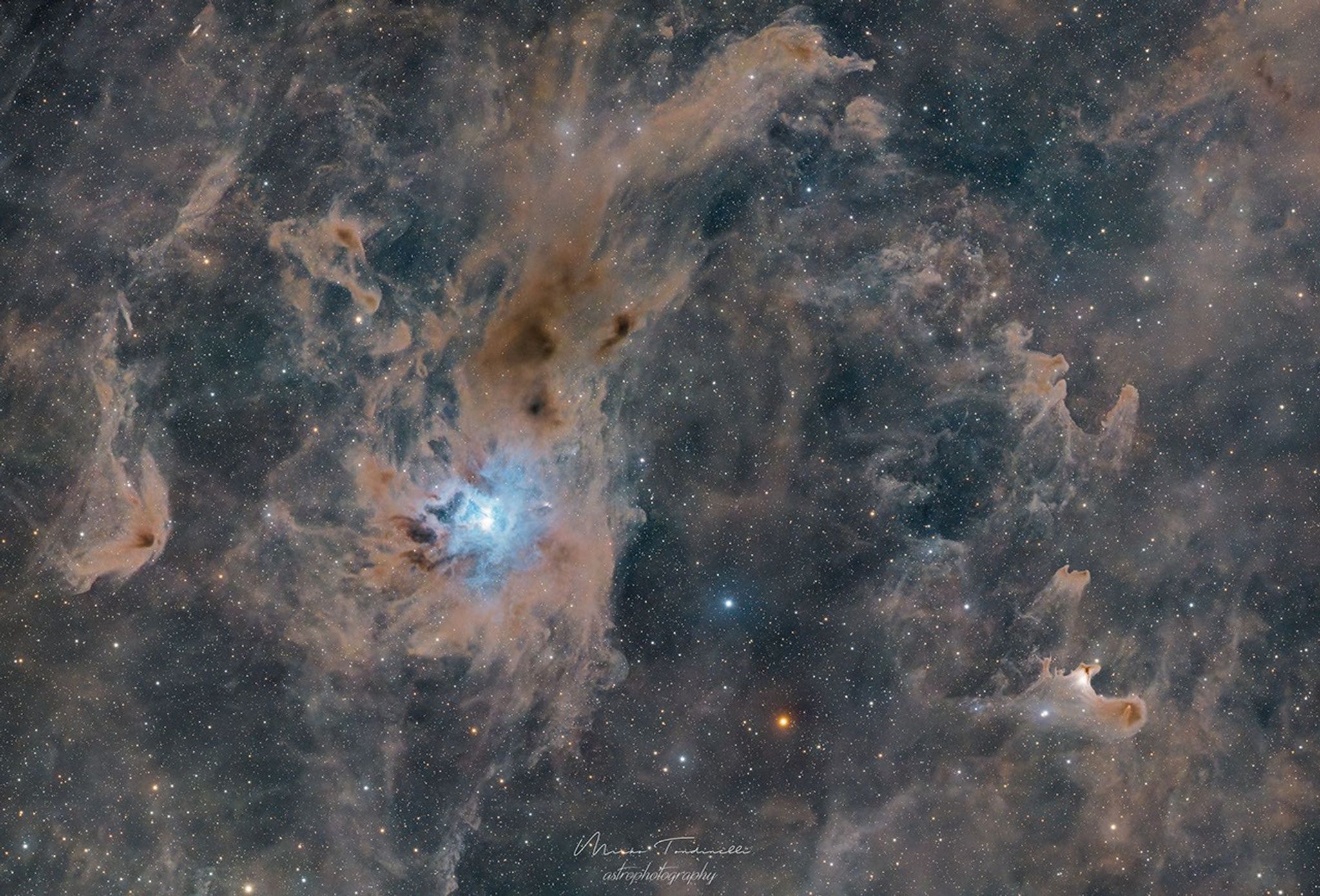
Image: NASA Astronomy Picture of the Day · Credit & Copyright: Mirko Tondinelli · Original page
Dust can brighten a view or obscure it
Dust need not supply its own visible light for us to see it. Starlight striking tiny grains can scatter toward our telescopes. Dust between us and more distant stars can also weaken their light. The same interstellar environment can therefore contain luminous haze and dark gaps.
The blue patch left of center is NGC 7023, the Iris Nebula. A NASA/ESA research account describes it as a reflection nebula illuminated by the nearby star HD 200775. Its familiar blue color is connected to the way light scatters. That does not give every color the same explanation: the account also discusses unexpectedly red dusty filaments and chemical ingredients that researchers were still investigating.
A ghost more than two light-years wide
The brighter cloud at lower right is vdB 141, also catalogued as Sh2-136 and nicknamed the Ghost Nebula. APOD puts its width at more than two light-years and describes this part of the Cepheus cloud region as roughly 1,200 light-years away. A light-year measures distance, the ground light covers in a year; it does not tell us the cloud's age.
APOD identifies reddish features inside the Ghost Nebula as signs of dense cores collapsing during the early stages of star formation. A seemingly quiet outline can enclose ongoing change. But each red filament is not necessarily an already formed star, and color alone cannot establish age or temperature.
The full telescopic frame stretches almost six full moons across the sky. That is an angular span, rather than a claim that the dust is six lunar diameters wide. A small patch of sky behind an outstretched finger can hold clouds measured in light-years.
Look again: find the blue glow left of center, then the ghost at lower right, then the dark textures between them. Those darker areas need not be empty. They may be the places where dust makes it harder for background starlight to reach us.