
On the western Ocean of Storms, an astronaut stands beside a robot that had been silent on the Moon for more than two years. NASA's November 14, 2026 Astronomy Picture of the Day brings that scene back: Apollo 12 astronaut Pete Conrad is working near Surveyor 3, while the lunar module Intrepid rests on the horizon beyond.
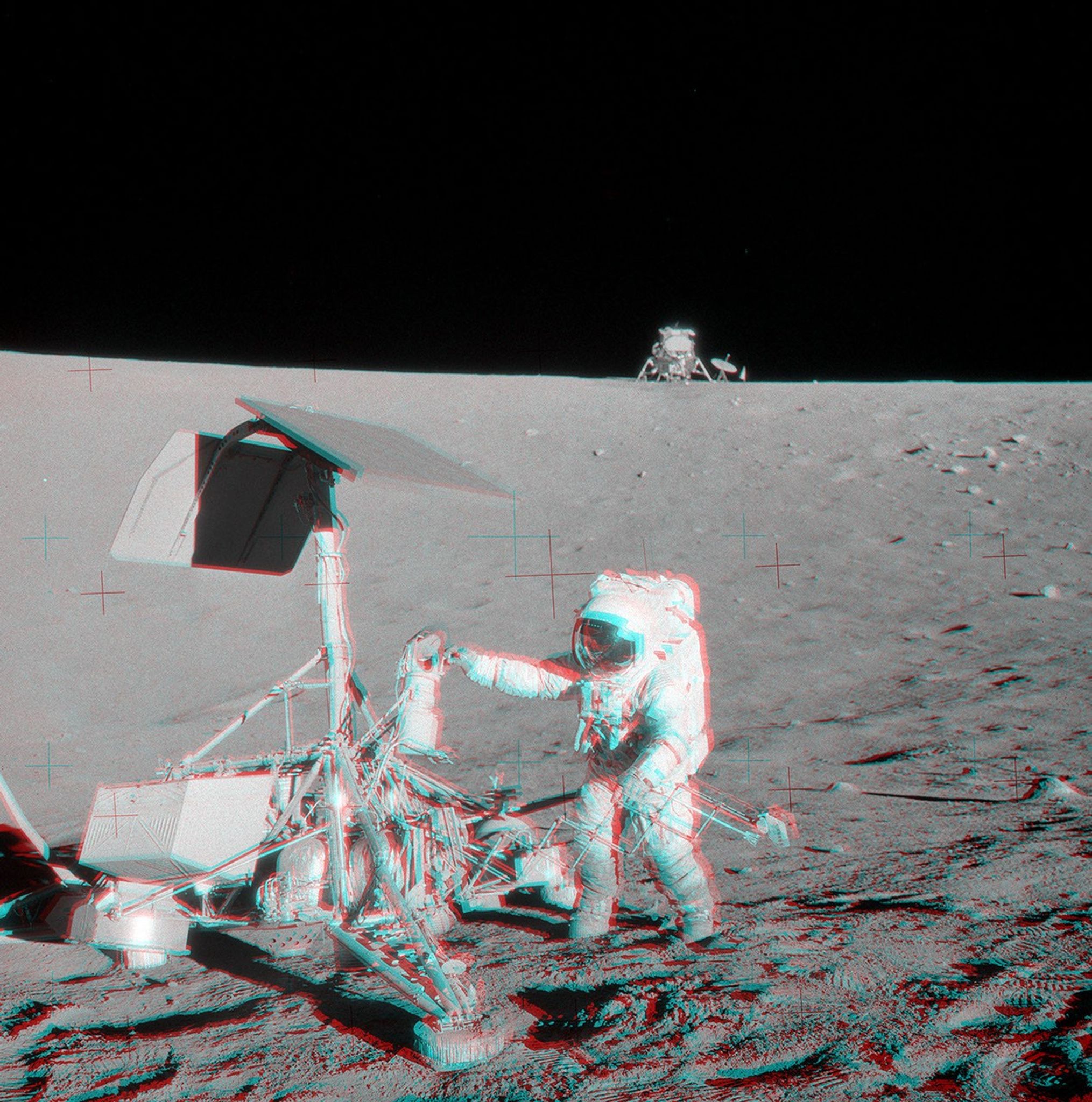
Image: NASA Astronomy Picture of the Day · Apollo 12, Alan Bean; Stereo Image Copyright: Kevin Frank · Original page
This is not an ordinary single photograph. It is a stereo image made from two pictures taken from slightly different positions. Their difference in viewpoint approximates the spacing between human eyes. With red-blue glasses, each eye receives a different view, and the brain combines them into a scene with depth. NASA calls this an anaglyph.
Surveyor 3 landed on the inside slope of a small crater in April 1967. About two and a half years later, Apollo 12's lunar module touched down less than 200 meters (650 feet) away, close enough for the astronauts to walk to the spacecraft. That proximity was deliberate: Apollo 12 chose a landing site near Surveyor 3 so people could inspect a probe that had already worked on the lunar surface.
The source photographs are AS12-48-7133 and AS12-48-7134. They record the same scene from slightly different positions on the Moon. That small horizontal shift is what gives a flat image the feeling of a place you could step into.
You can try the same visual trick by downloading NASA's image and viewing it with red-blue glasses. Or look for parallax in an ordinary photograph: the more a nearby object shifts against the distant background, the easier it is for your eyes to recover the distance.