
A small black horse seems to stand against a red sky. Its shape comes from gas and dust interrupting our view of light behind it. NASA's November 19 Astronomy Picture of the Day brings the Horsehead and Flame Nebulas into the same richly colored field.
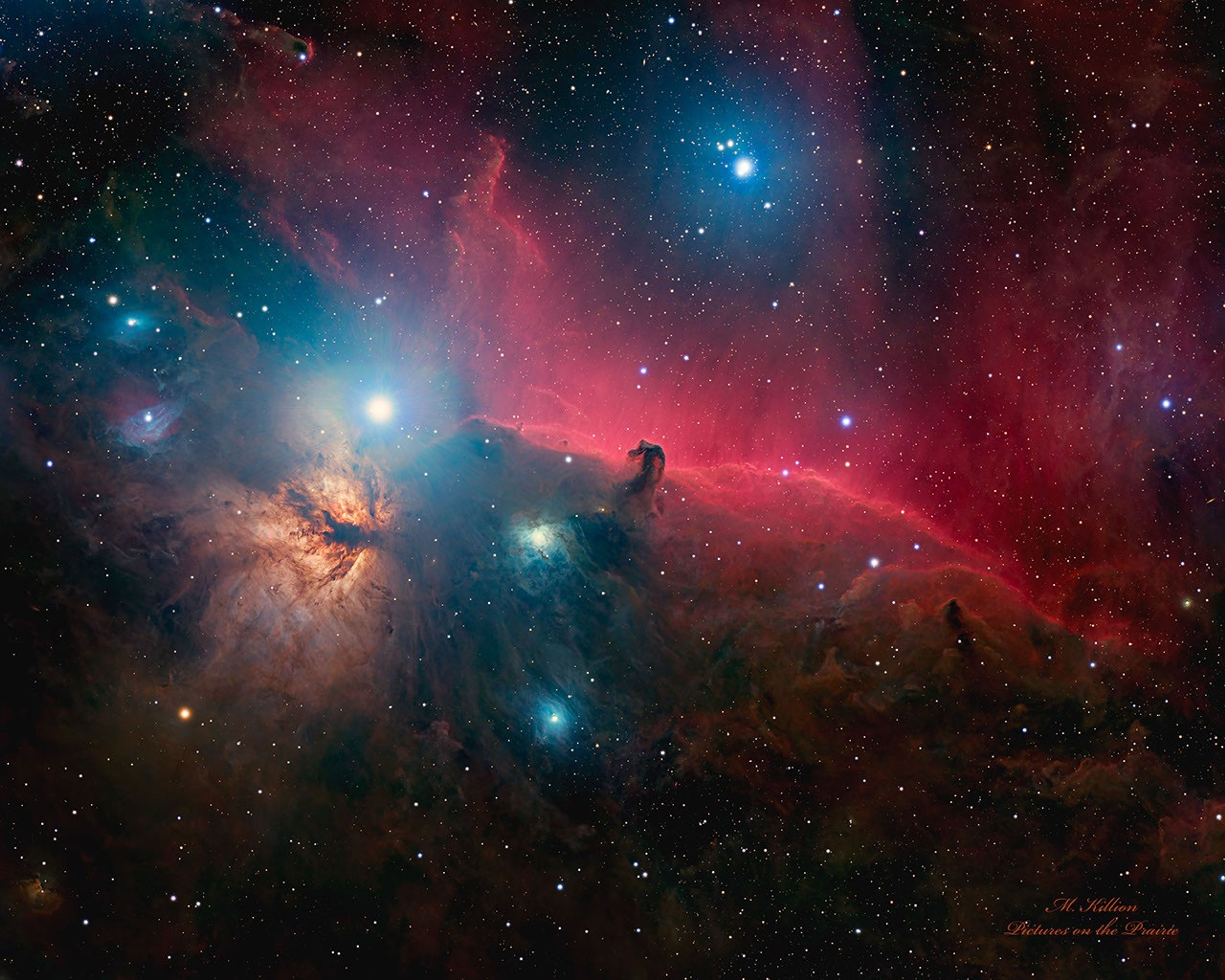
Image: Credit: Mark E. Killion. Original page
Mark E. Killion collected nearly six hours of data with equipment at Utah Desert Remote Observatories, operating it from his home more than 2,000 kilometers away in Illinois. The photograph gathers faint light over time; its brightness is not what a glance at the sky would reveal.
Three colors, different processes
The Horsehead is about five light-years tall and roughly 1,500 light-years away. A light-year measures distance: even light would need around five years to travel the height of the whole structure. The dusty cloud appears dark because it blocks visible light from the glowing background. A cloud can become recognizable through the light missing from our view.
The red background comes from hydrogen ionized by the bright star Sigma Orionis. Energetic starlight strips electrons from hydrogen; recombination and subsequent transitions release light, including prominent red emission. The red glow does not mean the dust has become red-hot.
Nearby NGC 2023 is a blue reflection nebula, where dust scatters light from neighboring stars. Extinction, scattering, and emission from gas can occur in adjacent regions, but they should not all be described as a single patch of dust changing color. The orange region with dark filaments at the left is the Flame Nebula. The dazzling blue star left of center is Alnitak, at the eastern end of Orion's Belt: it looks like one star, but is a triple system.
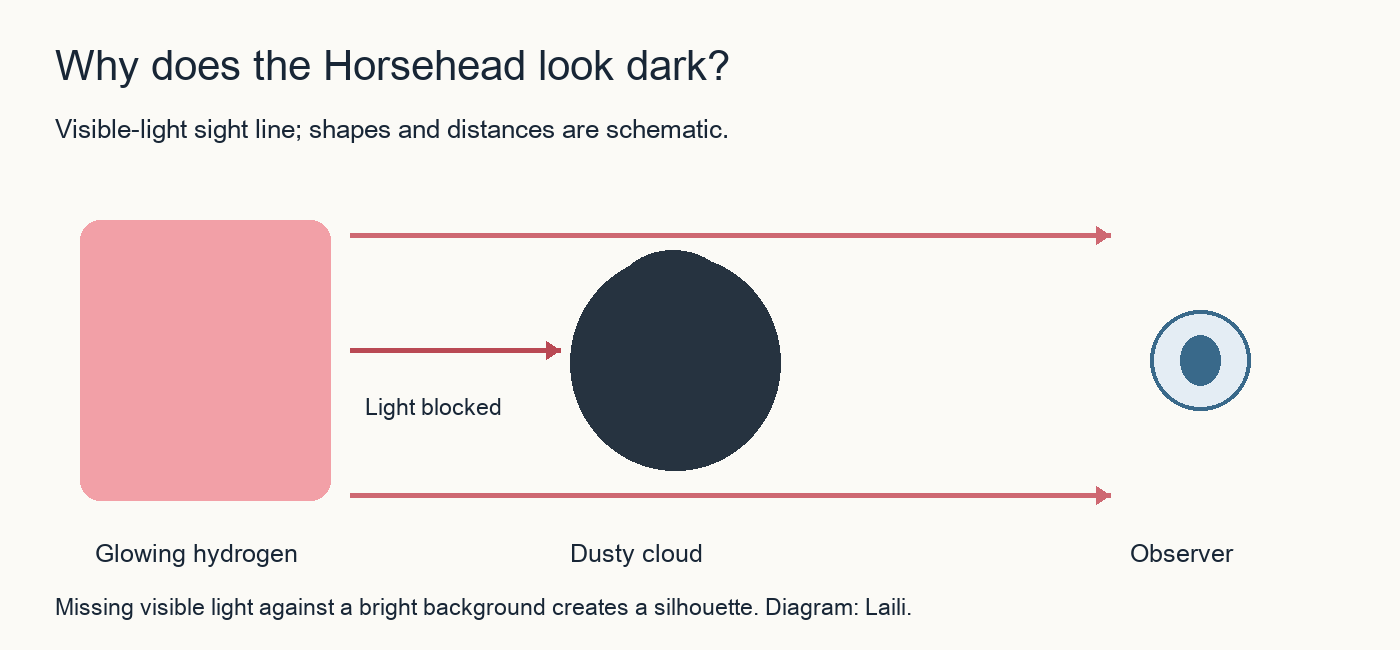
Diagram: Laili. A schematic view of visible-light extinction; shapes and distances are not to scale.
Photography recorded the shape long before today's remotely operated observatories. Harvard's astronomical plate archive connects Williamina Fleming's discovery of the Horsehead with glass plate B02312, exposed in 1888. Her work involved examining plates and measuring and classifying starlight. An inconspicuous dark feature could become a discovery. There is a long connection between her glass plate and our search for the Horsehead in a modern exposure.
Begin with Orion's Belt
On a winter evening, Orion provides a recognizable signpost. Find the three Belt stars, then locate Alnitak on a star chart to place this photograph in the sky. Knowing the direction is much easier than actually seeing the Horsehead, which is not a simple naked-eye target.
Open the original page and switch between Original and Annotated to find the Horsehead, the Flame, and NGC 2023. For a small demonstration of the viewing geometry, hold a hand in front of a lamp and notice how a bright background reveals its outline. A hand is vastly denser than interstellar dust, and the scales are entirely different, but the silhouette makes the idea easier to remember.