
A narrow band of starlight cuts diagonally across the dark, with rusty-brown dust lanes running along its bright disk. Near the center, a blue-white star throws out long, cross-shaped spikes, almost as if it were lighting the galaxy. It does not live there.
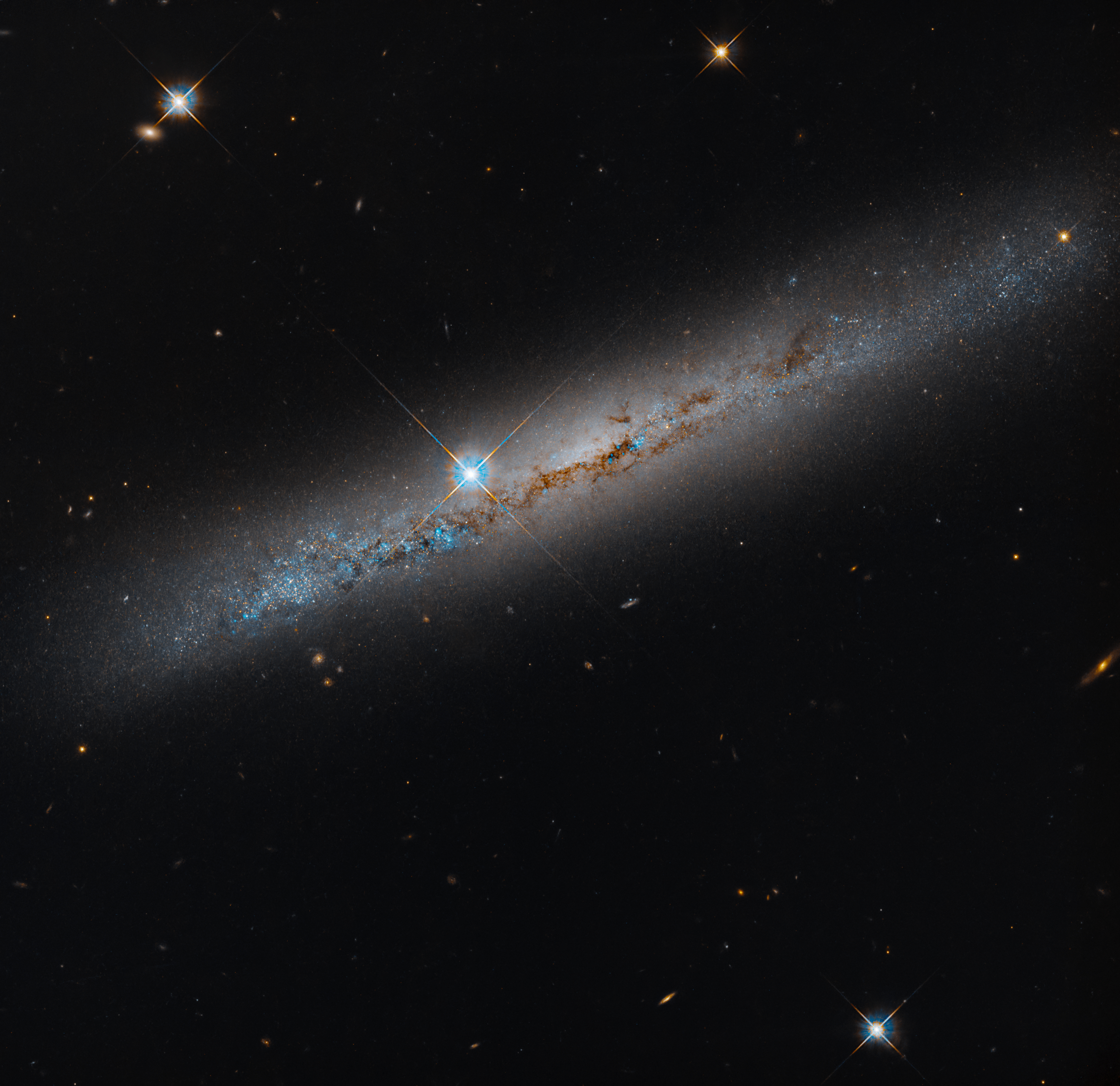
Image credit: NASA, ESA, Michael Jones (California Institute of Technology); Image Processing: Gladys Kober (NASA/Catholic University of America). Original page.
NASA selected this Hubble view for its October 22 Image of the Day after its initial release on October 16. NGC 1827 lies roughly 37 million light-years away in Columba, the Dove. It is an intermediate spiral galaxy, a form between the usual unbarred and barred categories. Because we see it nearly edge-on, its spiral arms are much harder to recognize than they would be in a face-on view of a disk.
Neighbors on the page, far apart in space
The Hubble team's account identifies the bright star just left of the galaxy's central bulge as a foreground object, between us and the galaxy. Appearing close together in an image does not put two objects close together in space.
Nor does the star have four long physical points. Supports inside Hubble hold its secondary mirror in place. Light diffracting around that structure produces the regular spikes in the image. They are a signature of light interacting with the telescope. Once you recognize them, a deep-space photograph begins to separate into layers: nearby stars, the main galaxy far behind, and still more distant galaxies scattered across the dark background.
The brown lanes belong to NGC 1827's disk. Interstellar dust blocks some of the starlight behind it, making those regions look dark. Hubble's Advanced Camera for Surveys also reveals bright-blue regions along the disk where the team says new stars are likely forming. The dark band is an obstruction along our view through the disk, not an empty crack splitting the galaxy apart.
One portrait in a larger comparison
The image belongs to an observing program studying low-mass satellite galaxies, smaller neighbors gravitationally bound to larger galaxies. Comparing them lets researchers test how well cosmological models work on small scales.
One beautiful photograph cannot tell us what dark matter looks like. Researchers need a collection of objects and measurements such as their stellar distributions to compare real galaxies with predictions. The Hubble team describes a program of 260 satellite galaxies around 22 Milky Way-like hosts. That does not, by itself, identify NGC 1827 as one of the low-mass satellites.
Try a small observation exercise with the full image. Find the spiked foreground stars first, follow the brown dust lanes through the disk, then enlarge the dark background and look for tiny glows that are not quite points. Near and far do not arrange themselves neatly from left to right.